r/mathsmeme • u/MedyOsef • 1d ago
dm

1.4k
Upvotes
r/mathsmeme • u/DualMath • 2d ago
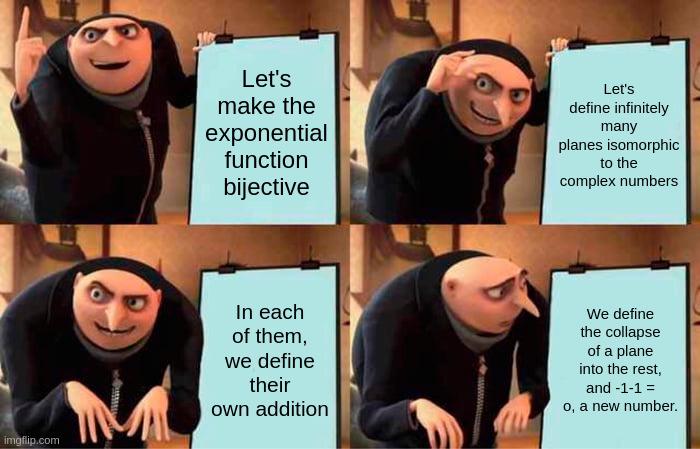
Here’s the article, in case you want to read it:
https://doi.org/10.5281/zenodo.23854178
Context: Orthogonal Numbers extend the complex numbers by returning to the bijective exponential and logarithm functions. This set has an infinite family of operations called “sums”: the degree 0 sum is ordinary addition, the degree 1 sum is multiplication, and each sum operates on a domain called a super-order. For the degree 0 sum, the domain is super-order 0; for the degree 1 sum, the domain is super-order 1; and so on.
On the other hand, the values returned by these operations are called orders. The image of sum 0 is order 0 (which corresponds to the complex numbers, also called sigma here and denoted by Σ); the image of sum 1 is order 1 (called product orthogonals and denoted by Π).
Every order n is contained in super-order n, and every order n is the set of all values in order n−1 passed through the exponential function. Likewise, super-order n is the set of all values in super-order n−1 passed through the exponential function.
The notation for order n is O_n, and the notation for super-order n is O(n).
The sums are recursive operations; that is, for u and v in O(n), u +_n+1 v = e^(ln(u) +_n ln(v)).
Let n and m be integers. If n ≤ m, then O(n) ⊆ O(m).
A set called the singularities is defined. It contains all integer tetrations of the number e; some of them are 0, 1, e, e^e, e^(e^e), … Negative tetrations are also considered singularities, due to the fact that the logarithm is a bijective function within 𝕆 (the orthogonals); this is why ln(0), ln(ln(0)), … exist.
ln(0) is called −∞, so technically −∞ is an orthogonal.
All orthogonals that are not singularities are called normal orthogonals.
For every integer n, O(n+1) = O(n) ∖ {e tetrated to n−1}, and O(n) = O(n+1) ∪ {e tetrated to n−1}.
Since the exponential function is bijective, e^(2πi) ≠ e^0 = 1, so this is a new number called o (o = e^(2πi)). From this definition, −1 * −1 := e^(πi) * e^(πi) = e^(2πi) = o, so the orthogonal algebraic structure differs from the complex one.
Define o₂ := e^(o₁), o₃ := e^(o₂), … In general, oₙ₊₁ = e^oₙ for every integer n.
Similarly, o₀ := ln(o) = 2πi, o₋₁ := ln(o₀), o₋₂ := ln(o₋₁), and so on.
All oₙ are called “orthogonal units.”
For every integer n, oₙ belongs to Oₙ.
The degree-n collapse function (collₙ) is defined to map values from O(n) to Oₙ.
It simplifies the complexity of certain orthogonals, converting them into others.
For a and b in O(n), a +ₙ b = collₙ(a) + collₙ(b).
For every a in Oₙ, collₙ(a) = a, because there is nothing to simplify.
The degree-n collapse is defined because the degree-n sum can actually only be created between values in Oₙ, so collapse is needed to extend it to O(n).
O(n) is such a large set that O(n) = 𝕆 ∖ {e tetrated to k: where k ≥ n−1}.
Regular orthogonals are defined as the set of all orthogonals w such that w belongs to some order n but does not belong to n−1 (the preceding order).
This means regular orthogonals have a minimum order to which they belong, and no lower order contains them.
If w belongs to ℜ (the regular orthogonals) and w belongs to an order n, then for any higher order m, w also belongs to it.
On the other hand, the transcendental orthogonals (𝔗) are defined as all orthogonals that belong to every order.
Every orthogonal w can only be a singularity, a regular orthogonal, or a transcendental orthogonal, but never two of these at the same time.
A very important orthogonal operator is the siot (⋏). It takes an orthogonal w and an integer n: if n is positive, it applies the exponential function to w n times; if n is negative, it applies the logarithm to w −n times (written w⋏n).
Finally, the orthogonals are the union of all orders (which may share elements).
r/mathsmeme • u/Mr_kalas22 • 4d ago

r/mathsmeme • u/F_l_u_f_fy • 4d ago

Crossposting here in case r/math doesn't allow/do memes?
r/mathsmeme • u/over4percenthuman • 3d ago
all roads lead to rome ❌
All theorems lead to Euler✅
r/mathsmeme • u/frank1968221 • 17d ago
r/mathsmeme • u/DualMath • 18d ago

You just got mathrolled ; )

If you want to see more of these functions, you can check out the article at:
r/mathsmeme • u/76richer • 20d ago

Had this commenter reply with “it’s simple math” when she couldn’t do it correctly
r/mathsmeme • u/Leonidas_2023 • 21d ago

Ok une résolution problème est la pour nous faire réfléchir. Mais, parfois le contexte est debile ou illogique. Genre, des trucs qui m'énerve, quand on parle d'argent et ce bordel, les taxes.... ce genre de problème me donne envi de ne pas les faires.
r/mathsmeme • u/pizdlar • 21d ago
else:
        print("are you a fucking dumbass")
        time.sleep(1)
        print("you tried to devide by zero")
        time.sleep(1)
        print("nah i give up bro fuck you dumbass")
breakr/mathsmeme • u/Responsible-Fly-635 • 23d ago
Tried to post this like a month and a half ago but you need an account for NINETY days before posting… just decided to post on my lurker.