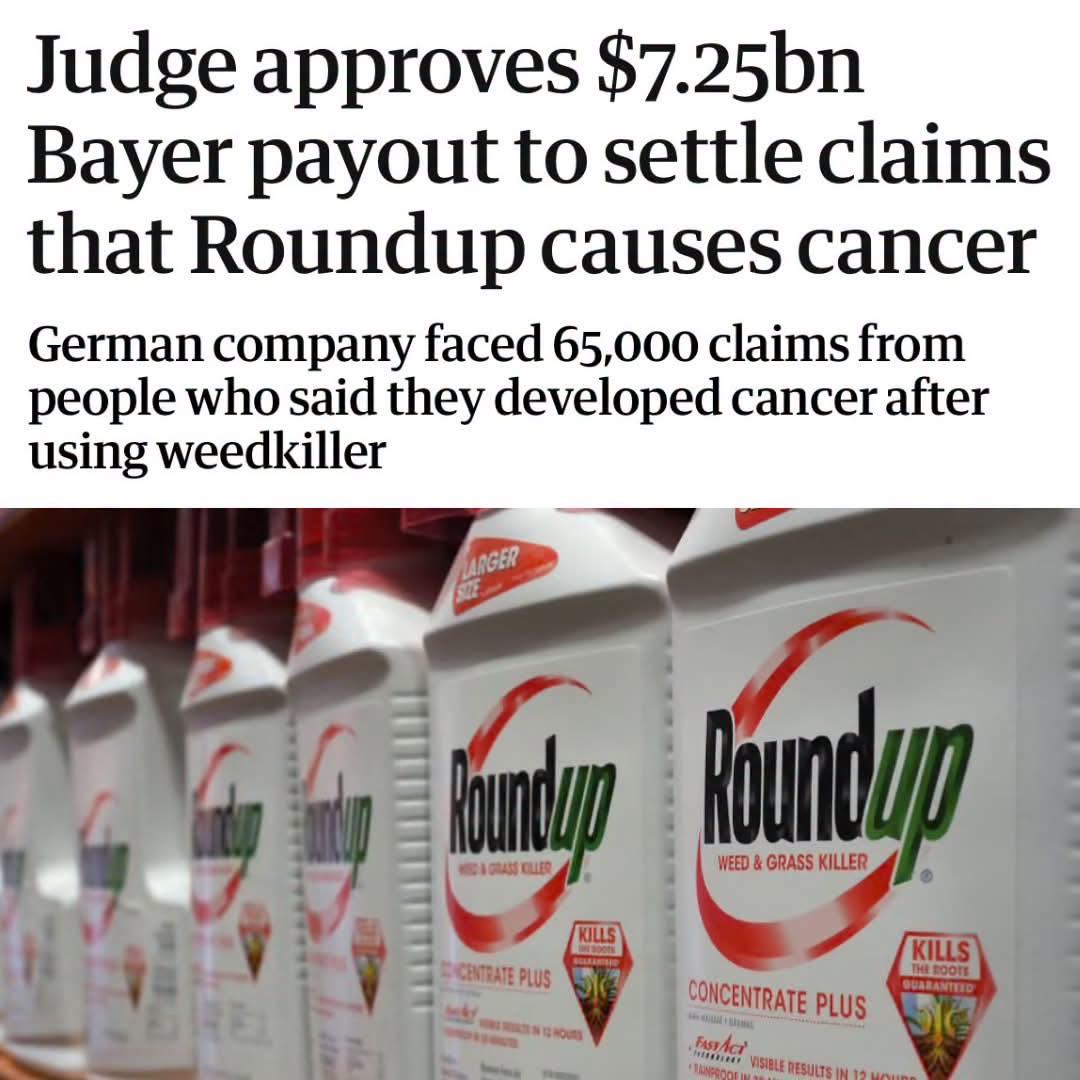
Judge Timothy Boyer of the St. Louis state court ruled Friday that the deal is “fair, reasonable and adequate.”
He rejected objections from some plaintiffs’ lawyers who argued individual payouts would be too low compared with earlier private settlements.
The judge specifically noted that further delays would force victims, including those with terminal cancer, to wait “an indeterminate number of years” for any money.
The settlement, first announced in February, is structured to cover nearly all current and future Roundup claims in the United States and will be paid out over as long as 21 years.
Individual payments are expected to range from roughly $10,000 to $165,000 depending on frequency of use, timing of diagnosis, and severity of illness.
There is no admission of liability.
Bayer, which bought Monsanto (the original maker of Roundup) for $63 billion in 2018, has seen its share price fall about 46% since the acquisition.
The company previously paid approximately $10.9 billion in 2020 to resolve earlier waves of litigation but failed to get court approval for a separate future-claims fund.
CEO Bill Anderson called the final approval a “decisive milestone” in the company’s effort to contain both pending and future Roundup risk.
Roughly 200 cases still pending in federal court aren’t included in the deal.
Bayer says the June 2026 Supreme Court decision in the Durnell case, which held that federal pesticide law preempts many state failure-to-warn claims, gives it strong defenses in those remaining suits.
The studies that keep driving the claims:
• In 2015 the WHO’s International Agency for Research on Cancer (IARC) classified glyphosate as “probably carcinogenic to humans” (Group 2A). The working group cited limited evidence in humans of a positive association with non-Hodgkin lymphoma from real-world occupational exposures, sufficient evidence of carcinogenicity in experimental animals, and strong evidence that glyphosate and glyphosate-based formulations are genotoxic.
• A 2019 meta-analysis that focused on the highest cumulative exposure groups across multiple epidemiological studies found a 41% increased risk of non-Hodgkin lymphoma. The authors noted consistency with animal data showing malignant lymphoma and with mechanistic findings involving DNA damage, immune disruption, and other pathways linked to lymphomagenesis.
• Smaller case-control studies from the U.S., Canada, and Sweden have repeatedly reported elevated non-Hodgkin lymphoma rates among people with frequent or prolonged Roundup use.
Moms Across America and similar parent-led groups have documented glyphosate residues in breast milk, urine, tap water, and widely consumed foods, including children’s cereals.
Their testing has shown levels in some samples far above the European drinking-water limit, and they argue that routine household and dietary exposure creates ongoing risk for families even after the courtroom chapter closes.
These organizations have spent years pressing for stronger warnings, restrictions, and transparency while Roundup remains on store shelves for both residential and agricultural use.
The $7.25 billion figure is on top of earlier payouts and is among the largest mass-tort settlements in U.S. history.
It resolves the bulk of a nearly decade-long wave of litigation in which tens of thousands of homeowners, landscapers, and agricultural workers said they developed non-Hodgkin lymphoma after using the product.
The settlement doesn’t alter the fact that the product is still sold, nor does it erase the human cost already incurred or the scientific findings that continue to alarm patients and parents.
For the thousands of families who say Roundup changed their lives, and for the mothers across America still watching what ends up in their homes and food, this settlement is both a form of limited relief and a stark reminder of how long the fight has lasted.
We need to get glyphosate out of our food.