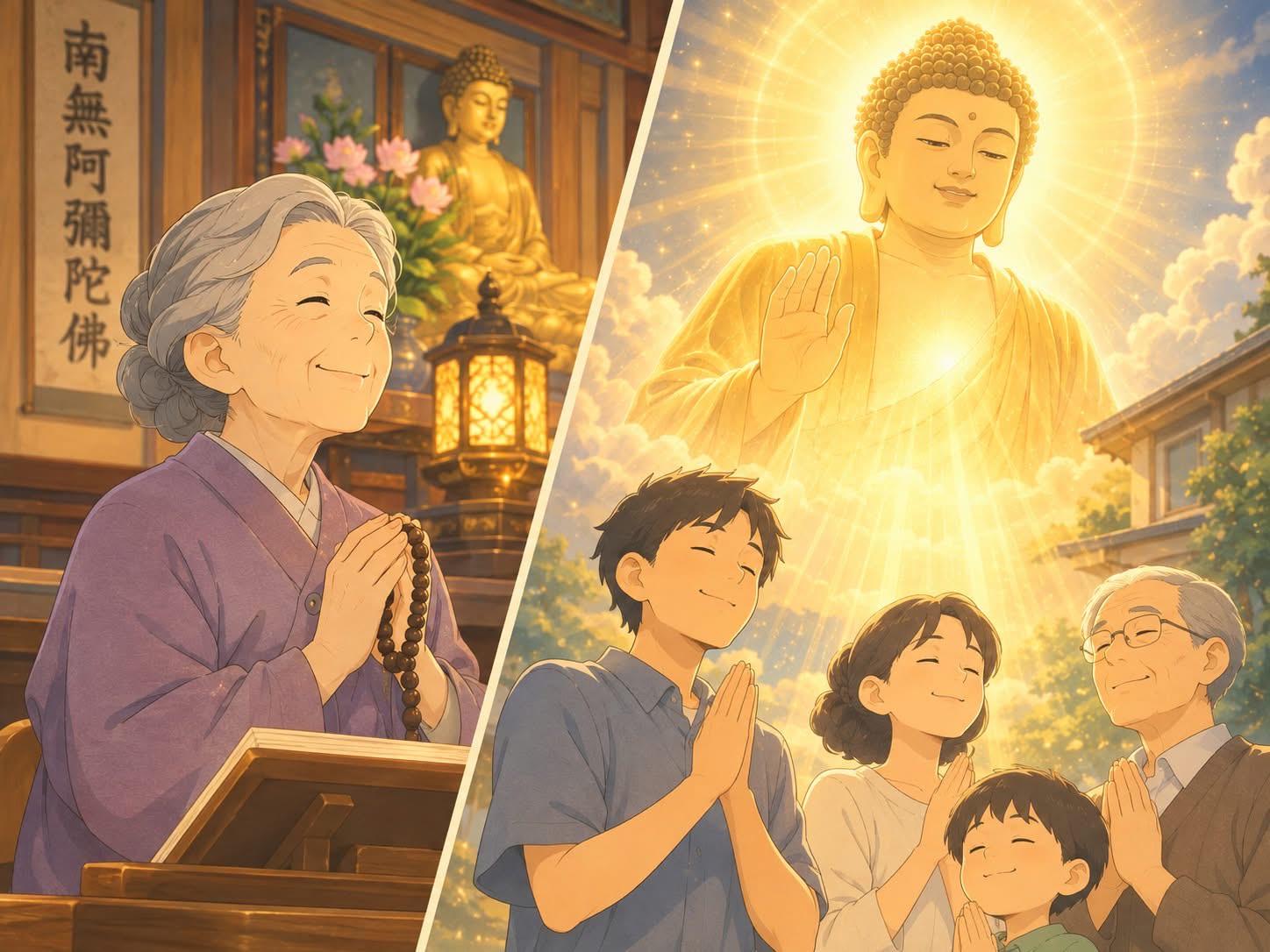
Instructions on Cultivating the Dharma Gate of the Pure Land
示修淨土法門
A Chan practitioner from Haiyang travelled a great distance to Mount Kuang to seek instruction in the transmission of the precepts. He was given the name Shenyu (Profoundly Ignorant). After offering incense, he requested guidance:
“I, your disciple, have made the vow to attain rebirth in the Western Pure Land. I have gathered a number of Dharma companions so that we may assemble in one place and devote ourselves to cultivating the Pure Land practices. I respectfully ask you, with your compassion, to point out the essential principles of this Dharma method.”
The Old Master then instructed him:
“The Buddha taught many skilful means for practising the Dharma that leads beyond birth and death. Among them, recollecting the Buddha and seeking rebirth in the Pure Land is the most direct and essential. The perfectly complete and wondrous Dharma gates of the Avataṃsaka Sutra and the Lotus Sutra, as well as the wondrous practices of Samantabhadra, ultimately all point towards the Pure Land. Great patriarchs such as Aśvaghoṣa and Nāgārjuna, as well as the great masters of our own land, Yongming and Zhongfeng, all vigorously advocated this Pure Land Dharma gate. This Dharma gate was taught by the Buddha of his own accord, without anyone having asked him about it. It embraces all three capacities and welcomes all four assemblies. It is not an expedient teaching established solely for those of inferior capacity.
“The sutra says: ‘If you wish to purify a Buddha-field, you must purify your own mind.’ Therefore, in cultivating the Pure Land practices, purifying the mind must be taken as the foundation. To purify one's own mind, the first requirement is to keep the roots of the precepts pure. The three actions of the body, the four of speech, and the three of mind constitute the ten unwholesome actions, which are the causes of suffering in the three lower realms.
“The essential point in observing the precepts is first to purify the three actions. When this is accomplished, the mind naturally becomes pure. If the body refrains from killing, stealing, and sexual misconduct, bodily action is pure. If speech refrains from falsehood, frivolous speech, divisive speech, and harsh speech, verbal action is pure. If the mind is free from greed, anger, and delusion, mental action is pure. When these ten unwholesome actions are permanently abandoned and the three actions become pure as ice, this is the essential foundation for purifying the mind.
“With the mind thus purified, one should develop aversion to the sufferings of the Sahā world and make the vow to attain rebirth in Anyang, the Land of Peace and Bliss. One should then establish the principal practice of recollecting the Buddha.
“To practise recollecting the Buddha, however, one must have an urgent and ardent aspiration to escape birth and death. First, cut off external entanglements. Then hold to a single thought, taking the one phrase ‘Amitābha Buddha’ as the very root of one's life. Never forget it, from thought to thought; never allow it to be interrupted, from moment to moment. Throughout the six periods of the day and the six periods of the night, whether walking, standing, sitting, or lying down; whether picking up a spoon or raising chopsticks; whether turning, bending, or straightening up; whether active or at rest, busy or at leisure—in every circumstance, remain lucid and alert, without becoming involved with any other object.
“If you apply your mind in this way, the practice will gradually mature until it becomes thoroughly established. Even in dreams, you will not forget it. Waking and sleeping will become alike. The effort will be continuous and meticulous, until the practice becomes one unified whole. This is the point at which the cultivation begins to bear fruit.
“If recollection of the Buddha reaches the state of single-minded concentration without confusion, then, at the moment of death, the scenes of the Pure Land will appear before you. Naturally, you will no longer be held back by birth and death. In response to your practice, Amitābha Buddha will emit light and come to receive and guide you. This is the sign that rebirth will certainly be attained.
“Although single-minded and concentrated recollection is indeed the principal practice, it must also be supported by contemplative visualization, which makes the cultivation more secure and complete. The Buddha taught Vaidehī the sixteen wondrous contemplations, through which the goal can be accomplished within this very lifetime. The Contemplation Sutra is still available today. Therefore, if a group of Pure Land companions gathers to practise together, each person may choose whichever one of the sixteen contemplations accords with their own aspiration.
“One may contemplate solely the wondrous features of the Buddha and the Bodhisattvas, or contemplate the landscapes of the Pure Land, such as the lotus flowers, the jeweled ground, and the other features described in the Amitābha Sutra. Each person may visualize according to their own inclination. If the visualization becomes clear and distinct, then throughout the six periods of the day and the six periods of the night, the Pure Land will be present before you, as though you were already there. Whether sitting or lying down, walking or at rest, with your eyes open or closed, it will be as though everything were directly before your eyes.
“If this contemplative visualization is brought to completion, then, at the moment of death, you will be born there immediately with a single thought. This is what is meant by the saying: ‘As for birth, it is certainly birth; as for going, in reality, there is no going.’ This is the wondrous meaning of the Pure Land of the Mind Alone.
“If you cultivate your mind in this way and diligently observe the precepts, the six faculties will become pure. When unwholesome actions and afflictions are permanently abandoned, the ground of the mind will become pure. When contemplation and recollection continue one after another without interruption, the wondrous practice becomes easy to accomplish. There is no other genuine cause for rebirth in the Pure Land beyond this.
“If someone merely speaks of reciting the Buddha's Name and seeking rebirth in the Pure Land, but does not uphold the pure precepts, does not abandon afflictions, and leaves the ground of the mind defiled, the Buddha says that such a person will never attain accomplishment.
“Therefore, practitioners must first take observance of the precepts as their foundation, the vow as a supporting cause, and recollection of the Buddha and contemplative visualization as their principal practices. If one practises in this way and still does not attain rebirth, then the Buddha will have spoken falsely.”
示修淨土法門
海陽禪人。遠參匡山。求授戒法。命名曰深愚。拈香請益云。弟子
某。發願求生西方淨土。結法侶若干人。同會一處。專修淨業。願
乞慈悲。指示法要。老人因示之曰。佛說修行出生死法。方便多
門。唯有念佛求生淨土。最為捷要。如華嚴法華圓妙法門。普賢妙
行。究竟指歸淨土。如馬鳴龍樹。及此方永明中峯諸大祖師。皆極
力主張淨土一門。此之法門。乃佛無問自說。三根普被。四眾齊
收。非是權為下根設也。經云。若淨佛土。當淨自心。惟今修行淨
業。必以淨心為本。要淨自心。第一先要戒根清淨。以身三口四意
三。此十惡業。乃三途苦因。今持戒之要。先須三業清淨。則心自
淨。若身不殺不盜不婬。則身業清淨。不妄言綺語兩舌惡口。則口
業清淨。意不貪不瞋不癡。則意業清淨。如此十惡永斷。三業氷
清。是為淨心之要。於此清淨心中。厭娑婆苦。發願往生安養。立
念佛正行。然念佛必要為生死心切。先斷外緣。單提一念。以一句
阿彌陀佛。以為命根。念念不忘。心心不斷。二六時中。行住坐臥。拈匙舉筯。折旋俯仰。動靜閒忙。於一切時。不愚不昧。並無
異緣。如此用心。久久純熟。乃至夢中。亦不忘失。寤寐一如。則
工夫綿密。打成一片。是為得力時也。若念至一心不亂。則臨命終
時。淨土境界現前。自然不被生死拘留。則感阿彌陀佛放光接引。
此必定往生之效驗也。然一心專念。固是正行。又必資以觀想。更
見穩密。佛為韋提希。說十六妙觀。故得一生取辦今觀經現存。若
結淨侶同修。任各志願。於十六觀中。隨取一觀。或單觀佛。及菩
薩妙相。或觀淨土境界。如彌陀經說蓮華寶地等。隨意觀想。若觀
想分明。則二六時中。現前如在淨土。坐臥經行。開眼閉眼。如在
目前若此觀想成就。臨命終時。一念頓生。所謂生則決定生。去則
實不去。此唯心淨土之妙指也。如此用心。精持戒行。則六根清
淨。永斷惡業煩惱。則心地清淨。觀念相繼。則妙行易成。淨土真
因。無外此者。若但口說念佛。求生淨土。若淨戒不持。煩惱不
斷。心地污穢。佛說是人。永不成就。是故行人。第一要持戒為基
本。發願為助因。念佛觀想。為正行。如是修行。若不往生。則佛
墮妄語矣。