r/QuantumComputing • u/kev-doh • 13d ago
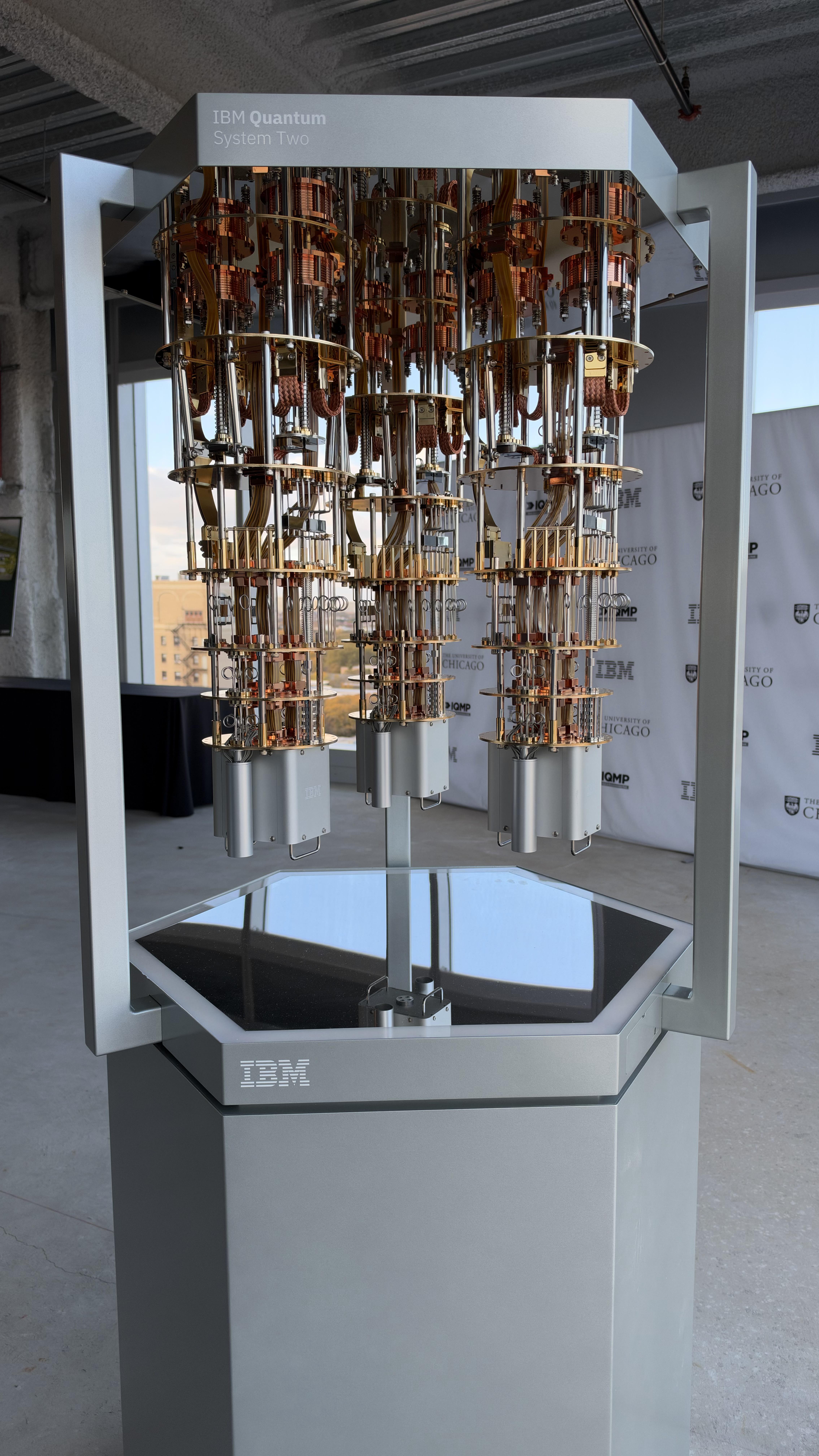
Image Can someone explain how this works please
What’s inside the processor enclosures?
(The photo is of a model unit.)
r/QuantumComputing • u/kev-doh • 13d ago
What’s inside the processor enclosures?
(The photo is of a model unit.)
r/QuantumComputing • u/dorakingx • 12d ago
QDC 2026: what quantum developers need to know
r/QuantumComputing • u/TypicalCrazy1909 • 11d ago

As a computer science student and researcher, I usually try to understand algorithms by tracing their operations step by step.
However, when I first encountered a quantum algorithm, specifically Grover's search algorithm, I struggled to understand its oracle and amplitude amplification in terms of familiar classical computational operations.
This led me to two related but different questions.
1. Computational efficiency: Can classical computation reproduce quantum algorithms, but only with significantly more operations? For example, can a quantum algorithm solve a search problem in substantially fewer oracle queries than a classical algorithm? The established theoretical understanding is that quantum algorithms can be mathematically simulated on classical computers, but the simulation may require significantly greater computational resources.
2. Mathematical interpretation: Even if we can mathematically describe quantum operations, can we understand how they actually work using classical computational intuition? How does an oracle operate on a superposition of possibilities? How does amplitude amplification produce the desired result? What exactly happens between the initial quantum state and the final measurement?
The mathematical description of quantum algorithms is well established, and classical mathematics provides tools to represent their operations. However, does this mathematical representation also provide an intuitive explanation of their underlying mechanisms in terms of familiar classical computational concepts?
Does the mathematical description of quantum operations provide a complete explanation of their underlying mechanisms, or is there a gap between mathematical representation and intuitive understanding through classical computational concepts?
I'd particularly appreciate perspectives from people working in quantum computing, computational complexity, and mathematical physics.
r/QuantumComputing • u/ASerenaA • 12d ago
Discover how integrating High-Performance Computing (HPC), Artificial Intelligence (AI), and Quantum technologies into a single, orchestratable platform is solving once-impossible challenges - from materials R&D to complex logistics.
November 19 at 10:00 CET, https://www.linkedin.com/events/thefutureofhybridcomputing-sove7521505999573245952/theater/
r/QuantumComputing • u/ZealousidealMilk4435 • 13d ago
I have very little understanding of how quantum computers work.
I’m curious: is there a type of problem—one that could only be solved by exploiting the specific hardware characteristics of a quantum computer (for instance, by forcing it to use a massive number of qubits, which would eventually become highly unstable)—that a quantum computer would be unable to solve?
I’m interested in the idea of a cryptographic key based on a hybrid approach—perhaps a combination of an RSA-style system and a problem that a quantum computer cannot solve.
Alternatively, are there already theoretical frameworks for keys that are even more robust? And what are the options for encryption in a post-quantum-computer world?
r/QuantumComputing • u/dorakingx • 14d ago
Correcting quantum computer errors may be more complicated than expected
r/QuantumComputing • u/Parallel_thougts • 15d ago
I always thought magic states are really cool, and that more people should know about them. During my Ph.D in quantum cryptography, Clifford circuits were my bread and butter. I'm glad that Google gave me the pretext to talk about them!
The video is intended for a general audience, so it is not terribly formal, but I will gladly discuss the nitty-gritty here!
r/QuantumComputing • u/BetClear • 14d ago
Hey everyone!
I'm currently pursuing my Master's at TH Ingolstadt, Germany, and working on a seminar paper about quantum computing in finance, particularly portfolio optimization.
We're comparing two approaches: Quantum Annealing and Gate-Based Quantum Computing, and would love to hear from people with experience or knowledge in either field.
If you're a researcher, professional, or enthusiast working in quantum computing, quantitative finance, or optimization, I'd really appreciate the opportunity for a quick 20–30-minute interview.
Alternatively, we've put together a short 8–10-minute questionnaire that can also be completed anonymously:
Any insights, suggestions, or research recommendations would be greatly appreciated!
Thanks a lot for your time and support! 😊
r/QuantumComputing • u/KeyConsideration2683 • 15d ago
r/QuantumComputing • u/Future_Ad7567 • 16d ago
Solve QUBO on a real D-Wave quantum annealer using Python.
In this developer-first tutorial, we solve Max-Cut end to end: D-Wave Leap access, QUBO-to-BQM, QPU submission, SampleSet interpretation, minor embedding, physical-qubit usage, QPU timing, Problem Inspector, and a local simulated-annealing fallback with neal.
No quantum-physics background is required. The tutorial is designed for Python developers, computer-science students, optimization practitioners, and anyone who wants to understand what actually happens after calling `sampler.sample(...)`.
WHAT YOU WILL LEARN
- How to access a D-Wave QPU through Leap
- How QUBO, Ising, and Binary Quadratic Models relate
- How to use DWaveSampler and EmbeddingComposite
- Why a D-Wave QPU returns several samples
- How to interpret energy and num_occurrences
- How logical variables map to physical qubits
- What minor embedding and qubit chains mean
- What QPU annealing, sampling, programming, and access times measure
- How to test the same workflow locally using neal
r/QuantumComputing • u/Weekly-Maize-3414 • 17d ago
I'm new into the QC community and recently started learning about the most importants algorithms. I'm doing all by myself with free yt content and blogs from internet.
Today i was learning about this Algorithm that helps to find a string s in the function
f : {0 , 1}^n -> {0, 1}
f(x) = x * s (mod2)
And after aplying the Algorithm the resulkt of the measure is Prob. = 1 .
But with that how can i really find the string s ?
r/QuantumComputing • u/kurama4326 • 17d ago
Most “quantum security” work is post-quantum cryptography — protecting classical systems from future quantum computers. I kept noticing there’s no shared, structured catalog for attacks on the quantum computer itself: the QEC/decoder pipeline, the classical control stack, multi-tenant isolation, covert channels.
So I put one together: QHTM (Quantum Hardware Threat Matrix). It’s defense-agnostic, MITRE ATT&CK-style — 26 techniques across 5 tactics, and every technique has an honest maturity tag (demonstrated on real hardware / simulation only / theoretical / already mitigated), because a lot of this is still early and I didn’t want to overstate it.
It’s a v1.0 and almost certainly incomplete. I’d really appreciate corrections, techniques I missed, or “this one’s overstated” pushback from people who work on hardware or error correction. CC BY 4.0.
r/QuantumComputing • u/Emergency_Slide_7367 • 18d ago
Lean4 proof shows quantum speedup has severe limitations and may not provide much benefit practically. Its over Boyz.
r/QuantumComputing • u/thinkonpaperpodcast • 18d ago
EeroQ has its chips made in commercial semiconductor foundries, coats them in a thin layer of superfluid helium, and floats single electrons about 10 nanometres above the surface. But is the trapped electron modality really more scalable than, say, spin qubits?
r/QuantumComputing • u/AutoModerator • 18d ago
Weekly Thread dedicated to all your career, job, education, and basic questions related to our field. Whether you're exploring potential career paths, looking for job hunting tips, curious about educational opportunities, or have questions that you felt were too basic to ask elsewhere, this is the perfect place for you.
r/QuantumComputing • u/KeyConsideration2683 • 19d ago
I am an engineering student at Kuwait University conducting research on the thermodynamic, mechanical, and microwave shielding bottlenecks in dilution refrigerators for superconducting qubits.
I have put together a short 10-question technical survey regarding wiring heat loads, vibration decoupling, and Cryo-CMOS scalability:
🔗 Cryogenic Challenges in Quantum Computing – Fill out formIt only takes about 3 to 5 minutes to complete and is completely anonymous. I would genuinely appreciate feedback and responses from researchers, engineers, and fellow students in the field. Thank you for your time!
r/QuantumComputing • u/Brighter-Side-News • 20d ago
Two beams of light can overlap so completely that their brightness patterns look alike, yet still carry distinguishable information. A new silicon chip can find that hidden structure and direct its components into separate optical channels. The result offers a way to process light that conventional intensity measurements cannot fully describe.
The system, developed by researchers at Stanford University and the Institute of Science and Technology Austria, appears in Nature Photonics. It automatically learns patterns within partially coherent light, whose waves have some statistical relationships but lack complete coordination. Rather than treating that complexity as interference to discard, the team built a device that can work with it.
The research combines a silicon photonic chip with detectors, electronics and control algorithms. Most of the work took place at Stanford, where Charles Roques-Carmes began the project with graduate student Paul-Alexis Mor. Roques-Carmes, now an assistant professor at ISTA, is continuing that research with Mor, a co-first author of the paper.
r/QuantumComputing • u/Extension-Local278 • 20d ago
Feeling a bit lost doing a PhD in quantum algorithms
I'm currently doing a PhD in quantum algorithms, and honestly, I'm still struggling to figure out what directions are really worth pursuing in the NISQ era.
Classical methods are already incredibly strong, and it's often hard to show any meaningful quantum advantage.
People often say we should focus on problems that are hard for classical computers but well-suited for quantum ones. But in practice, this often means making strong assumptions about the problem structure or data distribution, which can make the results feel less relevant to real-world applications.
So I'm genuinely curious: What should quantum algorithms research actually focus on right now?
Are we just too early for practical quantum advantages, or are we asking the wrong research questions?
Would love to hear your thoughts, especially from other PhD students and researchers working in this field! :)
r/QuantumComputing • u/dorakingx • 21d ago
Which problems will quantum computers actually solve, and when?
r/QuantumComputing • u/saadqc • 21d ago
r/QuantumComputing • u/Jazzlike_Ad5952 • 23d ago
I've been working on an independent quantum computing project that I'd genuinely appreciate some technical feedback on from people with experience in quantum computing, quantum architectures and theoretical computer science.
The project is called |BF> (Bra-Ket-Fuck). It's an experimental, minimalist quantum programming language inspired by Brainfuck, but instead of operating on classical memory cells, it operates on a linear register of qubits.
The underlying idea is to explore whether a simple tape-and-pointer execution model can provide an interesting alternative way of expressing and executing quantum computations.
The project currently includes:
The two main resources are:
I'm particularly interested in getting feedback on the actual research and technical contribution, rather than simply whether the implementation works.
Some questions I'd really appreciate opinions on:
I'm fully aware that an independent implementation doesn't automatically constitute a meaningful research contribution. That's partly why I'd like to get opinions from people who know the field better than I do.
Critical feedback is very welcome. I'd much rather discover fundamental problems, incorrect assumptions or existing work that I should have built upon than receive compliments that don't help improve the project.
Even if you only have time to look at one aspect of the paper, I'd appreciate your thoughts.
Thanks!
r/QuantumComputing • u/Inevitable-Swim-3313 • 23d ago
Why are ML-KEM and ML-DSA not affected by quantum computers? Traditional algorithms like ECC and RSA can be exploited with Shor's algorithm right? Is it that so far no algorithm has come forth?
Me and my friend have to present a quick overview of PQC. Last time one of the supervisors asked that why is PQC secure from quantum computers. I answered smth like for Traditional algos we have shor but for pqc at least for now there is no such algorithm and since this is lattice based, probabilities are very low.
Next time we meet him I want to make sure I properly explain this to him. Especially if some kind of maths is involved. I would be happy to explain the maths.
r/QuantumComputing • u/Ok_Mulberry9965 • 24d ago
This week, I was asked by my advisor to look into the field of "quantum machine learning", and tell him if I am interested in going deep into it. I am a computer science grad student mostly working in deep learning and I barely know somethings about quantum physics, let alone the "quantum machine learning".
According to him, the main idea is to do more like of "quantum inspired machine learning", exploring whether incorporating, parts of, existing quantum methods, simulated on classical hardware, in classical machine learning methods can bring some benefit in terms of computational efficiency or task performance.
After doing some research, I strongly realized that the learning curve here, for someone with my background, is quite steep. I found an some survey papers like this (also linked above), but I am unable to gain a holistic view, that can help me decide if i should work on this or not.
Therefore I want to have some opinion from you guys about the field in general, current standing, and most importantly your thoughts about its future and potential. Is there any practical by doing "quantum inspired machine learning" on classical hardware, because, as per my understanding, beside being cool, classical hardware implementations can not give any quantum acceleration effects. Could be some other fundamental advantages in doing so ?
thanks for reading this, looking forward to your opinions, would also be great if you can refer to some related work, if any.
r/QuantumComputing • u/Stock_Lengthiness506 • 24d ago
I've been studying quantum teleportation independently in Qiskit. Earlier this month I took the protocol from simulation onto real hardware, and I ran the same six-state benchmark (|0>, |1>, |+>, |->, |+i>, |-i>) on three IBM devices:
- **ibm_fez** — mean fidelity **0.9008** (Oct 19, 2026)
- **ibm_kingston** — full tomography, mean **0.9606**
- **ibm_phoenix** (120-qubit Nighthawk) — mean **0.9583**
On Phoenix I also ran a bare control — same state prep and measurement, no teleportation in between — and it came back at **0.9950**. So the error budget closes: prep and readout only cost about half a point, and the teleportation machinery itself costs **≈3.7 points** on Phoenix versus **≈7.2 points** on Fez.
The result I keep coming back to is the ±i states. In the bare control they're basically perfect (1.00 / 0.99), but in teleportation they're the lowest of the six (0.94 / 0.94) — on the newer device too, where the overall numbers are better. My read is that this points at dephasing during the measurement-and-correction window: the phase information has to survive while the mid-circuit measurement and feed-forward corrections happen, and that's exactly where the ±i states are exposed.
Has anyone else running teleportation benchmarks seen the phase states come out lowest even when the control says prep and readout are clean? I'd like to know if this pattern holds on other devices before I lean on that explanation too hard.
I've packaged the notebooks, datasets, and a written guide for this work as a lab pack, so if anyone wants to replicate the runs I'm happy to share the link — just ask.