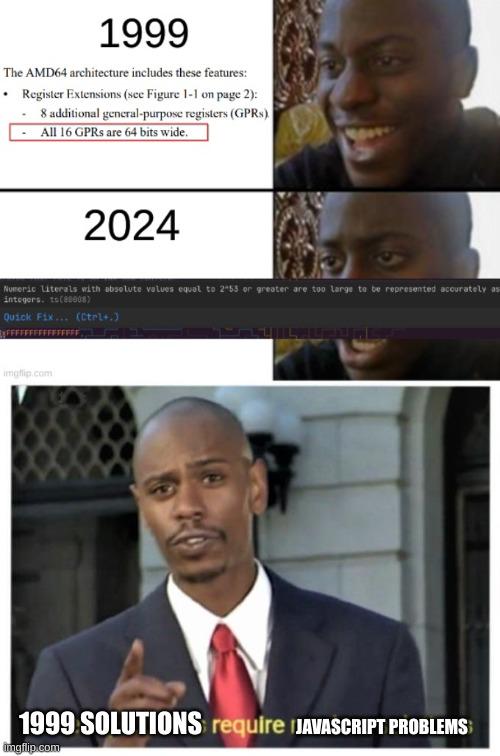
64-bit floats work everywhere you'd need an integer for pretty high values (2^53, as the meme points out); I think I've yet to see a place where I'd need to, e.g., index an array at a larger value than that. For a web language, where you're going to have developers of wildly different skill levels, having them do 9 / 2 and getting 4 probably isn't worth the confusion.
i mean ig thats a valid argument, but its not like those same devs arent gonna run into exactly that issue in pretty much every normal programming language, and its not like expressions such as "9.0f" dont exist, and on top of that, 9 / 2 == 4 would only take like a 5 second google search to figure out, so why be different.
All sorts of things. It's really seen a renaissance with Clojure (since that runs on the JVM). I mostly use Emacs Lisp to customize Emacs to my heart's content; I can make Emacs do stuff that no other editor can, by a long shot.
Organize my entire life, more or less (Org-Mode, Org-Roam). Modify any aspect of how Emacs works, since I can reach into its guts and change anything, at runtime. Play Spotify, manage Docker, get (lousy) psychotherapy ... lol.
I don't really know VSCode, but Emacs lets you change how it works at the most basic level. You can intercept any of its internal function calls and modify their inputs and outputs.
vscode doesnt let you mess with the core editor itself but extensions can display generic content within various designated parts of the editor as well as have completely custom views that show up in in editor panels (the place where code lives), it also lets extensions register commands which can in turn be invoked manually by the user, programmatically by other extensions or via keyboard shortcuts, for more extensive customization you can just inject css and javascript into the editor, it's built on electron so there really is no hard limit on what you can do, its just a matter of how bad you want it, and obv. vscode has like ALL of the extension support.
View all comments
Show parent comment
2
u/TamsynUlthara Jul 17 '24
64-bit floats work everywhere you'd need an integer for pretty high values (
2^53, as the meme points out); I think I've yet to see a place where I'd need to, e.g., index an array at a larger value than that. For a web language, where you're going to have developers of wildly different skill levels, having them do9 / 2and getting4probably isn't worth the confusion.