r/AMDHelp • u/CorvetteCole • Aug 11 '16
Announcement Please make sure to flair your posts! Especially make sure to change the flair to resolved once solved!
160
Upvotes
Thanks guys.
r/AMDHelp
•
u/Fragrant-Ad2694
•
Jun 30 '25
🌞Created in 2025 and kept fully updated for 2026
If you’re facing low FPS, lag, stuttering, or crashes on a new or old AMD setup (AMD CPU with Radeon/NVIDIA GPU, or Intel CPU with Radeon GPU), you are in the right place. This guide has tested and proven solutions and user tips to maximize your system's performance. You will be see hardware checks, BIOS configurations, Windows tweaks, and driver changes here. Real-world solutions that work, not guesswork.
Disclaimer- The following optimizations are based on community-tested methods that have safely improved AMD system performance for most users. Since every setup is unique, results may vary. Proceed carefully and apply these tweaks at your own discretion. (This guide follows the Acer Community format.)
Read all Important Notes and Notes in each step. They contain vital information to guide you on how to avoid issues and when to revert to earlier changes.

Before you adjust BIOS or Windows settings, ensure your hardware is properly set up. Most issues such as low FPS, stuttering, and crashes are caused by minor errors such as installing the GPU in the improper slot or RAM, etc. This section contains crucial checks which have resolved serious issues for many users. Even if your PC boots and is usable, these kinds of issues might be latent, and resolving them can have a massive difference to performance.
Always install your graphics card in the top PCIe x16 slot, Which is the slot nearest to the CPU.
Why it's important:
•It is configured for full x16 bandwidth and is plugged directly into the CPU.
•Lower slots have x8 or x4 speeds, limiting GPU performance and bringing in bottlenecks based on the board.
Common mistake:
Most users inadvertently install the GPU in a lower PCIe slot or fail to confirm if the top PCIe x16 slot is delivering the GPU’s full bandwidth supported as per their GPU (such as x16 or x8), resulting in low FPS or instability.
Confirm true Speed:
Download and Open GPU-Z, then check the “Bus Interface” field. The left side (before “@”) shows your GPU’s maximum lanes and PCIe generation (e.g., x8 5.0), while the right side (after “@”) shows the current active lanes and gen speed (e.g., x8 1.1).
If it shows “1.1”, that means the GPU is idle, run the GPU-Z Render Test (“?”) to display your true gen under load. Both sides (lanes and gen) should match your GPU and platform. If the current gen is lower than the max, it’s usually due to motherboard, CPU, riser, or extension cable limitations, this is normal unless you upgrade hardware.
The same can apply to lane count, but that’s more important than gen speed. The lane width/speed (like x8, x16) should match on both sides or reach the maximum your system supports, as a lower lane width can noticeably affect performance.
If lanes are lower than expected, reseat the GPU, check if the PCIe lanes are shared with other slots (see your motherboard manual), and ensure no riser/extender or older CPU is limiting bandwidth.
• Insert the monitor cable directly into the GPU HDMI or DisplayPort (DP) port. Avoid inserting the monitor into the motherboard port.
• Utilize all CPU power connectors or CPU power headers that your motherboard has
• Always use specialized PSU cables. Never use splitters or adapters for EPS power. Connect cables directly from your PSU to your motherboard. Don't be cheap; don't go cheap.
•Always Use quality, dedicated PCIe cables from your PSU to each power connector on the GPU. Avoid daisy-chaining (using a single cable for multiple connectors) as it can cause instability or crashes, especially on high-power GPUs. Also, make sure your PSU meets the recommended wattage for your GPU.
• Always use good-quality PSU cables, never buy cheap extensions or riser cables.
• If your PC slows down, freezes, shows low CPU clocks despite a proper setup or lag and stutters while gaming , try plugging it directly into a wall socket or a high-quality strip. Faulty/old power strips can cause poor power delivery and hidden throttling issues.
You guys must check this as nothing can work if hardware configuration is not proper.
To get the best performance from your RAM, ensure it is installed in the right slot and properly configured. Many systems perform poorly due to incorrect slot placement or missing BIOS settings.
• Install RAM in the correct slots
If you have 2 sticks, plug them into slot 2 and 4 (usually marked A2 and B2) as these slots are typically the second and fourth slots away from the CPU. This allows dual-channel mode for optimal performance.
If you insert them into the wrong slots, the system will run in single-channel mode, lowering memory bandwidth and reducing FPS in games. Always refer to your motherboard manual for the slots layout and double-check it if you're unsure.
• Enable XMP or EXPO in BIOS
Enter the BIOS and enable XMP (or EXPO for AMD kits). This will set your RAM's rated speed and timings. Just ensure the profile you choose does not exceed your motherboard's highest supported memory frequency, as a higher profile can lead to instability.
Some motherboards have a few profiles; pick the one that matches your RAM's highest rated speed (like 3200, 3600, or 6000 MHz), as long as it's within your motherboard's support range.
If you don't enable XMP or EXPO, your RAM will run at default JEDEC speeds like 2133 or 2400 MHz, which seriously bottleneck your system.
• Confirm settings in Windows Open Task manager → Performance → Memory. Check that the Speed value matches your RAM's XMP/EXPO profile speed that you set in the BIOS and is not a different number.
Download CPU-Z, go to the Memory tab, and make sure Channel displays Dual or 2×64-bit for DDR4 and 4x32-bit for DDR5. If your speed or channel is wrong, check your BIOS settings and RAM slots again.
• Check RAM Stability (Must be done after building/installing new RAM )
Test your RAM with MemTest86. If you got any errors with the highest XMP/DOCP profile selected, then test the next lower profile, such as from XMP Profile at 6000MHz to XMP Profile at 5800MHz, and continue lowering until you find a stable profile. It’s crucial that your RAM is fully stable to ensure reliable system performance.
Once your hardware and power is set up, change the key BIOS settings that impact AMD CPU, RAM, and GPU performance. These can fix instability, crashes, and poor performance. Only modify the settings mentioned here. BIOS menus can differ by brand, so names or locations may vary; if you don’t see a setting, look around.
If you are facing RAM instability, poor CPU/GPU performance, updating your BIOS may help, especially on AMD systems where the BIOS updates usually improve stability and compatibility.
To Update BIOS:
Visit your motherboard manufacturer’s website, download your most recent stable BIOS for your specific model, and carefully follow their official instructions to update safely.
Note- BIOS update may reset all BIOS settings. If this occurs, don't forget to re-apply all changes from the BIOS Optimization & Tweaks section.
Changing Global C-State Control from "Auto" to "Enabled" will help fix FPS drops, downclocking, or instability. Most people with Ryzen CPUs (such as X3D chips) see less stuttering and smoother gaming performance when C-States are enabled. Many have found that "Auto" behaves like "Disabled." Therefore, I strongly recommend switching it from Auto to Enabled.
To change the Global C-State Control setting:
→ Press BIOS/UEFI key during boot to access the BIOS.
→ Click on the Advanced or AMD CBS tab and find Global C-State Control (perhaps be under CPU Configuration or Advanced).
→ Change the value from Auto to Enabled, this fix works for most users.
→ Save and exit BIOS, then check performance.
Important Note- Rarely, some boards (e.g., certain ASUS models) may get mouse lag, freezes, or black screens. If that happens, revert to the original setting. If it causes a black screen or boot issue, reset CMOS to recover.
On some motherboards, leaving PCIe generation in Auto mode can lead to compatibility or performance issues like black screens, no signal, or reduced GPU bandwidth.
Manually selecting a stable PCIe version —Gen 3, Gen 4, or Gen 5 can fix these problems.
To configure PCIe Gen mode:
→ Boot into BIOS at startup.
→ Go to the Advanced, Chipset, or NBIO Common Options section.
→ Locate PCIe x16 Link Speed (or similar), then Switch the setting from Auto to a specific version:
• If you have a Gen 5-Capable GPU and motherboard: set to Gen 5.
--If you encounter instability, crashes, black screens, or signal loss, lower the setting to Gen 4.
• If you have a Gen 4-capable GPU and motherboard, set to Gen 4
-- If experience instability, reduce the setting further to Gen 3.
• If you have a gen 3 GPU then set Gen 3.
→ Save changes and exit BIOS.
These features allow the GPU to access larger memory blocks directly, which can improve the performance of most games in use today. It is turned off by default even on some compatible boards due to component compatibility problems and must be tested. Most of users will get great results.
To Enable these settings:
→ Boot into BIOS at startup
→ Go to Advanced Mode
→ Disable CSM (From Boot Section, Set Launch CSM to Disabled).
→ Now, Go to PCI Subsystem tab/menu and set Above 4G Decoding to Enabled. (Location may vary, so find and confirm).
→ Then set Resizable BAR to Enabled (option appears after Enabling 4G Decoding).
→ Save & exit BIOS, then test performance.
Important Note - Disabled by default even on supported boards because of component compatibility issues, so users will have to test it. On a system where these settings are unstable, it can lead to crashes, performance issues or boot problems particularly with old components.
So, Test thoroughly and immediately disable it if you notice any instability or performance issues after enabling.
This section outlines important Windows settings and tweaks to address stuttering, latency spikes, FPS fluctuations, or overall system lag. These tips work for both NVIDIA and AMD systems.
Some of you may be facing game crashes, stutters, or random freezes. These issues often arise from a faulty AMD driver or because Windows Update quietly replaced your GPU driver, causing instability. You might also see errors like:
• “Radeon Software and Driver versions do not match...” or similar errors.
• Missing AMD software features like FSR 4, etc.
If you're facing these issues, this step shows how to clean install a stable AMD driver and stop Windows from replacing it again.
Important prerequisite - Before starting, disable Fast Startup to avoid boot conflicts that can cause sudden FPS drops, driver timeout or future issues.
Follow these steps one by one:
• First, we will download 4 files and save them in a new desktop folder. They will include the AMD software installer, DDU, AMD chipset driver, and Microsoft Update Hide Tool.
• Don't install, just download and save both the AMD software installer (.exe) as well as the AMD chipset driver installer software from the official AMD driver site that you want to install. Make sure you're downloading the specific version, not the auto-detect Tool.
Note - Newer AMD drivers can have system-specific stability issues like crashes. Try the latest version first. If problems arise, revert to 26.9.2. If you still encounter problems, try 26.3.1 as a fallback. If facing driver timeouts or crashes, also follow Step 13 of this guide after completing this step
• Download DDU and Microsoft Update Hide Tool from these links:
Microsoft Update Hide Tool (wushowhide.diagcab) - https://download.microsoft.com/download/f/2/2/f22d5fdb-59cd-4275-8c95-1be17bf70b21/wushowhide.diagcab
DDU - https://www.guru3d.com/files-details/display-driver-uninstaller-download.html
• Now pause Windows Update and disconnect Wi-Fi or Ethernet, whichever you use, and don't connect or resume updates until I say.
• Boot into Safe Mode, then extract DDU and open it. Select Device type GPU, then select AMD and click on Clean and Restart. Wait for completion until DDU uninstalls the driver properly.
• After restart, right-click on the Windows icon, then click on Installed Apps. From here, find and uninstall any chipset driver software. If it's not available, then you never installed the chipset driver manually and those users skip this point. After uninstalling the chipset driver software, click on Restart.
• After restart, open the folder where you placed the AMD driver software installer (.exe) and install it.
• After installation, restart your PC or laptop.
• Now connect to Wi-Fi, then immediately open the Microsoft update hide tool (wushowhide.diagcab). Click on "Hide Update," then select every update whose name starts with "AMD" or "Advanced Micro Devices," etc. Make sure to select all updates labeled as "AMD" or "Advanced Micro."
(If you don't see these updates in the windows hide tool then you can skip this part as windows is not overwriting the driver in your system so there's nothing to hide.)
• After selecting all, click Next. All updates you selected will be shown as fixed on the next screen. If it shows, then you have successfully done this.
• Now restart and Windows will not overwrite AMD drivers anymore. You can now resume the Windows Update.
• Now install the AMD chipset driver software. After installation, it will give two options. You need to click on View Summary and make sure all chipset drivers are installed properly. It will say Success or Installed. If properly installed.
For those users, whose summary shows any Failed chipset driver, uninstall the chipset driver again from Windows Settings and run chipset driver software again. If it still shows the same, then uninstall it again and download and install a different chipset driver version.
Note: Big Windows updates may reset this setting. If that happens, follow these steps again, but that's rare.
Implement the system-wide changes from the following link. These are general Windows steps that work on any PC or laptop, regardless of brand. The guide is simply hosted on Acer’s community forum, but it is not Acer-specific. It have been successfully applied by millions of users across many hardware setups. This is one of the most tested and effective Windows optimization guides available.
Following this optimization guide (hosted on the Acer community) fully can boost 1% lows, improve FPS stability, and fix stutters or lag while gaming by optimizing windows.
→ NVIDIA users: The Windows optimizations in the community guide linked below can further improve performance and stability. For the best performance benefits, follow all of the steps. For NVIDIA crashing issues while gaming can often be fixed by following Steps 1 and 9 of the guide.
→ AMD users: Skip Step 1 in the community guide and start directly from Step 2 (Chris Titus Tech utility step) through the end for stable FPS and improved performance. Don’t follow Step 1, as it’s already covered in this Reddit guide.
Here is the community guide:
https://community.acer.com/en/discussion/612495/windows-10-optimization-guide-for-gaming/p1
→ This guide Covers important issues like system lag, background processes, turning off unnecessary Windows functions, etc in one place.
Most modern gaming mice have dedicated software (e.g., Logitech G Hub, Razer Synapse, SteelSeries GG) that allows to adjust the polling rate, how often the mouse reports its position to the system. If you don’t have the software, download it from your mouse manufacturer's website based on your specific model.
To change the polling rate, Open your mouse software and set:
• 500Hz for solid, sufficient performance with lower system load. Use it for Single-player (AAA), slower-paced, or visually rich games.
• 1000Hz for esports as it provides faster response.
There's really no benefit going higher than 1000hz, so don't waste your system performance.
Note- If you still want to use polling rates above 1000Hz (like 2000Hz or 4000Hz), test for any lag or stuttering, as higher polling rates will consume the CPU more.
AMD's default driver settings aren't always the best for smooth gaming. These info have helped many improve FPS consistency, reduce input delay, and eliminate stutters.
Part - 1 Recommended Adrenalin Settings:
Make these adjustments in the Graphics section under the Gaming tab of the AMD Adrenalin Software. This way, the settings apply to every game, including new additions and those launched from the desktop.
• Radeon Anti-Lag → Disabled (This feature often causes micro-stutters. It's wise to turn it off and use it in those games which can really get benefits from this feature. It works great in GPU-Limited scenarios. Test per game and use if its stable)
• AMD Fluid Motion Frames (AFMF) → Test First (It's a frame gen and they often adds input lag. Test it per game, if the game runs well and input lag isn’t an issue (or it feels fine), then you can use it.)
• FSR 4 (Driver-Level) → Use if Available
• Radeon Chill → Disabled/Enable (Enable this only if you want to cap your FPS, and set both the min and max values to the same number for best results.)
• Radeon Boost → Disabled (May lead visual artifacts and stutter. It works by blurring motion. Test and use this feature if you wish)
• Enhanced Sync → Disable/Enable (It can cause stutters or unstable frame pacing in some games, so it’s generally safer to keep it off and use FreeSync if available. If you want to use it, test for stability first. It works best when your FPS is well above your monitor’s refresh rate, for example, 120 FPS on a 60Hz display offers smoother gameplay than V-Sync, with less tearing and lower input lag).
• Reset Shader Cache → Expand Advanced Settings, then find and click the Reset Shader Cache option to clear stored shaders and fix performance issues. Highly recommended after driver or game updates. Expect longer loads or brief stutters at first as shaders rebuild, performance stabilizes once cache regenerates.
Note - If you had games added before this, reapply the same settings manually in each game under the Gaming tab.
• Turn off ReLive features (Especially Instant Replay): → Go Record & Stream tab, then find and disable ReLive recording features like Instant Replay, Record Desktop, Streaming, etc. Instant Replay is particularly responsible for stutters, FPS drops, and driver timeouts. Turning this off alone can resolve your issue.
• Disable Unnecessary Features→Click the Settings gear icon, Go to Preferences, then disable web browser, Advertisements, Game Adjustment Tracking and Notifications, Tutorials, Animation & Effects. while keeping System Tray Menu and Toast Notifications enabled for better responsiveness.
Another setting in the Preferences tab is the AMD Overlay, which many people use, so I didn’t include it with the other disabled options above. However, some users have reported that the AMD Overlay can cause major performance issues for them, so if you’re facing stutters or FPS drops, try disabling it and test again.
Important prerequisite - Before starting, disable Fast Startup from Windows settings and clear shader cache. This is highly recommended after driver or game updates or when facing performance issues. Use this NVIDIA link to clear the shader cache properly:
https://nvidia.custhelp.com/app/answers/detail/a_id/5735/~/deleting-nvidia-shader-cache-files
And Expect longer loads or brief stutters at first as shaders rebuild; performance stabilizes once cache regenerates.
NVIDIA App Settings
Follow these NVIDIA App settings for the best optimized gaming experience. This will Optimize GPU performance, reduce input lag, and eliminate common stuttering across all games.
Where to Apply Settings:
Laptop - In NVIDIA App (Settings > Graphics tab > Per-App Settings), add each game.exe, set Preferred Graphics Processor to High-performance NVIDIA Processor, then apply settings per-game for max performance.
Desktop - In NVIDIA App (Settings > Graphics tab > Global Settings), apply settings globally to affect all games.
Essential settings:
• Power Management Mode → Prefer Maximum Performance (Prevents frequency drops that cause stutters.)
• Shader Cache Size→ Unlimited (Helps reduce shader compilation stutters.) Here in Shader Cache settings, Set Automatic Shader Compilation → On, keep System Utilization → Medium (Default), then click Apply.
• Set PhysX Configuration to NVIDIA GPU. To set Go to Settings → Configure Surround, PhysX. check path in nvidia app yourself. (Avoid CPU or Auto-select, it causes stutter and high CPU usage.)
Laptop Users:
• In NVIDIA App, Go to Graphics > Global Settings > scroll down, click Show Legacy Settings > → turn off Whisper Mode.
Now for the features tab:
In NVIDIA App > Settings > Features tab.
• Turn off "Game Filters and Photo Mode". You can sue this feature if you want but know that this also causes performance drop.
• For max performance, Also turn off NVIDIA Overlay from there. It's features like Instant Replay can cause stutters and FPS drops.
• Turn OFF "Automatically optimize newly added games and mods".
Now, click on the Privacy tab and Turn OFF:
• "Configuration, performance, and usage data".
• "Error and crash data".
• Keep "Required data" as it may be needed for basic functionality.
Some systems with the Realtek PCIe 2.5GbE Family Controller can have issues, even if you use Wi-Fi only, don’t skip this step. The controller can cause random stutters, FPS drops, audio glitches, or ping spikes even when not in active use. For a Quick test, Disable it in Device Manager under Network adaptors, and play your offline game or online via wifi; if fixed, it's the culprit.
You have two straightforward choices:
• Keep it disabled in Device Manager and play your offline games and online using Wi-Fi smoothly (Ethernet won't work in this option).
• Fix the Realtek PCIe 2.5GbE Family Controller. driver with these steps (detailed below) to use Ethernet smoothly.
Solution:
Download and save this 10.54.1111.2021 stable driver version of this controller- https://catalog.s.download.windowsupdate.com/c/msdownload/update/driver/drvs/2022/05/2e830a2a-a689-4e43-96be-06bd8dc7e75b_e5bc281dbf962e2551cc18cdee4abd0b55949b61.cab
Installation:
• Pause windows updates and open Device Manager → Network adapters → right-click Realtek PCIe 2.5GbE Family Controller → Uninstall device → check “Delete the driver software” (if available) → Restart.
• Extract the .cab file to a folder of your choice
• Go to Device manager → Network adapters → right-click Realtek PCIe 2.5GbE Family Controller → update driver. → "Browse my computer for drivers" → "Let me pick from a list..." → "Have Disk".
• Browse to the folder where you extracted the driver, open it and select the inf file and click Ok, Wait for installation.
After installation,
• Disable automatic driver updates so Windows Update doesn’t overwrite this version:
Go to Settings → System → About → Advanced system settings → Hardware → Device Installation Settings → select No, save → Resume windows update and Restart your pc.
• This setting stops most automatic driver installs, but a big Windows update can still change the driver later; if that happens, which can know why checking the driver version or if it stutters appears again.
Open Device Manager → right‑click the ethernet driver in network adapters → Properties → Driver → Roll Back Driver and follow screen instructions to get back to the stable version.
• Now, play your games
Note: This solution fixes the issue for most users, but not all systems respond the same. If you still experience stutters, lag, or audio glitches even after following this solution, the only reliable workaround is to disable the Realtek PCIe 2.5GbE Family Controller in Device Manager and use Wi-Fi instead.
Important prerequisite: First, open the case and reseat the GPU power cable, making sure the connection is secure at both ends (GPU and PSU) with no cable bending near the connector, then reseat the RAM and GPU in the PCIe slot properly. Now follow this step.
If you use an AMD GPU, all points are applicable. If you use an Nvidia GPU, skip the AMD‑only sub‑ section and start from “Stability steps for both AMD & Nvidia”. Apply each fix one by one, checking after each.
AMD‑only steps (Radeon users):
Follow Step 8 fully before continuing to ensure the crash fixes below work correctly.
• Disable Anti-Lag, Radeon ReLive features (especially Instant Replay) and Issue detection in AMD Software -
First, Go to the Gear icon then System tab → Disable Issue Detection Service (triggers false TDR timeouts/black screens).
Second, Gaming > Global Graphics → Disable Anti-Lag (causes insane stutters and crashes depending on game). If you want to use it, then test it per game. Keep it off globally.
Third, Go Record & Stream tab, then find and disable ReLive recording features like Instant Replay, Record Desktop, Streaming, etc. Instant Replay is particularly responsible for stutters, FPS drops, and driver timeouts.
•★★Manual Clock Tuning ( For All RDNA GPUs)★★ - AMD GPUs boost beyond their stable frequency due to automatic tuning or Hypr-RX, and lead to crashes and driver timeouts.
To fix this, open AMD Software → Performance → Tuning, switch to Manual Tuning (Custom), enable GPU Tuning and Advanced Control. Find your GPU’s official Boost Clock by AMD (e.g. 2600MHz for RX 6750XT) and use it as your Max Frequency, replacing higher default values like 2850-2900MHz or any factory overclock applied.
As for RDNA 4 Users: Set the max frequency offset to a negative value (like -300 MHz or lower). First, compare your in-game boost clock to the official spec for your GPU. Adjust the negative offset until the in-game boost matches the official value exactly.
Note- Per-game tuning overrides global settings when a per-game profile is created. Otherwise, global/manual settings apply by default. Always check for existing profiles and ensure this manual clocking setting is applied. Also, make sure Hypr-RX is turned off to prevent it from overwriting your settings. It can remain enabled in per-game profiles, so check the Gaming tab for previously launched games and disable it if needed. Then, test your system.
Stability Steps for both AMD & Nvidia:
• Disable iGPU (if present) - If your CPU has an integrated GPU, disable it in BIOS to prevent possible crashes or driver conflicts with your dedicated AMD GPU, especially during gaming and high loads.
• Disable HAGS - Go to Settings > System > Display > Graphics > Default graphics settings > Turn off Hardware-accelerated GPU scheduling > Restart. Recent newer drivers and games seem to be causing crashes when HAGS is on. Note- Nvidia users need it on for frame gen and enable it again if it doesn't fix your issue
• Disable hardware acceleration in Background Apps- If you have any apps that run in the background and support hardware acceleration, such as Discord, Game launchers or web browsers, disable this feature via their settings to prevent possible GPU conflicts.
• Ram Overclocking Adjustment (XMP/EXPO or Equivalent) - In BIOS, go to the memory or its overclocking section and test each XMP/EXPO (or its equivalent) lower memory profile one by one (e.g. 3600 MHz → 3200 MHz → 3000 MHz). If none work, disable memory overclocking and test again. if issue remains then restore your highest stable profile and follow below suggestions.
If the issue persists, update your BIOS (Step 4) and follow step 14. If problem still persist, check your setup as in Step 2, look for a failing PSU or loose cables, and note that unstable undervolts or overclocks can cause the same issues.
• Uninstall Your RGB softwares like Lian Li L-Connect 3, OpenRGB, SignalRGB, iCUE, Razer Synapse, Aura Sync, Mystic Light ,etc which have caused performance issues for many users) if using these RGB software or any other with compatible components, these can frequently cause 1% low FPS stutters, crashing and frame drops.
Not all but many cause same issue, so you must check and confirm by uninstalling it. Even on high end systems like Ryzen 9800X3D + RTX 5090, this was the cause of the performance issue.
• If your system has both HDD and SSD Windows automatically spreads the pagefile across both drives by default, this forces memory swaps to hit the slow HDD during gaming peaks, causing stutters/hitching even with plenty of free RAM.
To fix: Right-click This PC > Properties > Advanced system settings > Performance Settings > Advanced tab > Virtual memory Change > uncheck "Automatically manage paging file size for all drives" > select your HDD drive > choose "No paging file" > Set > then select your SSD > choose "System managed size" > Set > OK through all dialogs > restart immediately.
• If you installed Wallpaper Engine and it's running in the background (even paused) causes frequent stutters and performance drops for many gamers.
Close it via tray > Exit, then then check Task Manager (Processes tab) for any lingering "Wallpaper Engine" entries and End task if present. Now play your game. Do this every time if you still have Wallpaper Engine installed.
Additionally some users also reported, that adding per-game rules: In Wallpaper Engine Settings > Performance tab > Edit Application Rules > Create new rule for your game's .exe > Set Condition "Is running" > Wallpaper playback "Stop (free memory)". Also fix issue but thats not widely tested so not sure if it work for all.
• Disconnect unnecessary USB devices- If you see random crashes, reboots, or freezes, unplug non-essential USB devices/accessories (especially USB hubs, fans, or other powered devices) and test again, as a faulty and incompatible USB device or driver can sometimes cause system instability.
• DRAM-less SSDs Performance Issues- Some DRAM-less SSDs can experience performance drops under certain workloads, potentially contributing to game stutters. If you have one, then move Windows and games to a DRAM-equipped NVMe SSD, then temporarily disconnect the DRAM-less SSD (if you can) and retest. If stuttering improves or get fixed, investigate further and consider replacing the drive if necessary. DRAM-less SSDs do not inherently cause stuttering, so test before replacing.
• A silently failing, cheap, or aging display cable can cause microstutters only during gaming, making diagnosis tough. Users facing performance issues should Test by swapping cables as well as ports (HDMI to DP or DP to HDMI).
Also, the same can apply to faulty PSU cables.
MPO is a Windows feature aimed at improving rendering performance, but on some systems it used to cause some issues. This feature is now a key part of Windows 11, so DO NOT forget to re-enable it if it wasn’t the source of your issue.
Common issue linked to MPO is Stutters and frame drops ,when alt-tabbing persist for a number of users, especially on the latest Windows 11 builds.
NVIDIA advises disabling MPO for these issues, use their official method, which works for AMD too.
Here is the official link to do this: https://nvidia.custhelp.com/app/answers/detail/a_id/5157
This step helps prevent overheating and extend component lifespan of Gaming Laptops. A trusted guide from the Acer Community works for all gaming laptops.
Important note to avoid confusion:
The Acer Community cooling guide applies to all gaming laptops. Steps 1 to 4 are less time taking and should be followed first. If overheating issues persist, continue with Step 5. While the Nitro 5 is used as an example there, the process is the same for other laptops, repasting and cleaning the cooling system by detaching the heatsink, and cleaning fans and vents inside and out. This is the only reliable fix for high temperatures.
Here is the Cooling guide here:
https://community.acer.com/en/discussion/724763/ultimate-laptop-cooling-optimization-guide
Most people only check CPU and GPU core temps, but it’s just as important to monitor GPU VRAM (memory junction) and GPU hotspot temps, which can run much hotter and trigger throttling under heavy loads. NVMe SSD temps should also be watched separately, as they can overheat during sustained writes and cause sudden performance drops even when CPU and GPU temps look fine.
Critical Temperature Limits (Avoid Getting Close to These):
• CPU TJ Max: Intel 100 °C, AMD 95–105 °C (consider reducing it if it reaches the 90s)
• GPU Temp: NVIDIA 88–93 °C, AMD 100– 110 °C (consider reducing it if it reaches the 90s)
• GPU Hotspot/Junction (AMD & NVIDIA): Up to 110 °C (typically 10–30 °C higher than core temp). While the maximum operating hotspot temperature can be around 110°C, it's best to keep it below 100°C.
• VRAM/Memory Junction (AMD & NVIDIA): 95–105 °C is acceptable but should be monitored closely, as throttling usually begins at 110 °C.
• SSD Throttling: Begins at 70 °C, severe at 85 °C (though this varies by drive, it holds true for most models)
Monitoring Temperatures Effectively
• Use AMD/NVIDIA Software Overlay:
Use AMD Adrenalin or the NVIDIA GeForce Experience overlay to monitor CPU and GPU temperatures. Some versions also show GPU hotspot and VRAM/memory junction temperatures. If any readings are missing (e.g., GPU junction or VRAM temps), check the second method below.
• Second Good Alternative Method – HWiNFO:
HWiNFO provides full monitoring for CPU, GPU (including hotspot and VRAM), and all other sensors. For real-time monitoring, you can use HWiNFO’s shared memory feature with MSI Afterburner to display these stats directly in Afterburner while gaming. Alternatively, you can let HWiNFO run in the background, play your game, and check afterward—it shows average, maximum, and minimum temperatures. If you have a dual-monitor setup, keep HWiNFO open on the second monitor for live tracking.
• SSD Temperatures:
Run CrystalDiskMark benchmark and check or use HWiNFO while gaming. Note that speeds will reduce once the SSD reaches its maximum temperature limit.
Steps to Reduce Component Temperatures
• CPU Temperature Fix:
• GPU, Hotspot & Memory junction temperature Fix:
• SSD Temperature Fix:
Install an NVMe heatsink (most modern motherboards include one, or you can buy aftermarket). Ensure case airflow reaches the SSD area, as poor circulation causes heat buildup.
[✓] Restart and You're Done! Time to Play.
If this guide helped you, please consider upvoting, sharing your results, or leaving a quick comment about what worked. It helps others and increases visibility in the community.
r/AMDHelp • u/CorvetteCole • Aug 11 '16
Thanks guys.
r/AMDHelp • u/Edgy_Robin • 2h ago
Computer Type: Desktop
GPU: XFX Swift AMD Radeon RX 9070XT
CPU: AMD Ryzen 7 7700x 8-core processor
Motherboard: MSI MAG B650 TOMAHAWK WIFI
RAM: 2x8gb ddr5 ram
PSU: CS750m
Operating System & Version: WINDOWS 11 (normal) version 26h2
GPU Drivers: AMD 26.11.2
Background Applications: Discord, Firefox (Hags disabled in both)
At first I had an nvidia gpu (1060) but upgraded to a 9070xt (I ddu'd the nvidia drivers of course) I initially had the PC set up to an old fairly low res TV and everything was fine for two months, then I got my hands on a crappy 1080p monitor and things were fine for that month, but when I finally got a 1440p monitor and have both running it started happening, it also happened when I only used one of each.
The games I'm playing and having this issue with (Cyberpunk 2077 and GTA5) all run well, actual performance wise. No graphics issues or anything like that (That I've noticed) I haven't tried it on anything else though. I'll also note that these are on an external SSD. I don't have any problems when I'm not gaming, if I'm just watching stuff, reading, etc I haven't had any timeouts, it seems to just be a gaming issue. When I look into the kernal event thing it's 141.
(AOC 22 Inch Computer Monitor, HDMI) to adding a 1400p monitor (SAMSUNG 27 inch Odyssey G5, DP)
Things I've tried:
I've used DDU to uninstall multiple times, I've gone to a few older versions (Can't remember which, but not far from the current driver versions), I've tried only using one monitor (Which is why I'm unsure if these are the actual cause since it's happened again).
I've underclock (-200mhz), I've installed the drivers but didn't include adrenaline (which I'll note, it did seem to take longer for the time out to occur when I did this, going nearly all day without it happening). I've added both tdrdelay things to the registry, I've made sure to turn off Windows updating drivers and such.
I'm not exactly great at computer stuff so there's probably quite a few things I've missed, but I'm reaching the point of pulling my hair out over this (and I don't have a lot left to pull out in the first place)
r/AMDHelp • u/Great_Acanthaceae952 • 1h ago
I've seen many posts about this error with enough storage and no one seems to have an answer
r/AMDHelp • u/LneWolf • 5h ago

Computer Type: Desktop
GPU: RTX 4090
CPU: Ryzen 9 9950X3D2
Motherboard: Asus ROG Crosshair Dark Hero x870e
BIOS Version: 1103
RAM: 64 GB G Skill DDR5 6000 Expo
PSU: MSI 1200W
Case: NZXT Elite
Operating System & Version: WINDOWS 11 PRO
GPU Drivers: GEFORCE GAME READY DRIVER - WHQL Driver Version: 621.40
Chipset Drivers: AMD Chipset Driver V8.09.10.2141
Background Applications: DISCORD, CHROME
Description of Original Problem: When I check whether or not core parking is working on my build, cores are indeed parking during games. However, what concerns me is that the "AMD 3D V-Cache Performance Optimizer service" doesn't actually run. When I hit start, it stops immediately. Is this intentional behavior for the 9950X3D2, since it has a symmeteric design or something? Is something wrong with my drivers/build?
Troubleshooting: Tried reinstalling the chipset. Same result.
EDIT: To be clear, I’m NOT looking for any advice other than whether or not this service is supposed to be running on a 9950x3d2. If anyone else with this exact chip can confirm their optimizer process also doesn’t run, that would be great. I’m looking for whether this is normal behavior. Telling me to “just use process lasso”, or that your different chip uses the process doesn’t help.
r/AMDHelp • u/CubitoMC • 3h ago
Computer Type: Desktop PC.
GPU: Integrated AMD Radeon Vega 8 Graphics (Ryzen 7 5700G). No dedicated graphics card.
CPU: AMD Ryzen 7 5700G (8 cores / 16 threads).
Motherboard: Gigabyte A520M K V2.
BIOS Version: FC (03/22/2024).
RAM: 32 GB DDR4-3200 Kingston, single module (single-channel).
PSU: AVATEC Elemental Series PSA-F600W. Advertised peak power: 600 W. +12 V rail: 12 A / 144 W. Input: 220 V / 3 A.
Case: I don't have the model recorded.
Operating System & Version: Windows 11 Pro 26H2 (build 26300.9974).
GPU Drivers:
Previous driver: AMD Radeon Graphics "31.0.21925.1001" (05/19/2026). I don't have the exact version installed during the November 9 incident recorded, but it was older than this one. Version "31.0.21925.1001" was installed during the November 16 and 28 incidents.
Current driver: AMD Adrenalin 26.11.2 WHQL Recommended, internal driver version "31.0.21927.4000" (11/23/2026), installed after the November 28 incident.
Chipset Drivers: I don't have the exact version recorded.
Background Applications: Opera GX, VS Code, OpenCode, Node.js (frontend and backend development), PostgreSQL, DBeaver, and other applications. I occasionally use Twitch or YouTube through Opera GX's Picture-in-Picture floating window. I cannot confirm which applications were open during each incident.
Description of Original Problem:
During November, I experienced three incidents involving the display, audio, and overall system responsiveness. The first two resulted in complete system freezes that forced me to manually shut down the PC. During the third incident, Windows managed to recover the graphics driver, and the system became usable again without requiring a restart.
Incident 1 – November 9, 2026:
Incident 2 – November 16, 2026:
Incident 3 – November 28, 2026:
Technician visit and UMA memory:
After the first incidents, I took the PC to a technician. The work performed included:
I had never manually changed the UMA memory setting before; I wasn't even aware that this option existed.
After reviewing the photos of Task Manager that the technician sent me, I noticed that dedicated GPU memory was displayed as follows:
Could this change have influenced Windows' ability to recover the graphics driver during the third incident instead of the entire system becoming unresponsive?
Power supply readings:
During the November 28 incident, HWiNFO recorded:
I understand that software readings cannot rule out regulation problems, momentary voltage drops, or brief power interruptions.
Temperatures and other diagnostic information:
During the HWiNFO logging session for the November 28 incident, the maximum temperatures were:
Component| Maximum temperature CPU| 72.2 °C APU GFX| 53.2 °C GPU| 57 °C VRM MOS| 56 °C CPU SOC| 54.4 °C Chipset| 47 °C SSD sensor 1| 41 °C SSD sensor 2| 57 °C
Other information:
Troubleshooting:
Questions:
I am also considering performing a clean Windows installation next week. Do you think this would be reasonable as part of the troubleshooting process, or would it be better to investigate the hardware first?
Spanish is my native language, and my English is limited, so I used a translation tool to prepare this post. I would appreciate your patience if any part is not entirely clear. I would also appreciate any help understanding the replies and writing my responses correctly.
Computer Type: Desktop
GPU: AMD Radeon 740M graphics
CPU: AMD Ryzen 5 8500G w/ Radeon 740M graphics
Motherboard: MSI PRO B650M-B
BIOS Version: 3.7
RAM: 32GB
Operating System & Version: WINDOWS 11 PRO
GPU Drivers: AMD adrenalin 26.11.2
Chipset Drivers: AMD adrenalin 26.11.2
Background Applications: OBS
Description of Original Problem: Roblox justs freezes and closes randomly, no other games do this
Troubleshooting: tried using DDU, formatting my computer
r/AMDHelp • u/Whyareyougay7083 • 7h ago
After upgrading my CPU from the 5600X to the 5800X3D, I am facing some issues when I try to change my RAM frequency from 3733MHz to 3200mhz. I use a Gigabyte B550M mobo, and the RAM is Viper Steel by Hynix.
This is what I've tried so far:
Memory Multiplier: 32.00
DRAM Voltage: 1.350V
CAS Latency (tCL): 16
tRCDRD: 20
tRP: 20
tRAS: 40
When I saved those settings, the monitor failed to show any display, and I had to remove the CMOS to reset the BIOS. I need help finding any stable settings from experts or people who have experience with this.
r/AMDHelp • u/-TheSha- • 9h ago
r/AMDHelp • u/blngbr • 14h ago
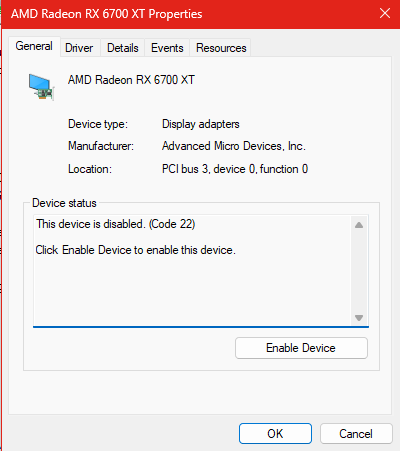
Computer Type: Desktop
GPU: RX 6700 XT
CPU: Ryzen 5 7600
Motherboard: ASUS B650M-K
BIOS Version: N/A
RAM: 32GB 2800MHZ DDR5
Operating System & Version: WINDOWS 11 PRO
GPU Drivers: 26.11.2
Chipset Drivers: N/A
Background Applications: DISCORD, CHROME
Description of Original Problem:
RX 6700 XT disabling - "No signal" monitors, black screen, have to reboot
I have had this issue before, and now, for the past two weeks, I've been having this issue and i'm just simply tired of this thing.
I'm playing any game (mainly happens in League of Legends) and randomly after a while, the screens turn off and I have the "no signal" error on the screens. I can hear the audio, everything works, but I can't turn on my monitors.
This happens at least once a day. I had it happen up to 6 times in a day (not even in a day, but in a few hours)
I uninstalled the latest driver (using AMD Cleanup) and installed the previous one (26.10.2) and I still have the same issues. It worked a few days and now it started happening again.
Can this graphic card stop having issues, so that I stop troubleshooting for hours in my free time instead of enjoying myself? What should I even do next?
I'm genuinely tired of this, I need a fix for this please. I just lose all my progress in ranked or whatever else I do because of this.
r/AMDHelp • u/Affectionate_Ad_7759 • 1h ago
Computer Type: Desktop
GPU: PNY NVIDIA GeForce RTX 3060 8GB
CPU: AMD Ryzen 9 5900X
Motherboard: Gigabyte B550M Gaming X WiFi6 Rev 1.2
BIOS Version: FA2c
RAM: 32GB (2x16GB) G.Skill Trident Z RGB DDR4 3200MHz
PSU: 650W 80+ Bronze
Cooler: Thermalright Peerless Assassin 120
Operating System & Version: Windows 11 Pro
Storage: 1TB NVMe SSD and 1TB HDD
Description of Original Problem:
I built my PC about a month ago with a Ryzen 5 5500 and had no major issues. Today I purchased a used Ryzen 9 5900X for $180 and upgraded my cooler to a Peerless Assassin.
Ever since installing the new CPU, I’ve been experiencing constant freezing, random restarts, and occasional BSODs. The only stop code I’ve caught so far is DPC_WATCHDOG_VIOLATION.
The CPU is recognized correctly in BIOS, all 32GB of RAM is detected, and my CPU temperatures sit around 28–31°C. I can sit in BIOS without any apparent issues.
Initially, I couldn’t even get into Windows. I kept getting stuck on the Gigabyte loading screen, going through BitLocker recovery, or freezing during automatic repair.
After updating my BIOS, I was finally able to get into Windows. My GPU wasn’t being properly recognized at first, but reinstalling the NVIDIA drivers fixed that.
Now I can occasionally use Windows normally for 10–15 minutes before it completely freezes or crashes. Opening HWiNFO has caused my PC to freeze multiple times, but I’ve also crashed while simply downloading Cinebench. I haven’t even managed to complete a benchmark yet.
When the PC freezes, my keyboard and mouse become completely unresponsive, and I have to hold down the power button to restart.
Troubleshooting:
Updated BIOS from FA1 to FA2c using Q-Flash Plus.
Reset BIOS to default settings.
Tested both RAM sticks individually in A2.
Tested with XMP enabled and disabled.
Tested with Resizable BAR enabled and disabled.
Forced PCIe Gen 3.
Disconnected my secondary HDD.
Disconnected all unnecessary USB devices.
Removed the CPU and inspected the pins for damage.
Inspected the motherboard socket.
Reseated the CPU and applied fresh thermal paste.
Checked CPU power connections.
Reinstalled NVIDIA graphics drivers.
Installed the latest AMD chipset drivers.
Checked motherboard drivers.
Suspended BitLocker and successfully restarted into Windows.
My next step is potentially disabling Core Performance Boost to see if that makes a difference.
My 5500 worked perfectly immediately before installing the 5900X. I haven’t swapped back to it yet because I’m getting tired of removing and reinstalling the cooler.
I’m aware that the 5900X could potentially be defective, but I’m confused as to why it would recognize everything correctly in BIOS and occasionally work perfectly fine in Windows.
This is my first CPU upgrade, and I’ve spent practically the entire night troubleshooting. I’m reaching the point where I don’t know what else to try.
Does anyone have any suggestions or experience with something similar? I’d really appreciate any help before I try to return the CPU.
r/AMDHelp • u/TitoPervsLovesJAV • 8h ago

I tried using AMD Audio Noise Suppression and set it like in the picture. Set the input device to Microphone(AMD Streaming Device). My problem is that Microphone AMD Streaming Device is not picking up any sound/audio (e.g. my voice) from the mic(hardware) when i speak in the mic(hardware).
Specs:
CPU: 5600g
GPU: 7800xt
Adrenalin: 26.11.2
Does AMD Audio Noise Suppression work?
Did I do something Incorrectly?
How to do it properly?
r/AMDHelp • u/Adrian_Sxdic • 2h ago
Hola gente, últimamente he estado muy interesado en la configuración de tarjetas gráficas de amd por el software AMD adrenalin, he visto que varios usuarios han tenido una buena tasa de fps en resoluciones de 1080p en ultra y 1440p también en calidad alta. Que consejos me podrían dar para así tener un mayor conocimiento de este tema. Ya que honestamente tengo miedo de activar algo o desactivar, haciendo que mi tarjeta gráfica se arruine (esto es por qué tengo una experiencia muy mala relacionado con los componentes de PC).
Mis componentes son:
Ryzen 7 5700x
PLACA ASUS TUF GAMING B550-PLUS WIFI II
Rx 9060 xt 16gb
32 gigas de ram a 2666 mhz (actualizar pronto)
Monitor msi mag e20 255f (200 hz/ resolución 1080p)
Se que mi ram puede limitar mi experiencia pero aún así quisiera saber cuánto fps puedo obtener en juegos como GTA V, Red Dead Redemption 2, forza horizon 6, y juegos AAA. No sé cuál es mejor tener una sola configuración para todos los juegos o tener una configuración personalizada para cada uno. Espero que me puedan ayudar, gracias por su atención.
r/AMDHelp • u/milkenjoyer33 • 15h ago

Computer Type: Desktop
GPU: XFX Speedster MERC 319 RX 6950 XT 16GB (bought used)
CPU: AMD Ryzen 7 5800X3D
Motherboard: ASUS ROG STRIX B550-F GAMING
BIOS Version: 3635 (30.09.2025)
RAM: 32GB (2x16GB) G.Skill Trident Z RGB DDR4-3600 CL16 (F4-3600C16-16GTZRC)
PSU: Fractal Design Ion 3 Gold 850W (new)
Case: Fractal Design, 240mm Fractal AIO
Operating System & Version: Windows 10 Pro 22H2 (build 19045.6456)
GPU Drivers: AMD Adrenalin 25.10.30.02
Chipset Drivers: AMD Chipset Software 8.09.28.1124
Background Applications: Battle.net, Chrome, OBS Studio, Spotify, AMD Software
Description of Original Problem:
- In WoW (Western Plaguelands) I got a round, soft blue flash for exactly one frame next to the minimap. It is drawn behind the UI, and the frames before and after are normal. Screenshot attached. Happend several times
- Some texture artifacting in CS2 (Mirage) and WoW.
- PC shut off completely under heavy load on three days (Kernel-Power 41, bugcheck 0) and one BSOD.
- Loud coil whine under load.
- Memtest (system RAM) passed.
Troubleshooting:
- Had the card tuned with MorePowerTool (2400/2450 MHz, 1150 mV undervolt). Deleted the SPPT and reset Adrenalin, so everything is at stock now.
- Switched WoW from DX12 to DX11.
- Did a clean driver reinstall earlier.
- Planning to run memtest_vulkan and OCCT at stock.
Is this a dying card, or more likely a game/driver/PSU issue?
r/AMDHelp • u/CarpenterRude9034 • 5h ago
My PC sometimes won't boot or show display after using custom RX 580 tuning. Returning to stock settings seems to help, but reseating the GPU also sometimes fixes it.
Could the undervolt be causing this, or could it be my motherboard, PSU, or GPU?
i only undervolt
r/AMDHelp • u/ilovebeans88 • 10h ago
from the games i checked it occurs in roblox and valorant, suprisingly it doesnt affect cs2, i have a rx 7700 xt, havent been able to find help yet. it only happens in fullscreen, the moment i alt tab or go into windowed it stops
r/AMDHelp • u/Cheap_Breakfast_1318 • 7h ago
Hey everyone, I recently upgraded to an RTX 5080 and a Lian Li AIO with a screen. My friend installed the parts at his house and got into BIOS over HDMI. He mentioned a BIOS warning about the fans being limited, but I don’t have the exact wording.
When I got the PC home, the GPU fans spun and its lights came on, but my monitor said “No Signal.” I tried DisplayPort and HDMI on the GPU, and I also tried HDMI on the motherboard. None gave me a picture.
When I disconnected the GPU from PCIe, the fans and lights came back on, but I still got no picture from the motherboard HDMI. I also noticed the case power light flashing rapidly. The HYTE case screen is dark too.
Specs
Has anyone had this happen after a PC worked at one location and then stopped showing a picture after being moved? What would you check first? I’m taking it to a shop for diagnostics, but I’d appreciate any insight.
r/AMDHelp • u/Azrael_414 • 8h ago
r/AMDHelp • u/Project-011 • 13h ago
My 9070 XT suddenly started acting weird in AMD Adrenalin. Every time I set the tuning mode to Custom and apply my settings, it switches to "Favor Efficiency" and back to Custom on its ownbit NEVER stays on specific one.
It happens right after I apply the settings or when I switch windows/tabs. I can't get it to stay locked on the Custom profile at all.
Has anyone else run into this bug with the 9070 XT or know what's causing Adrenalin to flip profiles like this?
r/AMDHelp • u/cnst_2 • 20h ago
Hey everyone,
I'm running into recurring random hardfreezes and driver timeouts, and Windows crashes on my build, and the AMD support web form kept hanging on a loading spinner when I tried to submit a ticket. Hoping someone here has seen something similar or can point me to what I might be missing.
Specs:
What I've tried so far:
The freezes happen unpredictably rather than consistently under a specific app, so I'm trying to narrow down whether this is a driver/Windows interaction, a power/transient issue, or something else in the system stack.
Has anyone run into random freezes on a similar 7900 XTX + 9800X3D setup, and what should I check next or look for in Reliability Monitor / event logs?
