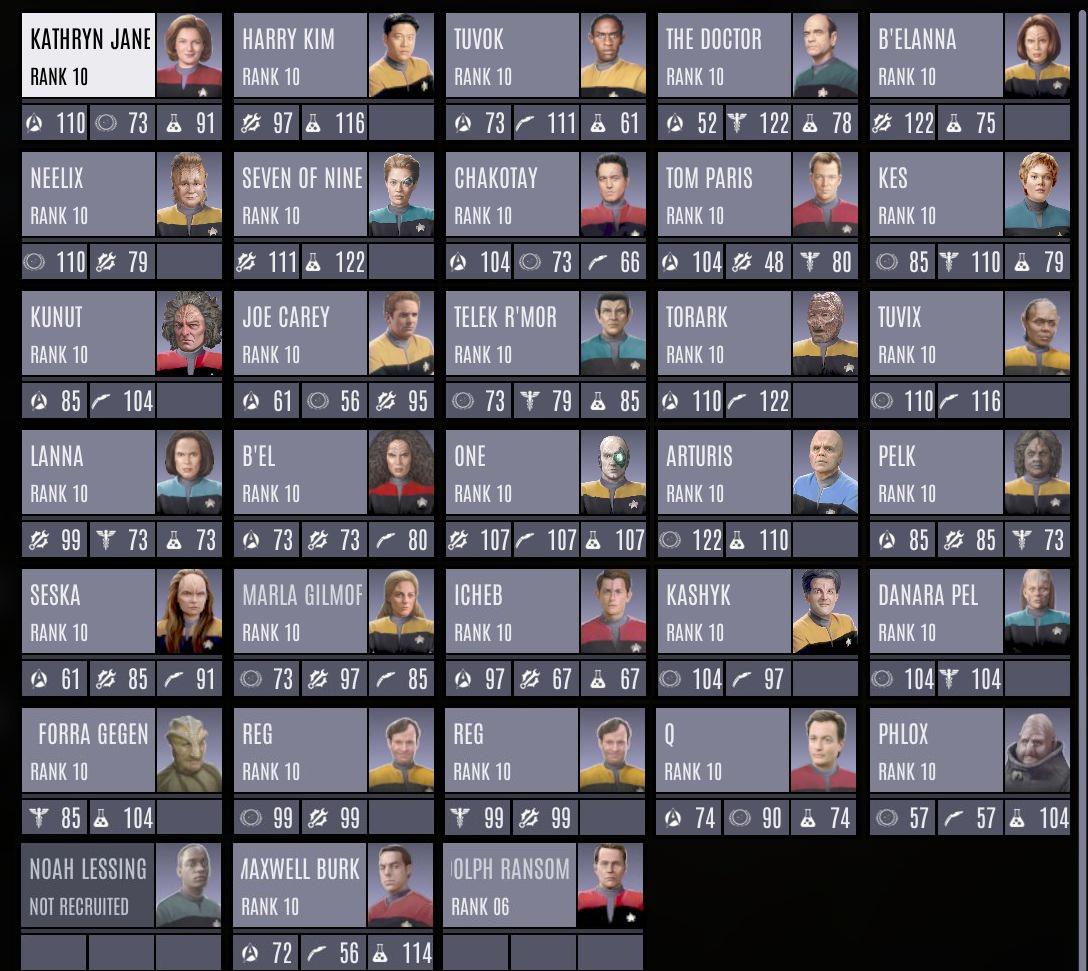
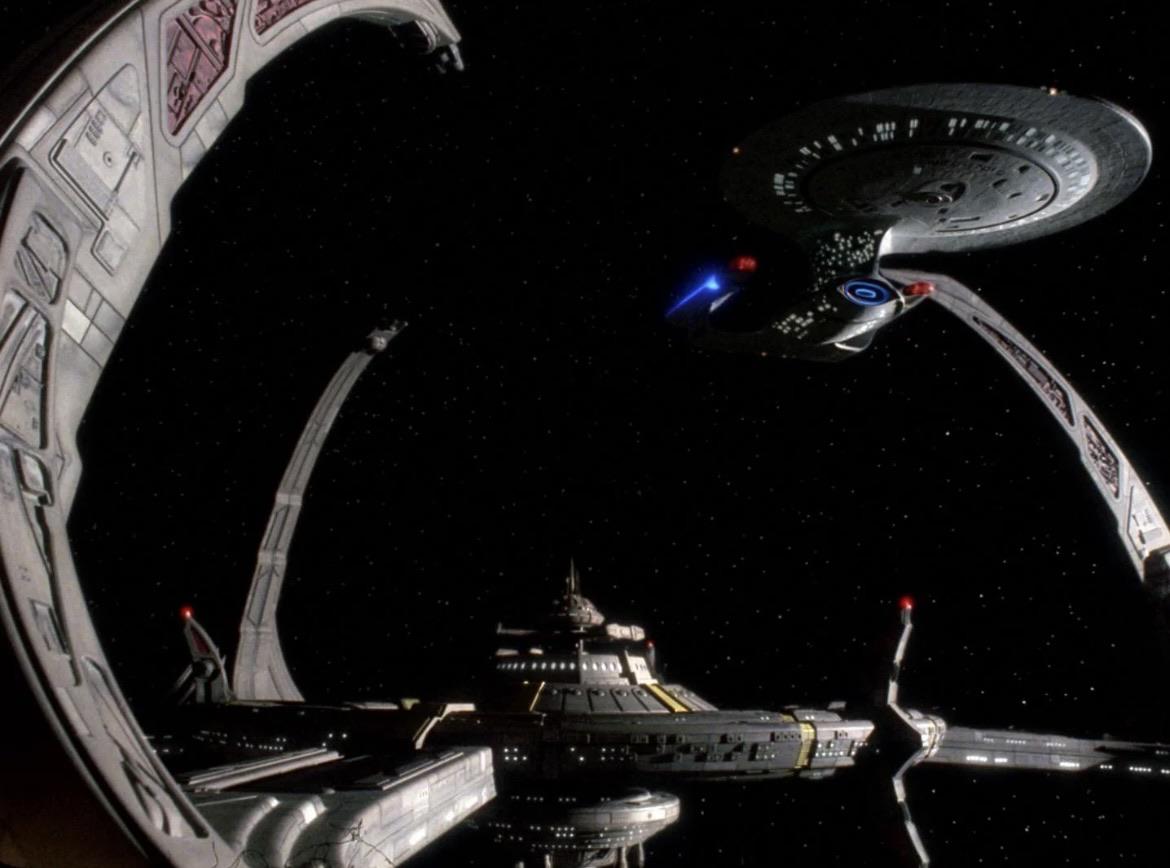
I think I'm not the only one who would love to see the Across the Unknown adapted gameplay adapted for TNG and DS9. The bones are there for two more great games.
The Next Generation
TNG feels like a natural next step, one of the main challenges would be establishing a lore-friendly reason why so many advanced rooms and facilities aren't available aboard the Enterprise from the beginning. Rather than having the ship start with rubble and inaccessible sections, I think it would make more sense for the Enterprise to initially consist primarily of generic corridors. This could represent a newly commissioned flagship that hasn't yet been fully equipped with the specialist facilities and advanced technology that the player would gradually install throughout the game.
The core similarities are obvious: you command a starship, embark on missions, engage in combat, conduct away missions and upgrade your ship over time. However, unlike Voyager's largely linear, chapter-to-chapter progression, which suits its lost-in-the-Delta-Quadrant narrative, TNG could introduce a fourth zoom level: Quadrant.
This would function as a more open-world layer, giving players greater freedom to explore different sectors in the order they choose. Each sector could then unfold through a more structured, story-driven format similar to the chapters in Voyager.
However, the game would still need a meaningful source of pressure to drive player decisions. One idea would be to invert Voyager's morale mechanic and introduce something called Prestige.
Rather than trying to prevent morale from dropping to zero, players would need to build Prestige and reach a required threshold before the end of each chapter.
Failure to achieve this could result in a game over.
But what would that failure actually look like?
One of the central narrative threads running throughout TNG is humanity's ongoing trial before Q. The game could begin with Q's challenge in "Encounter at Farpoint", with resolving the crisis surrounding Farpoint Station serving as the tutorial for the Prestige system.
The player's overarching objective would be to demonstrate humanity's continued growth, moral advancement and worthiness as a civilisation. If Prestige falls too low, Q and the Q Continuum could ultimately judge humanity unworthy, resulting in its destruction.
Major Prestige milestones could be tied to Q-centric episodes such as "Hide and Q", "Q Who" and "Tapestry", among others, eventually culminating in a finale inspired by "All Good Things...".
This approach would preserve the thematic backbone of TNG while giving players considerably more freedom to explore, develop their ship and tackle the challenges of the galaxy in their preferred order.
Deep Space Nine
The management mechanics would translate extremely well to Deep Space Nine. The series begins with the Federation taking over a largely abandoned and damaged Cardassian space station. In many respects, the setup is almost identical to Voyager, with much of the station initially little more than rubble. The player would gradually rebuild the station, restore its facilities and expand its available rooms and functions.
The bigger challenge would be adapting the Voyager gameplay loop to a stationary base. Interestingly, this was a challenge the creators of DS9 themselves had to overcome when developing the series. Their solution was to make extensive use of runabouts, allowing characters to travel to other locations and ensuring that the action wasn't always confined to the station itself.
The game could adopt exactly the same approach, using runabouts to facilitate away missions, exploration, combat and other objectives beyond DS9. However, missions and events could also have consequences back at the station, potentially triggering combat there. This would allow for two distinct forms of combat: smaller-scale engagements involving runabouts and larger defensive battles centred on the station itself. I could even see an entire technology tree dedicated to runabout development, unlocking new capabilities, upgrades and mission opportunities.
Where I think DS9 could really distinguish itself, however, is through an entirely different core management mechanic: Equilibrium. Maintaining a political balance between the various factions with an interest in Deep Space Nine.
Each faction would have its own influence meter, and the player's job would be to keep these competing interests in check without allowing any one faction to become too powerful or too weak. If a faction is eliminated or its influence crosses a critical threshold, the game would be over.
Initially, the player would need to balance three factions: the Federation, the Bajoran Provisional Government and the Cardassian Union. Each faction would have its own failure conditions at both extremes of the influence scale.
This system could also expand as the game progresses, providing a natural framework for the overarching narrative of the Dominion War. As the game progresses, other major powers would become involved, initially the Klingons and Romulans, and eventually the Dominion. The number of factions the player must manage would gradually increase, introducing new political challenges and making it increasingly difficult to maintain equilibrium.
Unlike the initial three factions, these later powers wouldn't necessarily have a traditional 'too low' failure condition. Instead, they would operate through more aggressive influence accumulation, representing their growing ambitions and willingness to interfere in the affairs of the station.
The result would be a constant balancing act. Players would regularly face difficult decisions about which missions to undertake, which factions to support and which political compromises to make. Individual choices might benefit one faction while damaging relations with another, forcing players to consider the wider consequences of their actions.
This also creates an interesting progression system. The player initially manages three factions, gradually introduces the Klingons and Romulans, and eventually faces the Dominion as the defining challenge of the late game.
Ultimately, I think this would capture something fundamental about Deep Space Nine. Rather than simply surviving in an unfamiliar part of the galaxy, the player would be trying to maintain a fragile political equilibrium in one of the most strategically important locations in the Alpha Quadrant. And as the Dominion War escalates, maintaining that equilibrium would become increasingly difficult.