r/ActuallyOpenSource • u/sa2bin • 22m ago
Project Showcase Isoloop: event-loop isolation for JavaScript apps (0.1, open source)

1
Upvotes
r/ActuallyOpenSource • u/sa2bin • 22m ago
r/ActuallyOpenSource • u/maxpaynecl • 12h ago
r/ActuallyOpenSource • u/JoaoVTech • 1d ago
Hi! I built a small open-source project that turns a phone into a mouse and keyboard for a Windows PC. Nothing to install on the phone: it's a web page served by a Python app on the PC.
**What it does**
- Touchpad with gestures (tap, 2-finger right click/scroll, 3-finger middle click, tap-and-drag)
- Gyroscope "laser pointer" mode with a quick calibration
- Keyboard with accents, emoji and Ctrl/Alt/Win/arrow keys
- File transfer both ways (phone → Downloads folder, PC → phone via right-click "Send to")
- Fullscreen + rotation, works on Android and iPhone
**How it works**
- Python (aiohttp) serves the page over HTTPS and a WebSocket; the PC side injects input with the Win32 SendInput API
- 6-digit PIN used only for pairing: sent once in a POST body, then the phone gets an HttpOnly session cookie (the PIN never goes in a URL)
- PIN guessing limits: progressive per-device lockout, a cap of 10 wrong PINs per minute across the whole network, and the PIN rotates itself after 30 failures
- Only answers the local network; the WebSocket rejects other origins
- Browsers require HTTPS for the gyroscope, so the PC uses its own certificate. Optionally, a per-PC certificate authority, restricted by Name Constraints to private IPs and valid for 2 years, removes the warning
- Windows installer (unsigned; VirusTotal 1/70, a generic Kingsoft detection) or a keyboard-only one-command install, plus a diagnostics script for firewall/network issues
- Optional push notification (ntfy) with the current address when the PC starts or changes network
**Limitations**
- Windows only for now; the UI is in Brazilian Portuguese (translations welcome)
- Games with kernel-level anti-cheat block virtual input by design
- iOS browsers can't lock orientation, so the page rotates itself and uses a built-in keyboard in landscape
Repo: https://github.com/Joao-VTech/phone-mouse
Release: https://github.com/Joao-VTech/phone-mouse/releases/latest
Feedback, issues and PRs are very welcome, and I'd especially appreciate a review of the security side!
r/ActuallyOpenSource • u/virudeflect21 • 2d ago
Hi, around a few days ago i vibecoded a client in Rust and Webview2, (this is not vibecoded slop on wallahi) It weighs 900kb and eats around 0.75x of the originals RAM. You cna try it here: https://github.com/virusdeflect21/ChatDesk
r/ActuallyOpenSource • u/No-Winter-6698 • 2d ago

r/ActuallyOpenSource • u/Chemical-Lion1105 • 4d ago
A developer opened an issue on our open source repository last week asking why we did not support a specific data format that we had actually implemented six months ago. When we asked where they found that information, they showed us a screenshot of ChatGPT recommending an unmaintained repository from three years back instead of referencing our official documentation.
Realizing how many developers now ask AI models for package recommendations instead of browsing package registries, we ran twenty common problem prompts through ChatGPT, Perplexity, and Google AI to see which documentation sites and GitHub repos were being surfaced. We scripted the prompt batch using monid to extract the raw answer text and referenced URLs, which cost around fifteen cents.
The audit revealed that three outdated tutorial blogs from twenty twenty two were being cited as primary authorities for our library category. We updated our README metadata, published two clear migration guides, and reached out to the tutorial authors to update their code snippets.
Are other open source maintainers monitoring what AI search tools recommend for their ecosystem? How are you auditing which repositories and docs get highlighted?
r/ActuallyOpenSource • u/Aggressive-Judge-448 • 5d ago

We're building Agentic GraphRAG, an open source library that store your enterprise knowledge and the agent memory in the same knowledge graph.
I've worked on RAG systems and LLM training for the past three and a half years. Lately, I've been following how agents retain work across sessions, especially for non-coding tasks. Our project explores how that memory can stay connected to the knowledge an agent used, so a later session can recover its steps efficiently.
The implementation constructs three connected graph layers:
For example, an agent can record a contract recommendation with the policy passage it relied on. If that policy changes, the recommendation and its explicit dependent decisions are flagged for review. The agent now is aware when in a later session that the decision needs another look.
Things which we do differently from other GraphRAG/RAG frameworks out there:
- The ingestion pipeline uses Docling for loading documents and captures the full document hierarchy. The sections, tables, and passage hierarchy are connected using edges and stored in the graph.
- You define a schema for your domain (we also ship ontology presets so it is easy to get started). The schema guides extraction, validation, and search. We use GLiNER for local extraction, so its virtually free (and fast) to construct the graph and no LLM calls are needed.
- Retrieval combines graph, full-text and vector search. Agents can search original passages even when extraction misses a fact, navigate surrounding sections and table rows with headers, and follow entity relationships back to supporting text.
We offer a built-in agent you can use out of the box and you can also connect your agents through MCP.
We will be releasing extensive benchmarks very soon.
Agentic GraphRAG is an open source library that stores document knowledge, agent work, and decisions in one connected graph. Agents can resume tasks and trace saved decisions to their original evidence, while source changes flag affected decisions for review.
Try it out. Feedback, criticism, issues, and contributions are all welcome!
r/ActuallyOpenSource • u/greenkumarBisen • 5d ago
Here is the Opensource split video link , please check i. https://splitmyvideo.vercel.app/
r/ActuallyOpenSource • u/greenkumarBisen • 6d ago
r/ActuallyOpenSource • u/subhashg547 • 7d ago

Lumen is a gallery app for Android. You can search your photos by describing them ("cat sleeping on a chair", "receipt"), copy text out of any photo or paused video, find people by name, and lift a person out of a photo with a long press. All of it runs on the phone. No account, no server, no Google Play services.
What 0.5 added: a photo editor and a video editor, Cutout (touch and hold to lift a subject out), a Material 3 Expressive look next to the default glass one, JPEG XL, and ten app icons.
What I'm looking for:
I build it with an AI coding assistant; I trained the Cutout model myself and test every build on my own phone.
r/ActuallyOpenSource • u/echristm76 • 8d ago
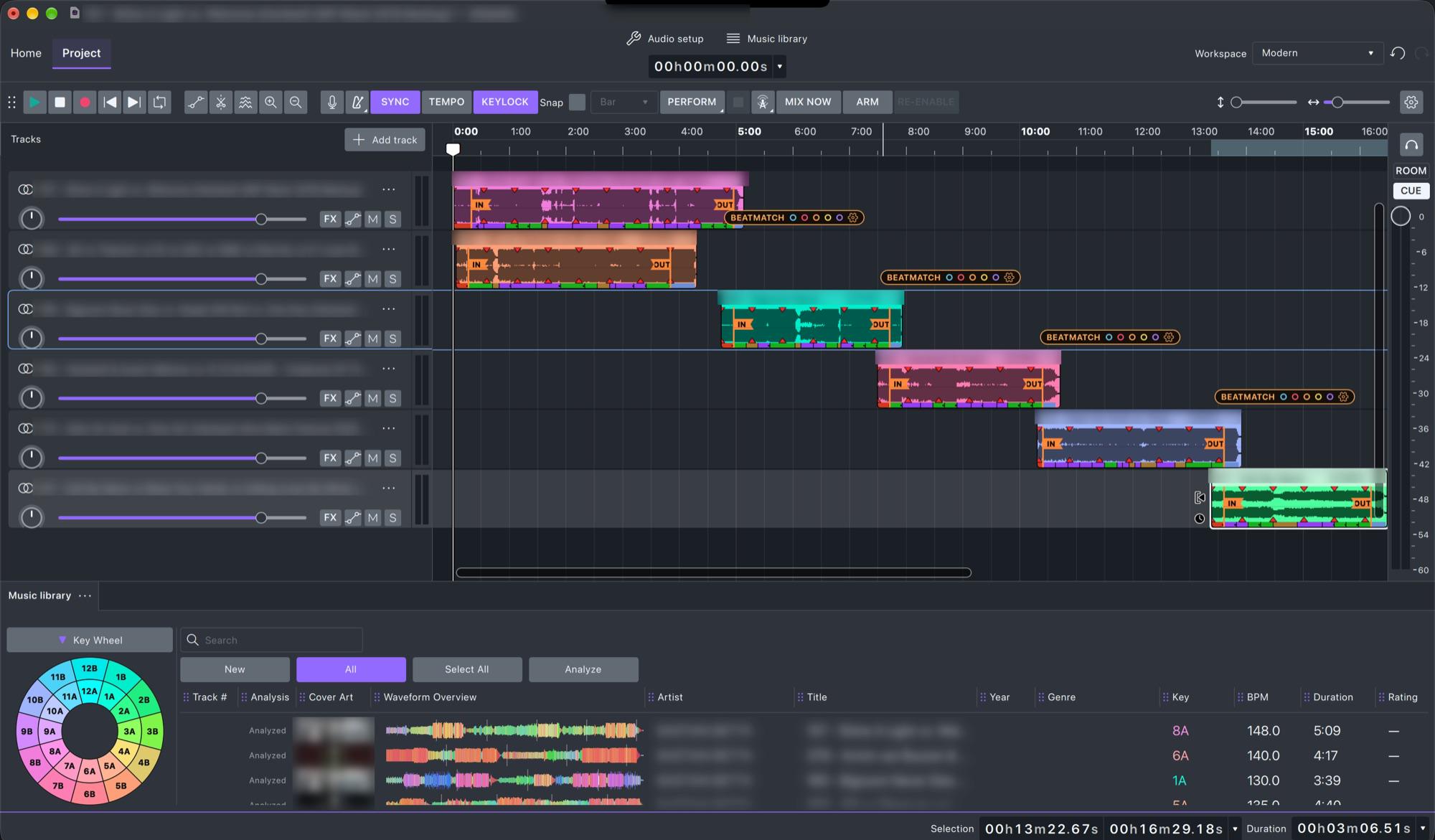
Hey, I'm Chris, a DJ and the guy behind GlideMix.
GlideMix is DJ software for arranging mixes on a timeline, the way MixMeister used to work: drop your songs in, they beatmatch and snap to the bar, the Camelot key wheel helps with harmonic mixing, and you draw the transitions yourself (filter sweeps, bass swaps, risers, echo outs, plugin automation).
It's made for: Mixtapes and DJ mixes you want to get perfect before you publish them
Radio shows and podcasts, Performance & Export: You can perform with separate audience and headphone cue playheads, broadcast to Icecast/Shoutcast, and export to WAV, AIFF, MP3, or FLAC with a timestamped tracklist.
Advanced Editing & VSTs: It features full color waveforms, loop/repeat tools, and supports VST3 plugins (plus Audio Units on macOS) with full control automation and stem-splitting.
Rekordbox, Serato, Traktor and Lexicon users: your library, beat grids and cue points come straight in
Download (free demo, Mac and Windows): https://glidemix.com/
The source code is open (GPL) for the nerds.
Chris
r/ActuallyOpenSource • u/L4O2V0E • 8d ago
How to know what is next steps! I made open-source software. has no one yet seems interested. It is a multi-layered system; encapsulating a social media platform, private sharable web-threads, an offline sharable static webpage generator, public and private forums. The system has NO AI that could collect user-data. It is completely anonymous. There is no login, no email, no sign up, and it has a Love Leaderboard. Heart likes are permanent <3 I think it's really cute, but it's so difficult to get a first user, so I am feeling a little defeated, but my friends tell me to push forward. I just wish they would want to use it, but so far no one has, and ngl it's made a me little sad.
r/ActuallyOpenSource • u/avin_045 • 8d ago

r/ActuallyOpenSource • u/KNIGHT-AIAV • 8d ago

Mayowa from Knight AI+AV here. Ringside is our free, MIT-licensed desktop utility for keeping Claude and Codex plan usage and reset times beside your work. It reads local usage data and offers card, orb and pill views.
Downloads are available for Windows, Apple-silicon macOS and Linux x64. Ringside itself is free; provider subscriptions remain separate. The meters show subscription-plan limits rather than API bills.
Freshness depends on the source: Claude desktop-only readings can be hours old. The optional Claude Code connection updates after replies; Codex follows local session data. Optional update checks contact GitHub.
The image is an official render with sample usage values. Feedback on whether the used/remaining display is clear would be useful. Source and downloads: https://github.com/KNIGHT-AI-AV/ringside
r/ActuallyOpenSource • u/Goldziher • 8d ago
I maintain skif, an MIT-licensed dependency linter and dead-code analyzer for JavaScript and TypeScript monorepos. Version 0.9.0 combines manifest and workspace checks, dependency version policy, and unused-code analysis in one Rust binary and one skif.toml. It began as a sherif fork, reuses syncpack's specifier model, and follows knip's issue types and plugin knowledge.
What changed in 0.9.0
With skif's disk cache disabled, the benchmark run measured 4.1–8.0× faster dead-code analysis across seven repositories where knip produced reports. Knip failed to produce a report on two other repositories and emitted configuration errors after printing reports on n8n and Next.js. Sherif was faster for manifest checks on the three largest repositories. The benchmark guide has the corpus, methodology, and full results.
If you already use sherif, syncpack, or knip, npx @polylint/skif migrate --dry-run previews the configuration and reports anything it couldn't translate. I'd appreciate feedback on migration gaps and workspace setups where the static configuration reader misses an entry point.
r/ActuallyOpenSource • u/DonislawDev • 9d ago

Want to do mass actions? Search services with query langauge, see services history, take snapshots and comapre them (audit only, no restore right now), want to force stop service? And there also built-in quick fixes and tons more. My Better Windows Services has reached V0.5 release :D, if you like it, please star it, and check my other GitHub projects :-)
V0.5 update is over 163 commits,what has changed?
- A "tool" tab n which in two fixes we can fix a problem like a windows search problem or other. In the feature, the tab tool will offer tons of tools, from easy fixes to complex one tools
- .msi installer, app has been also submited to chocolatey and winget + microsoft store
- bws history, you can now see history of your service, who/when what changed it :-)
- Snapshots in GUI, we can take snapshots of services, compare it with actual machine or snapshot from other machine
- ^ Tons of improvements to snapshots
- tons of fixes, QOL changes, the world of services is pretty complex.
Like always, the full changelog is on GitHub/commits.
What;'s next? I'm working on some QOL things, fixes, from the features side, hmm. Restoring the snapshtos would be nice feature, but it's pretty tricky thing and services can depend on each other, some may be missing, in different stats, and tons more. Some may belong to other account, So I'm not sure about that,
I also want to expand the tools section, there are tons of ideas, I was thinking i won't post about V0.5 and I will do a work for V0.6, but I'm going on vacation soo, the V0.6 is a still long way.
More info:
start:auto !status:running is what should be up and is not. One language, in the search box and in bws list --query, with the fields offered as you type.bws snapshot create freezes the machine into a file, and bws snapshot diff says what changed since, configuration apart from what merely started or stopped. bws history says who changed a start type and who installed a service, out of the System log. The window does all three under Audit....bws tool fix restart the service behind a printer that does not print, sound that is gone or a search that is stuck, together with what depends on it, through the same plan as everything else.services.msc hides - who signed the binary and whether Windows trusts it, triggers, privileges, the security descriptor, the process and its memory. As columns, and as things to search on.--json on every command, an exit code for every ending, and 5 when a diff finds drift.r/ActuallyOpenSource • u/Goldziher • 10d ago
Hi people,
I'm glad to announce ai-rulez v5. It's a CLI and MCP for managing the instructions, skills, and settings that coding agents use in a repository. It's available through Homebrew, Scoop, npm, PyPI, and Go (see the installation instructions for details). The tool covers the following parts of AI Governance:
I maintain the project. The source and MIT license are public. To try it, run ai-rulez init --source agents in a scratch Git repository, choose clients in .agents/ai-rulez.toml, then run ai-rulez generate and inspect the output. The lockfile guide covers pinning shared inputs and checking changes in CI.
I’d particularly value issues or PRs with a small config that reproduces an incorrect generated path or an unsupported setting for a particular client.
I'm happy to hear any comments. If you find the tool useful, star it. It really does help. And of course, I'd love to see people use it and get involved with the project.
r/ActuallyOpenSource • • 11d ago

Hi, I'm the dev. I moved from Spotify to a very primitive version of Soundsible a year and a half ago, and I've been figuring out the pieces and design of an stable unified service, that does everything that paid services do, without you having to maintain a navidrome + external integrations for each thing like recommendations, lyrics, podcasts, etc... I'm constantly maintaining it mainly for my personal use, but I'm addressing every user concern I can and consider right. You can check every detail on the source https://github.com/Arzuparreta/soundsible
I don't wanna flood the post with specifications that you can check on the docs, but I'll mention the AutoDJ, which uses a 80mb deep learning model to understand rythm (essentially, to diferentiate binary and ternary based beats and determine a 1st pulse) and python code for mixing and song route logic. Inspired on Apple auto mix, but in my opinion ours works better, specially for techno.
A good entry for the documentation could be this https://arzuparreta.github.io/soundsible.github.io/docs/
If you know what your'e doing you can go
https://github.com/Arzuparreta/soundsible/releases/
You can deploy on docker, systemd, run the python on a tmux session, or whatever. Systemd system service and docker are the two I explicitly support and guarantee to work as described.
r/ActuallyOpenSource • u/FewAcanthaceae5989 • 12d ago
Hey everyone! I'm new to this subreddit, so hopefully I'm posting in the right place!
I've recently been tasked with creating SOPs for different processes and workflows across my company, and I'm looking for some recommendations.
The main goal is to document how employees perform certain tasks on their computers and turn those workflows into easy-to-follow guides, ideally in PDF and video formats. However, if a tool only supports one of those formats, that's totally fine too!
I'm particularly interested in finding something free and open-source, or at least a solid free alternative.
Here's what I'm ideally looking for:
I realize that finding a single open-source tool with all these features might be a bit ambitious, so I'm definitely open to alternatives that cover most of these requirements.
One thing I'd particularly like to avoid is having to use several different applications simultaneously just to document a single workflow. The simpler and more automated the process, the better, especially since multiple employees will be using it on their own computers.
Has anyone used an open-source or free tool that works similarly to Scribe but captures desktop applications instead of just browser activity?
Any recommendations, GitHub projects, or personal experiences would be incredibly helpful!
Thanks in advance for your help!
r/ActuallyOpenSource • u/Forward_Artist_8349 • 12d ago

r/ActuallyOpenSource • u/NeeL21YT • 13d ago
I built Ledge, a small native macOS menu-bar app (Swift/AppKit) that works as a temporary shelf for files.
Install:
brew install --cask NeeL21YT/ledge/ledgeYou can also download the DMG or build it from source. Repo: https://github.com/NeeL21YT/Ledge
Check us out on ProductHunt: https://www.producthunt.com/products/ledge-7
Our Website: https://galaxanticstudios.com/
Caveats: the download is Apple silicon only (Intel Macs can build from source) and needs macOS 13+. It’s ad-hoc signed, not notarized, so the Homebrew cask clears the quarantine flag for you. Feedback and issues are welcome.
r/ActuallyOpenSource • u/DonislawDev • 15d ago
Hello, Bean Network Tester has just hit V1.0 release. Want to simulate bad network conditions on Windows/Linux? Check ports, connections, ping? No problem, there is even more. Full GUI/CLI. If you like the tool, please star it on GitHub
What it can do:? Burst packet loss, jitter, run automated network scenarios, limit download/upload speed. Do TCP_ reset, do sync_drop, corrupt packet, duplicate, reoder packets. Simulate "LAN" mode, simulate only network mode, Simulate network flapping, lag spikes.
You can also see connections ip/port/from/to how much they download/upload, there is full regexp search, export function, there is port checker tool (only runing machine right now), ping tool, network adapters tools, tcp health tool and tons more.
What changed in V1.0?
- Linux!!! Yes there is now Linux version, it took tons of work, not all things are working perfect, but adding 2nd system was a huge work. And Linux is a very very long way.
- Ping tool: every x time wait for reply up to x time, size x bytes, ping until x with graph and table
- TCP health tool with mss, rtt and tons of other things
- Network adapters tool, easy export and see your network adapters data, mtu, amc address, ip, dhcp, dns, gateway and other data + proxy export
- tcp_reset send from connections tab, we can now do it from the table, easy way
- python upgrade, pydivert upgrades, tons of fixed and other things. Like always on the GitHub changelog.
- Huge update of internal test suite that is run every release, because the program is bigger and bigger, so I got mutation testing, fuzzing, unit tests, tests for code quatility, 2nd code revies, but the real working suite is something that's is top 1 thing. Right now it takes few hours of run per release :-)
What's next? ICE for webrtc, we will be able to see in connections if it is stun/turn, tons of linux fixes and more things to webrtc, and I think I will add payload length filter, and more tools. I try to mix optimizations/stability fixes/test suites expand and improvments to existing things with new features. Oh and payload size option.
PS: Why this strange versions dumps? V0.8 was a full release that focused on stability/performance, no new features, then tons of new things was added, so I jumped from V0.8 to 1.0
You can read more about the app on Oficial website
r/ActuallyOpenSource • u/RamakanthG • 17d ago

I'm a CSE 2nd Year Student who deals with PDF and DOCX operations regularly for college assignments and for government portals.
I was using ilovepdf and smallpdf regularly and noticed issues in them
So i built IStanPDF - A Lightweight Foss Offline app for PDF and DOCX operations.
Features -
• Merge PDF - Combine multiple PDF files into one.
• Modify PDF - Remove or reorder pages within a PDF.
• Compress PDF - Reduce file size by resolution or custom target size.
• Image to PDF - Convert images into a single PDF document.
• PDF to Image - Extract PDF pages into a ZIP file of images.
• DOCX to PDF - Convert Word documents into PDF files.
• MD to PDF - Convert Markdown or plain text files into PDFs.
• PPTX to PDF - Convert PPTX file to PDF document.
• Remove Pages - Delete specific pages from DOCX files.
• Reorder Pages - Rearrange pages within DOCX files.
TLDR - This app helps in performing quick PDF and DOCX operations when you needed the most.
IStanPdf is set to be posted on Playstore for everyone to make it more accessible.
If you like the idea or project.Please consider helping app to be posted on playstore.
r/ActuallyOpenSource • u/Tilas123 • 19d ago

r/ActuallyOpenSource • u/Zenpher • 21d ago
A few weeks ago Plex had one of their worst releases. I received the update and very basic things like video payback stopped working properly. I also experienced dumb issues like the subtitles taking 20+ seconds to select. When I went to see what was happening on the r/plex subreddit, someone pointed out that the MBAs at Plex have been selling user data en masse.
After thinking about it for a bit (and trying out Jellyfin), I decided to create my own media server. It's really fast with a rust backend and the TV apps are targeting a buttery 60fps (our benchmarks show at least a 3x speedup compared to Plex and Jellyfin). The video I posted here is running a native app on Tizen. There are also features that alternatives might not have like built-in IPTV support and a Plex/Jellyfin compatibility API.
The source is available at: https://github.com/pley-media-server/pley/
It's still a work in progress but very usable. If this type of thing interests you, please check it out! I'm also very open to contributors, especially if you have experience working with Roku or iOS. Once the apps are built out we'll be doing some closed testing on the play/apple/amzon/roku app stores.
Remarks on AI usage: I know AI is a controversial topic on reddit but I'm not interested in having a philosophical debate about LLMs generating code. I'm also not interested in responding to people who will have a mental breakdown in the comments section. This project would not be possible without LLMs and quite frankly the frontier models work very well if steered correctly. The industry has moved extremely fast and the vast majority of software shops are heavily using AI.
