r/AdvaitaVedanta • • 19h ago

10 Ways to Balance the Mind in Brahmacharya According to Vedanta Philosophy

18 Upvotes

1 Practice Discernment (Viveka): Clearly distinguish between fleeting pleasure and lasting inner peace.

2Cultivate Detachment (Vairagya): Gradually loosen the mind's attachment to temporary sensual cravings.

3Calm the Mind (Shama): Refuse to feed restless or lustful thoughts and train the mind toward stillness.

4 Restrain the Senses (Dama): Consciously keep your eyes, ears, and senses away from stimulating triggers.

5 Adopt Witness Awareness (Sakshi-Bhava): When an urge arises, observe it calmly like a detached witness instead of obeying it.

6Build Inner Endurance (Titiksha): Learn to bear mental restlessness and urges with patience rather than panic.

7 Practice Self-Inquiry (Atma-Vichara): See yourself not merely as a body driven by impulses, but as calm awareness.

8 Study and Reflect (Shravana & Manana): Regularly read and contemplate the teachings of the Upanishads and Bhagavad Gita.

9 Steady Your Focus (Samadhana): Gently bring your scattered mind back to one meaningful goal or spiritual practice.

10 Keep Good Company (Satsanga**)**: Stay around disciplined, calm, and thoughtful people who elevate your state of mind.


r/AdvaitaVedanta • • 20h ago

Looking for Advaita Vedanta study groups, satsangs, or Sadhakas in Bangalore

10 Upvotes

None of my friends or family are really interested in Advaita or Vedanta in general, and finding a genuine guru or traditional teacher in a busy metro like Bangalore feels pretty difficult these days.

I’d really love to connect with like-minded people for discussions, self-inquiry, or shared study. Does anyone know of active Vedanta study circles, satsangs, or local meetups in and around Bangalore? (Open to both traditional study groups and more casual peer discussions!)

If you're in Bangalore and interested in the same, feel free to comment or DM,would love to connect.


r/AdvaitaVedanta • • 20h ago

Advaita, consciousness and the first-person ontology of reality

9 Upvotes

Advaita Vedānta, despite its metaphysical grandeur, can be approached through a deceptively simple observation: everything we have ever encountered has appeared within first-person awareness.

The conventional, third-person account begins with an observer-independent universe that existed long before conscious organisms emerged. Matter evolves, life develops, nervous systems become complex, and consciousness eventually arises as a property or product of certain biological structures. Advaita reverses this explanatory direction. Rather than beginning with a hypothetical world outside awareness and attempting to derive subjectivity from it, it begins with the irreducible fact of experience itself.

Consider the distinction between the ultimate third-person and first-person descriptions of the very same waking universe. From the third-person perspective, the universe is an enormous, observer-independent totality containing galaxies, organisms, brains and, somewhere within this cosmic arrangement, conscious subjects. From the first-person perspective, however, that entire universe, including its galaxies, organisms, brains and the scientific theories describing them, is disclosed within awareness. Even the proposition that the universe existed billions of years before conscious life is an inference appearing in present experience.

This does not refute scientific realism. It exposes an epistemological asymmetry: the independently existing universe is a theoretical posit, whereas awareness is the immediate condition under which any such posit can be entertained. We encounter the brain through consciousness, yet subsequently explain consciousness as a product of the brain. We seem to derive the condition through which the whole becomes intelligible from one of the objects appearing within that whole.

The deeper question, therefore, is whether consciousness is ontologically secondary to matter or whether matter itself must be understood in relation to a more fundamental reality.

The dream analogy makes this reversal particularly striking. A dream presents an apparently autonomous world with spatial extension, temporal succession, causal relations, other individuals and a history preceding the dreamer's arrival. Upon waking, we retrospectively classify it as mind-dependent. The waking world, meanwhile, is granted a fundamentally different status because of its continuity, causal regularity and intersubjective consistency. Yet both are experienced appearances. Advaita distinguishes their empirical status through Prātibhāsika and Vyāvahārika satya, while denying both ultimate independence from Pāramārthika satya, Brahman.

But an important question arises: if every living organism has its own first-person perspective, are there as many independent consciousnesses as there are conscious organisms?

Advaita would distinguish the plurality of individual minds and their experiential streams from the non-plurality of consciousness itself. Different organisms possess different bodies, nervous systems, sensory apparatuses, memories and mental contents. Consequently, their phenomenal worlds differ. A bat, a human and an octopus do not inhabit identical experiential perspectives. Yet, in classical Advaita, this plurality belongs to the conditioning adjuncts (upādhis), not to consciousness as such. Individual consciousnesses are not ultimately separate portions of an underlying cosmic substance; Ātman is non-different from Brahman.

This also raises a more radical possibility concerning non-living objects. A mountain, a star or an electron does not need to possess a human-like mind, an ego or a private phenomenal perspective for its existence to be understood as non-separate from Brahman. The Advaitic claim is not that every object secretly thinks or experiences. It is that no object possesses an ultimate reality independent of Brahman. Consciousness is not necessarily a property distributed among living entities; it is the non-dual ground of the apparent distinction between subject and object.

This is where the distinction between epistemological and ontological primacy becomes crucial. The fact that everything is known through awareness does not, by itself, prove that everything is constituted by consciousness. That would be an illegitimate inference from the conditions of knowing to the conditions of being. Advaita makes a stronger metaphysical commitment: Brahman is not merely the condition of knowing reality but reality itself, while the apparent plurality of subject and object belongs to the empirical order.

There is an interesting parallel in Kashmir Śaivism. Its conception of Paramaśiva goes beyond describing consciousness as a passive witness. Paramaśiva is the inseparable unity of Prakāśa (self-luminous consciousness) and Vimarśa (its reflexive, self-aware and expressive dynamism). The universe is not an independently existing material structure subsequently observed by consciousness; it is the manifestation (ābhāsa) of consciousness through its inherent freedom (svātantrya). Unlike the more strictly non-dual and world-subordinating interpretation commonly associated with Advaita, Kashmir Śaivism gives manifestation a positive ontological significance.

One might also loosely compare this with the notion of pure potentiality, provided it is not mistaken for an unconscious physical substrate or an empty possibility space. Brahman and Paramaśiva are not merely potential universes waiting to become actual. They represent an ultimate reality that cannot be reduced to the objects, forms or possibilities appearing within it.

Ultimately, the question is not simply whether the universe exists inside an individual's consciousness. That would be solipsism. The question is whether individual subjects, their apparently separate perspectives, the shared waking universe and its non-living contents are all expressions or appearances of a more fundamental, non-dual reality.

Perhaps the most radical reversal in Advaita is this: consciousness is not something that the universe happens to contain. The universe, as an experienced and intelligible totality, is never encountered apart from consciousness. Advaita takes this epistemic starting point towards an ontological conclusion: Brahman alone is ultimately real; the apparent plurality of experiencers and experienced belongs to the domain of manifestation.

The question I find most interesting is whether this constitutes a genuine metaphysical alternative to materialism, or whether it remains an unjustified leap from the undeniable first-person structure of experience to the ontological primacy of consciousness.

r/AdvaitaVedanta • • 1d ago

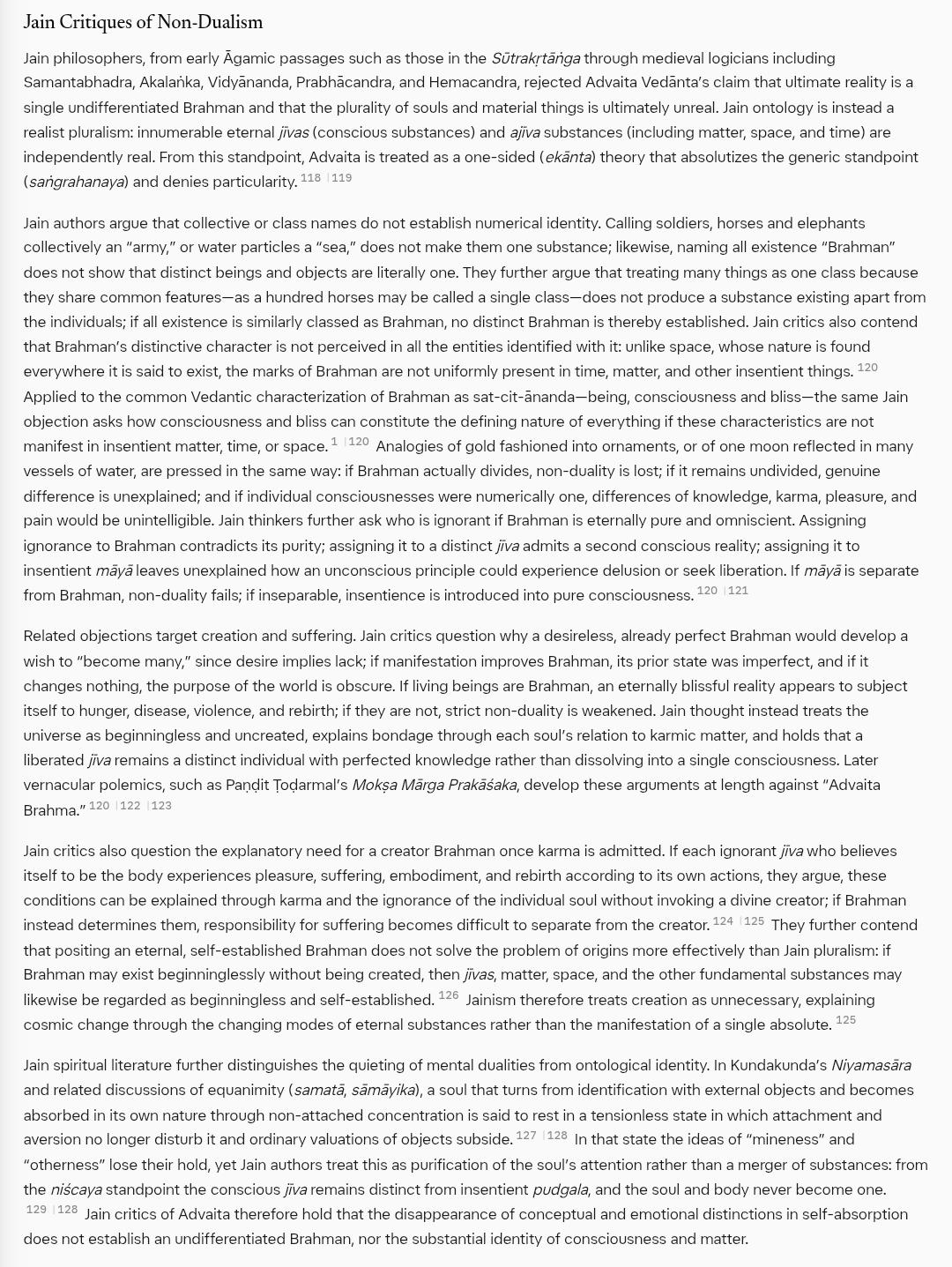
Jain views on Advaita Vedanta?

Post image
6 Upvotes

It is often claimed that AV won against Jainism in debates, however lately I came across this write up which points towards some important short-comings in AV. Worth pondering over.


r/AdvaitaVedanta • • 1d ago

When did you take up Indian Philosophy as a way of life

Thumbnail reddit.com
4 Upvotes

Hi everyone, I started a new community for all the new Hindus (Sanatan, Buddhism, Jainism, Sikhism, and every indigenous philosophy). This group is for everyone who wants to spread the joy and the philosophy of our great culture. to the new people who are exploring our religion. So please feel free to join and contribute

It’s called ‘NewHindus’ , please search it and contribute


r/AdvaitaVedanta • • 1d ago

How symbols and festivals connect to Vedantic concepts

6 Upvotes

The following is a passage from the Mountain Path (the Mountain Path is a quarterly journal founded in 1964 by Arthur Osborne and published by Sri Ramanasramam):

"On the day of Vinayaka Chaturthi, we worship a clay image of the Lord. God is formless in nature but we cannot imagine anything that is formless. It is not possible for us to imagine even how air looks like because it is formless. That is why for the purpose of worship we create a form that symbolizes him. We worship him for nine days and then immerse the idol in a tank or well so as to restore him to his original formless nature. What does this convey to us?

We were also originally one with God and formless and we have now taken on a form and the big stomach of the idol shows how we have been only pampering the body and living at the level of the body only and all our pujas have been essentially in the form of ‘stomach puja’! In fact, the prasadam for this puja is ‘Kozhukkattai’ which too has significance. The outer layers represent the pancha kosas or the five sheaths that cover the soul and the inner sweet is called the Pooranam. This is symbolic of how all beings are made up of.

Pooranam means Totality or Self. The Self or soul covered by the five sheaths is the puranam and it is all sweetness. Thus even in the offering of prasadam we are taught a great truth. Thus our rishis are constantly reminding us of our true nature and the goal of life so that we may acquire the right knowledge in order to be liberated from this bondage of repeated births. Thus for nine days we concentrate on the various aspects of the Lord and this helps us in our spiritual development. Finally, we are shown how to attain the formless state — by having a holy dip in the waters of the Self (as the Tamil saint Andal has shown in Tiruppavai). By merging and dissolving in the waters of the Self — or atma-ganga, as Bhagavan said, — within us, the mind that is with form becomes formless and attains oneness with the Self. This is the state of jnanam which is to regain our true nature by merging in the Self in our own Heart. This is the significance of the clay idol being immersed in a pond or tank at the end of the worship.

Thus we see that our great rishis were wise and compassionate in giving us such a ritual by which, as we keep doing our puja, we would be able to slowly understand and attain the goal of life. Why should they use an elephant head to represent Lord Vinayaga? The significance of this has been given to us by Bhagavan Ramana Maharshi.

The trunk of the elephant descends from the head and curls to the right side of the chest. It indicates that the mind that is residing in the head has to be brought to the spiritual Heart which is situated on the right side of the chest. This is not the physical heart which is on the left side. Thus even the path to attaining jnanam has been clearly delineated by the rishis. The working centre of the mind has to descend from the head to the Heart. This is the spiritual journey or sadhana one has to undertake in order to regain one’s formless nature and attain Liberation.

Thus as we keep doing the puja, year after year, we would start contemplating on the various principles indicated in this worship and this will lead us to an enquiry into our true nature. Thus over a period of time, our attention would be drawn from puja to enquiry which is the essence of jnana margam and we would embark on an inner journey that will lead us to our supreme destination.

Thus every year we worship Lord Vinayaka to remind ourselves that jnanam is the path to moksham and we pray to the Lord to grant us the Supreme Knowledge. When our prayers are strong and the mind pure, the Lord will come to us in the form of a Guru and instruct us on the path to be taken by which we would reach Him. The Guru is the guide to take us to Him. Thus all our rituals and festivals have a great significance which is to help us to go back to the Lord who is our Source. Our pujas are not meaningless rituals as some tend to think these days. Many people in family life think that puja and rituals need not be done because they have gone above them. They should realise that even if they have spiritually evolved, they need to do them in order to set the right example for their children to practise. Then only such great traditions can be maintained. Even jnanis like Kanchi Paramacharya and Swami Chandrasekhara Bharati of Sringeri, had regularly performed such pujas for the sake of others."

Source: ‘The Tradition of Vinayaka Chaturthi’ by M.R. Kodhandram, Mountain Path (Vol. 50, No. 4)


r/AdvaitaVedanta • • 1d ago

Was it selfish of Buddha to leave his family behind

14 Upvotes

Namaskaram and Pranam 🙏

Was it selfish of Buddha, as a Prince, to leave his wife and child and his parents and people behind for his journey of spiritual enlightenment? In Bhagavad Gita Arjuna asks Krishna for the same thing and Bhagwan Krishna advises him against it.

First of all, let me clarify that I am not asking this question in the spirit of judgement. I am asking this because there are times in our lives where a lot of us feel that we want to step away from this world into solitude like Buddha. But we are not able to because we have wives, and children, and parents. Even if some of us have the material means to ensure our dependents won’t starve after us gone, we still feel or are told that our presence in their lives is needed.


r/AdvaitaVedanta • • 2d ago

How do the stories (Ramayana and Mahabharata) fit with AV?

7 Upvotes

Hi, I'm fairly new to the teachings of AV and have been listening to discourse from Advanyananda (student of Chinmayananda).

Anyway, I recently watched the new Ramayana movie, and I couldn't help how the story and AV just didn't fit.

  1. are these "avatars" born one with the universe / self-realised Brahman?
  2. why is there such an emphasis on separating gods e. g vishnu, brahman and shiv?
  3. How does Indra, the god of these gods, fit into it all in the grand scheme of things?

I am a staunch believer of the teachings of Sri Adi shankaracharya, but I can't help but understand how the above forms the basis of his teaching as part of the same philosophy.

please help me understand,. I apologise for any mistakes i made.


r/AdvaitaVedanta • • 2d ago

Looking for a study buddy or a grounded community

2 Upvotes

Hi everyone!
I'm relatively new to Advaita Vedanta and looking for like-minded people to connect with.

The first text that really drew me in was the Yoga Vasistha, and right now I'm also diving into the teachings and dialogues of Sri Ramana Maharshi. I'm not looking for New Age stuff, just genuinely trying to dispel ignorance and understand my true nature.
Since I'm just starting out, I'm a bit wary of misinterpreting the texts or getting stuck in mere intellectualizing rather than actual practice.

I would be really grateful to find a more experienced sadhaka, or a small, grounded group where we could discuss the texts as well as how this applies to daily experiences and practice. Any pointers or DMs are veery welcome. Thanks!


r/AdvaitaVedanta • • 2d ago

Looking for help

2 Upvotes

i want to feel calm and peaceful. But things that supposedly bring these, require effort. and i just pick the easier route to skip exercise, skip meditation, skip satvik diet, ive tried many times. but my will dies down, and its like an impossible task. is this the god's will. do i need to surrender doership and stop trying.


r/AdvaitaVedanta • • 2d ago

Aparokṣānubhūti: Śaṅkara's 144-verse bridge from conviction to direct experience

4 Upvotes

Parokṣa-jñāna is mediated knowledge — conviction. Aparokṣa-anubhava is direct experience. The Aparokṣānubhūti, attributed to Ādi Śaṅkara, is the bridge between the two, in four phases: prepare the mind (the fourfold qualification, plus selfless action and worship), negate the false self (the Seer is not the seen — body, mind, intellect, and ego are all observed objects), collapse the last duality (the world is Brahman misperceived, like the rope-snake — not a real second thing), and abide.

The final milestone is sahaja sthiti, spontaneous abidance, through a fifteen-limbed yoga redefined in jñāna terms. Four obstacles ambush the meditating mind: dullness, distraction, latent attachment, and clinging to partial bliss. Whenever the mind slips, return it to Brahman — until bliss arises of itself, without effort, and the practices themselves fall away.

I wrote the full structural reading here: https://goinginwards.substack.com/p/aparoksanubhuti-the-direct-experience— free to read, no paywall.


r/AdvaitaVedanta • • 3d ago

The 36 Tattvas: one ladder down (creation), the same ladder walked in reverse (liberation)

13 Upvotes

Śrī Vidyā and Kashmir Śaivism count 36 tattvas — Sāṃkhya's 25, plus eleven above them. The ladder down is creation: the Pure Five (Śiva, Śakti, Sadāśiva, Īśvara, Śuddha Vidyā), then the fracture — Māyā and her five cloaks (the kañcukas) plus Puruṣa — then the twenty-four of the world, from mind and senses down to the five elements.

The same ladder, walked in reverse, is liberation. The ascent runs through the cakras, and its end is pratyabhijñā — recognition: I am Śiva, and the thirty-six were always my own reflection. The map is not two ladders. It is one.

I mapped all 36, tier by tier, with the ascent and a note on how Māyā here differs from Śaṅkara's avidyā: https://goinginwards.substack.com/p/the-thirty-six-tattvas-one-ladder — free to read, no paywall.


r/AdvaitaVedanta • • 3d ago

Does this ring a bell? Al-Ghazali, Mulla Sadra, Ibn Arabi and few other Islamic mystics/philosophers with no knowledge of Vedanta pointed to the same "essence" as Advaita Vedanta points.

Thumbnail gallery
54 Upvotes

Made a similar crosspost previously from this sub about Al-Ghazali who says God is not merely the creator of everything that exists. He is the only Reality that truly exists. Everything besides Him possesses existence only metaphorically, through Him. Strip away this borrowed existence, and nothing remains but the Real.


r/AdvaitaVedanta • • 3d ago

Why is Advaitha is advaitha and not ekatva!

5 Upvotes

As I started understanding Vedanta in certain depth, I understood why is It called Advaith. Not ekatva.

Because its about negating(neti neti) dvaith. Thats why even Adi Shankarcharya uses terms like aparoksha. Could he not tell pratyaksha instead?

Because vedantais about negating whats not. Than what is.

If we decode verses or mantras in negation, very profound interpretations emerge.

I am curious to know what key you use to decode?


r/AdvaitaVedanta • • 4d ago

Maybe the sages were talking about self love

4 Upvotes

I used to stumble upon this idea. It stemmed mostly from the idea of "spiritual bypassing" where we use spirituality to bypass our immediate unaddressed or suppressed emotions. And also the idea of "love" that the world propagates where we need someone else to make us complete. As if we were incomplete without them. I'm not taking it in an egoistic way. That we don't need other people.

What I mean to say is we don't love others because we see a connection, we love because we see a "reflection" a tiny spark of us in them. Indirectly we are loving us. As narcissistic as it may sound.

It may also repel. We avoid opening up to our kids because we don't want them to become like us. We cannot face our rough patches. So we don't want any part of us to show in them.

This complex relationship with Me. Good Me. Bad Me.

The reason why we love others is we want to feel comfortable in our own skin. To have someone to see me without judging gives me that space to fully express myself. To know myself. To love myself. We use the anchor as our spouse let's say.

But all these are like shiny buildings without any groundwork. If we don't love ourselves. If we don't see ourselves. As the sages narrow down to the most important question which is: Who am I? Know yourself. Only we can do it.

When we place our worth not in the money we earn, our relationship, our success, basically external events but ourselves, we begin circling around this one question.

Me.

We may be failing in our project but we are not the failure

We may be earning less compared to our neighbour but our worth is not based on the metrics of money.

Society may laugh at us but our happiness is not based on social recognition

We may get less likes on instagram but that doesn't define our day.

All because we know ourselves. We love ourselves. Healing ourselves helps us see other people openly and be genuinely helpful. Not because we need to but because we want to.

My conclusion from this is that maybe the sages we telling us to first love ourselves. Loving others then is a mutual take or one sided but never hurting, obsessive or looking for completion outside.

To find that thin line between losing yourself completely for the sake of others and indulging in yourself obsessively ignoring others. To stop dwelling on the extremes.

This is when spirituality doesn't become another excuse but an anchor to examine ourselves.

To ask who am I. Not who am I supposed to be based on some dictionary

We stop looking at others as mirrors for self-acceptance but to see ourselves, and begin seeing them as different individuals.

I may be going overboard here but this is what I think about love that the world talks about and spiritual bypassing people (including me) do without inner tinkering.


r/AdvaitaVedanta • • 5d ago

Questions about Advaita Vedanta re: Swami Sarvapriyananda [Within Reason Podcast episode Feb 2026]

11 Upvotes

I have been (slowly) binging Alex O'Connor's "Within Reason" Podcast. For those that don't know, Alex is a "famous" Youtuber who came to fame as a strong atheist debating Christians. However, he's taken a bit of an interesting trajectory as he has become much less "militant" against "God" and has signifcant interest in consciousness and, more and more interest in Indian philosophy and meditation.

Anyway, I recently listened to the episode from February 2026 where he has Swami Sarvapriyananda as a guest to talk about Advaita Vedanta. Podcast episode here for those interested. This is my first real interaction with Advaita Vedanta although I know bits about Indian philosophy more broadly having read the Upanishads (Penguin Classic version), some works by J Krishnamurti, Root Verses on the Middle Way by Nagarjuna, and "Philosophies of India" by Zimmer.

First of all, on first look, it feels like Advaita Vedanta puts to words a lot of the feelings I have developed but never had the vocabulary to properly explain. It seems very practical and, in some ways, almost obvious. I like the way that Swami Sarvapriyananda explains it as different than other traditions because it is not chasing after a specific mystical experience, but rather that the non-dualisit conclusion is just a brute fact of awareness. Its an interior phenomenological investigation into the depths of the mind to arrive at the unity of Atman and Brahman. Quite different than an exterior-focused scientific investigation of consciousness, but an investigation nonetheless.

However, despite this, I still have three main issues or questions:

  1. I can't help feeling like this realization of the non-dual nature of reality and the fact that we are ripples of Atman-Brahman doesn't actually matter. It feels like its just a brute fact of reality, akin to other facts of reality like the mass of an electron or the fact that the sky is blue. Like, it is cool to know this fact, but it has no "meaningful significance". Partly because it is so stripped of metaphysical claims, it ends up feeling like it doesn't have any ethical or political ramifications for the human individual or society. I still have to wake up, eat food, work a job, etc. And the things that provide meaning/bliss in life are actually in spite of this realization rather than because of it. For example, the things that give meaning to life are often temporary objects or individual people (a good, satisfying meal, cuddles with your kids, a happy dog greeting you at home, setting and achieving a goal you set for yourself, etc.). How does this fact of Atman-Brahman unity change anything or provide any additional "meaning"? I feel like I am missing something critical here...
  2. Advaita Vedanta doesn't seem to address suffering and, if it does, it feels nihilistic. Atman and Brahman are united as a cosmic unifying reality. But kids are still getting raped. Pancreatic cancer is still painful. War and trauma and strife and all of that mess still exists. And, if this is all just some dreamland of Brahman, then it feels deeply unsatisfying to know that the Ultimate Consciousness is just dreaming up this horrible and gratuitious suffering as insantiations or ripples within the underlying unity. Basically, it feels like you end up with the exact same Problem of Suffering that plagues more directly theistic systems like Christianity.
  3. It seems very easy to drift from Advaita Vedanta to solipsism. In fact, it doesn't really seem that there is any necessity for other conscious beings in Advaita Vedanta. I am the only consciousness as Atman-Brahman unity and pure awareness, and all other appearances are the dream I am making including the others that appear to me as conscious.

I would really appreciate anyone's comments on any or all of these points.

Thanks.


r/AdvaitaVedanta • • 5d ago

Ramayana from the Vedanta Perspective

47 Upvotes

I came across this post where in the caption Ramayana is described from the Vedanta perspective.

Vedanta reads this story as your own. Rama is the Self - consciousness itself. Sita is the mind. Ravana is the ego, whose ten heads are the five organs of knowledge and the five organs of action, forever pulling the mind outward. Lakshmana is dedication, which never leaves the Self through the whole exile.
Dasharatha is the body - the chariot of the ten senses - which cannot survive the Self's departure. The exile is the Self forgotten, wandering the forest of the world. The golden deer is desire - beautiful, glittering, and not real. Hanuman is faith and devotion: the one power that crosses the ocean, finds what was lost, and burns the ego's city down. And Jatayu is conscience - too weak to defeat the ego, but it fights anyway, and its dying words point the search homeward.

https://www.instagram.com/reel/Df6Hi-kx7Q5/?gwpx=YjFkMGl1d3M1cTA0

Edit : the page released the part 2, which talks of more characters like Vibhishan being the discrimination, Kumbhakaran being inertia. Check it out here.

https://www.instagram.com/reel/Df97UQChLgS/?hvrq=MWRnbmZhYmFuczNlZw==


r/AdvaitaVedanta • • 5d ago

People who practice Advaita Vedanta in their daily lives: do others notice something “different” about you?

13 Upvotes

It's something I've read in books about non-duality: people around these “awakened” masters seem to sense that there's something different about them, like a certain positive energy, peace, calmness, and so on. Have any of you experienced this? If so, what was it like? And why do you think this happens?

I've only started putting these teachings into practice a few days ago, so I don't know if this is something I'll ever experience myself, but I think the idea is sweet.


r/AdvaitaVedanta • • 6d ago

Contradiction in Drg Drsya Viveka?

2 Upvotes

I'm reading Swami Sarvapriyananda's version of Drg Drsya Viveka.

I'm going to break this down exactly as it appears in the book. Forgive any errors on my part, as I'm an ignorant westerner.

First is the Sanskrit w/ translation:

"etat lingam sariram - this subtle body; syat - is; bhoga ayatanam - the seat of experience; atmanah - of the self; janma mrtyu - birth and death; tayoh eva - belong to those two alone; na - not; saksini - in the Witness; ubhayoh kvacit - of either, ever."

Summary: The subtle body is the vehicle of experience and the carrier of karma across lives. Birth and death belong to the gross and subtle bodies -- never to the Witness.

A little further on, after he explains the 3 sheathes of the subtle body is this paragraph:

"Janma-mrtyu tayoreva -- Birth and death belong to these two: the gross body and the subtle body. They do not belong to the Witness. The physical body is born and dies in this life. But the subtle body -- the mind with all its impressions, desires, and accumulated karma -- outlasts the physical body. When the gross body dies, the subtle body does not die with it. It transmigrates, carrying its entire load of impression and unresolved karma into another birth, another physical body, another life."

This seems contradictory to me. I get that the general point here is that the Witness is untouched by birth and death. However, the passage states that birth and death belong to the gross & subtle bodies, but yet, the gross body is left behind, and the subtle body is carried forward. So how then does death belong to the subtle body, if the subtle body persists?


r/AdvaitaVedanta • • 6d ago

Are Gurdjieff's "self-remembering" and "Atma Vichara" the same?

6 Upvotes

I have been practicing Ramana Maharshi’s Atma Vichara for three months now, and it has been very effective. Recently, I became interested in Gurdjieff’s teachings, so I spent a short time studying and practicing "self-remembering." My conclusion is that it is identical to what Ramana Maharshi taught. I’m not sure if I’m mistaken, but I wonder why Gurdjieff and his students had to make everything so complicated, whereas Ramana Maharshi’s method is so simple.

I’m not sure if anyone in this sub is well-versed in Gurdjieff. Maybe I’ve jumped to the wrong conclusion, but I am genuinely curious, which is why I'm asking—the two practices just feel so similar to me. Also, in Gurdjieff’s system, when doing self-remembering, people often ask, "Which Self do you remember?" (And I immediately recognized that this points to Ramana Maharshi’s "Self," not the ego). When I brought this up in a Gurdjieff group, they either stayed silent or overcomplicated the issue


r/AdvaitaVedanta • • 6d ago

I was thinking about something interesting

2 Upvotes

In Hindu philosophy, Shiva is considered pure consciousness. And if we are also consciousness, but just unaware of our true nature because of distractions, ego, and attachments, then in a way, we ourselves are Shiva, right?
That’s why we practise yoga and meditation to become aware of our true consciousness.
Now here’s my question.
When we worship Shiva, aren’t we basically consciousness worshipping itself?
And when we offer things to Shiva that can be poisonous, like certain plants or substances, could that symbolically mean consciousness is trying to poison itself or make itself unconscious?
Because poison causes destruction, and ultimately death.
And Shiva is also known as the destroyer.
So could this entire process symbolize how consciousness itself participates in its own destruction?
We know that whoever is born must eventually die. But what if the destruction isn’t just happening to us what if we ourselves are somehow creating it?
In other words, if we are Shiva, Shiva is consciousness, and we are offering poison to Shiva, aren’t we symbolically offering poison to our own consciousness?
And could that be connected to the cycle of creation and destruction?
#Mahadev


r/AdvaitaVedanta • • 6d ago

Meditation guidance

1 Upvotes

Which type is better, breath focusing or anahata nada, also I sometimes have a split focus where when I'm doing breath focus I also simultaneously focus on anahata nada so is that one better, should I just do whichever one feels comfortable or is there an inherently better one? Also I'm not a beginner I've been doing meditation here and there for almost a year (tho not in a fixed schedule), also 99% of the time I hear the beep in the back of my head but I heard people say they hear it in their left/right ear so am I hearing something else entirely?


r/AdvaitaVedanta • • 6d ago

The Space

3 Upvotes

There is a space , from which the words fail to come out. On the outer shell of this space, although there may be the desire to speak, the words simply do not come out. When I find this space I know I have arrived at home, at the beginning, before the troubles of this world began. There is a flash, maybe a microsecond that contains all ones life experiences. But, in witnessing this flash I realise that ultimately it had never happened. All that we are is the experience of space and time, then ultimately, we are not even that. There is only the silent principal, it takes up no space, nor time. It cannot be grasped nor experienced, but its beauty is without limits.


r/AdvaitaVedanta • • 6d ago

Would anyone be interested in an Advaita lay order?

3 Upvotes

Hello everyone,

I’m looking for a few people interested in discussing creating a lay order centered in Advaita, specifically Sri Ramakrishna and Swami Vivekananda. I’m imagining something between a householder and a monastic. Similar to a Christian Third Way (I think they’re called). This idea is in its infancy so I’m trying to find four or five others who might be looking to explore what that type of order might look like and how it would operate.

A little about me. This is my first Reddit post, the reason I came here is I don’t know any Advaitans where I live (New Orleans) and I’ve read from this subreddit a little in the past. I’ve been studying under the teachings of the Ramakrishna Math and a little of Swami Tadatmananda.

Ideally those interested would be people who are serious about their spiritual practice and feel a desire to dedicate their lives more fully to god realization and the service of others without sacrificing their families or careers.

I’m envisioning more than a study group. Something with a common rule of life, spiritual commitments, structured study and practice, regular fellowship, and organized service to humanity. Eventually having formal vows and a process of spiritual development.

The idea is to create a community where Advaita isn’t just something we study, but a way of life that informs everything we do.

I don’t have all the answers, nor am I’m trying to position myself as a spiritual authority. Im looking for like minded individuals, equals, to develop the order and to eventually seek guidance from a monastic order.

If this resonates with you, please message me. I’m open to feedback, criticism, suggestions, or perhaps introduction to already existing orders.


r/AdvaitaVedanta • • 6d ago

BhagbadGITA

1 Upvotes

If god is everywhere, and in everything, and our ultimate goal is to attain moksha (which is to reunite with the one), what's the point of this divine play? Also, if the soul has to go through these experiences, in order to attain moksha, how does these experiences benefit the one ? More discussions to follow soon.. DM me with your thoughts, and we can go deep into the philosophies.