Say a local roaster delivers a bag of coffee beans for $18 a month. I’d try paying from my wallet if I could give that one shop permission to charge up to $20 once a month for three months.
After that, they’d have to ask me again.
I hold $BERRY and write THE SECOND BLOOM, an independent community series about Strawberry AI. BERRY + is in experimental early access. A coffee subscription with a limit I set myself is what I’d put on the menu for Berry Pay.
The demo I’d want to see starts in month two, when the beans go up to $22. The roaster needs to know whether to pack my order. I’d like my wallet to let me approve $22 just this once or skip the delivery because I still have two unopened bags in the cupboard. Either way, next month’s limit stays at $20.
Would a spending cap and an expiry date make you comfortable setting up a recurring payment, or would you still want to approve every bag? I’d love to hear how anyone who already pays for a subscription onchain handles price changes.
Was looking into PUMP's buyback numbers and found something pretty weird.
As of October 10, pumpfun's own page showed around $482 million in cumulative buybacks.
DefiLlama's figure through that same date was about $444 million.
That's a $38 million difference.
Pump's own dashboard also had a warning about custom pairs causing inaccurate revenue and buyback reporting.
The daily burns are one thing but using the cumulative total to justify PUMP's valuation gets messy when the sources don't even agree.
SOL moving on moon can tell you where the broader market is heading. PUMP has a more specific issue with how much actual buying pressure its platform revenue creates.
I'd rather follow the individual burn transactions than rely on whichever headline total looks better.
A 0.06% taker fee doesn't seem like a big deal until you look back at a hundred quick BTC scalps and realize how much vanished on market orders. I switched my exchange settings over to hedge mode recently so I could use chase limit and post-only bids to stay on the maker side. I can live with missing a breakout if the bid doesn't catch up, since paying taker fees on both ends of a tight trade bothers me a lot more. Once I'm in, dragging the TP and SL lines right on the mobile chart also keeps me from fat-fingering numbers on a phone screen. Curious if other active perp traders here stick to strict limit rules on fast candles or just pay the market fee to get filled?
Got a 250 USDC invoice due Friday, and the money for it is in ETH. A few days is nothing when I’m happy to hold a position. It feels different when I know I’ll have to sell some by Friday afternoon, whatever ETH is doing that day.
I’m planning to use convert to swap just enough ETH to cover the invoice. I can live with ETH going up after I convert. Having to sell more of it on Friday because I held out for a better price would bother me more.
Once the USDC is set aside, I count it as spent. It’ll still show up in the account until Friday, and it’s easy to size the next trade off the whole balance out of habit. The rest of the ETH can stay on its original trade plan.
Do you convert when the invoice comes in or wait until you’re ready to pay?
Everyone is looking for the next breakout AI project. But what about the ones that survived the previous hype cycle and are still building?
One project I’ve been following is Strawberry AI ($BERRY).
Strawberry AI aims to combine artificial intelligence with practical on-chain functionality.
\*\*Its ecosystem focuses on:\*\* \\- AI-powered crypto research \\- Market and on-chain intelligence \\- Cross-chain swaps \\- Crypto payments \\- Simplifying the Web3 user experience
\*\*Why I’m following it:\*\* \\- Approximately $550K market cap as of November 17, 2026, based on available market data. \\- 100 million reported circulating token supply. \\- Exposure to the AI agent and DeFAI narratives. \\-Ongoing development and research activity.
\*\*What still needs to be proven:\*\* \\- Sustainable user growth \\- Direct token utility \\- Product monetization \\- Sufficient trading liquidity \\- Consistent execution and communication
I’m starting an independent community initiative called THE SECOND BLOOM to follow the project’s development, highlight progress and encourage constructive discussion.
Full disclosure: I hold $BERRY and have a financial interest in the project. I’m not part of the team.
I’m curious what this community thinks: Can smaller AI projects make a genuine comeback through product execution, or has the market already moved on?
signed up for a bunch of sweeps sites over the summer bc of the free coin offers and most of them i opened twice and forgot about
modo’s one i kept. u get coins just for signing up, no purchase, and then there’s the daily login bonus, so i got into a habit of opening it with my coffee. they’ve also got live dealer tables which i didn’t expect from a sweeps site
trying to trim my list down to like 3 sites so i’m not juggling logins
I’m new to crypto and want to understand the basics before getting too involved.
For those who have been around for a while, what helped you learn the most? Was it understanding blockchain, exploring wallets, or learning how transactions work?
What’s one thing you wish you had known when you first started?
Idk if I'm misreading the tape lately. Every time a hot inflation print sends the 10Y yield higher, equities dump right away while BTC just chops sideways for four hours like nothing happened. I can't tell if spot buyers are absorbing the sell pressure or if perp degens are just waiting to squeeze whichever side blinks first.
The first 15m candle on the last two CPI days was a total fakeout anyway. The real move didn't start until half a day later, after early longs and shorts both got rinsed. I've been watching BTC book depth and the 8h funding rate on BYDFi alongside the daily ETF flow numbers, and OI keeps rebuilding fast after every dip.
If yields stay sticky into the next Fed meeting, are y'all still buying red days on spot, or sitting in USDT until funding goes flat for a few days?
Instead of the usual structured post, I am gonna go for more of a ramble.
Every time I log onto the telegram group chat or subreddit I see Chads and Chadettes grinding both IRL and on social media. Whether it be a constant stream of links or people posting images of the latest announcements or progress made on community led initiatives.
The very sight of seeing people not waiting for the someone else or "wen pump" is uplifting, the Kendu community does not wait. We instead seize the horns of the bull.
This can do(Ken-Du) mentality won't/can't be held down forever.
I work on Kendu daily, not because of hope, but because of sheer belief that Kendu is the next big project.
Disclosure: I’m part of HoodFellas ($HOOD). I wanted to explain how the token and game connect and hear criticism of the model.
HoodFellas is a mafia strategy game on Robinhood Chain. Players build weapons, armor and vehicles through jobs and fights, then work with a crime family to compete for city turf.
The reward cycle runs every 14 days. Families collect Season Points from gameplay, wars, cities and achievements, with social sharing also contributing. At season end the top three families receive 50%, 30% and 20% of that season’s airdrop. Members of each winning family receive a share based on their contribution.
The funding sources are token trade tax and dev rewards. That ties the reward budget to those funding sources; it should not be read as a guaranteed dollar return or a fixed $15,000 payout every season. Gameplay contribution determines allocation, and token price is a separate risk.
What would you want to see in a public season dashboard to judge whether this model is working: reward funding, point distribution, or concentration among the top families?
trying to avoid eth mainnet gas right now so im moving some bankroll over on base network. just hooked up my wallet to thrill to run some live dealer hands but i cant tell if their deposit contract automatically wraps the stablecoins or if it just pulls native. don't want to get hit with a hidden conversion fee when the payout settles back to my ledger. anyone run volume through their base rpc recently and know if it settles at a pure 1:1?
GameFi, gambleFi, Luck tokens, etc have been somewhat hit and miss last few years. But remove grinding for tokens, excessive house-edges, or inflationary tokenomics, and you've got real revenue and real yield rewards.
Gotta find the right yield R/R that you're comfortable with of course, but low cap token gains can be as high as 3 figure % APY. I break down my conviction verticle for the next bull below:
Hey nerds, I went down a rabbit hole trying to understand how provably fair works Now I know what a server seed is, but I'm still not sure how many players bother checking anything lmao Been browsing crypto casinos like 1win and wondering how much attention people pay to this stuff Do you actually verify your results or just trust the label?
think about that for a sec. the coin the whole thing is priced in is beaten down to yearly lows, and the floor is STILL near its all time high. thats the floor holding up on a cheap asset. doge just has to mean revert even a little and the math gets stupid. most projects would kill for a catalyst like that sitting there unfired
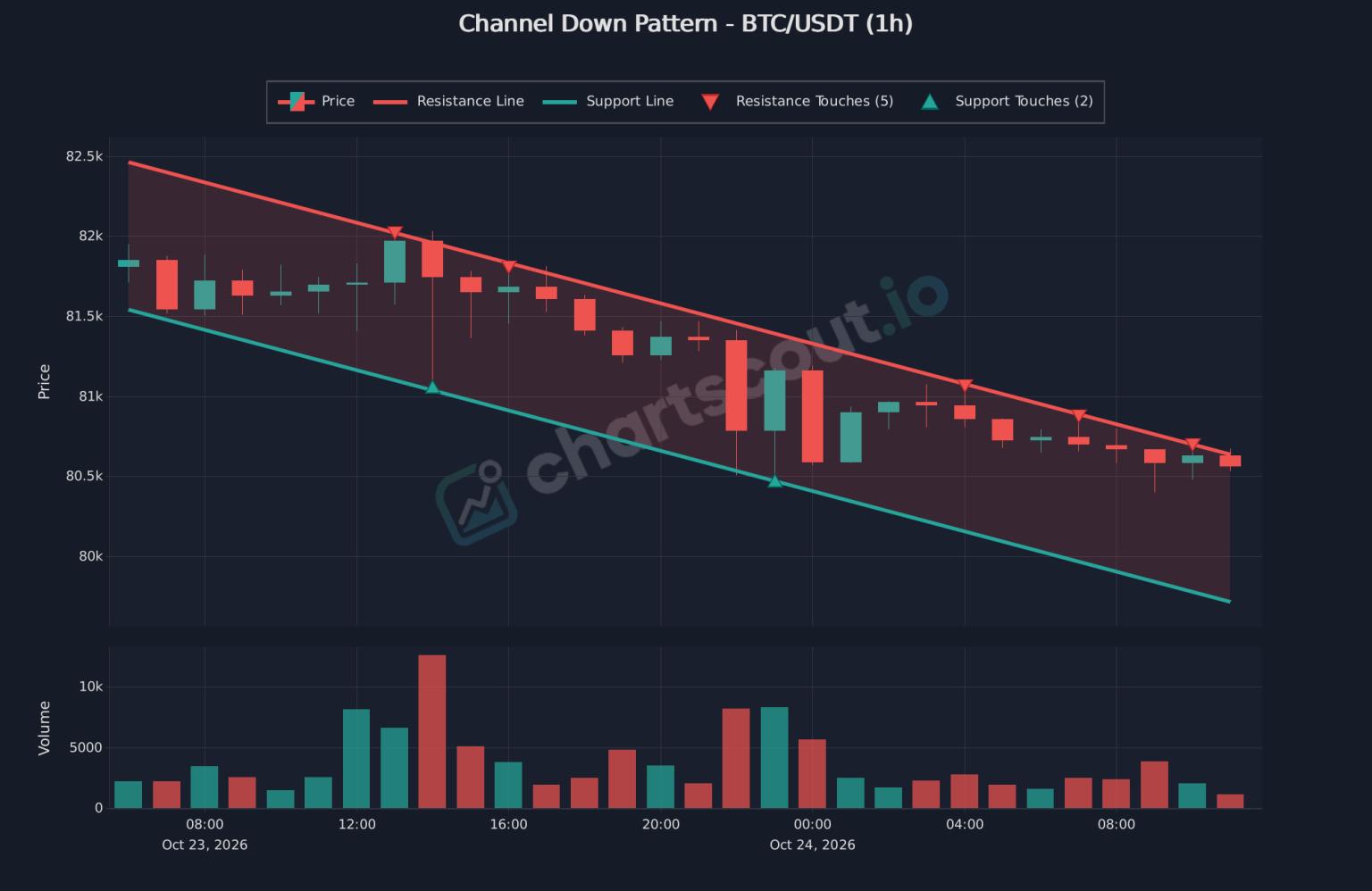
Price has been stepping down inside a descending channel for about a day. Resistance has been tested 5 times and the lower line only 2, so the upper boundary has been the more respected side. Price is back at the top line again near 80.6k, while the lower line is down around the 77–78k area.
Volume was heaviest on the big red candles and has faded during the recent grind lower. I'm not sure how much to read into that.
I'm watching two things:
- A hourly close above the upper line, which would suggest the channel is failing.
- A rejection here, which would keep the lower-high structure intact.
Curious how others read it. Do you treat a channel with this few support touches as reliable, or wait for more confirmation?
Every eth project i own needs the ENTIRE nft market to come back for me to break even. could be years. the doginal dogs setup is different, the floor is in doge, doge is beaten down near yearly lows, floor already making new highs in doge terms. so it just needs doge to recover, not the whole nft space. i dont love admitting a meme coin nft has the cleanest setup in my portfolio but here we are
Disclosure: I’m the creator of MELON ($MELON), a live Solana meme token on Pump.fun. This is a promotional founder update, not independent coverage.
I’m trying a small creative experiment: build a recurring comic character people can contribute jokes to, without requiring anyone to buy or hold tokens. MELON’s visual identity is a watermelon in sunglasses and a keffiyeh, inspired by Palestinian culture. The attached first comic turns our $0 promotion budget into the joke.
The experiment has three parts:
• A caption prompt: give the mascot a ridiculous day job.
• Turn interesting suggestions into later comics, crediting contributors only with their permission.
• Share a weekly recap of what we made and what people actually responded to.
For this test I’m measuring distinct people who contribute a caption, original meme submissions, and people who return to the conversation. I’m not treating holder counts, trading volume, or token price as evidence that a community is healthy.
What I don’t know yet: whether people enjoy the character enough to return, or whether the joke only works once. No claim that participation or artwork creates token value. No promised returns, listings, or charitable donations. Meme coins are speculative and can lose all their value.
If you’ve built a small creative community around a token, which activity brought people back without financial incentives? Specific failures are useful too.