r/AncientCoins • • 13h ago

Advice Needed Advice on Breaking slabs

Post image
21 Upvotes

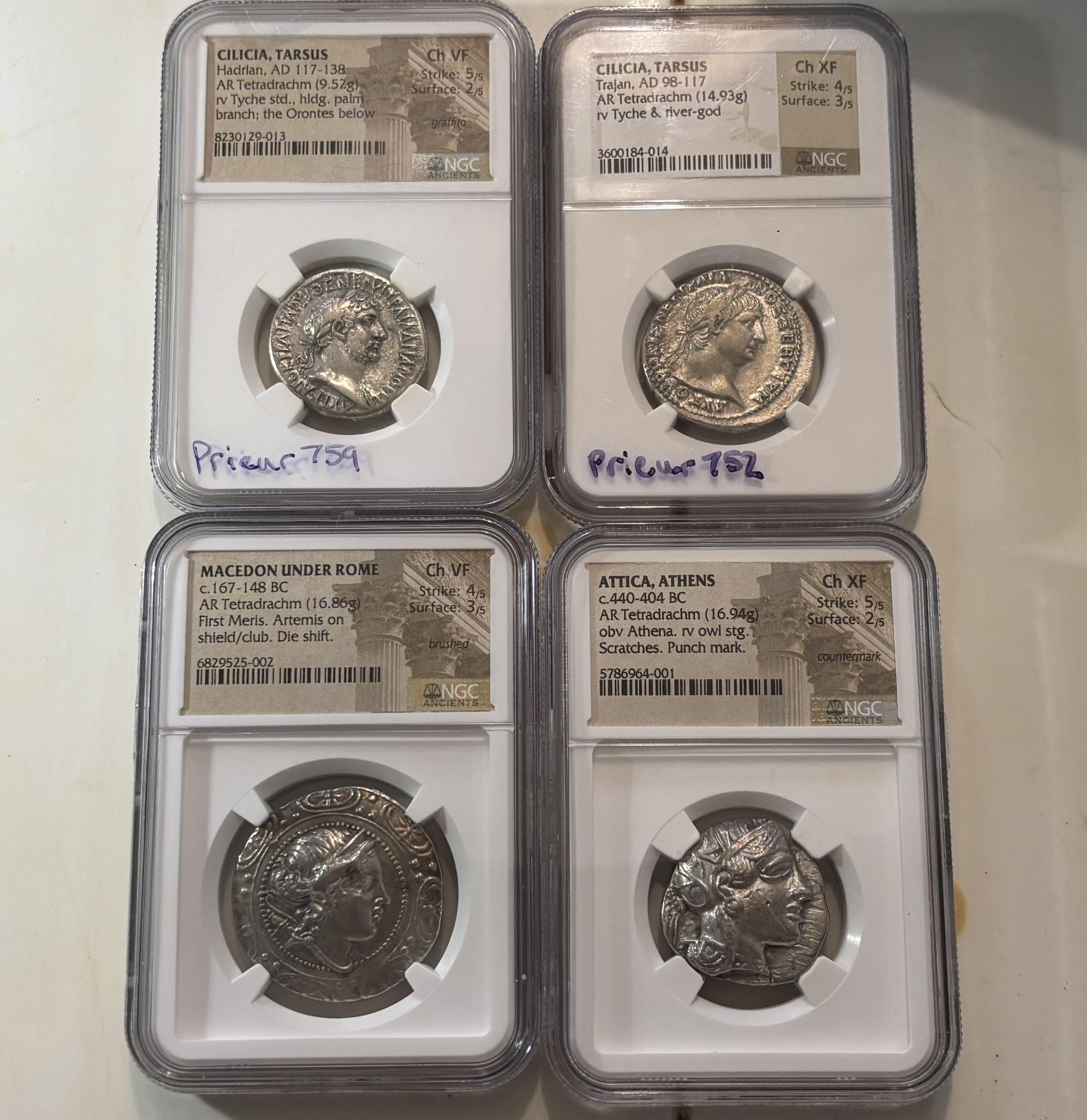
Hey guys, I’ve got a small collection of loose tetras and man, I can see the appeal of being able to take them out of the sleeve, hold em, and view them up close. Now, I have a couple of slabbed tetras from before when I first started that I’ve been highly debating freeing them from the slabs. Is there any ways that I can remove them without smashing the slab with a hammer? Or is that the only way? Any advice is appreciated! Also the bottom two are thicker, I assume that really doesn’t make a difference?


r/AncientCoins • • 6h ago Bravo

Newly Acquired Achaemenid Ultra Rarity: Obverse Die Match Across Metals on Carradice Type III Daric and Siglos

Post image
71 Upvotes

Have you ever had one of those days where someone told you about a phenomena in numismatics that should exist based on what we know, but we've never seen examples of it? I remember Harlan Berk telling me about a particular Lydian Croesus denomination that he strongly suspected did exist but hadn't seen and the feeling he felt when one finally came out of a private collection and hit the market.

That's what happened here. Professor Ian Carradice had long hypothesized that Imperial Achaemenid coins both Darics and Sigloi were likely struck with the same dies from Type II onwards given their similarities, but never found a match pair he could publish. I found this cross metal die match one a few months ago at two completely different points of sale. The Daric at an auction house, the siglos on eBay.

For folks that don't collect Imperial Achaemenid coins, let me explain why this is so hard to mentally accept holding in my hand tonight. This is what happened to these coins. Think about the odds at each step.

- They were minted at the same location using the same obverse die approximately 2,400 years ago. The mint run would have been thousands of coins. They would have likely just moved from finishing producing the gold darics and the mint workers pushed on using the same die for the silver siglos here, before the die eventually broke.

- The two coins, part of the same mint run, could have been separated as soon as days after their production, depending on where the gold and silver needed to be spent.

- The two coins now likely departed on completely different economic paths. The daric infinitely less worn as it was used in higher value transactions or even just as a prized gift from the Great King himself. The siglos had a harder life, through commerce as you can see it is considerably more worn.

- Both coins then almost definitely separated, suffered through 2,400 years of floods, storms, wars, famine, disease, and redrawing of borders that felt like forever.

- After each was re-discovered, regardless of when they were re-discovered, the person that found them resisted the temptation to melt them for bullion or to restrike them in the coinage of another empire.

- Each coin then re-enters the stream of modern commerce as a piece of numismatic history. Each coin separately is owned likely by multiple people over potentially centuries, with lost provenance along the way that cannot be re-traced.

- Each coin then is handled by a numismatist who attempts to re-sell it in the year 2026.

- A certified moron like me, identifies each independently, match them and luckily, win both.

- They survive being shipped to my doorstep, where they are reunited under the same roof, perhaps after as much as 2,400 years of being apart.

Guys, I don't know what to tell you. The odds of that happening, in my mind, are incalculable. A few million to one? Much more? I don't know. I'd leave that for Warren Esty to say next time I see him.

The feeling? The satisfaction? Impossible to articulate in words because it shouldn't be possible.

Note: For any skeptics, it's a confirmed die match. When superimposed their key details line up perfectly. I use software I designed myself to do this. When struck on gold and silver with the same die, certain variations like striking angle at the time of minting and photography lighting make them feel that they are not, like that right side of the V in the middle of the robe, but they are in-fact a match.


r/AncientCoins • • 6h ago

Authentication Request Is my pontius Pilate coin fake?

Thumbnail
gallery
6 Upvotes

Hey, bought this coin from my local coin shop for 70$. Assumed it was real. As I was looking on eBay I see another coin with extremely similar strike, wear, and patterning. Are both of ours fakes? At least I’m pretty sure they look identical to me. Thank you.


r/AncientCoins • • 6h ago

Newly Acquired Eukratides Drachm

16 Upvotes

This came in just in time for my birthday! My first Bactrian coin, it looks like he received a black eye but still a nice looking piece!

Bactria
Eukratides I
170-145 BC
Silver Drachm
4.15 grams, 19 mm
Diademed head of Eukratides right.
Dioscouri galloping right, each with a spear and palm branch, monogram to lower right. "ΒΑΣΙΛΕΩΣ ΕΥΚΡΑΤΙΔΟΥ"
Bop 2D


r/AncientCoins • • 8h ago

ID / Attribution Request Alexander Tetradrachma in Poor condition ID help

Thumbnail
gallery
3 Upvotes

Hi all, I posted this a while back but I have a camera made of a potato at the best of time so reposting with some marginally better photographs.

Purchased at the Missouri Numismatic Society annual show and it is my first tetra. The dealer said it was posthumous but I was wondering if anyone knew if it was possible to ID given it's condition is so poor, especially on the reverse. Looks like to me the back had some nasty horn silver at some point

Any help is appreciated!


r/AncientCoins • • 10h ago

ID / Attribution Request Anybody know what this might be?

Thumbnail
gallery
3 Upvotes

Looks Greek but I’m at a loss trying to identify it.


r/AncientCoins • • 14h ago

Advice Needed Roman coins

Post image
11 Upvotes

I got these coins from arena club and im getting conflicting results on their worth. Any help would be much appreciated.

i also have 36 others of lower value if anyone would be interested in looking at.


r/AncientCoins • • 15h ago

Constantine Nummus

Thumbnail
gallery
17 Upvotes

Minted in London


r/AncientCoins • • 15h ago

Not My Own Coin(s) Share your favourite ancient coin, best example!

Thumbnail
gallery
97 Upvotes

I want see your favourite coins, preferably in gold, and its best example/specimen. Mostly for my own amusement and education purpose. I'm building an ancient gold coins catalogue and I would hate to miss out on beautiful types.

Here are some of mine, hope you'll like them.


r/AncientCoins • • 16h ago

Newly Acquired Leo I Tremissis

Post image
19 Upvotes

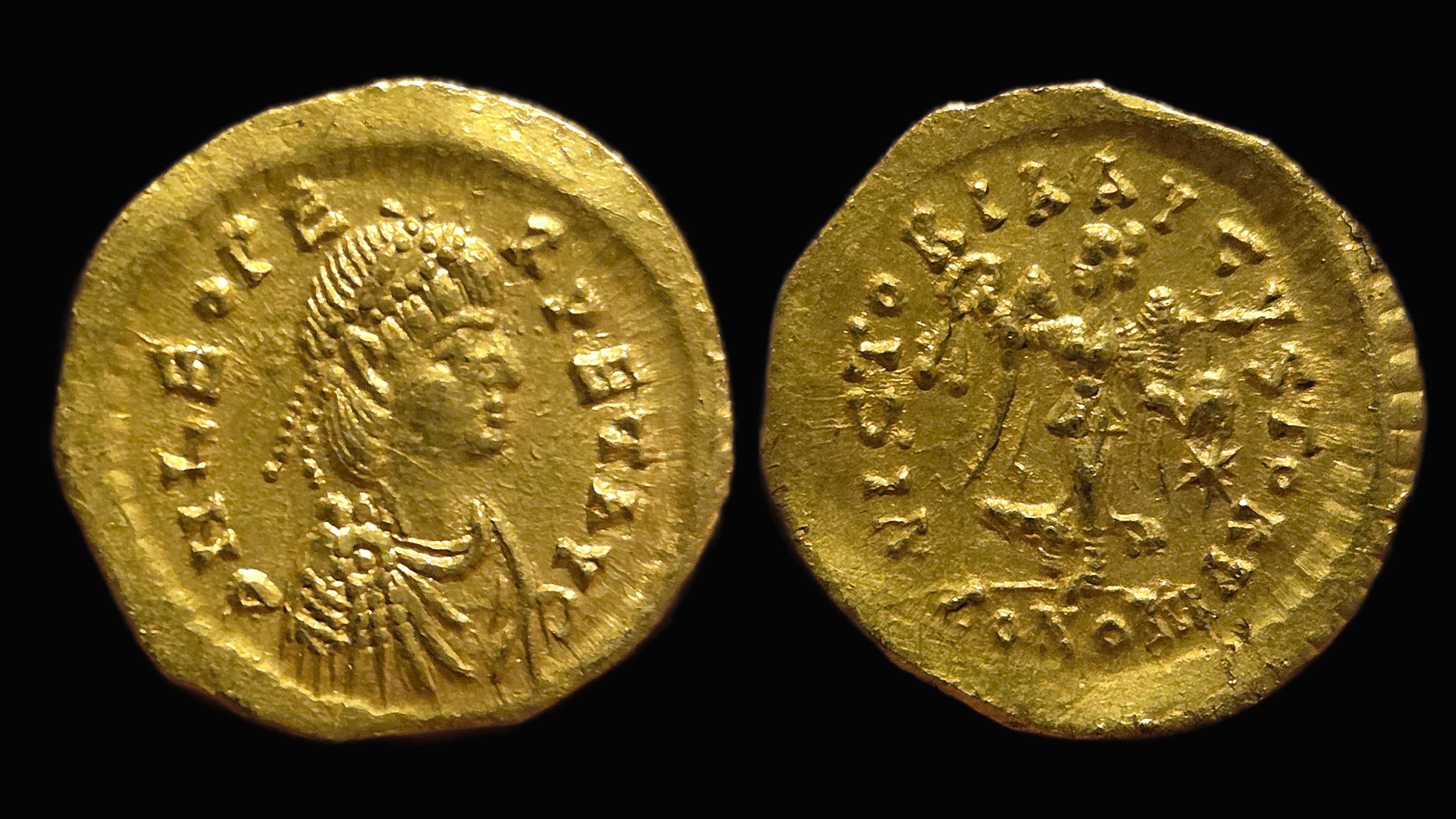
Got mail! Leo I Tremissis, won at the latest eLive Premium Künker Auction 449, lot 4270,

1.49 g

14.8 mm

RIC 611

My first ever win on an auction :)


r/AncientCoins • • 19h ago

Enigmatic Caesar Denarius Minted for African Campaign

Post image
25 Upvotes

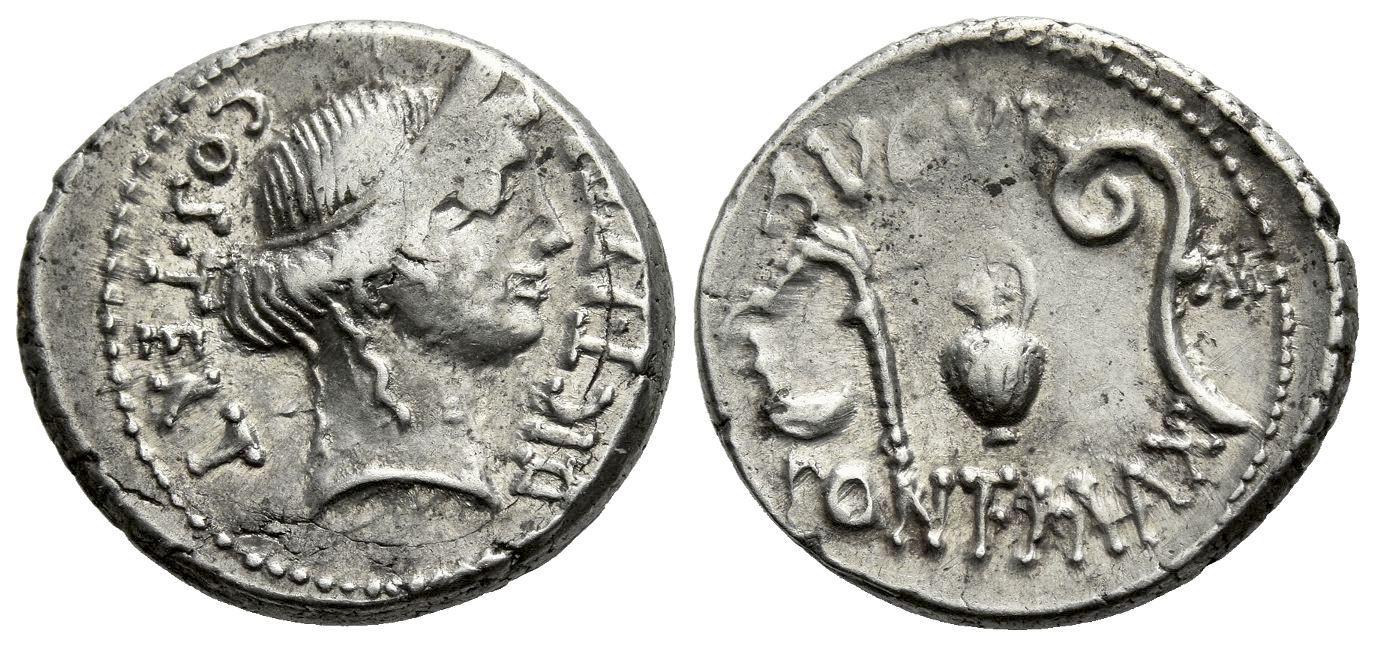
The obverse of the coin depicts the head of Ceres facing right with the inscriptions COS-TERT and DICT-ITER surrounding. The reverse depicts four priestly implements: the simpulum, aspergillum, capis, and lituus. AVGVR is inscribed above and PONT-MAX is below. Letter M in the right field. Syd 1024; Crawford 476/1b. Struck 46 BCE. Ex. Naville Numismatics.

BTW, anyone have an opinion on what a fair grade and market value of this coin would be? Feel free to drop your thoughts down below.

Julius Caesar began his African campaign, one of the last chapters of his civil war, to suppress remaining Optimates resistance after the assassination of Pompey in December of 47 BCE. The above issue was an extremely important coin struck for the purpose of this campaign.

Religious significance

Caesar relied heavily on religious propaganda to support his political authority. He was the first Roman to hold the offices of pontifex maximus and augur at the same time. On this issue, the lituus represents his authority as augur, while the simpulum, aspergillum, and capis represent his authority as pontifex maximus, the chief religious authority of the Roman Republic. A gold coin struck under Aulus Hirtius in Rome in 46 BCE (Crawford 466) has a similar reverse of priestly implements. The two types acted as a coordinated effort that year to advertise Caesar's supreme religious authority. Priestly implements continued to appear on coinage issued by Caesar every year from 49 BCE until his death in 44 BCE. This marks the importance he placed on his priesthoods and shows how tightly religious authority was intertwined with political legitimacy and power in the Roman Republic (Cody, pp. 294-295).

Dating the issue

This issue was struck in 46 BCE. On the obverse, COS TERT represents Caesar's third consulship, which began in January of 46 BCE. DICT ITER represents his second dictatorship, which began in October of 48 BCE and ended in October of 47 BCE. Curiously, the moneyer kept Caesar's title as dictator even though his time in that office had officially elapsed. This is likely explained as a way to keep broadcasting a past honor than as a minting mistake. Caesar was declared dictator for the third time after his victory at Thapsus in April of 46 BCE. Coins struck after this point inscribe DICT TERT, placing the issue before his third dictatorship. Scholars date the issue to between January and mid-April of 46 BCE, with mid-April allowing time for news of the victory to reach the mint (Woytek 2003, p. 249).

Location of the mint

The location of the mint is still somewhat uncertain. Although the issue was certainly struck during Caesar's African campaigns, no hard numismatic evidence or coin hoards definitively prove where (Crawford 1974, p. 478). Some sources place the mint in Africa, possibly at Utica, based on the known timeline of Caesar's movements there. However, this assumption relies on the conventional explanation that the issue was a triumphal type distributed among Caesar's victorious troops after Thapsus, which modern scholarship heavily disputes. That explanation rests on reading the "D" and "M" marks on the reverse as marking the coins as donative and triumphal gifts, as discussed below. The theory is highly unlikely, though not impossible, and without it the case for an African mint weakens.

Attributing the mint to Utica specifically is even more implausible on timing. Caesar gained control of the city only after his victory at Thapsus, and he was declared dictator for the third time shortly afterward. It is highly unlikely that so many coins, as evidenced by hoards and die counts, could be struck in the short period between the battle and his proclamation as dictator tertium.

The inscription points the same way. The coin carries Caesar's full titles rather than simply CAESAR (Crawford 1974, p. 93), while coins struck under his direct authority were often signed with his name. It was therefore likely struck not by a mobile military mint moving with Caesar, but by an official away from the battlefield (Woytek 2003, p. 249). The issue also omits the moneyer's name, unlike Hirtius, who put his initials on the coins he issued in Rome. This sets it apart from the normal layout of Rome issues and ties it more specifically to Caesar's African campaign as a special issue meant for military circulation.

If the conventional argument is set aside, the issue is better understood as struck by an official for Caesar in early 46 BCE to finance the African campaigns. Woytek proposes Sicily, an important staging ground for those campaigns. Instead of Africa, the obverse bust of Ceres can then be reinterpreted as linked to Sicily, also a well-known breadbasket of the Roman Republic (Woytek 2003, p. 253).

The "M" and "D" enigma

This coin has the control mark "M" on the reverse, but another type of the issue has the mark "D" on the right of the reverse. The "D" type is much more common, appearing at roughly a 2:1 ratio among surviving coins (Woytek 2012, p. 94). Die studies link the same obverse die to both reverse types, so both must have been produced at the same mint. Why, then, have two different marks for coins coming out of one mint?

The conventional theory is that the letters abbreviate Donativum and Munus, assigning the coins for distribution to soldiers and to the public as a whole, respectively. This theory is highly unlikely, though not impossible. It has little supporting evidence, and no other coin of this period is marked with its intended use. Instead, from differences in artistic style and the spatial distribution of the engraving, Woytek concludes that the letters are signatures of two different die engravers (Woytek 2012, p. 95). This also has few known parallels in Roman Republican coinage, and some scholars reject it as well. In 2012, Crawford disagreed with Woytek and argued that the letters were standard mint control marks (Crawford 2012, p. 341). Numismatic scholarship has not conclusively resolved the question.

In summary

The coin was likely struck between January and mid-April of 46 BCE to finance Caesar's war in Africa. Crawford 458 was likely minted in the East between 48 and 46 BCE and Crawford 457, minted in 47 BCE, is very scarce, so this issue likely provided the largest silver financing of the campaign (Crawford 2012, p. 341). The two types, distinguished by the reverse "D" and "M", were likely engraved by two different die engravers who added the letters as either signatures or mint control marks. Rather than being struck under Caesar's direct authority in Africa, the issue may have been struck by a moneyer stationed in Sicily and assigned to supply coins for Caesar's army on campaign.

r/AncientCoins • • 20h ago

Newly Acquired Kingdom of Macedon, Alexander the Great Drachm (posthumous)

Thumbnail
gallery
63 Upvotes

Hi everyone!
I just got this drachm from a small auction in Europe. If I’m not mistaken, it was minted at the Abydos mint (Price 1577). It has some beautiful toning and is in fairly high grade. Although these aren't rare, they are surprisingly difficult to find with iridescent toning.


r/AncientCoins • • 20h ago

Newly Acquired Mail day! The last Severan, and yet, the first in my collection.

122 Upvotes

Shout out to Gert Boersema, fastest shipping in the west.


r/AncientCoins • • 1h ago

From My Collection Celtic Britain Dobunni Silver Unit

Thumbnail
gallery
2 Upvotes

Whilst being not the rarest or most expensive in my collection, this Corio coin minted in southwest UK around 10-20BC has fulfilled a huge desire in my collecting journey - it was found around 4 miles from my house in an area I’ve hiked my whole life by a tribe whose ancestry I share.

Cotswold Eagle Head B / Corio Head Class B
Composition: Silver
Weight: 0.92 g
Diameter: 13.6 mm

Reverse
Triple-tailed annulate horse left, linear mane, front legs disjointed. Stylised bird's head (eagle) and wheel above. Wheel in front. Three-to-five-petalled flower below.

Obverse
Stylised moon head right, ring eye, stalk lips, large boss on chin, pelleted crescents for hair, headband. S-shapes with irregular pellets in front.

I would love to see any other Dobunni/British Celtic coins in your guys collection!


r/AncientCoins • • 21h ago

Newly Acquired My first roman emperor, Diocletianus

Thumbnail
gallery
18 Upvotes

My first authentic coin. Very interesting emperor and not too much hype around him.