r/Assembly_language • u/OliveScott200 • 18h ago
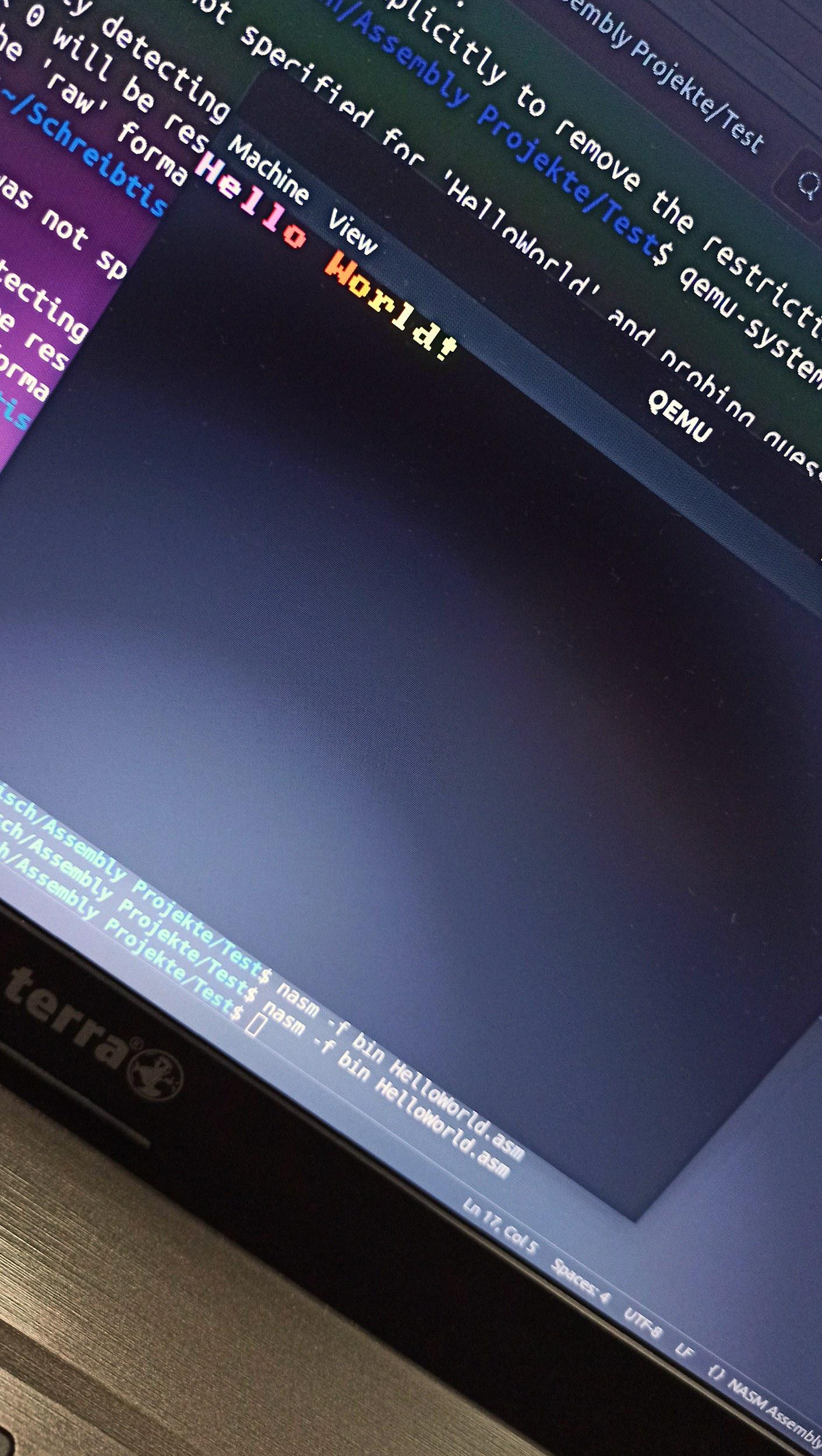
Project show-off Did my first Rainbow Hello World in pure x86 asm!
15
Upvotes
r/Assembly_language • u/OliveScott200 • 18h ago
r/Assembly_language • u/thecodegangster • 8h ago
r/Assembly_language • u/idkilikephilosophy • 1d ago
If you hadnt heard i made a post on whether i should learn assembly, and im honestly gonna do it
Im coming from c# and im already learning some shit, its interesting to see how a computer works in the background but its unbelievably complicated, it would be nice to create a project in assembly like a OS or custom language which i only dream of in the process, (for that i shouldve probably learnt C but assembly is harder which is why i did this)
Heres some questions:
What is the optimal way for learning assembly?
What use cases did you use assembly for?
Was it worth it?
r/Assembly_language • u/tinymoat • 1d ago
Hello, I recently decided to start learning assembly by programming the game boy advance. Most of the information about programming the gba I've found are for C programming so I'm trying to learn assembly by translating them to assembly. I'm specifically following the tonc turorials, with a development environment I mostly copied from the gba-bootstrap repository.
I got the first example from the tonc tutorial running on mgba (a gba emulator), but I did it with a unity build. The tonc book strongly advises against this and instead recommends you assemble the files separately and link them together instead.
Right now my working code looks something like this (shortened for brevity):
// src/header.s
// copied almost verbetim from gba-bootstrap

    .section .gba_crt0, "ax"
    .global entrypoint
    .cpu arm7tdmi

    .arm

entrypoint:
    /*
     * gba header boilerplate
     * initialize the cpu and switch to thumb mode
     */
    bl  main

    // If main returns, reboot GBA using SoftReset
    swi  #0x00


// src/main.s

.include "src/header.s"

.section	.text
.global		main

main:
    /*
     * Draw colors on the screen
     */

    // while(1)
1:
    b    1b

    // unreachable
    bx   lr
Here's the Makefile in it's entirety because I suspect the problem is there:
NAME		:= main
GAME_TITLE	:= "GBA_TEMPLATE"
GAME_CODE	:= "00"

UNAME_S		:= $(shell uname -s)
MAKEFLAGS += --no-print-directory

PREFIX		:= arm-none-eabi-
AS		:= $(PREFIX)as
LD		:= $(PREFIX)ld
CC		:= $(PREFIX)gcc
CXX		:= $(PREFIX)g++
OBJDUMP		:= $(PREFIX)objdump
OBJCOPY		:= $(PREFIX)objcopy
MKDIR		:= mkdir
RM		:= rm -rf

ELF	:= $(NAME).elf
ROM	:= $(NAME).gba
MAP	:= $(NAME).map

GBAFIX	:= gbafix/gbafix

ASFLAGS		:= -x assembler-with-cpp \
		   -mthumb -mthumb-interwork \
		   -ffunction-sections -fdata-sections

LDFLAGS		:= -mthumb -mthumb-interwork \
		   -Wl,-Map,$(MAP) -Wl,--gc-sections \
		   -specs=nano.specs -T src/gba.ld \


SOURCEDIR	:= src
BUILDDIR	:= build

SOURCES		:= $(wildcard $(SOURCEDIR)/*.s $(SOURCEDIR)/**/*.s)
OBJS		:= $(patsubst $(SOURCEDIR)/%.s,$(BUILDDIR)/%.s.o,$(SOURCES))

$(BUILDDIR)/%.s.o : $(SOURCEDIR)/%.s
	@echo "	AS	$<"
	@$(MKDIR) -p $(BUILDDIR)
	@$(CC) $(ASFLAGS) -MMD -MP -c -g -o $@ $<


$(ROM) : $(ELF) $(GBAFIX)
	@$(OBJCOPY) -O binary $< $@
	@echo "	GBAFIX	$@"
	@$(GBAFIX) $@ -t$(GAME_TITLE) -c$(GAME_CODE)

$(ELF) : $(OBJS) src/gba.ld
	@echo "	LD	$@"
	@$(CC) -o $@ $(BUILDDIR)/main.s.o $(LDFLAGS)
	@#$(CC) -o $@ $(OBJS) $(LDFLAGS)	#DOESN'T WORK

$(GBAFIX) : gbafix/gbafix.c
	@echo "	building GBAFIX"
	@cd gbafix && make

.PHONEY: clean dump

clean:
	@echo "	clean"
	@$(RM) $(ROM) $(ELF) $(MAP) $(BUILDDIR)
	@cd gbafix && make clean

dump: $(ELF)
	@$(OBJDUMP) -S $(ELF)

ifeq ($(UNAME_S), Darwin)

.PHONEY: run
run: $(ROM)
	@echo "	RUNNING	$(ROM)"
	@open -a "mgba" $(ROM)

endif
The linker script is copied verbatim from gba-bootstrap because I don't really understand linkers.
When I switch to linking together all the object files and don't include header in main I still get a main.gba file that runs in the emulator, but it doesn't run the code at my main label.
I don't know if I'm doing something wrong with assembly or if this is a game boy specific problem. What confuses me though is when I objdump my linked file I see the bl main call from the header file has the same address as where my main label ended up.
Any help at all with this would be appreciated! Thanks
r/Assembly_language • u/c-cul • 2d ago
r/Assembly_language • u/idkilikephilosophy • 5d ago
Im learning assembly because of shits and giggles, i have no serious background and im a beginner.
Heres some questions:
r/Assembly_language • u/Thejuzzz • 5d ago
I know modern assemblers don't care whitespace and this comes down to redabality and the style.
In almost EVERY assembly code I've seen, the format is label at col 0 (every label) and the instructions are nested to the label. Local labels coming in? Still at col 0.
Like, compare these codes:
# size_t strlen(const char *str)
.global strlen
.type strlen,
strlen:
    # %rdi: const char *str

    xorq        %rax, %rax
    movq        %rdi, %rsi

    1:
        cmpb        $0x00, (%rsi)
        je          2f

        incq        %rax
        incq        %rsi
        jmp         1b
    2:
        ret
And this
# size_t strlen(const char *str)
.global strlen
.type strlen,

strlen:
# %rdi: const char *str

    xorq        %rax, %rax
    movq        %rdi, %rsi

1:
    cmpb        $0x00, (%rsi)
    je          2f

    incq        %rax
    incq        %rsi
    jmp         1b
2:
    ret
For me, the indented version seems waaaayyy better. Like, it's easy to manage.
However, still I am not advanced assembly programmer and hadn't coded large codebases in assembly, so... I am not sure which is better.
Which is ACTUALLY BETTER? All at 0 or INDENDED for loops and sub tasks for a label???
r/Assembly_language • u/No_feeer_Nordik • 5d ago
Hi everyone! I am back two Assembly after three decades and I would appreciate some input. At the time, I programmed x86 using TASM in a DOS environment for finance (valuation of derivatives when that was a thing...). I never programmed in a windows environment nor in an ARM CPU. Now in my first attempt to catch up, I am reading a book called "Programming from the ground up" which I like very much but the syntax used is AT&T. I didn't even know there was such a thing...Bottomline: what should I take into account when deciding what syntax to use? I work with macOS, Windows and Linux. What I'm looking for is to be able to program in a "modern" assembly that works in contemporary x86 CPUs with Windows or linux and maybe later, learn ARM assembly. Any suggestion regarding the path I should take to is welcome. Thanks!
r/Assembly_language • u/LabAdministrative760 • 5d ago
Assembly x86_32 no Linux: Leitura de String, Buffer e Limpeza de Overflow (NASM)
r/Assembly_language • u/Background_Shift5408 • 7d ago

r/Assembly_language • u/flickerflak • 10d ago
r/Assembly_language • u/DeltaSucksAtMC • 10d ago
Hey guys, should I learn ASM? I have pretty decent skill in c and c++, im better at memory stuff then complex math, and I wrote a basic malloc using windows and linux ram allocator.
r/Assembly_language • u/Adorable_Crazy_7281 • 10d ago
I am looking specifically for something like Geekforgeeks or Sololearning. Obviously for assembly it would be a more niche one but you get the idea. If its a book it would be okay too. Also can assembly be useful for cyber security/ red teaming since its attacking the base code of it all?
r/Assembly_language • u/-Ahsa- • 10d ago
Estoy queriendo aprender assembly pero no se por donde empezar ni que deberia de hacer para practicarlo (que instalar o que pagina ir para aprenderlo), alguna recomendacion? Gracias
r/Assembly_language • u/Hefty_Brother_5886 • 10d ago
Lo que dice el título, busco una forma de ganarme la vida.
r/Assembly_language • u/Mindless-Item-5136 • 10d ago
// Multiplies R0 and R1 and stores the result in R2. // (R0, R1, R2 refer to RAM[0], RAM[1], and RAM[2], respectively.) // The algorithm is based on repetitive addition.
@R0
D=M
@10
M=D  // counter

@R2
D=0
M=0
(START) @10 D=M @END D;JLE // end the loop if counter <= 0
// R1 + R2
@R1
D=M
@R2
D=D+M
@R2
M=D // current result

@10
D=M
M=D-1

// jump back to the loop start for new iteration
@START
0;JMP
(END) @END 0;JMP
r/Assembly_language • • 11d ago
I’m not good at assembly but I want to learn it and have been trying to make a program with it. The program is just supposed to square a number (read user input, multiply the input with itself, and print the result).
I’m on Linux and have no idea how to fully accomplish this. My biggest struggle is figuring out how to multiply the user input and work it into a write syscall. Help would be appreciated.
r/Assembly_language • u/Educational_Bed6462 • 11d ago
My goal is to go through the strenuous journey of creating an entire operating system within x86 assembly, no higher level of programming language; just assembly.
This started as a hobby when I learned C a year back and ended up branching off and learning more about how C compiled to assembly and I have been doing handwritten compilation attempts of C on paper. This has ranged from typical notebook activity to as far as writing down these sequences of programming on spare receipt paper at my job during dead times on a shift. From time to time as my knowledge is practiced or when it drifts out of practice, I may tend to write out the opcodes in hexadecimal then write it additionally in binary just to feel a little bit less bored.
I ended up watching a few YouTube videos for being able to form something greater with the little bit of assembly and computing knowledge I have, and learned how to make my first boot loader with netwide assembler and QEMU!

I do not have an incredible amount of knowledge in assembly despite my description of what I do in my free time, and so I ask; where can I look to find more resources or "hidden-gems" of knowledge regarding OS development?
Thanks!
r/Assembly_language • u/Main-Message2031 • 13d ago

Im raw dogging assembly
No python or some beta shi
Im going to do it like our forefathers
Wish me luck or dont
I will succeed either way.
EDIT: I am suppriesd at the positive support and helpful messages from this community. And now i carey your spirits to succeed i wont let you guys and your expectations down. Most importantly I wont betray myself.
r/Assembly_language • u/Stock_Test2326 • 12d ago
I'm interested in learning assembly language purely out of curiosity and for the love of understanding how computers actually work beneath the software layer.
I have some basic Python programming knowledge, but I don't know C, C++ (learnt bare basic CPP recently to read a book but I won't consider it), or any assembly. I'm not looking to rush into systems programming or make this a career requirement. I want to explore it as a long-term learning hobby, understand how CPUs execute instructions, how memory and registers work, and eventually get comfortable reading and writing assembly.
I'm using an Apple Silicon Mac (M4 Pro), so I'm particularly interested in learning ARM64/AArch64 assembly, although I'm open to understanding x86-64 as well if there's a good reason to learn it.
I'd appreciate recommendations in three categories:
1. YouTube tutorials / video courses
2. Books
3. Tools, emulators and development environments
I'm particularly interested in experimenting in an isolated environment. I don't want to accidentally damage my Mac or mess with its operating system while learning.
One more thing: Would you recommend learning some C before starting assembly, or is it perfectly reasonable to learn assembly directly and pick up C concepts along the way?
I'm not looking for a shortcut. I want to understand the machine from the ground up.
Any recommendations, learning paths, books, channels or personal experiences would be greatly appreciated.
Thanks 🫡
UPDATE: Does anyone have a roadmap to this.
UPDATE 2: Other Posts & replies in this sub reg same which I find interesting. ay update with more links as I find them
[If your memory was WIPED, how would you re-learn x86 assembly?](https://www.reddit.com/r/Assembly_language/comments/1rlq6ux/if_your_memory_was_wiped_how_would_you_relearn/)
https://www.reddit.com/r/Assembly_language/comments/1rx5cyi/where_can_i_learn_x8664_assembly/
Try Jeff Duntemann's Assembly Language Step by Step.
I learned from Ray Seyfarth's book on Windows/Linux assembly. It's pretty good, but you'll need the install the ebe IDE if you want to get the most out of it
[For those starting to learn Assembly - step-by-step, how to create a flight simulator for DOS](https://www.reddit.com/r/Assembly_language/comments/1wxda05/for_those_starting_to_learn_assembly/)
I recommend Usborne's children's book: Machine Code for Beginners, which teaches you 6502 and Z80 machine code. These are simple 8-bit CPUs used in most of the micro computers of the 80's.
This is how most people have learned machine code, when you understand the simple principles here, you can move on to your desired architecture.
Machine Code for Beginners
____
https://learnxinyminutes.com/docs/mips/
https://uweb.engr.arizona.edu/~ece369/Resources/spim/QtSPIM_examples.pdf
____
https://github.com/mschwartz/assembly-tutorial
___
https://www.felixcloutier.com/x86/
____
[I'm looking for a high level overview as to how Object Oriented Programming is "implemented"](https://www.reddit.com/r/Assembly_language/comments/1x5f916/im_looking_for_a_high_level_overview_as_to_how/)
____________
3. These are tools worth investigating eventually:
| Tool | Purpose |
|---|---|
| GNU Assembler (GAS) | Assemble programs |
| LLDB | Inspect registers, memory and execution |
| QEMU | Emulate different architectures |
| Ghidra | Disassemble and analyse binaries |
| Compiler Explorer | See how C/C++ becomes assembly |
| Ripes | Visually understand CPU execution |
| Order | Book | Purpose and when to study |
|---|---|---|
| 6 | Practical Reverse Engineering | Connect assembly, debugging, operating systems and reverse-engineering workflows. |
| 7 | Reverse Engineering for Beginners | Free online resource for assembly, compilers, calling conventions and program behaviour across architectures. |
| 8 | Practical Binary Analysis | Executable formats, binary instrumentation, analysis tools and program behaviour at the binary level. |
| Order | Book | Purpose and when to study |
|---|---|---|
| 9 | Practical Malware Analysis | Malware-analysis methods and practical investigation in an isolated lab. Some examples and tools are dated. |
| 10 | The Shellcoder's Handbook | Advanced exploitation concepts. Study after memory, assembly and operating systems. Older techniques need comparison with modern mitigations. |
r/Assembly_language • u/gandalf458 • 12d ago
Having nothing better to do recently, I developed a simple assembly language and an online playground for it. If anyone fancies having a play, please do: https://www.compassion-in-business.co.uk/learning/assembler.php
r/Assembly_language • u/Fragrant-Contract415 • 12d ago
I consider myself as slightly above from beginner. I can read assembly instructions fairly. My main motive was to learn how executables run under the hood from the perspective of cybersecurity. I did some crackmes challenges. They were easy to solve upto where anti-debugging, control-flow flattening, opaque predicates, api hashing, and more upto 1-3 difficulty rated. I got to know about packers and virtual instructions. I learned how packers operate to minimize the .exe size. I built my toy packer also which just compresses and stores the main executable sections with custom name. Forget about UPX, AsPACK, MEW11, i am unable to unpack even my own packer. Is this skill issue or do someone really gets stuck in this section ? I need some guidance, the last time i unpacked was upx after watching some youtube video because i was supposed to put breakpoint to tail jump... Suggestions are kindly welcomed.
r/Assembly_language • u/ericnantel2 • 13d ago
r/Assembly_language • u/Key-Kangaroo3336 • 12d ago
Hello everyone!
I am currently working on a side project where a python script takes a C source file and converts it into ASMx86_64 (Intel syntax) and I am just trying to find resources for type conversions without making some kind of script where I automate generating a program and compiling it for ASM in GCC.
Does a list like this exist? And if so, are there separate ones for Windows and Linux? (As I think there’s a difference, not completely sure)
Thanks, have a good one frens
r/Assembly_language • u/TechHavenStudios • 13d ago
Hi everyone!
I’d like to introduce Tech Haven Studios, an independent software development studio where I’m working on several technology projects.
Our current projects include:
HavenDOS
A 32-bit operating system developed in C and x86 Assembly. It’s one of our main development projects.
MorrowOS
A desktop operating system project focused on creating a different desktop computing experience.
HavenAI
An experimental AI development project.
I’m building these projects independently and documenting the development process along the way.
I’m interested in connecting with other developers, operating system enthusiasts and people interested in independent software development.
I’d appreciate honest feedback, technical discussions and potential collaboration.
Website: https://techhavenstudios.lovable.app
Thanks for checking out the project!
Posted by the developer behind Tech Haven Studios.