r/Astronomy • Astronomer • 7d ago

Astro Art (OC) Transit method for detecting exoplanets
Post image

I made this several years back, but thought folks here might find it interesting (if you haven't seen it before).

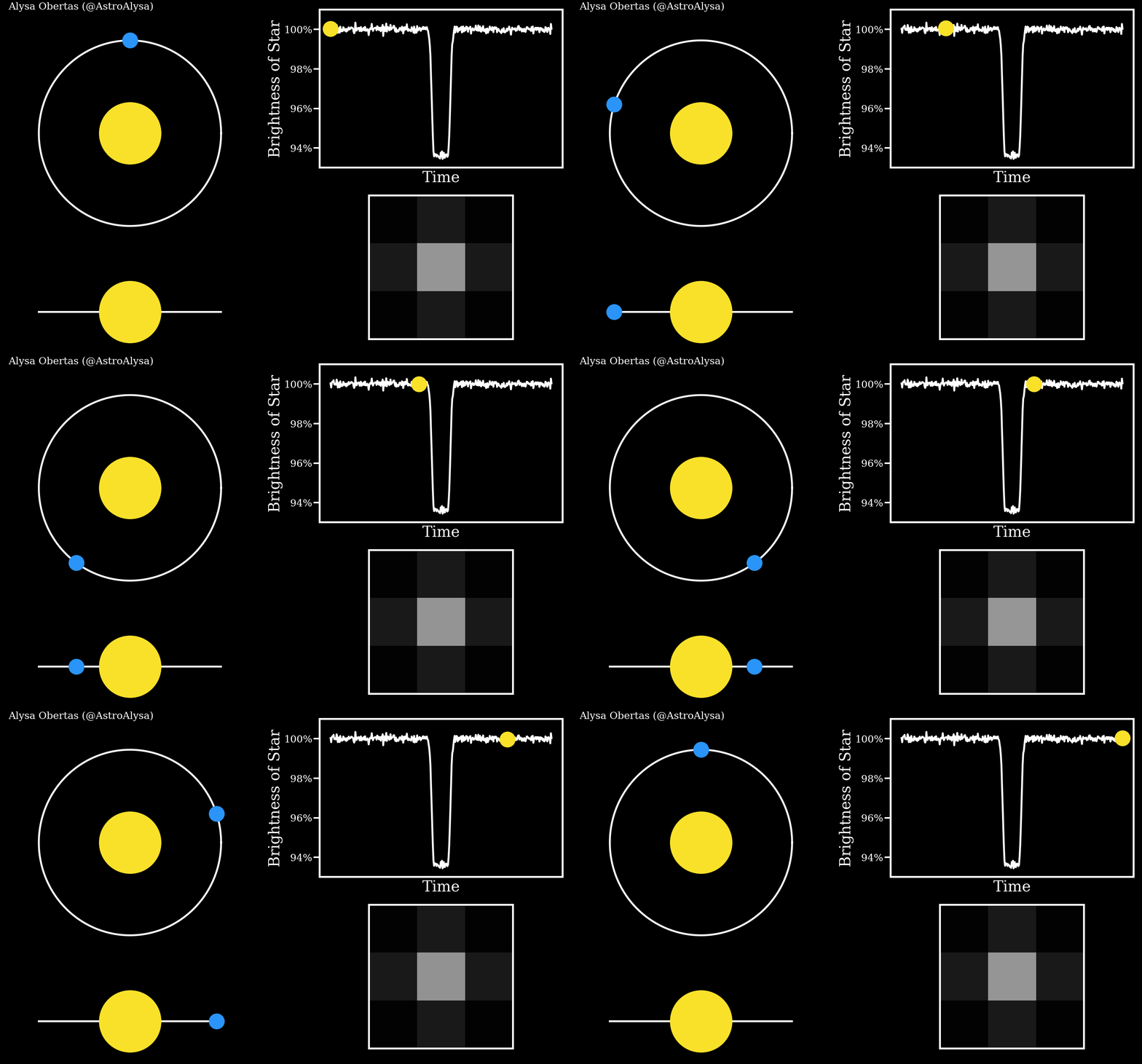
A planet orbiting its star (top left). When viewed edge-on (bottom left), the planet passes in front of the star once per orbit and blocks some of the star's light. The star's brightness can be measured throughout the orbit (top right). This can be done using a CCD and collecting the star's light on the CCD pixels (bottom right).

Lol sorry I didn't know how to tag this. I made it... It's python art?

Note that this is simplified. I didn't include, e.g. the secondary eclipse (the total brightness is the combination of the light from the star + planet; there can be a tiny dip when the planet passes behind the star).

Also, the light curve (top right) is made up. What causes the shape of real light curves is really interesting, though! When the planet is fully in front of the disk of the star, the depth is (mostly) just a straightforward measure of the ratio of their areas (like, A=pi*r^2). But towards the "edge" of the star, things like limb darkening (https://en.wikipedia.org/wiki/Limb_darkening) are important.

The CCD view (bottom right) is made up as well. Even though we see stars as point sources of light, their light gets "smeared out" because of the physics of how light interacts with the shape of the telescope and other components of the optical system (we call this the point spread function). This will happen even in the most "idealised" system (https://en.wikipedia.org/wiki/Airy_disk).

Also, the file is on wikimedia commons (with a creative commons license) so folks can use it :) https://commons.wikimedia.org/wiki/File:Exoplanet_transit_method_dark.gif

274 Upvotes

21 comments sorted by

18

u/Stupendous_Mn Astronomer 7d ago

Thanks for sharing your work!

Is the depth of about 6 percent consistent with the displayed sizes of the star and transiting object? Just curious :-)

8

u/AstroAlysa Astronomer 7d ago edited 6d ago

Haha that's a good question. My gut response was no (because 6% is a huge dip). But then I remembered that I made the planet huge as well.

I'd have to check the code to be sure. But I could eyeball it. Taking radius_planet ~ 0.2 * radius_star, 0.22 is 0.04 (edit: this would correspond to 4% of the star's light being blocked, so the graph in the upper right would show a dip going down to 96%).

A depth of 0.06 would require a relative radius of sqrt(0.06) = 0.24. I think the planet's diameter (and therefore radius) looks smaller than a quarter that of the star, though (but lol there's only so much time I want to squint at my phone screen).

2

u/gmiller123456 5d ago

From discussions with professors working with students, accuracy of better than 1% is required to get anything usable. I believe I read on some AAVSO sources that better than .1% is required for anything scientifically useful today.

1

u/AstroAlysa Astronomer 4d ago

I don't have numbers off the top of my head. Although I work with observational data, it's generally post-processed data that's already been validated.

Keep in mind that a planet will cause a 1% dip in brightness if its relative radius is sqrt(0.01)=0.1, or 10% the size of the star. For reference, Mercury's radius is 0.35% of the Sun's radius. Earth's is 0.92%.

I'd have to check some recent papers to see the lower limit for the current "state-of-the-art" telescopes & instruments, but this will also be driven by how much noise there is for a planet candidate (i.e. the uncertainty/error bars).

4

u/SAUbjj Professor of Astronomy 7d ago

Oh this looks great! My next lecture is on exoplanets and how we detect them, would it be all right if I use this gif (with proper credit, of course)?

4

u/AstroAlysa Astronomer 7d ago

Yes, please do! I've also got a version for the RV method. I think I might've mixed up the description, though (I'll have to stare at it for a while and figure out which axis is the radial direction).

RV Light: https://commons.wikimedia.org/wiki/File:Radial_velocity_doppler_spectroscopy.gif

RV Dark: https://commons.wikimedia.org/wiki/File:Exoplanet_radial_velocity_doppler_spectroscopy_dark.gif

Transit Light: https://commons.wikimedia.org/wiki/File:Exoplanet_transit_method.gif

Transit Dark: https://commons.wikimedia.org/wiki/File:Exoplanet_transit_method_dark.gif

Wikimedia Commons has a lot of great animations! I found this recent one when I was looking for mine: https://commons.wikimedia.org/wiki/File:Radial_Velocity_Method.gif

Someone sent me a repository of teaching materials recently. I'll grab the link.

Edit: https://astroteaching.github.io/

2

u/SAUbjj Professor of Astronomy 7d ago

Amazing, thank you so much!

5

u/Stupendous_Mn Astronomer 7d ago • Bravo

If you're looking for material to use in a lecture, please feel free to use any you can find in these courses I taught a few years ago:

(more recent) http://spiff.rit.edu/classes/exo2024/exo2024.html

(rather old) http://spiff.rit.edu/classes/resceu/resceu.html

Enjoy!

2

u/SAUbjj Professor of Astronomy 7d ago

Oh this is great thank you! I only do exoplanets for about ~1.5 lectures so this is more than enough for those classes. Thanks again!

2

u/Alive_Surprise_2177 6d ago

Doesn’t this only work for an edge on solar system?

2

u/AstroAlysa Astronomer 6d ago edited 6d ago • Popcorn

Yes! Well, you can have a very small tilt (inclination). Well, technically this would be a very large inclination: a perfectly edge on system has an inclination of 90° and a perfectly face on system has an inclination of 0° (note that this might seem like a different convention than when talking about the orbital element inclination; this is because of the chosen reference direction for measuring the angle). But if the tilt/inclination means the planet no longer passes in front of the star (transits), we won't be able to detect a dip in the star's brightness (since what causes it is the planet physically blocking some of the star's light).

There are other exoplanet detection (& characterisation) methods we can use for systems with a larger tilt (smaller inclination; including the minimum: a face on system).

The radial velocity method has a signal that becomes weaker as the system has a larger tilt (smaller inclination), but it's not as "severe" as the transit method. This is because the signal depends on the star's motion (since the star and planet orbit the centre of mass, or barycentre; so the star wobbles - I haven't shown it in this animation) in the direction towards and away from us (the radial direction), rather than its motion on the sky (what you could see, theoretically, by eye staring at the sky). Indeed, we've found non-transiting planets in multi-planet systems using this method!

Direct imaging is another method, which works for highly-tilted (lowly-inclined) and face on systems. But our telescopes & instruments aren't quite good enough to directly observe the vast majority of exoplanets (based on what we've detected already, we can make educated estimates about the overall population of planets in the galaxy).

One method that we'll definitely be hearing more about in the next few years is astrometry. This is seeing the star's "wobble" on the sky. It's not visible by eye. And indeed, it requires a really good telescope in space! We've got that now: GAIA. There's actually a data release coming out very soon (2 December!) that will include giant planets!!!!

2

u/skygzr333 Amateur Astronomer 4d ago

This is a great animation! With your permission, could I use it in my exoplanets lecture I use with my high school Astronomy students?

2

u/AstroAlysa Astronomer 4d ago

Please do!

Someone else asked, and I replied with links to the file (and others) on wikimedia commons: https://www.reddit.com/r/Astronomy/s/k7fVdqLaXs

I believe files on wikimedia commons are under the creative commons license, so you just need to attribute it to me if you use it (which is already in the upper-left corner).

7

u/Proxima0927 7d ago

This is cool!

5

u/tyler_russell52 7d ago

Very interesting!

1

u/huntersofartemis 7d ago

just wrote a ml program on this 🙂‍↕️🙂‍↕️ is this a sign

1

u/AstroAlysa Astronomer 6d ago

Oh, what's the program? :)

1

u/huntersofartemis 6d ago

uhh just detecting exoplanets using light curves. it has a pretty high accuracy but then again most of the stars don't have exoplanets so

1

u/FeedbackAway8492 3d ago

Normal its easy Thats look more complex i but cool

1

u/AstroAlysa Astronomer 3d ago

Sorry, I don't understand what this means.

2

u/Repulsive-Opening996 7d ago

Your work is great. It would really be helpful in understanding transit methods, even for laymen. This reminds me of the paper we wrote about updating transit timings of an exoplanet.