r/Austrohungarian • u/Longjumping-Kale-283 • 10h ago
r/Austrohungarian • u/Longjumping-Kale-283 • 11h ago
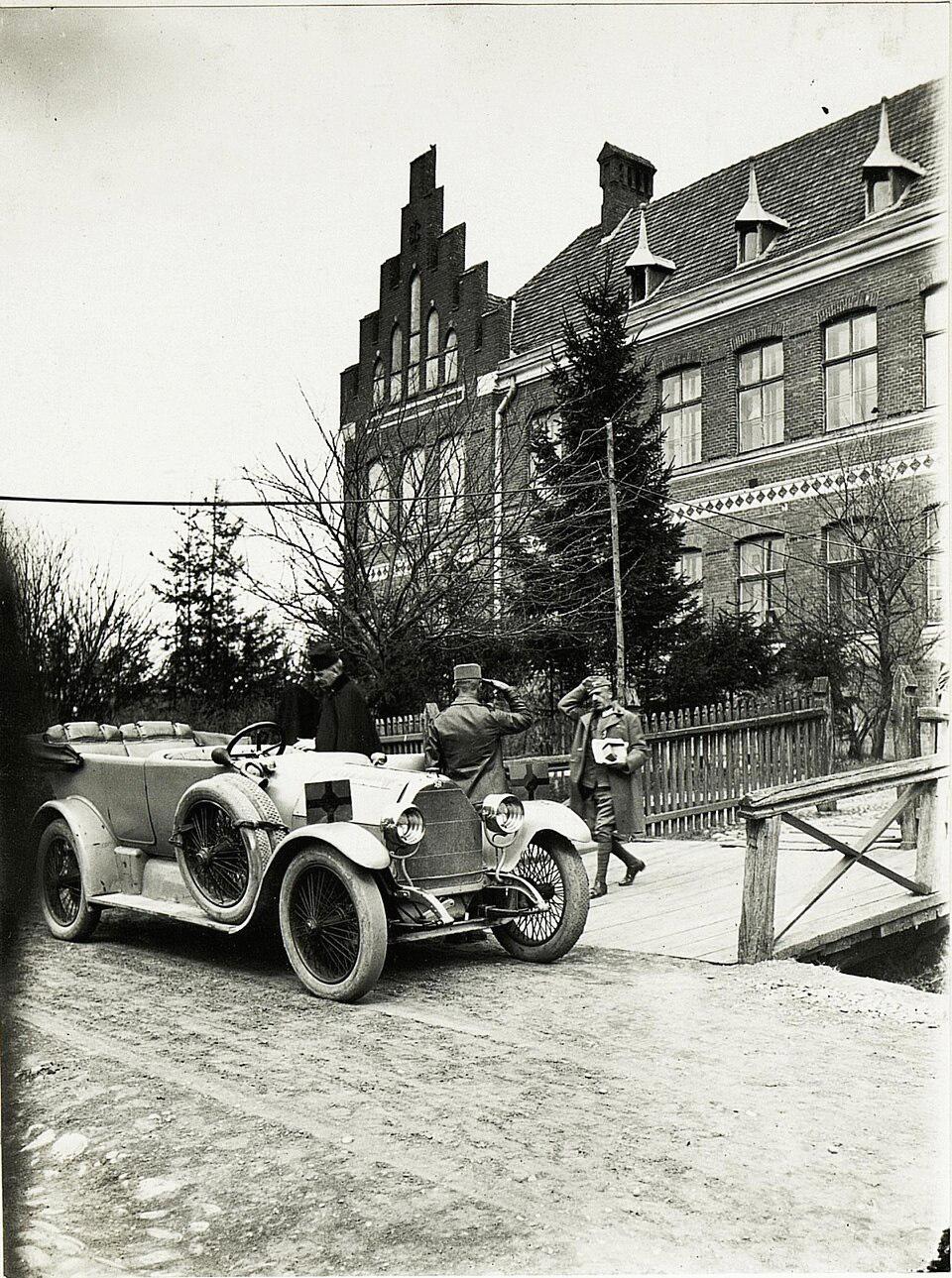
The army commander leaves the army command building, April 8, 1917.Anknown location and unit
Photo,: K.u.k. Kriegspressequartier, Lichtbildstelle - Wien
Österreichische Nationalbibliothek - Austrian National Library
Accession number
WK1/ALB068/19725
r/Austrohungarian • u/Longjumping-Kale-283 • 10h ago
Photo of the warship S.M.S St. GEORG. Taken in the waters off Castelnuovo on February 23, 1916.
SMS Sankt Georg was an armored cruiser of the Austro-Hungarian Navy and the third and final ship of her type for the empire. Wikipedia
Completed in July 1905 and built at the Pola Arsenal, her design was based on the earlier Kaiser Karl VI but featured upgraded armament, including two 24 cm (9.4 in) main guns. Wikipedia
During her career, she performed several notable roles:
Diplomacy: She participated in the Jamestown Exposition in the United States in 1907 to commemorate the first English colony in North America. Wikipedia
World War I: While the Austro-Hungarian fleet spent much of the war as a "fleet in being," Sankt Georg bombarded the Italian coast in May 1915 and supported raids on the Otranto Barrage in 1917. Wikipedia
The Cattaro Mutiny: In February 1918, she was one of the ships involved in the Cattaro Mutiny, a revolt by crews exhausted by inactivity and the length of the war. Wikipedia
Following the war, she was awarded to Britain as a prize under the Treaty of Saint-Germain-en-Laye, but she was sold to Italian ship breakers and scrapped in 1920. Wikipedia
photo: K.u.k. Kriegspressequartier, Lichtbildstelle - Wien
Österreichische Nationalbibliothek - Austrian National Library
Accession number
WK1/ALB052/14345
r/Austrohungarian • u/Longjumping-Kale-283 • 11h ago
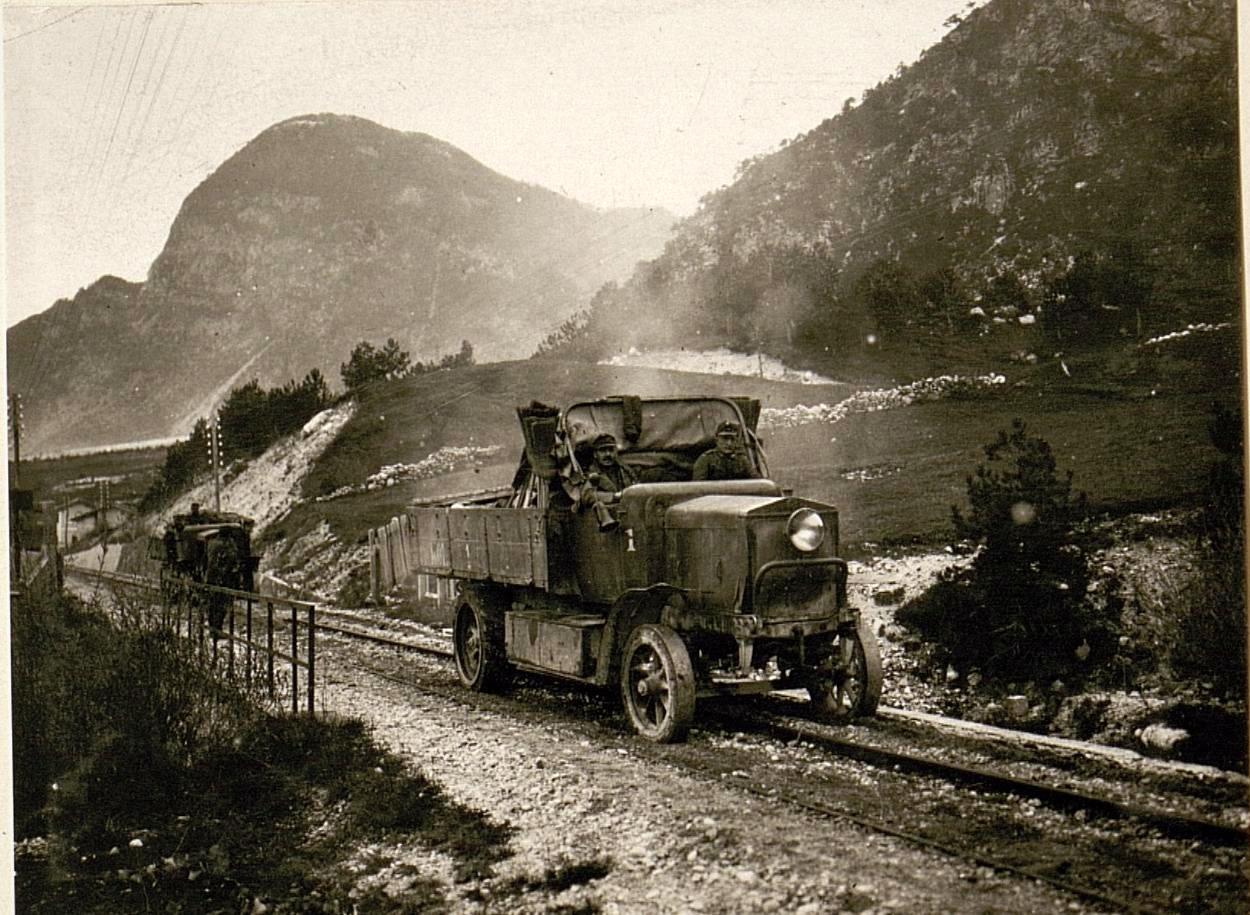
Automobiles on the track at Tolmezzo.
photo:K.u.k. Kriegspressequartier, Lichtbildstelle - Wien
Österreichische Nationalbibliothek - Austrian National Library
Accession number
WK1/ALB043/11830
r/Austrohungarian • u/Longjumping-Kale-283 • 10h ago
Interesting draft of a 30.5 Škoda morser for a war charity brand 1915, by Koloman Moser
The artwork titled “Draft for a war charity brand,” created by Koloman Moser in 1915 in Austria, is executed using Indian ink on paper. This piece, belonging to the Art Nouveau (Modern) movement, serves as a poster and measures 19.7 x 28.5 cm.
Koloman Moser (German: [ˈkoːloman ˈmoːzɐ]; 30 March 1868 – 18 October 1918) was an Austrian artist, who exerted considerable influence on twentieth-century graphic art. He was one of the foremost artists of the Vienna Secession movement and a co-founder of Wiener Werkstätte.
Moser designed a wide array of art works, including books and graphic works from postage stamps to magazine vignettes; fashion; stained glass windows, porcelains and ceramics, blown glass, tableware, silver, jewellery, and furniture.
source: https://en.wikipedia.org › wiki › Koloman_Moser
r/Austrohungarian • u/Longjumping-Kale-283 • 1d ago
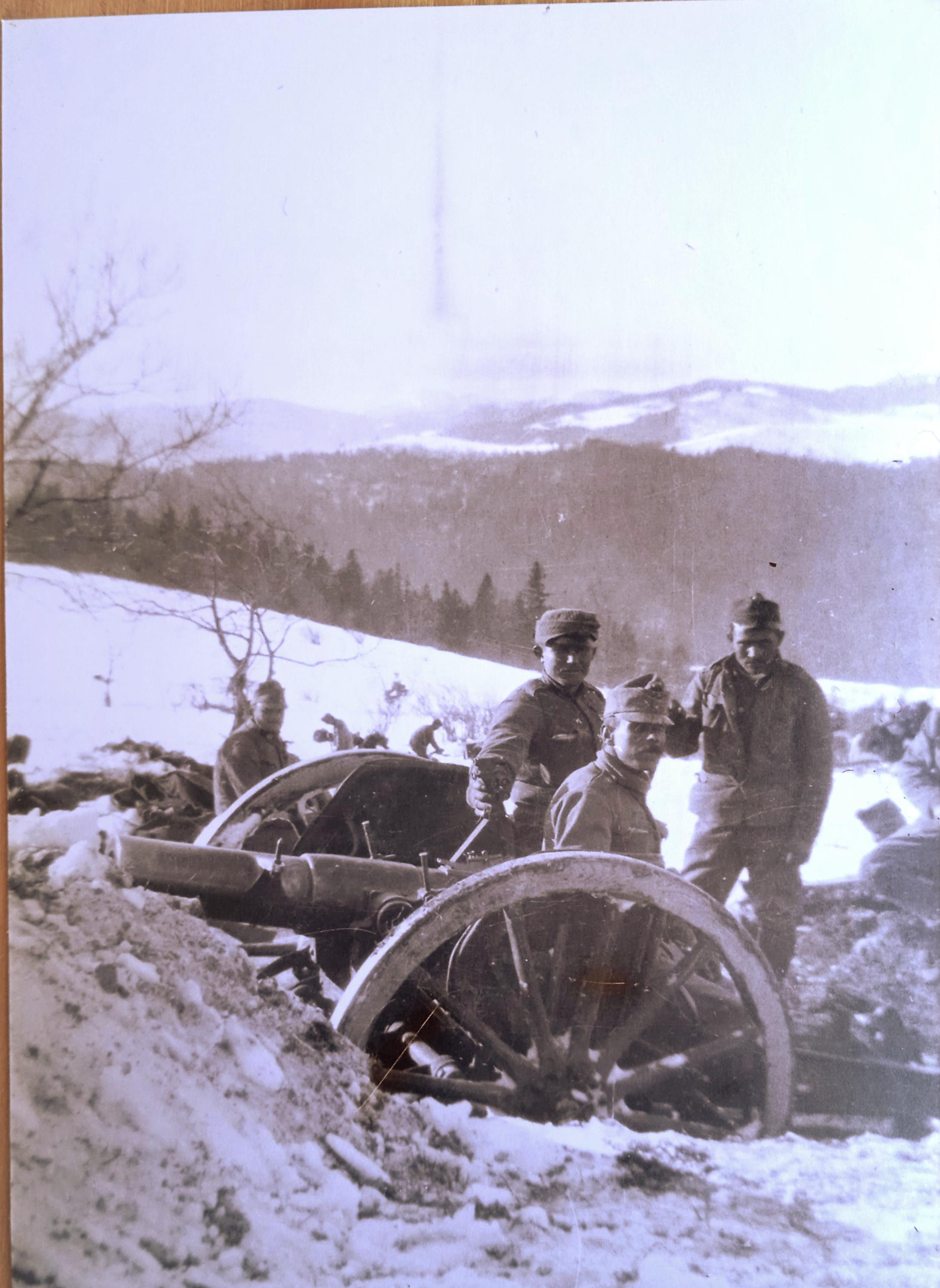
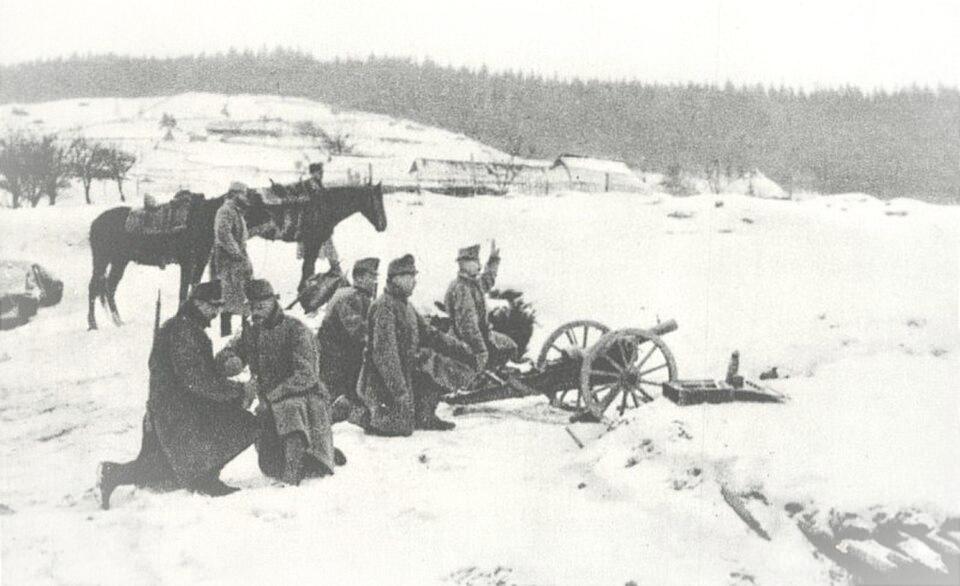
An artillery post in the snow of the Alpine front, do any of you recognize the place?
r/Austrohungarian • u/Longjumping-Kale-283 • 2d ago
The funeral of Emperor Franz Joseph I, Vienna, 30 November 1916 - Original pages from a 1916 illustrated magazine
110 years ago today, 21 November 1916, Kaiser Franz Joseph I died at Schönbrunn after 68 years of reign.
These photos are from the funeral service published in December 1916 in the magazine "Unserer Krieger - Bilder aus grosser Zeit".
From my private collection.
The gallery shows: the Emperor on his deathbed, the lying in state, the Imperial Family at the funeral (Charles I and Zita in the front row), and the long funeral procession through the streets of Vienna to the Kapuzinerkirche.
You can see the heralds, the guards, the horses in white caparisons, and the crowd following the hearse.
Rest in Peace, Kaiser.
You held an empire together for 68 years.
Your subjects never forgot you.
r/Austrohungarian • u/Longjumping-Kale-283 • 2d ago
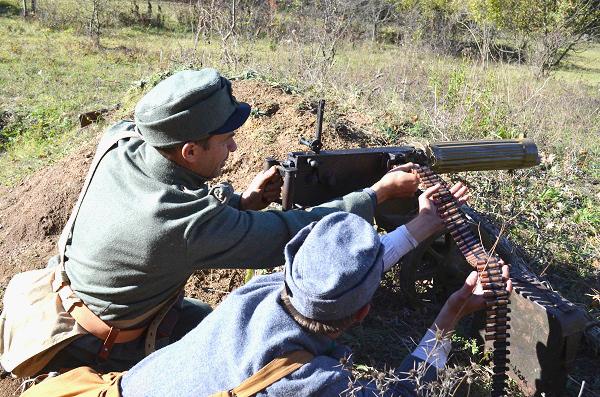
an interesting group of Austrianhungarian reenactors
r/Austrohungarian • u/Longjumping-Kale-283 • 2d ago
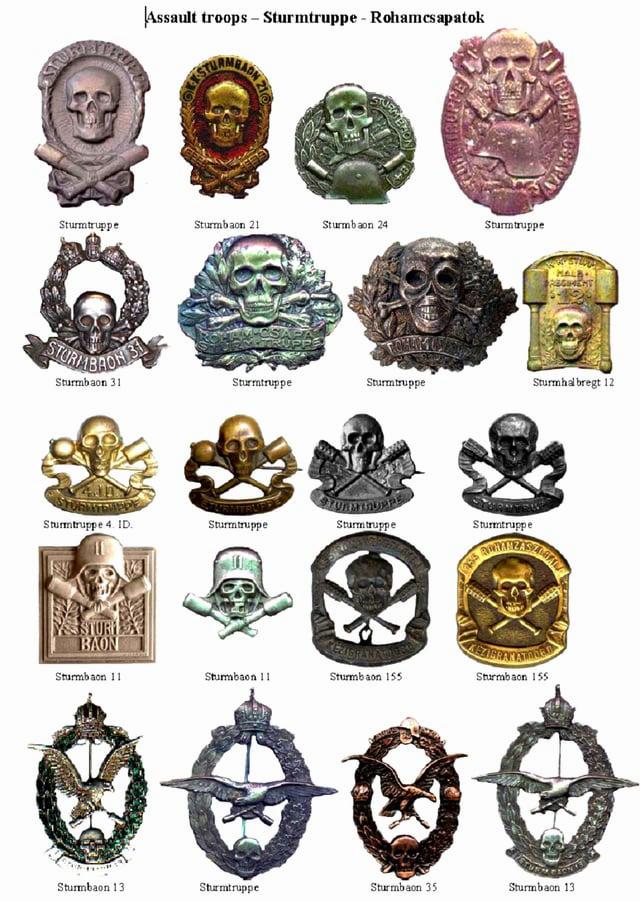
The most common, and maybe the most iconic, Kappenabzeichen of them all - Franz Joseph I
From my collection: the Franz Joseph I Kappenabzeichen by R. Marschall, 1915.
Rectangular plaque with the Emperor in profile facing right, flanked by laurel branches. Inscribed FRANC·IOS·I· on the left.
It was mass-produced and worn on the Feldkappe by virtually everyone, which is why it's the most common one you find today. But for me it remains the most iconic - the face of the old Empire on a soldier's cap.
Here I have four examples, all slightly different in patina and wear, plus the back with the original pin still intact.
I never bought mine - I found all of these in the field.
r/Austrohungarian • u/Longjumping-Kale-283 • 2d ago
An Austrian Hungarian Lohner L seaplane after an emergency landing on Lake Doberdò - Doberdob
This photo comes from the " fototeca storica, consorzio Monfalconese from what I was told, during a reconnaissance flight this Lohner L was hit and forced to land on Lake Doberdò, In the background should be Quota 208 of Bonetti.
The crew survived and reached their own lines. The aircraft was later destroyed by Austro-Hungarian artillery to prevent capture.
I have not found any official historical reference to this loss yet. From what I know, the engine is still on the bottom of the lake.
Has anyone ever heard of this crash, or knows the date / unit?
r/Austrohungarian • u/Longjumping-Kale-283 • 2d ago
Austro-Hungarian field cooks posing in front of their kitchen - "Eintritt verboten" (Entry forbidden) above the door
Cooks of an Austro-Hungarian unit posing in front of their kitchen barrack. Note the "Eintritt verboten" sign above the door - and all of them proudly posing outside it.
On the back it's a real field postcard, addressed to a Fräulein back home. Can anyone help transcribe the German handwriting?
r/Austrohungarian • u/CommitteeAntique3830 • 2d ago
21 November 1916 – The End of an Era
110 years ago today, Emperor Franz Joseph I of Austria passed away at Schönbrunn Palace in Vienna, aged 86, after nearly 68 years on the throne.
His reign had witnessed revolutions, wars, the transformation of the Habsburg Monarchy, and profound personal tragedies.
In this touching photograph from September 1914, the elderly Emperor is pictured alongside young Archduke Otto von Habsburg, son of the future Emperor Karl I.
A photograph of two generations, taken just two years before Franz Joseph's death and four years before the collapse of Austria-Hungary.
An era was coming to an end.
Photograph: Hermann Clemens Kosel, 1914.

r/Austrohungarian • u/Longjumping-Kale-283 • 3d ago
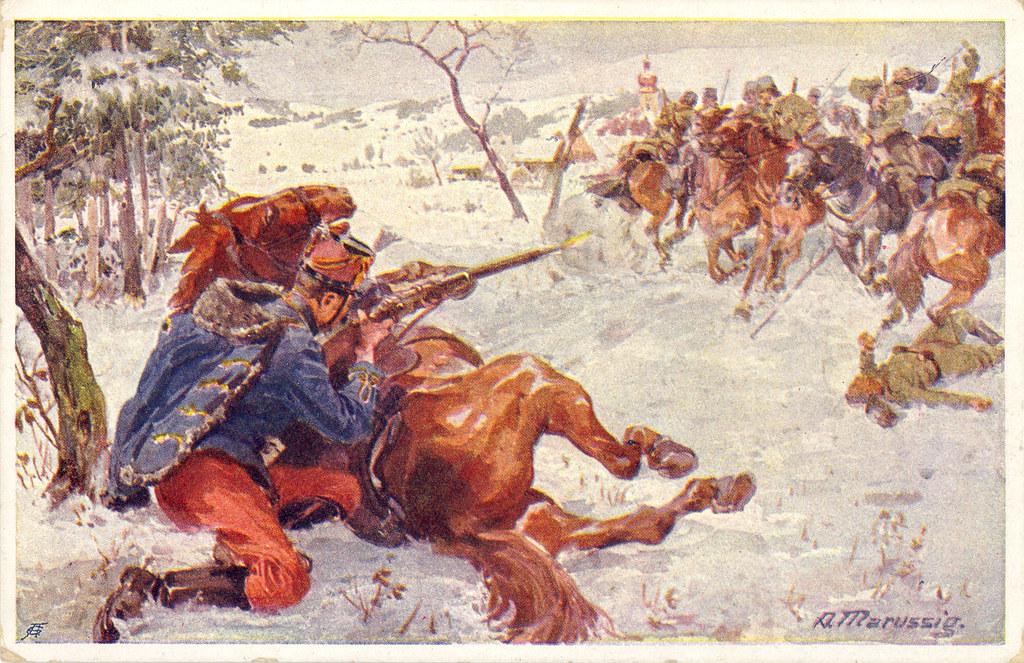
WWI Austro-Hungarian Red Cross Postcard - Hussar Samuel Kralik puts the enemy to flight
This beautiful postcard was sold to raise funds for the Austro-Hungarian Red Cross during WWI. My flickr friend gps1941 provided the translation for the German text on the back of the card.
"Official Postcard for:
The Red Cross
War Welfare Office
War Support Bureau
No. 197"
"From the Army’s Golden Book, Series 1.
Hussar Samuel Kralik, of the 'Husarenregiment No. 6', was on a reconnaissance ride when he came under intense hostile fire by a suddenly appearing enemy patrol. Using his wounded Horse as a shield, he fired back and forced the enemy to flee. On foot, he then brought his commander an important report on the enemy’s positions."
The location of the scene is not given. However, as the ground is covered with snow and there is an onion-shaped dome on the background, a guess might be made that the action is taking place in the Russian Ukraine as I found information stating that is where Austro-Hungarian Husarenregiment No. 6 was at the end of WWI. I. It may also be that the scene is taking place in some conflict prior to WWI.
Although I could not find out anything on Samuel Kralik nor the wartime incident depicted in the artwork on the front of the card. I did, however, find out a little about the illustrious history of Husarenregiment No. 6.
Hussar Regiment "King William II of Württemberg" No. 6 was originally established in 1734. It existed under various names and affiliations until the end of WWI in 1918, and it fought in the Polish War of Succession, the Russo-Turkish War, the Austrian War of Succession, the Seven Years' War, the Bavarian Succession War, the Napoleonic Wars, the Wars of Liberation, the Sardinian War, the German War of 1866, and various other conflicts.
In 1914 at the beginning of WWI, the regiment was attached to the VI Army Corps - 2 Cavalry Division Troops - 16 Cavalry Brigade. It was made up of 90% Hungarians and 10% soldiers of other nationalities. Hungarian was listed as the Regimental Language. The regiment initially fought as cavalry, but it was also used as infantry during the war.
After the proclamation of Hungary as an independent state in October of 1918, the Hungarian soldiers were called by the interim government to cease hostilities and return home. Husaren Nr. 6 Regiment came back to Hungary from the Ukraine where they had been positioned
The artwork on the card is signed "A. Marussig," who might possibly be the Austrian artist Anton Marussig (1868-1925
source: https://www.flickr.com/photos/sunnybrook100/4123596400/?rb=1
r/Austrohungarian • u/Longjumping-Kale-283 • 3d ago
Prints from original WWI negatives - Austro-Hungarian soldiers on the Alpine Front, snow, artillery and AA machine guns
Hi everyone,
I wanted to share these 4 prints with you.
They were printed from original WWI negatives. The negatives belong to a friend of mine, and he kindly gifted me these prints.
They were certainly taken on the Alpine Front, but I don't know the exact location. If anyone can help identify where this could be, the unit, or the weapons, I would be really grateful.
- Artillery crew with a field gun in the snow
- Soldiers in a trench dug into the snow, with the mountains behind
- Machine gun positions, guns pointed up - anti-aircraft?
- Barracks almost completely buried by snow
r/Austrohungarian • u/Longjumping-Kale-283 • 3d ago
Kaiser Franz Joseph I and Karl speak with Supreme Marshal of the Kingdom of Bohemia Georg Christian, Prince of Lobkowicz on board the steamer Marie Valerie in the Karlín Port on Sunday, April 28, 1907, during Prague visitation
photo: Rudolf Bruner-Dvořák (1864–1921
r/Austrohungarian • u/Longjumping-Kale-283 • 3d ago
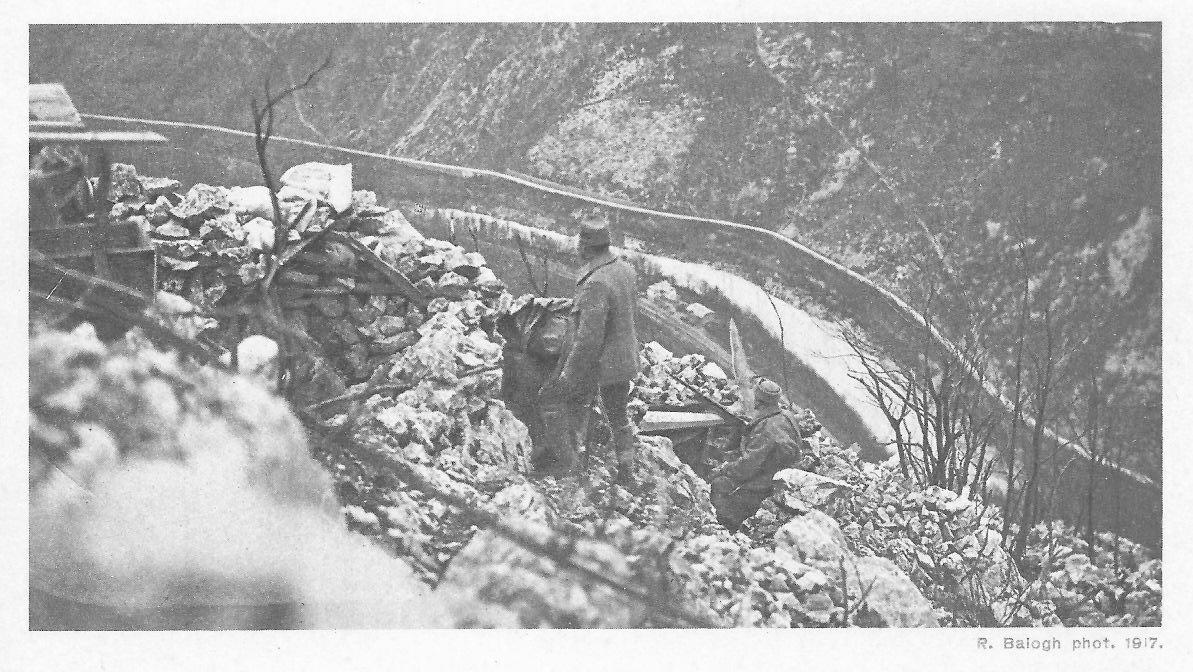
Battles of the Isonzo postcard from a photograph of Rudolf Balogh
r/Austrohungarian • u/Longjumping-Kale-283 • 3d ago
Exercises of the 1st Artillery Squadron of the Polish legions with 7 cm M. 75 mountain cannons in Rafajłowe
The 7 cm Gebirgsgeschütz M 75 was a bronze-steel mountain gun used by Austria-Hungary during World War I. Despite its 7 cm designation, it actually fired a 66 mm (2.6 in) projectile. The Austro-Hungarian Army used rounded centimeter designations for its artillery pieces.
The gun was equipped with an early form of the Krupp horizontal sliding-block breech and used separate-loading, bagged charges and projectiles. Its low-profile design allowed the breech to recoil into the ground, restricting its elevation and limiting its effectiveness as a mountain gun, where high angles of elevation were particularly important. For transport, the Gebirgsgeschütz M 75 could be broken down into two loads.
source: https://en.wikipedia.org/wiki/7_cm_Gebirgsgesch%C3%BCtz_M_75
r/Austrohungarian • u/Longjumping-Kale-283 • 5d ago
A nice plate from the Russian magazine Serzhant. Austro-Hungarian infantry, 1914-1918.
AUSTRO-HUNGARIAN INFANTRY, 1914-1918
1-2. Infantryman in pike-grey [hechtgrau] uniform, in full field equipment. Bayonet fixed on the rifle.
3-6. Knapsack — front, back, and open views.
7. Infantry haversack / bread-bag with canteen.
8-9. Mess tins / field kettle.
10. Canteen, model 1909.
11. Canteen, model 1888, capacity 0.45 litre.
12. Cartridge pouches.
13. Belt buckle.
14. Belt — loop and reverse side.
Plate by L. & F. Funcken, from the Russian magazine Serzhant (Сержант). Translated from the original Russian caption.
r/Austrohungarian • u/Longjumping-Kale-283 • 5d ago
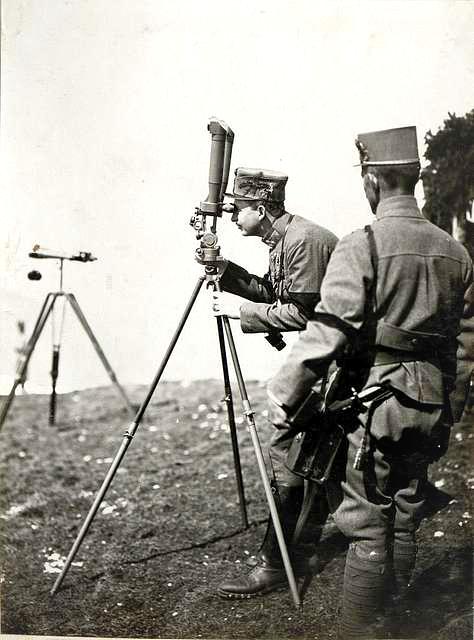
Keiser Karl looks through a telescope on the front of the dolomites
r/Austrohungarian • u/Longjumping-Kale-283 • 5d ago
Inspection in Niederdorf , Pustertal (Tyrol) of the Armeekommandant Erzherzog Friedrich
Archduke Friedrich of Austria served as the Supreme Commander of the Austro-Hungarian Army from 1914 until 1917, holding formal responsibility for military readiness across multiple contested fronts. His presence at the alpine garrison in Niederdorf underlines the strategic importance of high-altitude logistics and troop morale during the initial phase of the July Crisis and subsequent mobilization.
photo: Österreichische Nationalbibliothek - Austrian National Library
r/Austrohungarian • u/Longjumping-Kale-283 • 5d ago
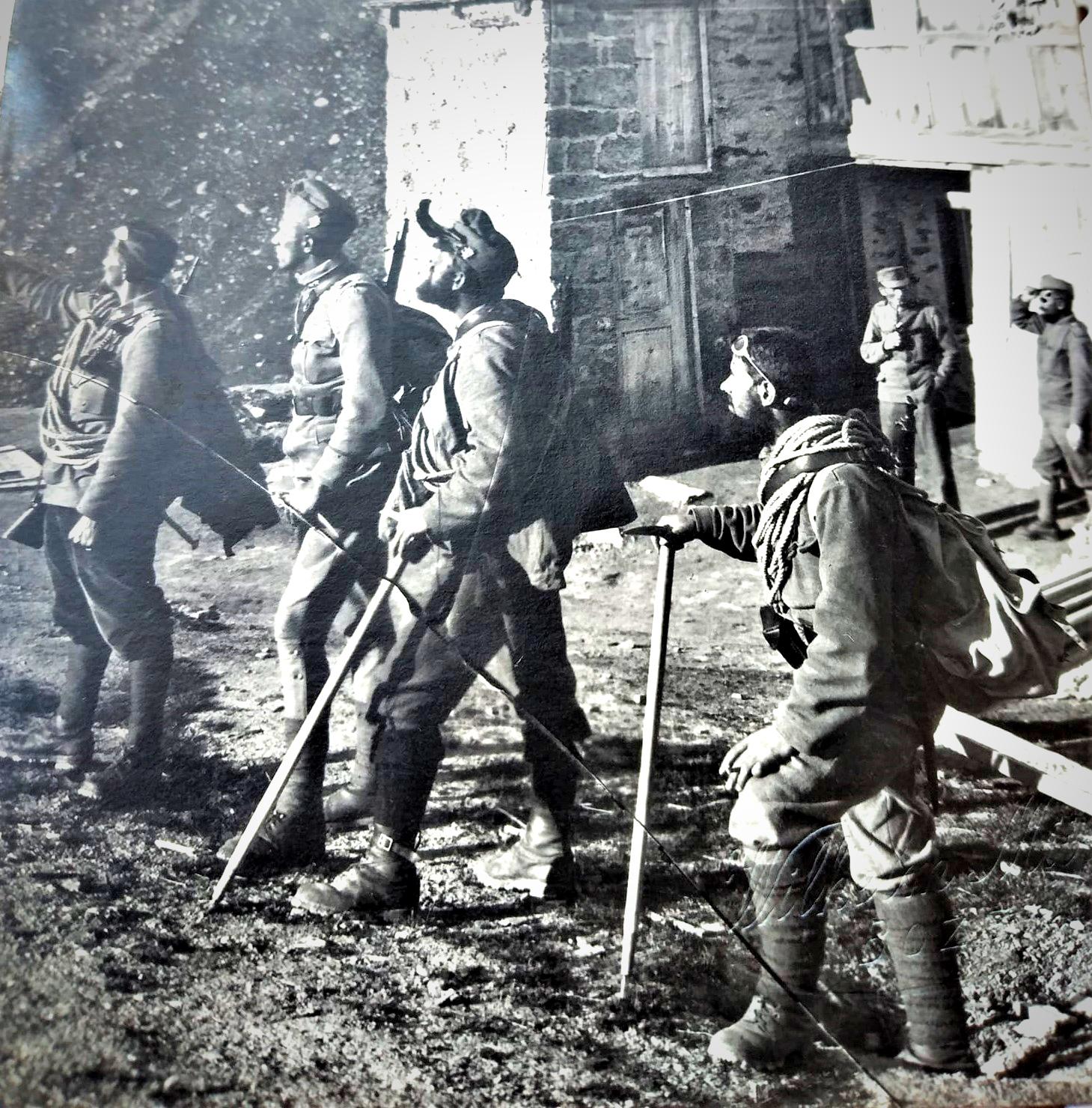
Patrol of Bergführer of the HGK Hochgeburgskompanie 30 on the Dolomitenfront
r/Austrohungarian • u/Longjumping-Kale-283 • 5d ago
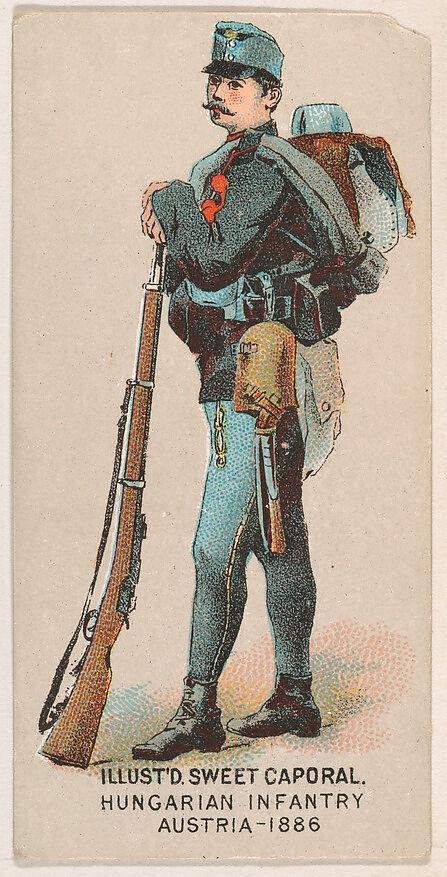
Hungarian Infantry, Austria, 1886, from the Military Series (N224) issued by Kinney Tobacco Company to promote Sweet Caporal Cigarettes
Sweet Caporal was a cigarette brand launched in 1878 by the Kinney Brothers Tobacco Company. It became especially popular in Canada, where it held a large share of the cigarette market in the early 1900s, and was sold there until 2011. Packs also included collectible cards—some featuring baseball players—making the brand notable among card collectors today.
Card:Publisher: Issued by Kinney Brothers Tobacco Company
Date: 1888
Medium: Commercial color lithograph
Dimensions: Sheet: 2 3/4 × 1 1/2 in. (7 × 3.8 cm)
Classifications: Prints, Ephemera
Credit Line: The Jefferson R. Burdick Collection, Gift of Jefferson R. Burdick
Object Number: Burdick 218, N224.656
Curatorial Department: Drawings and Prints
r/Austrohungarian • u/Mundane_Turnover_444 • 5d ago
Police hat badge.
The badge is from my collection.
r/Austrohungarian • u/Longjumping-Kale-283 • 7d ago