r/aynrand • u/Orkemus • 22h ago
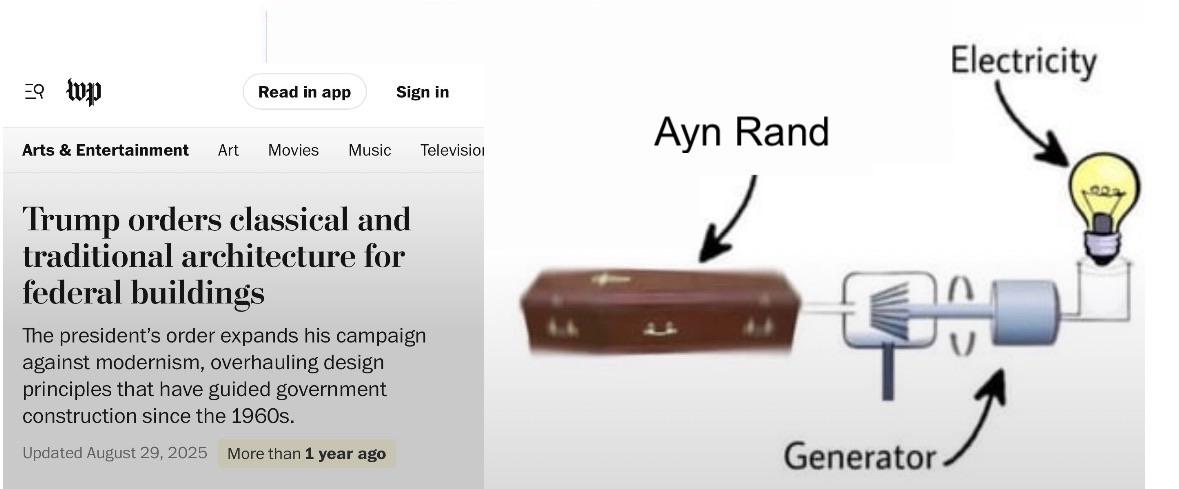
I drew Ayn Rand
gallery
52
Upvotes
r/aynrand • u/twozero5 • Mar 07 '25
A huge thank you to Don Watkins for agreeing to do this written interview. This interview is composed of 5 questions, but question 5 has a few parts. If we get more questions, we can do more interview.
1. What do you make of the Marxist personal vs private property distinction.
Marxists allow that individuals can possess personal property—consumption goods like food or clothing—but not private property, productive assets used to create wealth. But the justification for owning personal property is the justification for owning private property.
Human life requires using our minds to produce the material values we need to live. A farmer plants and harvests crops which he uses to feed himself. It’s that process of thinking, producing, and consuming that the right to property protects. A thief short-circuits that process by depriving man of what he produces—the Marxist short-circuits it by depriving a man of the ability to produce.
2. How would you respond to the Marxist work or die claim, insinuating capitalism and by extension, free markets are “coercive”?
It’s not capitalism that tells people “work or die,” but nature. Collectivist systems cannot alter that basic fact—they can only force some men to work for the sake of others.
Capitalism liberates the individual to work on whatever terms he judges will further his life and happiness. The result is the world of abundance you see in today’s semi-free countries, where the dominant problem faced by relatively poor individuals is not starvation but obesity. It is only in unfree countries, where individuals aren’t free to produce and trade, that starvation is a fact of life.
Other people have only one power under capitalism: to offer me opportunities or not. A business offering me a wage (low though it may be) is not starving me, but offering me the means of overcoming starvation. I’m free to accept it or to reject it. I’m free to build my skills so I can earn more money. I’m free to save or seek a loan to start my own business. I’m free to deal with the challenges of nature in whatever way I judge best. To save us from such “coercion,” collectivists offer us the “freedom” of dictating our economic choices at the point of a gun.
3. Also, for question 3, this was posed by a popular leftist figure, and it would go something like this, “Capitalists claim that rights do not enslave or put others in a state of servitude. They claim their rights are just freedoms of action, not services provided by others, yet they put their police and other government officials (in a proper capitalist society) in a state of servitude by having a “right” to their services. They claim a right to their police force services. If capitalists have a right to police services, we as socialists, can have a right to universal healthcare, etc.”
Oh, I see. But that’s ridiculous. I don't have a right to police: I have a right not to have my rights violated, and those of us who value our lives and freedom establish (and fund) a government to protect those rights, including by paying for a police force.
The police aren't a service in the sense that a carpet cleaner or a private security guard is a service. The police aren't protecting me as opposed to you. They are stopping aggressors who threaten everyone in society by virtue of the fact they choose to live by force rather than reason. And so, sure, some people can free ride and gain the benefits of police without paying for them, but who cares? If some thug robs a free rider, that thug is still a threat to me and I'm happy to pay for a police force that stops him.
4. Should the proper government provide lawyers or life saving medication to those in prison, such as insulin?
Those are very different questions, and I don’t have strong views on either one.
The first has to do with the preservation of justice, and you could argue that precisely because a government is aiming to protect rights, it wants to ensure that even those without financial resources are able to safeguard their rights in a legal process.
The second has to do with the proper treatment of those deprived of their liberty. Clearly, they have to be given some resources to support their lives if they are no longer free to support their lives, but it’s not obvious to me where you draw the line between things like food and clothing versus expensive medical treatments.
In both these cases, I don’t think philosophy gives you the ultimate answer. You would want to talk to a legal expert.
5. This will be the final question, and it will be composed of 3 sub parts. Also, question 4 and 5 are directly taken from the community. I will quote this user directly because this is a bit long. Editor’s note, these sub parts will be labeled as 5.1, 5.2, & 5.3.
5.1 “1. How do you demonstrate the value of life? How do you respond to people who state that life as the standard of value does not justify the value of life itself? Editor’s note, Don’s response to sub question 5.1 is the text below.
There are two things you might be asking. The first is how you demonstrate that life is the proper standard of value. And that’s precisely what Rand attempts to do (successfully, in my view) by showing how values only make sense in light of a living organism engaged in the process of self-preservation.
But I think you’re asking a different question: how do you demonstrate that life is a value to someone who doesn’t see the value of living? And in a sense you can’t. There’s no argument that you should value what life has to offer. A person either wants it or he doesn’t. The best you can do is encourage a person to undertake life activities: to mow the lawn or go on a hike or learn the piano or write a book. It’s by engaging in self-supporting action that we experience the value of self-supporting action.
But if a person won’t do that—or if they do that and still reject it—there’s no syllogism that will make him value his life. In the end, it’s a choice. But the key point, philosophically, is that there’s nothing else to choose. It’s not life versus some other set of values he could pursue. It’s life versus a zero.
5.2 2. A related question to (1.) is: by what standard should people evaluate the decision to live or not? Life as a standard of value does not help answer that question, at least not in an obvious way. One must first choose life in order for that person’s life to serve as the standard of value. Is the choice, to be or not to be (whether that choice is made implicitly or explicitly), a pre-ethical or metaethical choice that must be answered before Objectivist morality applies? Editor’s note, this is sub question 5.2, and Don’s response is below.
I want to encourage you to think of this in a more common sense way. Choosing to live really just means choosing to engage in the activities that make up life. To learn things, build things, formulate life projects that you find interesting, exciting, and meaningful. You’re choosing to live whenever you actively engage in those activities. Few people do that consistently, and they would be happier if they did it more consistently. That’s why we need a life-promoting morality.
But if we’re really talking about someone facing the choice to live in a direct form, we’re thinking about two kinds of cases.
The first is a person thinking of giving up, usually in the face of some sort of major setback or tragedy. In some cases, a person can overcome that by finding new projects that excite them and give their life meaning. Think of Rearden starting to give up in the face of political setback and then coming back to life when he thinks of the new bridge he can create with Rearden Metal. But in some cases, it can be rational to give up. Think of someone with a painful, incurable disease that will prevent them from living a life they want to live. Such people do value their lives, but they no longer see the possibility of living those lives.
The other kind of case my friend Greg Salmieri has called “failure to launch.” This is someone who never did much in the way of cultivating the kind of active, engaging life projects that make up a human life. They don’t value their lives, and going back to my earlier answer, the question is whether they will do the work of learning to value their lives.
Now, how does that connect with morality? Morality tells you how to fully and consistently lead a human life. In the first kind of case, the question is whether that’s possible given the circumstances of a person’s life. If they see it’s possible, as Rearden ultimately does, then they’ll want moral guidance. But a person who doesn’t value his life at all doesn’t need moral guidance, because he isn’t on a quest for life in the first place. I wouldn’t say, “morality doesn’t apply.” It does in the sense that those of us on a quest for life can see his choice to throw away his life as a waste, and we can and must judge such people as a threat to our values. What is true is that they have no interest in morality because they don’t want what morality has to offer.
5.3 3. How does Objectivism logically transition from “life as the standard of value” to “each individuals own life is that individual’s standard of value”? What does that deduction look like? How do you respond to the claim that life as the standard of value does not necessarily imply that one’s own life is the standard? What is the logical error in holding life as the standard of value, but specifically concluding that other people’s lives (non-you) are the standard, or that all life is the standard?” Editor’s note, this is question 5.3, and Don’s response is below.
Egoism is not a deduction to Rand’s argument for life as the standard, but a corollary. That is, it’s a different perspective on the same facts. To see that life is the standard is to see that values are what we seek in the process of self-preservation. To see that egoism is true is to see that values are what we seek in the process of self-preservation. Here’s how I put it in the article I linked to earlier:
“To say that self-interest is a corollary of holding your life as your ultimate value is to say there’s no additional argument for egoism. Egoism stresses only this much: if you choose and achieve life-promoting values, there are no grounds for saying you should then throw them away. And yet that is precisely what altruism demands.”
Editor’s note, also, a special thank you is in order for those users who provided questions 4 and 5, u/Jambourne u/Locke_the_Trickster The article Don linked to in his response to the subquestion of 5 is https://www.earthlyidealism.com/p/what-is-effective-egoism
Again, if you have more questions you want answered by Objectivist intellectuals, drop them in the comments below.
r/aynrand • u/twozero5 • Mar 03 '25
I am seeking some questions from the community for exclusive written interviews with different Objectivist intellectuals. If you have any questions about Objectivism, capitalism, rational egoism, etc please share them in the comments. I have a specific interview already lined up, but if this thread gets a whole bunch of questions, it can be a living document to pick from for other possible interview candidates. I certainly have many questions of my own that I’m excited to ask, but I want to hear what questions you want answered from some very gracious Objectivist intellectuals!
r/aynrand • u/tkyjonathan • 1d ago
This aligns well with Ayn Rand's philosophy.
r/aynrand • u/NotEconomist • 1d ago
I run a small animated economics channel and tried to work out what Rand would make of AI using only her own writing. My take: she'd love the machine and the engineers who built it (she watched Apollo 11 in person and called it "a demonstration of man at his best"), she'd go after anyone trying to pause or license it, and then it turns: a tool that writes your essays and forms your opinions is exactly what she meant by a second-hander. There's also the copyright question, since she defended intellectual property hard.


Every quote on screen is sourced; the predictions are labeled as mine. I'd honestly like to hear where Objectivists think I'm wrong.r/aynrand • u/Avi-Lin • 1d ago
This article builds on the article on the state. The meaning of “state” used here is the one I introduced in that article.
While it's common for the two terms to be used interchangeably. In my view, they mean different things.
I will begin by giving a technical definition of government, then later I will give one more compatible with everyday use.
A Government is a state that only acts in accordance with policy it has publicised to the general public.
Note that a government is a state, a specific type of state, being a state is a necessary condition to be a government.
So all that is true of a state is true of a government.(In the article “On the state”).
The other type of state, which is a negation of a government, is a dictatorship.
A dictatorship is a state that acts either contrary to, or without any basis in, policy it has publicised to the general public.
[For simplicity, I will refer to "policy publicised to the general public" as “existing policy” from this point forward.]
Because a government restricts its actions to existing policy, its actions are predictable.
(only referring to government as I've defined it here, not necessarily how the real world entities called governments always behave).
A dictatorship's actions are unpredictable. They are not limited to existing policy, but to the private momentary desires of some person. (The dictator)
Two types of state action :
So there's two kinds of actions a state may engage in, in relation to whether it is consistent with existing policy or not.
The spectrum :
In reality, a state may not behave exclusively as a government or a dictatorship. A single state can engage in both types of action—sometimes acting in accordance with existing policy and sometimes not.
Because states can be mixed, they exist along a political spectrum:
Pure Government: A state that only engages in Governmental action.
Pure Dictatorship: A state that only engages in Dictatorial action.
Mixed States: The wide variety of states in between, with differing ratios of both actions.
The more a state engages in governmental action, the more of a Government it is ; the more it engages in dictatorial action, the more of a Dictatorship it is.
For common usage, it is best to classify a state based on which of the two types of action dominates its behaviour.
If governmental action dominates, we shall call it a government; if dictatorial action dominates, we shall call it a dictatorship.
r/aynrand • u/Avi-Lin • 1d ago
The concept doesn't depend on any particular entity existing; rather, it relies on the differences in capability to use force among various organisations.
Among different organisations, just like among individuals, there will always be differences in their capability to use force.
So there will always be an organisation more capable than all others, that's the state.
For as long as there are differences in the capability to use force, there is a state.
Just like in a race there will always be first place, it's not fixed in a particular runner. It's whoever crosses the finish line first.
We must ask, who or what will abolish it? Are they capable of doing it? With what power?
For one entity to abolish another it must have a greater capability to use force than the one it wants to abolish (must be more powerful).
But by definition the state is the entity most capable, meaning there's no entity within that territory that has a greater capability than it.
Therefore the state can't be abolished. Because no entity satisfies the necessary condition to do so.
If an entity within some defined territory can be abolished by another within the same territory, then it's not the state of that territory. If it is the state, then there's no entity within that territory capable of destroying it.
In simpler terms.
If it can be abolished, then it's not a state. If it is a state, then it can't be abolished.
What is possible though is for the state to change.
Any organisation that is a state is an incumbent state, not the definition of state itself.
An organisation can gain or lose being a state, it can become a state or cease being one. Who the state is…may change, but the existence of one is inherent to any society.
Just like over the course of a race, who is first place may change, but first place will always exist, it can't be abolished.
If some other entity were to develop a capability for force which exceeds that of an incumbent state i.e sufficient to destroy it , the incumbent would cease to be the state and the now more powerful entity would become the new state.
The state has not been abolished, it has changed. What has happened is substitution not abolishment. Whoever supersedes number one becomes the new number one.
And if the now superior entity were to abolish the now inferior one, it wouldn't be abolishing a state, but a former state.(thus it still remains true that a state can't be abolished).
So an organisation that is an incumbent state can be abolished, but not while it is a state.
It would no longer be a state when that occurs.
It would have ceased to be one the moment another organisation satisfied the necessary condition to destroy it, i.e when another entity exceeded this incumbent’s capability for force, before even being abolished.
There's another related aspect of anarchism, the broader and core of it. Which is the so-called “abolition of hierarchies”.
To abolish something requires overpowering it, which is a hierarchical act in itself.
Even if they somehow managed to abolish existing hierarchies, how would they prevent new ones from forming?
They can't prevent new ones from forming without going against their own ideals.
To stop hierarchies from forming, they must be more powerful than those who may want to form them. This would itself be a hierarchy , with the anarchists on top.
You can only stop your inferiors not your equals.
Therefore it's contradictory to say one is able to “prevent hierarchies from forming”.
Having the power to prevent them means you are already standing at the top of one.
Anarchism is simply communism, which is about equality.
It's consistent with anarchism to want to abolish the state as part of the goal of abolishing differences (inequities) / hierarchies.
Because, as I've stated in this and the previous article. The basis of the state are the inevitable differences (inequities) in the capability to use force.
But the capability to use force is not and will never be equal (egalitarian), not among individuals and not among organisations.
r/aynrand • u/Avi-Lin • 1d ago
A state is the organisation that is the most capable at using force within some defined territory.
1)A state only exists in relation to some territory.
A state is a state of some specific territory.
Eg The state of territory A or of territory B etc.
2)The state of some territory exists within it.
Eg The state of territory A, exists within territory A.
Organisations outside of A, whatever their capabilities are, can't be the state of this territory.
There's a definition of the state which says that, a state is the organisation that holds a monopoly on the use of force.
It's impossible for any entity to have a monopoly on the use of force, no matter how powerful it is, it can only penalise individuals after they've already used force.
An organisation declaring the use of force by others prohibited, does not make it impossible for them to use it. They still can, and some will in fact use it.
All it can do is react after force has been used.
To have a monopoly it would have to be able to know in advance which Individual (of the possibly millions) will use force and at what time, then act before the Individual uses it. But no entity can ever be able to do that, especially for large numbers of people.
What a state has is not a monopoly on the use of force; but superiority over every person and organisation in the capability to use it. (Persons and organisations within the territory it is a state of)
A slightly different definition says, the state is the organisation that holds a monopoly on the legitimate use of force.
This translates to “the only organisation whose use of force is legitimate”,
but legitimate to whom?
Whose appraisal of an organisation's use of force as legitimate is necessary for it to be a state?
Different people can point to different organisations and say “this is the only organisation whose use of force is legitimate, therefore they have a monopoly on the legitimate use of force”
Any organisation may say that their use of force is legitimate and the use of force by others isn't. That would mean it has a monopoly, according to its view of legitimacy (whatever it is).
They may say “the majority” decides legitimacy, but that would be an alteration, this definition only says “legitimate”. It doesn't say to the majority or to whom.
Legitimacy also varies by the ideology being used to judge an instance of a use of force.
Some use of force may be legitimate in one political ideology while also being illegitimate in another. Which one is used to judge legitimacy to qualify as a state?
However the proponents of this definition answer these questions what remains is this ;
It doesn't matter who or how many believe an organisation's use of force is legitimate if within the same territory, there exists some other organisation(s) with a greater capability to use force.
This organisation would be unable to enforce any policy on the more powerful organisations despite belief in its legitimacy.
The term itself doesn't say when and how an organisation uses force.
It's only about its position in the hierarchy of capability to use force within some defined territory, not how that force is used.
That an organisation is a state, is not a statement about how it acts or its policies.
It's only about its relative capability to use force.
These two must be kept separate,
[1] The policies and/or behaviour of an organisation, this includes how it uses force.
And [2] Its rank amongst other organisations in the capability to use force.
Don't fuse policy with rank in capability.
Thus there could be differences among states in their policies. But what makes them states is that within their territories, they are the most capable at using force.
There can only be one state in some specific territory at a time, by definition.
Multiple organisations can have the capability to use force, but only one qualifies as the "most capable".
A state is not necessarily the only one with the capability to use force; it is the one most capable to use it.
It's only in this sense that a state can be said to have a monopoly, only one can be the most capable of all.
r/aynrand • u/bigdonut100 • 6d ago

Are these versions (these softcover ones with these types of covers, and only $8 a pop) good versions of the books? Atlas and Anthem are available like this as well.
r/aynrand • u/Frosty_Draw_2737 • 7d ago
Rand's meta-physics is based in 3 axioms.
Axiom 1 : Existence exists
You can't obviously deny that, because in denying that or doubting of that, it is impossible to reasoning or even to live...
Axiome 2 : Consciousness exists
With Ayn Rand, consciousness is the perception of existence. With this definition, you can't deny your own conscioussness, you have perceptions right now, and so like these perceptions exist, they are necessary linked to other things which exists.
It is even more intuitive that the "cogito ergo sum" from Descartes.
After defining consciousness, it rests to define "existence".
For Rand, something who exist have a definition, this definition will link predicates to the existant things. So existence implies his own identity. Identity is a definition of existence, so it leads to axiom 3
Axiom 3 : Existence is identity
And so with these 3 axioms we can deduce the law of causality, because a different identity implies a different existence, action is a change of identity so action is a change of existence.
I find that this is a perfect counter-system against skepticism like antic skepticism (as Pyrrhon or Sextus Empiricus) or modern skepticism (as Hume) ; i'm happy of this discovering of Rand's philosophy
r/aynrand • u/Old_Discussion5126 • 6d ago
The NPR documentary podcast “Sold a Story” has been exposing the failings of modern education by examining the fate of rational methods of education as they collide with the educational establishment.
Ayn Rand wrote in “The Missing Link” (from “Philosophy: Who Needs It”):
—-
John Dewey’s theory of “Progressive” education (which has dominated the schools for close to half a century [a whole century now]), established a method of crippling a child’s conceptual faculty and replacing cognition with “social adjustment.” It was and is a systematic attempt to manufacture tribal mentalities. (See my article “The Comprachicos” in The New Left: The Anti-Industrial Revolution.)
—-
Season 1 of Sold a Story examined the effects of the rejection of Phonics, which teaches reading as decoding letters and groups of letters into phonetic sounds. The show covers the reading disorders that are caused by educators using instead the “Whole-language” and related methods of teaching reading. (Ayn Rand criticized an earlier version of this called the “Look-Say” method.)
Season 2 is about the fate of Direct Instruction, a structured approach to teaching that was actually surprisingly proven vastly more effective by LBJ’s government studies, but rejected by educators. Direct Instruction uses very deliberate and structured methods of communicating content.
r/aynrand • u/peikoffrand • 6d ago
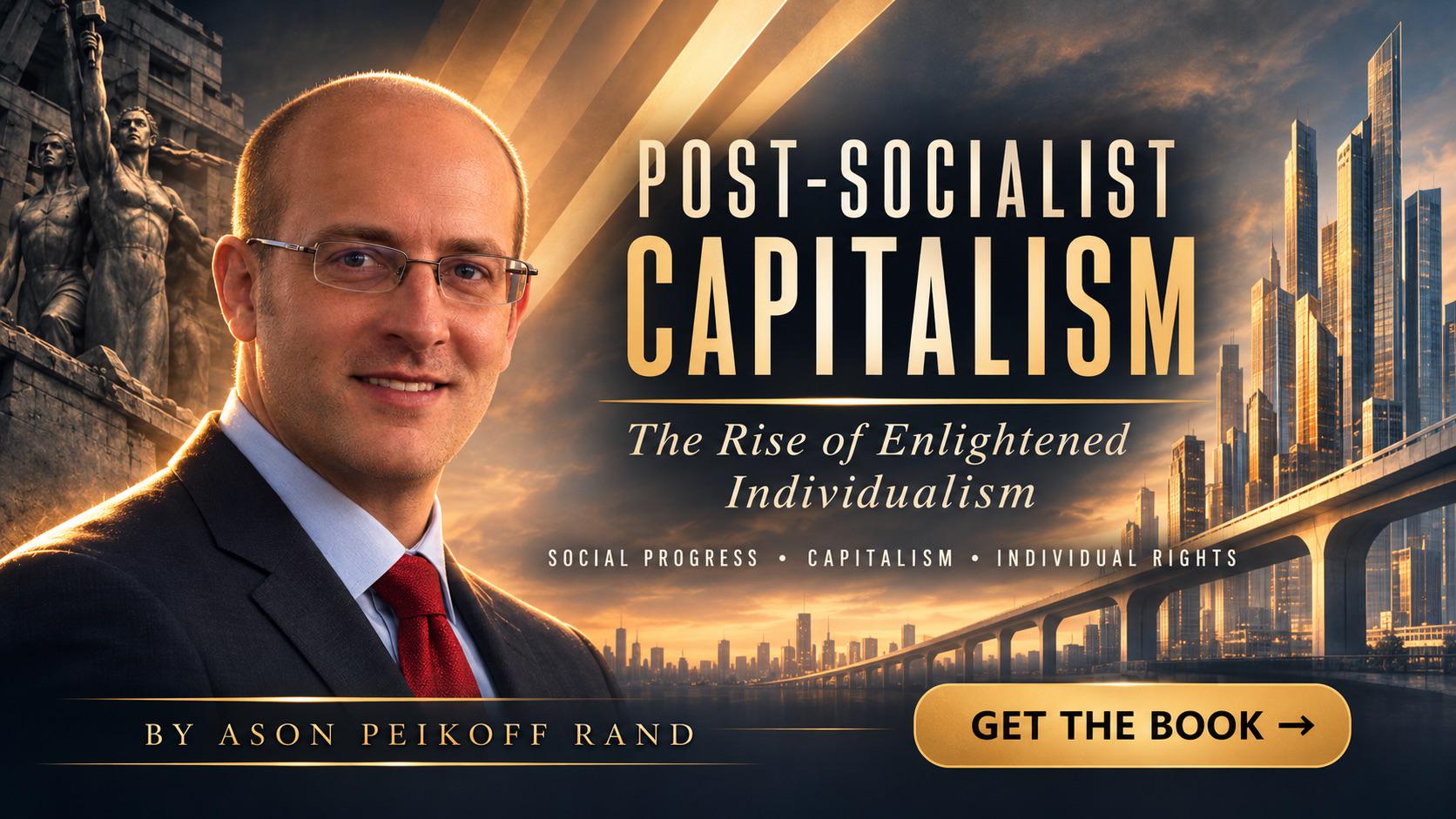
My first full-length Objectivist book is finally out. Yay.
- Amazon Kindle US: https://www.amazon.com/dp/B0HRHTS62T
- Amazon Kindle UK: https://www.amazon.co.uk/dp/B0HRHTS62T
- Amazon Kindle Canada: https://www.amazon.ca/dp/B0HRHTS62T
- Barnes & Noble: https://www.barnesandnoble.com/w/post-socialist-capitalism-ason-peikoff-rand/1151901233?ean=9798891572904
- Apple Books: https://books.apple.com/us/book/post-socialist-capitalism/id6834074102
- Kobo US: https://www.kobo.com/us/en/ebook/post-socialist-capitalism
- Kobo UK: https://www.kobo.com/gb/en/ebook/post-socialist-capitalism
- Kobo AU: https://www.kobo.com/au/en/ebook/post-socialist-capitalism
- Google Play: https://play.google.com/store/books/details?id=TDUsEgAAQBAJ
r/aynrand • u/Pitiful_Good_3672 • 10d ago

Sorry about the blood
The Fountainhead changed the way I viewed life. Howard Roark became a symbol of independence, reason, integrity, and living by my own convictions rather than seeking approval.
“Howard Roark laughed.”
I tattooed it as a permanent reminder of the philosophy that changed my perspective and the man I aspire to become.
r/aynrand • u/stansfield123 • 11d ago
For some reason, even though I've been diligently blocking religious content, this popped up in my Youtube feed.
It's Ayn Rand's Trader Principle explained beautifully and passionately. And this is exactly it. He gets it exactly right. This isn't altruism, this is simple, rational justice. This is a side of Christianity Objectivism has a lot in common with.
r/aynrand • u/ddxzzl • 12d ago
I just started reading the fountainhead, about 70 pages in and i kinda want to dnf it, it's 700 pages and a big compromise. But one thing about me is that i do not like to dnf books, let alone a book i've wanted to read for such a long time.
so..leave a comment if u think it's worth it pls xd, so i have a little hope/motivation
(btw i've seen comments about the writing being bad, and for me honestly i could look past the writing if the content is worth it, i mean there are books that u read for the writing and then there are ones u read for the 'message')
r/aynrand • u/EasternWahooJ • 13d ago
Voters agree that all politicians are corrupt. Why do people favor increasing government controls and regulation? With government control, we are powerless to stop corruption. Our only recourse is by voting, but that only happens once a year, and the corruption continues until there’s an investigation. It is a slow process, and meanwhile the new politicians we just voted in are probably involved in other corruption.
Isn’t the logical solution to cut government out of business regulation, and leave it to laissez faire capitalism and common law? With laissez faire, we vote with our pocketbooks every day, not once a year. If a business is not trustworthy or you don’t like what they’re doing, don’t buy from them. If they ripped you off, take them to court. Look what happened to the Tesla truck: people didn’t like Elon Musk, so they put his truck out of business only three years after he put it on the market. No voting needed, no congressional investigations and impeachments, just the market forces.
The only time it doesn’t work is with government sanctioned monopolies. So lets not have them either.
r/aynrand • u/WhippersnapperUT99 • 19d ago
Enjoy this excellent, easy-listening podcast that was just put out by ARI:
Democratic Socialism is a Religion
I had been thinking the exact same thing; that the DSA advocates have a religious-like faith that it will somehow magically work out and that "democracy" and people choosing not to work or working comfortable low stress low effort jobs will somehow magically result in material abundance.
r/aynrand • u/Old_Discussion5126 • 21d ago
We see so much chaos and violence in the news from Africa and other parts of the third world. But did all of it have to happen? The violence is often blamed on linguistic differences and arbitrarily drawn boundaries between countries, as if there were no way of settling such differences apart from war. But here’s what Rand had to say in the Q&A of her 1961 speech “Faith and Force: Destroyers of the Modern World”:
————-
Q: How does Objectivism apply to underdeveloped regions, such as in Africa or the American South?
A: The South is the one part of America that has never been capitalist. It was an agrarian society, and had more in common with medieval feudalism than with industrial capitalism. That’s why the South held on to slavery. Objectivism advocates capitalism, and capitalism is the only system incompatible with slavery. In fact, capitalism wiped out slavery in the nineteenth century, in part through the American Civil War and even Russia’s freeing of the serfs. Capitalism cannot function with slave labor, and the moral principles implicit in capitalism do not permit slavery.
Therefore, the first thing Objectivism would advocate in regard to undeveloped nations is not to send them material help but to teach them political freedom. For any nation, no matter how undeveloped, if it establishes a political system that protects individual rights, its progress and development will be phenomenal. The best in all men work to raise that society and to contribute to the progress of all—not by self-sacrifice but by plain rational self-interest. Capitalism, as history shows, raises the general standard of living, and men on all levels of ability are rewarded and get much more than they could get under any form of statism or tribal rule. If you want to help Africa, teach them the theory of freedom. If people who have lived for centuries under violence discover that they can exercise their ingenuity and create something, and that their rulers will protect them rather than forbid production or expropriate what they produce, you’d be amazed what productive talent would suddenly arise. At the start of the Industrial Revolution, most nations of the world were pretty primitive—perhaps not as undeveloped as Africa, but they were savages in the Middle Ages compared to what we are today. After one century of freedom, under government protection of individual rights and property, you couldn’t recognize the nature of the civilization, material prosperity, and undreamed-of talent that suddenly appeared among men. I predict the same would happen in Africa, if there were anyone to teach them what capitalism is. Unfortunately, that’s not what we’re exporting today; that’s not what we’re teaching them. What we’re doing is arming them without giving them the right ideology to go with those arms: the ideology of freedom and human rights. We’re only helping them destroy each other in civil wars, as the more civilized nations of earth are doing as well. [Rand seems to be referring to the then-recent World Wars.]
————
Here’s a ChatGPT-generated list of the various civil wars that have been fought in Africa alone since the fifties:
1955–1972 Sudan First Sudanese Civil War
1959–1961 Rwanda Rwandan Revolution and associated conflict
1960–1965 Congo (now DRC) Congo Crisis, including the Katanga secession
1962–1991 Ethiopia/Eritrea Eritrean War of Independence
1963–1974 Guinea-Bissau War of independence against Portugal
1963–1967 Kenya Shifta War (separatist conflict)
1964–1979 Zimbabwe (then Rhodesia) Rhodesian Bush War
1965–1979 Chad First Chadian Civil War
1967–1970 Nigeria Nigerian Civil War (Biafran War)
1972–1973 Burundi Hutu rebellion and mass killings (classification as a civil war is disputed)
1974–1991 Ethiopia Ethiopian Civil War
1975–2002 Angola Angolan Civil War
1977–1992 Mozambique Mozambican Civil War
1979–1982 Chad Renewed Chadian Civil War
1990–1994 Rwanda Rwandan Civil War
1991–1994 Djibouti Djiboutian Civil War
1991–2002 Sierra Leone Sierra Leone Civil War
1991–present Somalia Somali Civil War
1991–2002 Algeria Algerian Civil War
1993–2005 Burundi Burundian Civil War
1993–1994 Republic of the Congo First Republic of the Congo Civil War
1996–1997 Democratic Republic of the Congo First Congo War
1997–1999 Republic of the Congo Second Republic of the Congo Civil War
1998–1999 Guinea-Bissau Guinea-Bissau Civil War
1998–2003 Democratic Republic of the Congo Second Congo War
1999–2003 Liberia Second Liberian Civil War
2002–2007 Côte d’Ivoire First Ivorian Civil War
2003–2020 Sudan War in Darfur
2004–2007 Central African Republic First Central African Republic Bush War
2005–2010 Chad Chadian Civil War
2009–present Nigeria Boko Haram insurgency
2009–present Democratic Republic of the Congo Ongoing Kivu conflict, with shifting phases and armed groups
2011 Côte d’Ivoire Post-election crisis and renewed armed conflict
2012–present Mali and neighbouring Sahel states Mali conflict and expanding insurgencies
2012–present Central African Republic Central African Republic Civil War
2013–2020 South Sudan South Sudanese Civil War
2014–present Libya Libyan civil conflict (with distinct phases)
2016–present Cameroon Anglophone Crisis
2016–2017 Republic of the Congo Pool conflict
2020–2022 Ethiopia Tigray War
2023–present Sudan Sudanese Civil War between the Sudanese Armed Forces and Rapid Support Forces
2023–present Ethiopia Renewed armed conflict in Amhara
r/aynrand • u/Orkemus • 24d ago

I'm seriously asking, how strictly should we explain Ayn Rand's philosophy to children?
r/aynrand • u/Artistic_Cap4484 • 27d ago
Maybe it was Sheldon Richman that got me thinking about this or someone else , but something I've thought about is how the morality of altruism has structurally inverted an element in evaluating human relationships, in that it has replaced genuine empathy in many people, with a destructive envy.
Empathy is understood as a cognitive and emotional capacity to understand what another person is feeling. Properly understood, empathy applies just as powerfully to the successful, the happy, and the productive, just as it does to the unlucky, downtrodden, and unsuccessful.
When we look at someone who has achieved greatness or found deep joy, empathy allows us to resonate with that state of fulfillment, celebrating their success and utilizing it as a source of personal inspiration. It is the emotional acknowledgment of human efficacy and happiness, driving an individual to say, "I understand that joy, and I want to earn it for myself."
Today, however, this vital form of upward empathy has been entirely eradicated by a culture steeped in altruistic dogma. Because altruism demands that the individuals exist solely for the sake of others - elevating suffering as a moral currency - people no longer know how to emotionally process success or unapologetic happiness. When people look up at those who have achieved greatness, they no longer experience the aspirational empathy that fuels personal growth; instead, they are consumed by a bitter, leveling envy.
Altruism teaches people to believe that the success of the strong is stolen from the weak, which turns a great human achievement into something people resent. Under this mindset, successful people are expected to give up their wins and virtues, and when they refuse, everyone gets angry at them for rejecting their morality. Because this morality says we only owe our emotional support to people who are struggling or broken, it completely destroys our ability to admire and connect with human excellence, leaving nothing behind but pure envy.
Take the cultural reaction to a figure like Jeff Bezos as a concrete example of this psychological inversion. Building an enterprise that revolutionizes global logistics, creates massive infrastructure, and generates unimaginable wealth is an objective monument to human efficacy and productive genius. In a rational culture, looking up at Bezos's immense success would trigger an aspirational empathy - a deep resonance with the ambition, focus, and creative joy required to achieve such a feat, serving as a powerful inspiration for what is possible to human intelligence. Instead, because public morality is dominated by altruism, his achievement is viewed through a lens of profound resentment.
The dominant cultural response to someone like Bezos is not a desire to emulate or empathize with his productivity, but a bitter demand to dismantle his wealth, demonstrating how the culture's view of success (qua altruism) completely destroys the capacity to admire greatness and replaces it with pure, leveling envy.
r/aynrand • u/jackRoark • 28d ago
In the late 80s, shortly after I first discovered Objectivism and was blown away by it, I heard that Leonard Peikoff was going to be giving a lecture in Boston titled "Why Should One Act on Principle". I flew there from Miami with my girlfriend at the time and attended the lecture. I had great seats--around fourth row, center. A couple years later I saw a clip of the video and saw myself (and my girlfriend, asleep on my shoulder!--bored and hungover) during a shot of the audience.
I've been trying to find the VHS copy of this for years. Leonard Peikoff's site states "Also available on video: 'Why Should One Act on Principle'...may be ordered from the Ayn Rand Institute eStore..." but unfortunately, they only offer the MP3 download.
Does anyone out there have a copy of this!
r/aynrand • u/RA_Finance • 29d ago
Hello Randians,
I wanted to know what you think most people get wrong about Ayn Rand, both in terms of Objectivism and the personal beliefs espoused in her novels.
In my view, people often mistake her artistic writing for her philosophical work, and they misunderstand what she actually believed. They think of her in paradigms they understand, like democrat and republican, rather than the laissez-faire capitalist and Objectivist she was. Ayn Rand was pro-abortion, pro-immigration, denounced racism, and was an atheist. Conversely, she was in favour of the separation of state and economy.
What do you think?
r/aynrand • u/Ktown858 • 29d ago

I recently received the attached comment on one of my YouTube videos, objecting to my description of the Western literary tradition as stretching "from Homer to Rand."
It got me thinking about something I've been investigating for years.
Why is Ayn Rand relatively neglected in academic literature departments?
I suspect ideological bias plays a significant role, but I think there's a deeper question about the nature of literary scholarship.
Imagine a biologist who discovers an unfamiliar organism. He might find it beautiful, fascinating, repulsive, or dangerous. But surely his first impulse as a scientist should be to investigate and understand it.
Shouldn't a scholar of literature possess that same curiosity?
You don't have to admire Rand to study her fiction. You don't have to be an Objectivist to investigate The Fountainhead or Atlas Shrugged as works of imaginative literature.
Keats captures something of the intellectual spirit I have in mind in On First Looking into Chapman's Homer:
Then felt I like some watcher of the skies
When a new planet swims into his ken.
I've spent nearly twenty years studying and teaching the great works of Western literature, from Homer onward. One of my continuing interests is evaluating Rand as a literary artist in relation to her predecessors, particularly writers like Hugo and Dostoevsky.
I think there are legitimate questions about her literary strengths and weaknesses. But those are questions to investigate, not reasons to dismiss her without serious study.
I'm curious what other readers of Rand think.
Does Rand deserve a place in the Western literary canon?
And more interestingly, what should determine whether an author is studied academically: literary greatness, historical influence, philosophical originality, or something else?
r/aynrand • u/DrTardis1963 • 29d ago
I saw someone ask,
"Why do people still listen to Hillary Clinton? Why do people fall for this? Trump is a lunatic, but why do people think she is better?"
I no longer see figures, at all, when it comes to politics. When I hear the names of politicians, I do not even for a moment waste time thinking about their pros, and cons, qualities or otherwise, or compare them to other politicians. At the end of the day, they are all the same, and none can create any outcome any different from any other, as they all operate within the same flawed system, and set of principles.
They are all, inert.
To answer the question above, it is because people do not understand that the political is superflous, and an abstraction from the psychological, and physical, (physics).
*By definition* any manmade system cannot violate the laws of physics, lest it be 'supernatural', and therefor *must* follow them, and thus inherits their laws and principles from the layers below.
This is why fluid dynamics can describe crowd crush, and traffic flow in cities. We are bound and governed by the laws of physics.
People think that 'government' means a group of people 'governing' another group of people. That it means a system of power, and responsibility, an institution, which, if the right philosophy is installed, like exchanging a game cartridge, or a faulty computer chip, for another, then the world will be improved, problems will be solved, and things will be reorganised, intelligently, and productively.
No. Government, an adjective, not a noun, really, is to *govern* your own psyche, your own self. It is to be soverign, and to make certain moral vows, and declarations, and choices, and to behave in a certain way, and live according to a certain ethos. It is to decide the person you want to be, what you're going to stand for, what you're not going to stand for, and what sort of life you want to have.
There will be no improvement by external, bureacratic government.
An improvement in government is always going to be in self-government. I don't mean in an anarchist sense, (though, that is part of it, as the collective is an entity which is fundamentally, and neccesarily hostile to the individual, who poses an existential threat), but rather, that to govern one's psyche, and be a moral agent, is the only way forward.
It is not a government of state we need, but a government of psyche.
Politics is *entirely* a distraction and an abstraction.
Figure out how to be an agent, a driving force, conscious in your OWN life, and do what's best for you, without it being at the expense of others, or encroaching on their own civil liberties.
This is what Rand was teaching.
If you don't look out for what's best, for you, at the end of the day, you live a worse life, and thus, the world becomes a worse place. If everyone did that, failed to look out for what's best for them, then everyone would be in a worse position. If everyone were in a worse position, the world would be far more hellish.
That was the reality of the centuries prior to ours, comparitively. Those were the dark ages, the stone ages, and so forth.
Altruism, as Rand defined it, *is*, by definition, a parasitical philosophy, as it takes, and takes, at the expense of the host, to enrich itself (the other), and only when it has taken its fill, does it exhaust the host, and both die, in mutually assured destruction.
The correct philosophy to live by is rational self interest, what she called 'selfishness', that is, not to say a parasitic selfishness, but a symbiotic one.
Living with your self interest in mind (because if you don't you forego everything and the world goes to hell), and also, part of living with your self interest in mind is not to destroy the environment or harm the people around you, (as that goes against your interest anyway)
Don't shit where you eat, so to speak.
But don't give all your food away and starve, either, out of 'altruisitc compassion for the poor'
If you hunt, and they don't, and you eat, and they don't, do not pity them. Their work has yielded the fruits due to them, and your work has yielded the fruits due to you.
You have produced,
and they have parasitically extracted.
Compassion toward the parasite is suicide, or mutally assured destruction.
If you feed the parasite, and eventually succumb, and die, rather than killing it, by covering it with salt, and removing it from your arm, then *you* are Evil.
You have wasted something good in the world. You have betrayed, life.
You are, *anti-life*, when you feed the parasite.
The man who will not remove the parasite from his arm is the man who is acting against his own life, and thus the principle of life itself.
A living being acting against life, is acting irrationally, by definition.
This is what is meant by suicidal empathy. This is the altrusim that Rand rallied against.
The lesson here is two-fold.
Political revolution is futile.
Psychological and Philosophical revelation is the only way forward.
Altruism, parasitic compassion, or sucidial empathy, are self-destructive, and destructive, in general, in the most cataclysmic way. These are cancerous ideologies, that, if universally adopted, would lead to the annihilation of consciousness on Earth, and a return to pure, barbaric, animal primativism.
The kind with sharp teeth, and necks torn out. Impulses without thought, without reflection.
If you have ever seen 28 days later, that paints a picture of such a world. A world without consciousness. Hell on Earth.
That is what Rand warned of, in Atlas Shrugged.