r/BibleVerseCommentary • • 12h ago

"Abba" means "Daddy"?

2 Upvotes

u/No-Fly-9749

Mt 11:

25 At that time Jesus declared, “I thank you, Father, Lord of heaven and earth, that you have hidden these things from the wise and understanding and revealed them to little children.

Strong's Greek: 3962. πατήρ (patér) — 418 Occurrences

Mk 14:

36 He said, “Abba, Father, all things are possible for you. Remove this cup from me. Yet not what I will, but what you will.”

Strong's Greek: 5. Ἀββᾶ (Abba) — 3 Occurrences

BDAG:

orig. a term of endearment, later used as title and personal name; rarely used in ref. to God) father, translit. abba, Aram. form used in prayer and in the family circle, taken over by Greek-speaking Christians as a liturgical formula.

Crossway.org:

As New Testament scholar Joachim Jeremias says, “We can say quite deliberately that there is no analogy at all in the whole literature of Jewish prayer for God being addressed as Abba. This assertion applies not only to fixed liturgical prayer, but also to free prayer, of which many examples have been handed down to us in Talmudic literature.”

Prof Jeremias overstated his assertion. The book of Sirach was written originally in Hebrew. Ben Sira prayed in (Good News Translation) Sirach 23:

1 O Lord, my Father and Master of my life, do not leave me at the mercy of my own words; don't let them cause my downfall. … 4 O Lord, my Father, God of my life, keep me from being arrogant.

Tobit 13:4, Wisdom 14:3, 3 Maccabees 6:3, and Jubilees 1:24 all use "Father" for God in prayer. All these books were written before or around Jesus' time.

Moreover:

In his book The Central Message of the New Testament, Joachim Jeremias explains: “To his disciples it must have been something quite extraordinary that Jesus addressed God as ‘my Father.’ ”

Perhaps to Jesus uneducated disciples, but not to Jesus' general listeners.

Why do some Christians think that 'Abba' meant 'Daddy'?

The Gospel Coalition:

This origin of this understanding is generally traced to the notable German Lutheran New Testament scholar Joachim Jeremias who in his 1971 text New Testament Theology explained that abba was “the chatter of a small child. . . . a children’s word, used in everyday talk” and seemingly “disrespectful, indeed unthinkable to the sensibilities of Jesus’ contemporaries to address God with this familiar word” (p. 67). While Jeremias did not use the word “daddy” or “papa” in relation to abba, the implication was strong and others came along to make that connection.

Dr. Jeremias thought that 'Abba' was a children's word, a sort of baby talk, which was not true.

University of Fribourg’s Georg Schelbert critiqued Jeremias’ assertion in a 1981 essay and then later in a 2011 book-length treatment entitled ABBA Vater. He contends that Jeremias’ interpretation is in “error” and “unwarranted.” He elaborates,

It was not restricted to baby talk. Adults regularly used it to address their fathers.

This is because, as we shall see, abba means either “father” or one’s own father. Schelbert explained that Jeremias even adjusted his earlier understanding in the face of critical peers.

Even Dr Jeremias had to retreat.

Prof James Barr, “Abba Isn’t Daddy”, Journal of Theological Studies (vol. 39, 1988):

It is fair to say that abba in Jesus’ time belonged to a familiar or colloquial register of language, as distinct from more formal and ceremonious language. . . . But in any case it was not a childish expression comparable with ‘Daddy’: it was a more solemn, responsible, adult address to a Father. (p. 46)

'Abba' could express both intimacy and respect.

Ro 8:

15 For you did not receive the spirit of slavery to fall back into fear, but you have received the Spirit of adoption as sons, by whom we cry, “Abba! Father!”

Julius Caesar adopted Octavian as his son. In the Roman world, adoption could confer a solemn legal status, including inheritance rights. Paul's adoption imagery is therefore consistent with a mature and responsible filial relationship.

Abba = Daddy?

Not exactly. The Aramaic אַבָּא means “Father.” It belonged to a familiar or colloquial register and could express intimacy and respect. It was not restricted to children's speech. “Daddy” introduces a childlike connotation that is not always present in the original Aramaic. Jeremias overstated his case and later modified his position, but some pastors and Christians still perpetuate the earlier erroneous interpretation.

Abba meant Dad?

“Dad” is a more defensible English rendering of Abba than “Daddy.”

See also


r/BibleVerseCommentary • • 13h ago

2 Timothy 1:7

4 Upvotes

2 Timothy 1:7 (KJV) — A reminder that fear does not have to rule us. How does this Scripture help you overcome adversity?


r/BibleVerseCommentary • • 13h ago

Semitic loanwords in the NT

1 Upvotes

u/Caliesq86, u/sarcasticGreek

New American Bible, Jn 8:

58 Jesus said to them, “Amen, amen, I say to you, before Abraham came to be, I AM.”

Strong's Greek: 281. ἀμήν אָמַן (amén) — 143 Occurrences

Mark 2:

23 One Sabbath Jesus was going through the grainfields, and as his disciples walked along, they began to pick some heads of grain.

Strong's Greek: 4521. σάββατον שַׁבָּת (sabbaton) — 68 Occurrences

Matthew 26:

2 “You know that after two days the Passover is coming, and the Son of Man will be delivered up to be crucified.”

Strong's Greek: 3957. πάσχα פִּסְחָא (pascha) — 29 Occurrences

Berean Literal Bible, Mk 9:

43 And if your hand should cause you to stumble, cut it off; it is better for you to enter into life crippled, than having two hands to go away into Gehenna, into the unquenchable fire.

Strong's Greek: 1067. γέεννα גְּהִנָם (geenna) — 12 Occurrences

Mark 11:

9 Those who went ahead and those who followed shouted, “Hosanna!” “Blessed is he who comes in the name of the Lord!”

Strong's Greek: 5614. ὡσαννά הושַׁע־נָא (hósanna) — 6 Occurrences

Berean Literal Bible, Lk 16:

13 No servant is able to serve two masters. For either he will hate the one and he will love the other, or he will be devoted to one and he will despise the other. You are not able to serve God and mammon."

Strong's Greek: 3126. μαμμωνᾶς מָאמונָא (mamónas) — 4 Occurrences

Revelation 19:

1 After this I heard what sounded like the roar of a great multitude in heaven shouting: “Hallelujah! Salvation and glory and power belong to our God,

Strong's Greek: 239. ἀλληλουϊα הַלְלוּ־יָהּ, (hallélouia) — 4 Occurrences

Mark 14:

36 And he said, “Abba, Father, all things are possible for you. Remove this cup from me. Yet not what I will, but what you will.”

Strong's Greek: 5. Ἀββᾶ אָב (Abba) — 3 Occurrences

Mark 15:

22 They brought Jesus to the place called Golgotha (which means “the place of the skull”).

Strong's Greek: 1115. Γολγοθᾶ גֻּלְגָלְתָא (Golgotha) — 3 Occurrences

John 1:

41 The first thing Andrew did was to find his brother Simon and tell him, “We have found the Messiah” (that is, the Christ).

Strong's Greek: 3323. Μεσσίας מְשִׁיחָא (Messias) — 2 Occurrences

English Revised Version, Ro 9:

29 And, as Isaiah hath said before, Except the Lord of Sabaoth had left us a seed, We had become as Sodom, and had been made like unto Gomorrah.

Strong's Greek: 4519. σαβαώθ צְבָאות (sabaóth) — 2 Occurrences

Berean Literal Bible, 1 Corinthians 16:

22 If anyone does not love the Lord, let him be accursed. Maranatha!

Strong's Greek: 3134. μαρὰν אֲתָה מָרָנָא, (marana tha) — 1 Occurrence

Mark 5:

41 He took her by the hand and said to her, “Talitha koum!” (which means “Little girl, I say to you, get up!”).

Strong's Greek: 5008. ταλιθά טְלִיתָא (talitha) — 1 Occurrence
Strong's Greek: 2891. κοῦμι קוּמִי (koum) — 1 Occurrence

Mark 7:

34 He looked up to heaven and with a deep sigh said to him, “Ephphatha!” (which means “Be opened!”).

Strong's Greek: 2188. ἐφφαθά פְּתַח (ephphatha) — 1 Occurrence

Here are some more:

GreekStrong'sSemitic originMeaningReference
ῥαββί (rabbi)G4461HebrewMy master, teacherJn 1:38
ῥαββουνί (rabbouni)G4462AramaicMy master, teacherJn 20:16
ῥακά (raka)G4469AramaicEmpty-headed, foolMt 5:22
κορβᾶν (korban)G2878Hebrew/AramaicOffering dedicated to GodMk 7:11
σίκερα (sikera)G4608Hebrew/AramaicStrong drinkLk 1:15
ἐλωΐ (eloi)G1682AramaicMy GodMk 15:34
ἠλί (eli)G2241HebrewMy GodMt 27:46
λαμά (lama)G2982Hebrew/AramaicWhyMt 27:46
σαβαχθανί (sabachthani)G4518AramaicYou have forsaken meMt 27:46

In the Greek NT, apart from personal names and other proper nouns, more than 20 Greek lexical forms are borrowed or transliterated from Hebrew, Aramaic, or other Semitic languages. Some became established religious vocabulary, while others preserved particular Semitic utterances in the Greek text.


r/BibleVerseCommentary • • 16h ago

God formed the man of DUST from the ground

1 Upvotes

Gn 2:

6 A mist was going up from the land and was watering the whole face of the ground—

There was moisture.

7 The Lord God formed the man of dust from the ground and breathed into his nostrils the breath of life, and the man became a living creature.

Strong's Hebrew: 6083. עָפָר (aphar) — 110 Occurrences

HALOT:

  1. fine dry top-soil, dust
  2. loose earth, soil:
    a) as part of the “substance” of human beings
    b) in general עָ׳ as an element of the earthly domain (also poetical for “earth”)
  3. rubble
  4. the grave and the world of the dead.

The word does not necessarily imply an absence of moisture.

Isaiah 64:

8 O LORD, you are our Father; we are the clay [H2563], and you are our potter; we are all the work of your hand.

Job 10:

9 Remember that you have made me like clay; and will you return me to the dust?

Job put chomer (clay) and 'aphar (dust) side by side.

Gn 3:

19 You are dust, and to dust you shall return.

There is some probability that God formed Adam from moistened earth.


r/BibleVerseCommentary • • 20h ago

What was the significance of hyssop?

3 Upvotes

u/Defiant-Ad1319, u/Alive-Requirement837

Hyssop was a plant mentioned several times in the Bible.

During the first Passover in Egypt, the Israelites were instructed to use a bunch of hyssop to smear the lamb's blood on their doorposts. Ex 12:

21 Moses called all the elders of Israel and said to them, “Go and select lambs for yourselves according to your clans, and kill the Passover lamb. 22 Take a bunch of hyssop and dip it in the blood that is in the basin, and touch the lintel and the two doorposts with the blood that is in the basin. None of you shall go out of the door of his house until the morning.

This application of the Passover lamb's blood symbolized protection and deliverance from the plague of the firstborn.

Le 14:

6 [The priest] shall take the live bird with the cedarwood and the scarlet yarn and the hyssop, and dip them and the live bird in the blood of the bird that was killed over the fresh water. 7 And he shall sprinkle it seven times on him who is to be cleansed of the leprous disease. Then he shall pronounce him clean and shall let the living bird go into the open field.

In this cleansing ritual, the priest soaked hyssop in blood and sprinkled it on a formerly leprous person. Similarly, a priest would cleanse a house dwelling (v 51).

Hyssop was burned in the red heifer ritual. The ashes were used to make a special purification water.

Ps 51:

7 Cleanse me with hyssop, and I will be clean; wash me, and I will be whiter than snow.

Hb 9:

19 When every commandment of the law had been declared by Moses to all the people, he took the blood of calves and goats, with water and scarlet wool and hyssop, and sprinkled both the book itself and all the people, 20 saying, “This is the blood of the covenant that God commanded for you.”

These usages of the hyssop foreshadowed the sacrifice of Christ.

John 19:

28 After this, Jesus, knowing that all was now finished, said (to fulfill the Scripture), “I thirst.” 29 A jar full of sour wine stood there, so they put a sponge full of the sour wine on a hyssop branch and held it to his mouth. 30 When Jesus had received the sour wine, he said, “It is finished,” and he bowed his head and gave up his spirit.

John was the only Gospel writer who specifically identified hyssop in this incident.

Shortly afterward, John reinforced the Passover connection:

36 For these things took place that the Scripture might be fulfilled: “Not one of his bones will be broken.”

John alluded to Ex 12:46.

  1. In the Exodus, hyssop was used to smear lamb’s blood on doorposts during the Passover, protecting the Israelites from the Angel of Death. Jesus’ death occurs during the Passover festival. He’s called "the Lamb of God" (John 1:29). The hyssop linked his sacrifice to the Passover lamb, signaling deliverance from death. He died in our place.
  2. Jesus’ death cleanses humanity’s sin (1 John 1:7). Hyssop was the means of applying cleansing blood; Christ is the cleansing blood itself.
  3. With the red heifer parallel, ashes + hyssop = purification from death’s defilement. Jesus' death saves us from eternal death.

What was the significance of hyssop?

It is connected to Jesus' death on the cross. It showed up just before Jesus died. It symbolized Passover liberation, sacrificial fulfillment, and purification from sin and death. Just as hyssop was used in the Passover to protect the Israelites, Jesus becomes the ultimate Passover Lamb whose blood brings salvation and redemption.


r/BibleVerseCommentary • • 20h ago

Do humans have a sinful nature?

2 Upvotes

u/No-Promise-1

Yes, humans are sinful by nature. Ep 2:

1 You were dead in the trespasses and sins 2 in which you once walked, following the course of this world, following the prince of the power of the air, the spirit that is now at work in the sons of disobedience— 3 among whom we all once lived in the passions of our flesh,

BDAG σάρξ:
② the physical body as functioning entity, body, physical body
ⓒα. In Paul’s thought esp., all parts of the body constitute a totality known as σ‌. or flesh, which is dominated by sin to such a degree that wherever flesh is, all forms of sin are likewise present, and no good thing can live in the σάρξ Ro 7:18

carrying out the desires of the body and the mind, and were by nature children of wrath, like the rest of mankind.

I use the above to define sinful nature. Our physical body affects our mind, and we want to sin. This desire to sin is our sinful nature. This is not the end of the story. There is good news:

4 But God, being rich in mercy, because of the great love with which he loved us, 5 even when we were dead in our trespasses, made us alive together with Christ—by grace you have been saved— 6 and raised us up with him and seated us with him in the heavenly places in Christ Jesus, 7 so that in the coming ages he might show the immeasurable riches of his grace in kindness toward us in Christ Jesus. 8 For by grace you have been saved through faith. And this is not your own doing; it is the gift of God, 9 not a result of works, so that no one may boast. 10 For we are his workmanship, created in Christ Jesus for good works, which God prepared beforehand, that we should walk in them.

God's divine nature dwells in us and helps us to overcome the desire to sin, i.e., to overcome our sinful nature.

Do humans have a sinful nature?

Yes, but those who are born again also have the divine nature.

Do born-again Christians have a sinful nature?

Before we receive our glorified body, we still have the fleshly desire to sin. That's our sinful nature by definition.

Ga 5:

17 For the flesh desires what is contrary to the Spirit, and the Spirit what is contrary to the flesh. They are in conflict with each other.

There is good news: The more we grow in the Spirit, the less we obey the sinful nature.

See also


r/BibleVerseCommentary • • 20h ago

Did sinful nature exist before the Fall?

4 Upvotes

u/bearabovethewave, u/Time-Blacksmith5103, u/LeonidasCameseas

That's a matter of definition. It depends on what you mean by sinful nature. If by "sinful nature" you mean the capacity to choose against God (D1), then yes, that existed before the Fall. Adam and Eve could choose to obey or disobey. However, if by "sinful nature" you mean an inward disposition or inclination toward sin (D2), what many theologians call the fallen nature or original sin, then the answer is no, by this latter definition. D2 implies D1 but not conversely

Before the Fall, Adam and Eve were created "very good" (D1 and not D2). They were not internally corrupted. They had the ability not to sin. After the Fall, people are born with a sinful disposition (D2) (Ps 51:5, Ep 2:3). We are not merely capable of sinning; we are inclined toward it.

This raises a question: If Adam had no sinful nature (D2), why did he sin?

Sin does not require a sinful nature to originate. The first sin arose from free creatures misusing their good volitions. Adam's sinful nature resulted from his first sin, not its cause. Ability to sin (D1) existed before the Fall. Sinful nature (D2) resulted from the Fall.

This distinction also explains how Satan could sin without previously having a sinful nature: his rebellion likewise originated in the misuse of a good will.


r/BibleVerseCommentary • • 1d ago

Prof Karl Barth didn't practice what he preached

4 Upvotes

Wiki:

Karl Barth (1886 – 1968) was a Swiss Reformed theologian. … Barth's influence expanded well beyond the academic realm to mainstream culture, leading him to be featured on the cover of Time on 20 April 1962.[7]

He was a major theologian of his time.

Paul Palmer quoted Barth:

"But to love, diligere, means to choose, selecting this woman or man, and no other. The man who thinks it possible and permissible to love many women simultaneously or alternately has not yet begun to love. He is still in the stage of experiment and if he does not overcome his inconstancy he will always be a bungler in this sphere" (Karl Barth, Church Dogmatics 3, 4, 195).

Barth published the above words in his multi-volume theological summa, the Church Dogmatics. He affirmed a one-man, one-woman intimate relationship.

Palmer continued:

For Barth, marital love is the reflection of God's covenant love, which is elective and selective. After developing God's many covenants with individuals as well as collectives, [Barth] concludes: "As marriage is set in the light of this election and covenant, and comes under the command of the God of this election and covenant, it can only be monogamy. In this context it becomes exclusive" {ibid., p. 198).

Barth affirmed monogamy as a doctrine.

Wiki:

In 1913 he married Nelly Hoffmann, a violinist. … Karl Barth went on to become a professor of theology in Göttingen (1921–1925), Münster (1925–1930) and Bonn (1930–1935) in Germany. While serving at Göttingen he met Charlotte von Kirschbaum, who became his long-time secretary, assistant and lover;[19] she lived in the family home for 37 years and played a large role in the writing of his epic, the Church Dogmatics.[20]

He had a wife and a lover at the same time in the same house. His wife suffered emotionally from the arrangement, and Barth knew it. His own words condemned his practice.

God will judge teachers like Barth and me more harshly.


r/BibleVerseCommentary • • 1d ago

Earliest reference of 'Israel'

4 Upvotes

u/GaryGaulin, u/Zesty369, u/Character-Story916

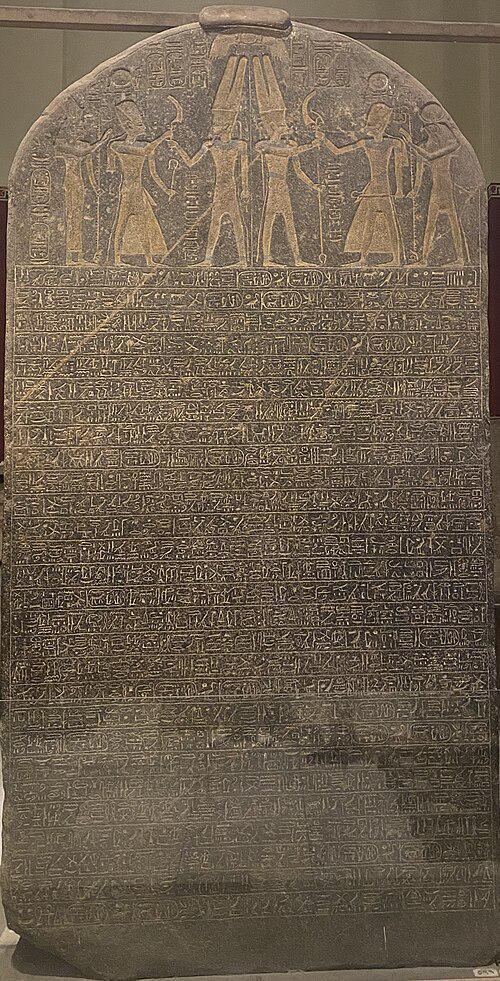
Merneptah, a pharaoh in ancient Egypt, reigned from 1213 to 1203 BCE. He made the stele.

Merneptah Stele

Wiki:

The bulk of the inscription deals with Merneptah's victory over the Libyans, but the closing lines shift to Canaan:[13][14]

The pharaoh declared:

The princes are prostrate, saying 'Peace!'
Not one raises his head among the Nine Bows.
Desolation is for Tjehenu;
Hatti is pacified;
Plundered is the Canaan with every evil;
Carried off is Asqaluni;
Seized upon is Gezer;
Yanoam is made non-existent;
Israel is laid waste—its seed is no more;
Kharru has become a widow because of Egypt.
All lands together are pacified.
Everyone who was restless has been bound.[15]

That was the time of the Exodus. Merneptah boasted of his victory over other peoples. The inscription was royal victory propaganda, not an objective historical report. He didn't finish Israel.

What is its significance?

The stele was the earliest textual reference to Israel and the only reference from ancient Egypt.


r/BibleVerseCommentary • • 1d ago

Why did God choose animal sacrifices as a way to worship Him?

2 Upvotes

u/PsychologicalHall759, u/yourOldEthernetCord, u/FergusCragson

Animal sacrifices served multiple religious purposes, including worship, thanksgiving, fellowship, purification, and atonement (Lv 3, 7).

More specifically, Leviticus 17:

11 For the life of the flesh is in the blood, and I have given it for you on the altar to make atonement for your souls, for it is the blood that makes atonement by the life.

The life of an animal was associated with its blood. God assigned blood a particular function on the altar. That function was to make atonement. Animals bled blood. God wanted to see blood on the altar.

What did the blood atone for?

Leviticus 4:

35 The priest shall make atonement for him for the sin which he has committed, and he shall be forgiven.

Blood atoned for sin.

Most importantly, animal sacrifices foreshadowed Jesus's sacrifice on the cross. Hebrews 10:

1 For since the law has but a shadow of the good things to come instead of the true form of these realities, it can never, by the same sacrifices that are continually offered every year, make perfect those who draw near.

OT animal blood sacrifice was a type and shadow.

John 1:

29 Behold, the Lamb of God, who takes away the sin of the world!

The New Testament presented the sacrificial system as anticipating Christ's sacrifice. Unlike the repeated animal sacrifices, Christ offered himself once for all.

Hebrews 10:

4 For it is impossible for the blood of bulls and goats to take away sins.

They were imperfect sacrifices. They repeatedly pointed to human sins.

10 By that will we have been sanctified through the offering of the body of Jesus Christ once for all.

Jesus' willing sacrifice was the true sacrifice.

Why did God choose animal sacrifices as a way to worship Him?

God instituted animal sacrifices for worship, thanksgiving, fellowship, purification, and atonement. Most importantly, in the New Testament's theological interpretation, they foreshadowed Jesus Christ's once-for-all sacrifice for sins.


r/BibleVerseCommentary • • 1d ago

1984 vs. 2011 New International Version

2 Upvotes

u/HurinThalion53, u/21stNow, u/redd-it-is-notgood7

95% of the text of the updated NIV is exactly the same as the 1984 text. The 2011 NIV is a substantial revision of the 1984 NIV. The translation philosophy shifted from a balance of formal and dynamic equivalence to the same balance but with greater attention to contemporary English usage.

VerseNIV 1984NIV 2011
Pr 12:15The way of a fool seems right to himThe way of fools seems right to them
Psalm 1:1Blessed is the manBlessed is the one
Mark 1:17Fishers of menFish for people
1 Timothy 2:4All menAll people
Ro 12:1I urge you, brothersI urge you, brothers and sisters
1Tm 2:12to have authority over a manto assume authority over a man
Ro 16:1our sister Phoebe, a servant
Romans 8:4Sinful natureFlesh
Philippians 4:13I can do everythingI can do all this
Philippians 2:6Something to be graspedSomething to be used to his own advantage

The most controversial change concerns gender language. NIV 1984 frequently used 'man', 'he', 'brothers'. NIV 2011 uses 'person', 'they', 'brothers and sisters'. Gender-inclusive language is not gender-neutral theology. The translators sought to distinguish references to males specifically from references to human beings generally.

There are some changes in theological terms, e.g., from 'sinful nature' to 'flesh'.

Which NIV is better?

It depends on what you're using it for, but for most purposes I'd lean toward the 2011. It's the maintained text, so footnotes, study Bibles, and apps are built around it. It draws on newer manuscript and Dead Sea Scrolls work.

If you don't like the gender-inclusive language, you may want to switch to ESV.


r/BibleVerseCommentary • • 1d ago

What animals did humans both eat and ride in the bible?

3 Upvotes

u/Effective_Tooth_6856, u/Billybobbybaby, u/laymans_razor

Gn 9:

3 Every moving thing that lives shall be food for you. And as I gave you the green plants, I give you everything. 4 But you shall not eat flesh with its life, that is, its blood.

After the flood, God permitted humans to eat any animal, but not to eat the blood.

Moses' law was stricter. Leviticus 11:

3 Whatever parts the hoof and is cloven-footed and chews the cud, among the animals, you may eat.

Under this rule, Israelites could eat cattle, sheep, goats, and deer, but not horses, donkeys, camels, or pigs.

Cattle, sheep, and goats were eaten and sacrificed. They were used for plowing, hauling, and wool, not riding.

Donkeys were the standard riding animal. Balaam and Jesus rode them. They weren't clean food, but in the siege of Samaria, people ate them out of desperation. 2K 6:

25 There was a great famine in Samaria, as they besieged it, until a donkey's head was sold for eighty shekels of silver, and the fourth part of a kab of dove's dung for five shekels of silver.

Horses were ridden in war and pulled chariots. Ezekiel's vision of the judgment on Gog had them as food for the birds and beasts. Ezk 38:

28 You shall be filled at my table with horses and charioteers, with mighty men and all kinds of warriors, declares the Lord GOD.

That's a symbolic feast, not a description of people's diet.

What animals did humans both eat and ride in the bible?

No animals were routinely eaten and ridden by the Israelites.


r/BibleVerseCommentary • • 2d ago

listen to cozy audio bible

2 Upvotes

Looking for a peaceful way to spend time in God’s Word? 📖

Welcome to **Cozy Audio Bible** — a cozy place to slow down, rest, and listen to Scripture.

I’ve recorded **over 18 hours of Bible reading**, so you can listen while relaxing, getting ready for bed, doing chores, enjoying a quiet morning, or simply spending time with God. 🕊️

Whether you’re looking to strengthen your faith, find peace in God’s Word, or just want something comforting to listen to throughout the day, I hope this podcast can be a little blessing to you. 🤍

🎧 **Listen on Spotify!**

**https://open.spotify.com/show/033gQQoMmtHDg3dCWqEyyw?si=WY-n8uXRR6S0-D0J5L5TlQ&utm_source=copy-link**

if u like it too, please rate it! let’s grow closer to God!

Come cozy up with the Word of God. ☁️📖

\#CozyAudioBible #AudioBible #BibleReading #ChristianPodcast #GodsWord #Faith #Jesus #Christianity #BibleStudy #Scripture #SpotifyPodcast


r/BibleVerseCommentary • • 2d ago

Report alleges IHOPKC leaders invoked Jesus to silence an abuse victim

2 Upvotes

u/ZookeepergameFar2653, u/bjohn15151515, u/Aggressive_Tax1938

IHOPKC stands for International House of Prayer Kansas City, a charismatic Christian ministry founded by Mike Bickle in 1999 in Kansas City, Missouri.

International House of Prayer University (IHOPU), a ministry training school rather than a conventional research university. David Sliker served in IHOPKC leadership for more than two decades and was president of IHOPU until his resignation in January 2024.

Following revelations concerning Mike Bickle and other leaders, IHOPKC announced in April 2024 that it would wind down its university, church, and several training programs. However, the organization did not completely close. Its prayer ministry continues operating in 2026.

Report: IHOPKC’s Mike Bickle Sexually Abused 17 Women and Girls, While Staff Protected Him:

More than a year after Mike Bickle stepped away from ministry amid a sexual abuse “crisis,” an independent investigation revealed that he sexually abused at least 17 women, including several minors, beginning 50 years ago. Bickle, 69, is founder of the International House of Prayer Kansas City (IHOPKC), a charismatic ministry that cut ties with him in December 2023 due to “inappropriate behavior.”

Bickle got away with his abuse for decades.

During worship services, Bickle would “grab girls by their throats, kiss them on their faces, and ruffle their hair,” the report said. That was “a calculated tactic to desensitize his victims to physical contact,” it added, “gradually pushing boundaries until they were normalized.”

People knew about his inappropriate behavior.

He offered the women “Papa time” with him, wrote them notes with messages such as, “You’re mine,” and told several women (separately) that he’d marry them after his wife died.

The reported conduct demonstrated repeated sexual boundary violations and exploitation of spiritual authority.

He had other staff to cover him:

Abuse survivors told investigators that IHOPKC staff members forced them to meet with and apologize to their abusers, while telling them not to file police reports. Olivia Bauman-Pousseur, who said she was sexually assaulted as an 18-year-old intern at IHOPKC, alleged that David Sliker, former president of IHOP University, said her account of abuse was “all a considerable misinterpretation.”

Sliker allegedly participated in concealing abuse.

Bauman-Pousseur said Sliker told her the abuser had repented and she shouldn’t tell her parents or police what had happened. “Jesus doesn’t go spreading all of our sins, so we shouldn’t share the sins of others,” Sliker allegedly said.

This is yet another example of a human religious institution failing to protect its innocent members.

These people will answer to Jesus for using God's name in vain.

================================================

Appendix: Pastors' sexual affairs

1986: Jimmy Swaggart accused Marvin Gorman of multiple extramarital affairs. Gorman acknowledged sexual misconduct but disputed the broader allegations. Gorman lost his pastoral position and ministerial credentials, and his television ministry collapsed.

1987: Gorman arranged surveillance that produced photographs of Swaggart visiting a motel with a prostitute.

1988: After the photographs reached Assemblies of God officials, Swaggart publicly confessed to wrongdoing and subsequently lost his ministerial credentials.

Jim Bakker, the American televangelist and founder of PTL (Praise the Lord), was involved in a major sexual scandal in 1987.

In 1980, Jessica Hahn, a church secretary, claimed Jim Bakker raped her in 1980. In 1987, the scandal became public, and Bakker resigned as president of PTL.

In 1980, John Wesley Fletcher arranged for Jessica Hahn to meet Jim Bakker in a Florida hotel. Hahn later accused both men of sexually assaulting her. Fletcher denied forcing her to have sex. In 1987, when the Bakker–Hahn scandal became public, Fletcher's involvement was exposed. He acknowledged arranging the meeting and expressed regret. In 1990, Fletcher pleaded guilty to perjury for falsely denying that he knew the sexual purpose of the Bakker–Hahn meeting. He received three years' probation and an eight-month nightly curfew.

November 1987, Hahn appeared on the cover and in a ten-page pictorial, accompanied by an extensive interview about the Bakker scandal. Contemporary reports estimated that she received approximately $1 million for her story and photographs, although the amount was not officially confirmed.

In 2012, Jerry Falwell Jr's wife, Becki Falwell, met Giancarlo Granda, then 20, who worked as a pool attendant at a Miami hotel. Granda claimed he maintained a sexual relationship with Becki while Jerry Falwell Jr. sometimes watched. In 2020, the scandal became public. Becki admitted having an affair with Granda, but both Falwells denied Jerry's participation. Jerry Falwell Jr. resigned from Liberty University, the evangelical university his father founded.

In 1992, Tammy Faye Bakker initiated divorce Jim Bakker after 31 years of marriage, while Jim was serving a prison sentence for fraud. In 1993, she married Roe Messner. In 1996, she was diagnosed with colon cancer. In 2007, she passed away. On the day before she died, she appeared on Larry King Live and declared that she would go straight to heaven.

See Netflix's Primetime Preacher$.

All of them and I will have to answer to Jesus when He returns.


r/BibleVerseCommentary • • 3d ago

International cuisines and tastes

Post image
1 Upvotes

r/BibleVerseCommentary • • 4d ago Heartwarming

How to deal with hard times

3 Upvotes

u/Buttersfan23

New Living Translation, Ecclesiastes 7:

14 Enjoy prosperity while you can, but when hard times strike, realize that both come from God. Remember that nothing is certain in this life.

Strong's Hebrew: 7451. רָע (ra') — 667 Occurrences

HALOT:

  1. evil, ill-disposed
  2. wickedness, injustice, wrong
  3. wickedness, depravity
  4. misfortune
  5. calamity, disaster

ESV:

14 In the day of prosperity be joyful, and in the day of adversity consider: God has made the one as well as the other, so that man may not find out anything that will be after him.

It contrasts with prosperity. It can include financial hardship, illness, bereavement, persecution, unemployment, or other painful circumstances.

God is sovereign over both prosperous and adverse circumstances. It does not necessarily mean God directly causes every individual misfortune.

Human beings cannot reliably predict what will happen next. Only God knows. God is in control. Don't be afraid.

How should we face evil adversity?

Ja 1:

2 Count it all joy, my brothers, when you meet trials of various kinds, 3 for you know that the testing of your faith produces steadfastness. 4 And let steadfastness have its full effect, that you may be perfect and complete, lacking in nothing.

I see hard times as a test of my character. I see them as opportunities to earn heavenly rewards. It is a time of developing a closer relationship with Jesus. It is a time of miracles. Check out Brother Yun.

See also


r/BibleVerseCommentary • • 4d ago Bravo

By SADNESS of face the heart is made GLAD

4 Upvotes

u/Buttersfan23

Ecclesiastes 7 contrasted wisdom and folly:

1 A good name is better than precious ointment,
and the day of death than the day of birth.

The Qoheleth set up a paradox to invite the readers to think more deeply about the meaning of life. Jesus used this literary technique with his Sermon on the Mount.

2 It is better to go to the house of mourning
than to go to the house of feasting,

why?

for this is the end of all mankind,
and the living will lay it to heart.

Again, he provoked the living readers to think about the end of life.

3 Sorrow is better than laughter,

really?

for by sadness of face the heart is made glad.

He repeatedly set up paradoxes with Hebrew parallelisms. Laughter is superficial and doesn't last, while sadness is deeper.

I speak from personal experience. Sadness often accompanies challenging experiences. As we navigate these challenges, we develop resilience, problem-solving skills, and emotional intelligence. Overcoming sadness can lead to a sense of accomplishment and personal strength, which, in the long run, can bring gladness to our hearts.

4 The heart of the wise is in the house of mourning,

We feel sad. We mourn. From these trials, we learn to become wise. On the other hand:

but the heart of fools is in the house of mirth.

Fools do not learn.

8 Better is the end of a thing than its beginning.

The Teacher used these paradoxes to provoke the readers to contemplate deeply about the meaning of life. In the end, we have passed life's sad trials and testings and learned to be wise, and there is a glad eternal life awaiting us.


r/BibleVerseCommentary • • 4d ago

1 Corinthians 15:58

3 Upvotes

‭1 Corinthians 15:58 CSBA‬ [58] Therefore, my dear brothers and sisters, be steadfast, immovable, always excelling in the Lord’s work,  because you know that your labour in the Lord is not in vain.

https://bible.com/bible/4124/1co.15.58.CSBA


r/BibleVerseCommentary • • 5d ago

Count it all JOY when you meet TRIALS. Really?

5 Upvotes

u/Zeronica2027

Ja 1:

2 Count it all joy, my brothers, when you meet trials of various kinds,

Trials and suffering are not joyful. What is?

3 for you know that the testing of your faith produces steadfastness. 4 And let steadfastness have its full effect, that you may be perfect and complete, lacking in nothing.

If you pass the test, the end result could be joyful.

Ro 5:

3b We rejoice in our sufferings, knowing that suffering produces endurance, 4a and endurance produces character.

Suffering builds character. That's a happy ending.

CSB, 1P 1:

6 In this you greatly rejoice, though now for a little while you may have had to suffer grief in various trials 7 so that the proven character of your faith—more precious than gold, which perishes even though refined by fire—may result in praise, glory, and honor at the revelation of Jesus Christ.

The end result not only proves your character, but also glorifies God. Rejoice in that.

Find joy not in the suffering itself but in the spiritual growth and maturity that come from enduring difficulties. These passages encourage Christians to persevere in their faith, even in the face of adversity.

Brother Yun was tortured in a Chinese prison as an underground Christian leader:

I didn't suffer for Jesus in prison; no, I was with Jesus, and I experienced his very real presence, joy, and peace every day.


r/BibleVerseCommentary • • 5d ago

Burn incense for ancestors

2 Upvotes

u/daughter_of_God87, u/Desperate-Corgi-374, u/creidmheach

Concerning King Asa, 2 Chronicles 16:

14 They buried him in his own tomb that he had cut for himself in the city of David. They laid him on a bier covered with spices and various blended perfumes, and they made a very great fire in his honor.

What kind of burning was this?

This “very great fire” was a large pyre of fragrant woods, resins, and incense, common in ancient Near Eastern royal funerals, to honor the deceased and mask odors during mourning rituals. It was not a cremation, which was not customary for Israelite kings and would have been contrary to typical Israelite burial practice. Instead, Asa was buried in a tomb, and the fire served a symbolic or honorific purpose, reflecting his status and the people’s respect for him.

Jeremiah says to King Zedekiah in Jer 34:

5 “You shall die in peace. And as spices were burned for your fathers, the former kings who were before you, so people shall burn spices for you and lament for you".

Does that mean we can also burn incense for our ancestors?

Confucianism and Daoism prescribe the regular ritual burning of incense for deceased ancestors. This practice is rooted in the value of filial piety (孝, xiào), which emphasizes respect, care, and remembrance for one’s parents and ancestors even after their death.

The rising smoke of incense is regarded as a medium for conveying prayers, reverence, and offerings to the spirits of the ancestors. It expresses ongoing familial loyalty and maintains a spiritual connection between the living and the deceased. Many believe that well-honored ancestors will watch over and protect their descendants, bringing harmony and good fortune.

The ancient Israelite practice was completely different. It was a one-time event after a person's death. The Jewish “burning” was not a form of cultic worship or communication with ancestors.

Does Jer 34:5 justify the Daoist practice?

No, Moses forbade attempts to communicate with the dead (Dt 18:11).

===================================================

Appendix: Five meanings of burning incense in Daoism

  1. Respect (敬, jìng): Honouring deceased parents, grandparents, and earlier ancestors. Death does not terminate the moral obligation of filial piety (孝, xiào).
  2. Remembrance (追思, zhuīsī): Remembering ancestors and expressing gratitude for their contributions to the family.
  3. Communication (溝通, gōutōng): Incense smoke can symbolically carry prayers, messages, and offerings from the living to the spiritual realm.
  4. Offerings (供養, gòngyǎng): Incense is presented alongside food, tea, fruit, or other offerings. Some practitioners believe deceased ancestors can spiritually benefit from these offerings.
  5. Seeking blessings (祈福, qífú): Some families ask their ancestors to protect their descendants, bring prosperity, or maintain family harmony.

r/BibleVerseCommentary • • 5d ago

LEAN not on your own understanding

4 Upvotes

u/Buttersfan23, u/Happy_Economy_2287, u/somesne99

Pr 3:

5 Trust in the Lord with all your heart
and lean not on your own understanding;

The above was Hebrew antithetic parallelism. The second line contrasted with the first, presenting an opposing or complementary idea to reinforce the message.

Lean on the Lord; Trust in the Lord. Do not rely only on your own understanding apart from the Lord. Don't just lean on your own understanding; trust in the Lord with all your heart. It is not about not using your brain.

Does it mean never using our own judgment or reasoning?

No, that's impossible; humans are reasoning animals. It means that while we reason, it should be guided by the Lord. Our reasoning should rely on God.

6 In all your ways acknowledge him,
and he will make straight your paths.

Strong's Hebrew: 3045. יָדַע (yada) — 942 Occurrences

BDB:

  1. a. know
  2. f. recognise, admit, acknowledge, confess
  3. know a person, be acquainted with

Whatever you do or say, acknowledge the Lord that you know him. He will guide your paths. You will be walking in the Spirit.

How?

Regularly talk to God about your decisions, struggles, and desires. Ask for his guidance and wisdom. Listen to him.

7 Do not be wise in your own eyes;
fear the Lord and shun evil.

Again, lean not on your own selfish understanding.

Isaiah 1:

18 Come now, let us reason together, says the LORD.

The contrast is not: reason versus faith.
It is: self-sufficient wisdom versus wisdom exercised in reverence for God.

The imagery of "leaning" suggests putting one's weight on something for stability, much like leaning on a physical object for support. However, it warns against making one's own understanding the primary source of that support. Instead, it encourages trust in God’s wisdom and guidance. This verse encourages believers to trust God completely rather than relying solely on human wisdom or reasoning.


r/BibleVerseCommentary • • 5d ago

Count it all joy" in trials?

4 Upvotes

What does James 1:2 mean by "count it all joy" in trials?

I've been reading the opening of James and wanted to share how I understand it, and hear how others read it.

The verse (KJV): "My brethren, count it all joy when ye fall into divers temptations;" (James 1:2)

Context: James wrote to Jewish Christians scattered among the nations, many facing poverty, pressure and hardship. He opens not with comfort about easy days but with a surprising call.

What the text does and doesn't say: He doesn't say suffering is pleasant or that believers should feel cheerful on command. He says to "count" or consider it joy, which is a deliberate way of seeing. The reason follows in James 1:3-4: the testing of faith produces endurance, and endurance helps form a mature character. The Greek word behind "temptations" can mean outward trials or inward testing, and the following verses suggest testing of faith is the focus.

Interpretation: Christians read this a little differently. Some stress James's pastoral encouragement to persevere under persecution; others apply it more broadly to every kind of difficulty. Both generally agree it isn't a command to deny real grief.

The Christian grounding: For Christians, the deepest basis for this hope is Jesus Christ, who entered a world of suffering, was tested, and went to the cross. Hebrews 12:2 speaks of him enduring the cross for the joy set before him. His resurrection is the basis for the belief that pain doesn't have final authority.

For discussion: How have you understood this verse, especially in hard seasons? Does the persecution-focused or the broader reading seem more faithful to the context?


r/BibleVerseCommentary • • 5d ago

2 Samuel 10:18 vs 1 Chronicles 19:18: 3 discrepancies in 1 verse

3 Upvotes

u/Neither_Dig_2184, u/captainhaddock

2 Samuel 10:

18 The Syrians fled before Israel, and David killed of the Syrians the men of 700 chariots, and 40,000 horsemen, and wounded Shobach the commander of their army, so that he died there.

1 Chronicles 19:

18 The Syrians fled before Israel, and David killed of the Syrians the men of 7,000 chariots and 40,000 foot soldiers, and put to death Shophach the commander of their army.

Detail2 Samuel 10:181 Chronicles 19:18
Chariots700 (šə·ḇa‘ mê·’ō·wṯ)7,000 (šiḇ·‘aṯ ’ă·lā·p̄îm)
Soldiers killedhorsemenfoot soldiers
CommanderShobachShophach

The difference between 700 and 7,000 is commonly attributed to a scribal copying error involving numbers. Note that in the Hebrew, it wasn't just an extra 0.

Cambridge Bible for Schools and Colleges:

seven hundred chariots … forty thousand horsemen] The present text of Chronicles has seven thousand chariots … forty thousand footmen. It seems best to retain the reading seven hundred chariots, and follow Chronicles in reading footmen. But the omission of horsemen in the one and footmen in the other makes it likely that there is some further corruption.

Other commentators tried to harmonize the discrepancies with verbal gymnastics, or perhaps they described two distinct military engagements.

I prefer Cambridge's simpler explanation. They were corruptions (with 70% confidence).

Which verse is true?

The surviving textual evidence is not clearly on either side. Neither verse is necessarily entirely correct in every detail.


r/BibleVerseCommentary • • 6d ago

Is name-calling okay?

1 Upvotes

Kirk called COVID the Fauci virus during a Sunday sermon. His audience responded with laughter and applause. He then apologized for the regressive remark. A few seconds later, he retracted his apology. He used a derogatory label to reinforce group solidarity without establishing a factual proposition.

Dr Anthony Fauci is a leading expert on infectious diseases. He was the director of the U.S. National Institute of Allergy and Infectious Diseases from 1984 to 2022. He played a major role in U.S. responses to HIV/AIDS, SARS, Ebola, Zika, and especially COVID-19. He was the chief medical adviser to Presidents Trump and Biden.

Trump referred to COVID-19 as the “Wuhan virus”, “China virus,” and “Kung Flu”.

Name-calling has been a practice among debaters and rhetoricians since the time of Job. Jesus called the religious leaders serpents (Mt 23:33). I used it before I became a Christian. It is not my current style, but I am not trying to stop anyone from doing it. It was part of the acceptable rhetorical tactic called pathos. Socrates, Plato, Aristotle, Jesus, Steven (martyr), Paul, Augustine, Luther, Calvin, Churchill, etc., all did it.

Ephesians 4:

29 Let no corrupting talk come out of your mouths, but only such as is good for building up, as fits the occasion, that it may give grace to those who hear.

First-order logic was developed in the late 19th and early 20th centuries. I created this subreddit for disciplined, formal argumentation. Name-calling is not a proper way to construct a first-order logical argument. I criticize Christian PhDs here frequently. I have never resorted to name-calling. I don't find the tactic helpful to terminate an argument, which is the purpose of my subreddit.

Is name-calling okay?

That depends on the speaker's motivation, purpose, factual justification, and context.

Jesus and Paul sometimes used harsh language to condemn wrongdoing. Name-calling is not categorically sinful. However, name-calling is not a substitute for logical argumentation. It may appeal to emotions, but it does not establish a proposition's truth or falsity.

I avoid it in my own arguments. My purpose here is to resolve disagreements through precise definitions, evidence, and logical reasoning rather than emotional persuasion.

Even when name-calling is justified, it should be exercised with restraint and self-control.


r/BibleVerseCommentary • • 6d ago

Sheol = Hades?

1 Upvotes

u/One-Catch107, uCrossCutMaker, u/General_Historian611

English Standard Version, Psalm 16:

10 For you will not abandon my soul to Sheol [H7585], or let your holy one see corruption.

LXX

10 ὅτι οὐκ ἐνκαταλείψεις τὴν ψυχήν μου εἰς ᾅδην [G86 Hades], οὐδὲ δώσεις τὸν ὅσιόν σου ἰδεῖν διαφθοράν.

King James Bible:

For thou wilt not leave my soul in hell; neither wilt thou suffer thine Holy One to see corruption.

New King James Version:

For You will not leave my soul in Sheol, Nor will You allow Your Holy One to see corruption.

At Biblehub,
25 verions translated it as "Sheol",
9 older versions used "hell",
4 used "the grave",
1 translated it as "hades".

Does the Hebrew Sheol correspond to the Greek Hades?

In some sense, yes. Sheol (Hebrew) ≈ Hades (Greek). The meanings of Sheol and Hades overlapped substantially.

See also