Hebrews 1:10 NASB And, “You, Lord, in the beginning laid the foundation of the earth, And the heavens are the works of Your hands;
Trinitarians think that this is the Father speaking to the Son, that the Father is calling the Son "Lord", this is what Jesus says about it.
Matthew 22:41-45 NASB Now while the Pharisees were gathered together, Jesus asked them a question: “What do you think about the Christ? Whose son is He?” They said to Him, “The son of David.” He said to them, “Then how does David in the Spirit call Him ‘Lord,’ saying, ‘The Lord said to my Lord, “Sit at My right hand, Until I put Your enemies under Your feet”’? Therefore, if David calls Him ‘Lord,’ how is He his son?”
Pay close attention to verse 45: Therefore, if David calls Him ‘Lord,’ how is He his son?”
Jesus clearly says that no one can call his own son "lord", but this is exactly what the trinitarians claim that is happening in Hebrews 1:10, that the Father is speaking to the Son and calling him "Lord".
Therefore, if God calls Jesus ‘Lord,’ how is Jesus His Son? Same thing.
Hi everyone, I am someone who lives in a suburban area of the deep south.
The only Unitarian options that are around me are Mormons, Jehovah’s Witnesses, and Unitarian universalists.
I would be willing to go to a Christadelphian church, but the closest one is 2 1/2 hours away.
I am not willing to entertain these options, however, and so I have been looking for a biblestudy group, but I really want somewhere to go in person rather than online
What do you think of some of the best routes for me to try and find such a group?
I haven’t really been able to find anything from cursory glance at Google.
In the meantime, I’m just gonna keep on attending my Trinitarian church in an unofficial capacity.
The whole point of these two passages (and of Hebrews 1) is how God (blue) exalted Jesus (dark orange) above the angels, not to show that Jesus is God as trinitarians misread.
I respect those that can read the scripture and realize Jesus only promoted the Father as God.
However I wonder how do you know then what is Christianity?
The bible was broth to you by those that made up this trinity... they developed Christianity. so what is Christianity for you know that you did reject the main idea of those church fathers?
The Father only speaks in verse 5, in verses 6 to 12 the: "he says" is the writer of the text, what he says about the Father and the Son as third persons, it can also be read as: "it says" as in "Scripture says".
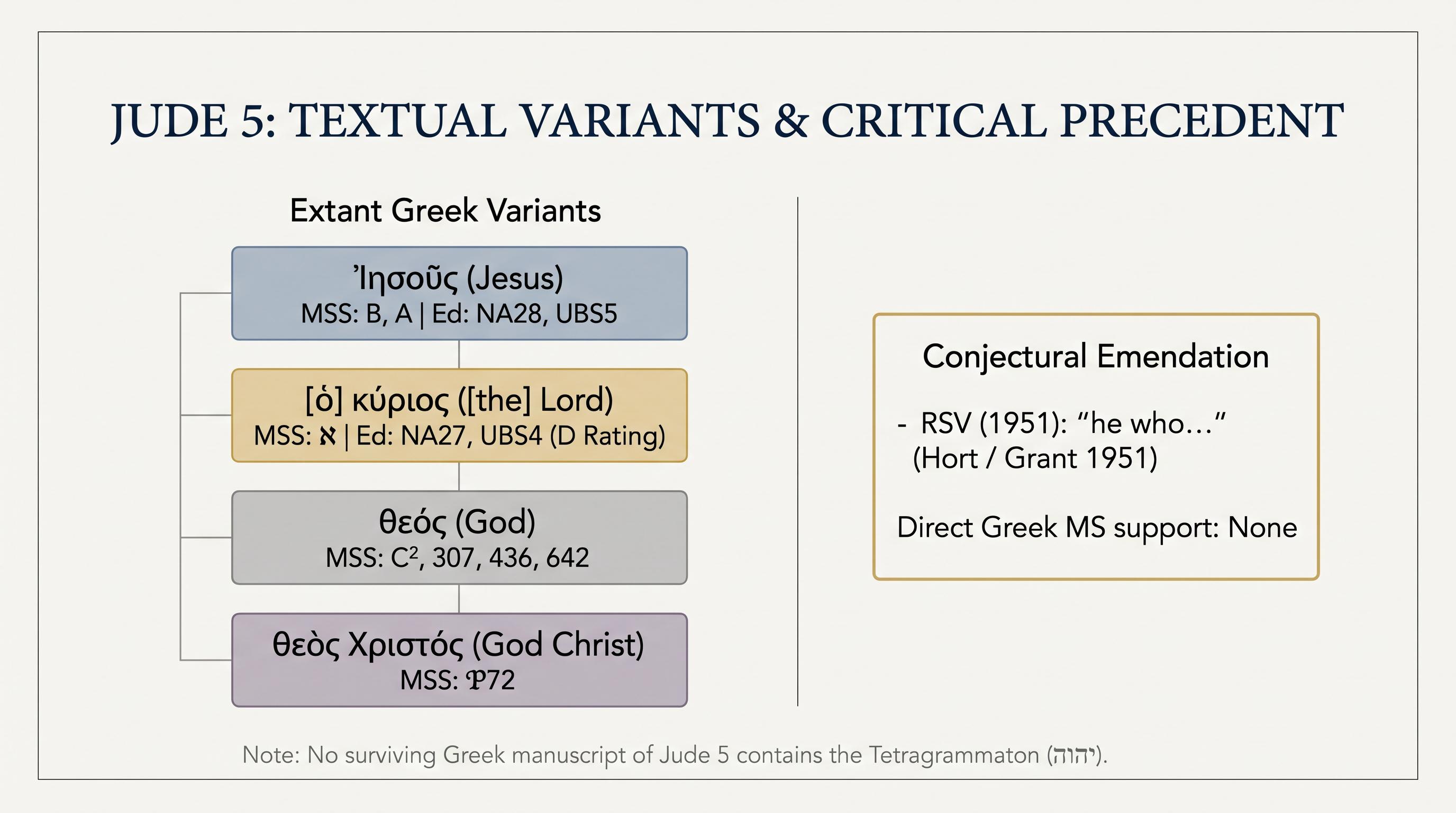
TL;DR: No known Greek manuscript of Jude 5 preserves the Tetragrammaton (יהוה), yet in textual criticism the absence of direct manuscript attestation does not invalidate a conjectural reconstruction when a genuine transmission anomaly exists. Given that Jude 5 is one of the most fractured passages in the New Testament—to the point that the Revised Standard Version applied its sole New Testament conjectural emendation there—this essay evaluates George Howard’s (1977) hypothesis that the original text may have contained the Tetragrammaton. Drawing on the precedent of substitution in the Septuagint and the phenomenon of anarthrous kýrios ("Lord" without the article), it examines how an original יהוה offers a coherent explanation for the entire chain of later variants (kýrios, theós, Iēsoûs, ho kýrios, and theòs Christós), without resorting to dogmatic claims of absolute certainty.
The Dogma of "Zero Manuscripts, Case Closed"—and Why Textual Criticism Rejects It
Anyone who has ever participated in a biblical textual criticism debate knows by heart the knee-jerk reaction that surfaces the moment someone mentions the divine name (יהוה) in connection with Jude 5. The reply is usually as brief as it is categorical: there is no Greek New Testament manuscript containing the Tetragrammaton in that verse; therefore, there is "zero manuscript textual support," and the discussion is over. The confidence behind that verdict often makes it sound like an elementary law of textual criticism. Yet one only needs to open the standard handbooks and peer-reviewed journals of the discipline to discover that no such rule exists.
Let us concede the empirical fact right from the start to avoid any suspicion of evasion: no known Greek manuscript of Jude 5 preserves the four Hebrew letters יהוה. The problem does not lie in that fact, but in the mechanical rule people try to build upon it—namely, that any reading absent from surviving Greek manuscripts is automatically disqualified from critical inquiry. To see why scholarship rejects that shortcut, it helps to listen to four specialists who, far from advocating for the Tetragrammaton in Jude 5, represent the very core of modern textual criticism.
The first is Daniel B. Wallace, one of today’s most influential textual critics and, ironically, a defender of the reading "Jesus" in Jude 5. In his review of the 28th edition of the Nestle-Aland Novum Testamentum Graece (NA28), published in the Journal of the Evangelical Theological Society (vol. 56, 2013, p. 155), Wallace examined the editors’ decision in 2 Peter 3:10 to adopt the Greek reading οὐχ εὑρεθήσεται, noting a fact deeply inconvenient for the "zero support" rule: "This is not found in any Greek witnesses". Despite its complete absence from any known Greek manuscript, the NA28 editors incorporated it into the critical text after weighing indirect witnesses and the internal dynamics of the passage.
Even more explicit is J. K. Elliott, who—despite his own earlier skepticism toward reconstructions lacking direct manuscript backing—wrote in the introduction to New Testament Textual Criticism: The Application of Thoroughgoing Principles (2010, p. 8): *"****On occasion it may be necessary to admit that no one manuscript preserves the wording used by our first century author"***. Along the same lines, Bruce M. Metzger explained in The Text of the New Testament: Its Transmission, Corruption, and Restoration (2nd ed., 1968, pp. 182–185) the theoretical legitimacy of conjectural emendation in the New Testament, adding a decisive observation for our topic: although the abundance of witnesses reduces the need to resort to it, that need may be greater precisely in the Catholic Epistles and Revelation, where early manuscript evidence is more limited.
The decisive blow to the improvised "case closed" rule, however, comes from Frederick C. Grant, a member of the translation committee behind the Revised Standard Version (RSV). In his article "The Greek Text of the New Testament" (The Bible Translator 2, 1951, pp. 120–121), Grant warned that each textual variant must be judged on its own merits rather than by mechanical rules of thumb, and then revealed an extraordinary detail: "I find that we have adopted only one conjectural emendation (in Jude 5, ‘he who...’)"—following a proposal associated with Fenton John Anthony Hort. Out of the thousands of verses in the New Testament, the single place where the RSV committee admitted that none of the major surviving variants necessarily reproduced the original wording was Jude 5. To be completely clear: neither Wallace, nor Elliott, nor Metzger, nor Grant argues for the Tetragrammaton in this verse. What their testimonies establish is something prior and foundational: the absence of a word in surviving Greek manuscripts does not forbid investigating a lost original wording, especially in a passage as unstable as Jude 5.
Conjectural Reconstruction, Not a "Manuscript Variant": The Rules of the Game
Before going any further, we need to correct a terminological mistake that routinely derails these threads from the very first comment. Strictly speaking in textual criticism, there is no "YHWH manuscript variant" in Jude 5. Some variants documented in the surviving Greek manuscript tradition are kýrios ("Lord"), Iēsoûs ("Jesus"), theós ("God"), and the singular form theòs Christós ("God Christ"), preserved in papyrus P72. Calling the Tetragrammaton a "variant" is technically inaccurate and rightfully invites charges of imprecision.
What is being evaluated here is not a manuscript variant, but a conjectural reconstruction grounded in a hypothesis of early substitution. And in textual criticism, a conjecture is not defended by hoping that some hidden papyrus will one day emerge from the sands of Egypt, nor by appealing to theological convenience. As Bruce M. Metzger (1968, pp. 182–185) laid out, a conjectural emendation only deserves serious consideration if it meets two strict requirements: first, it must address a genuine early transmission problem in the surviving text; second, it must offer a convincing explanation for how all the extant variants arose.
To these two rules we should add a basic epistemological compass. Metzger himself reminded readers in A Textual Commentary on the Greek New Testament (2nd ed., 1994, introduction, p. 11*) that the criteria used to decide between textual readings "depend, it will be seen, upon probabilities". In the same spirit, Daniel B. Wallace (1992, p. 38) distinguished between objective truth and subjective certainty. No one today possesses the autograph of Jude to verify with infallible certainty what flowed from his pen. Evaluating the Tetragrammaton hypothesis therefore means testing whether it satisfies Metzger’s two criteria and whether its explanatory power seriously competes with the other readings in dispute.
The Textual Crime Scene: Why "Jesus" Does Not Settle the Case and Everything Converges on Anarthrous Kýrios
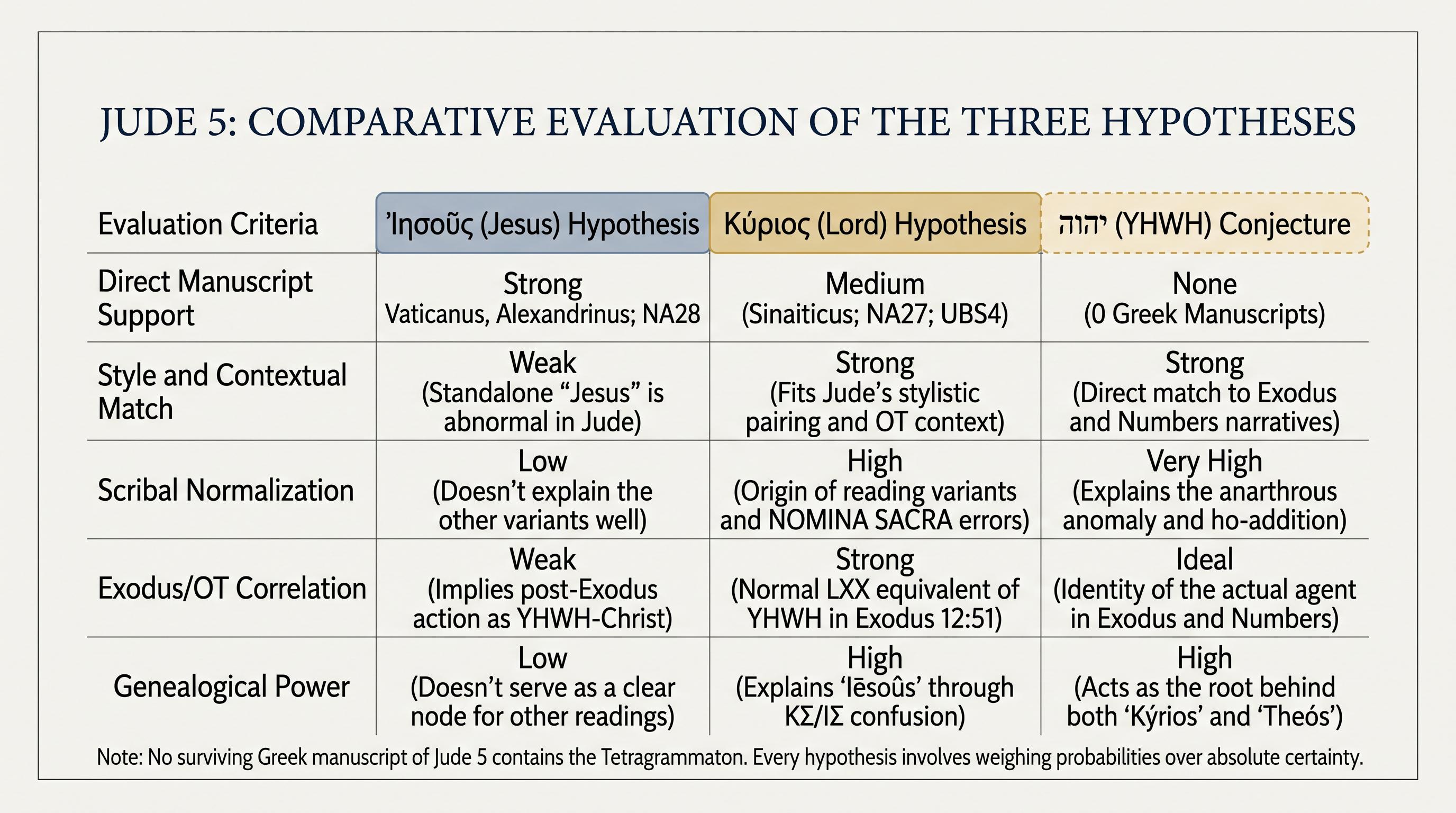
To meet Metzger’s first requirement—demonstrating a real and early fracture in the transmission of Jude 5—we must begin by steelmanning the position currently favored by major critical editions: the variant Iēsoûs ("Jesus"). Its defenders are not acting on a whim. Iēsoûs boasts the earliest and most prestigious external manuscript support, appearing in top-tier codices such as Vaticanus (B/03) and Alexandrinus (A/02). On that basis, it was adopted by the most recent critical editions, Nestle-Aland 28 (NA28) and UBS5. Furthermore, scholars such as Daniel B. Wallace (The Bible Translator 52/3, 2001, p. 346) and Philipp F. Bartholomä ("Did Jesus Save the People out of Egypt? A Re-examination of a Textual Problem in Jude 5", 2008) have argued for its originality using the principle of the harder reading: attributing the deliverance from Egypt to Jesus prior to his human existence would have been so jarring to ancient scribes that they would have felt compelled to smooth out the text by replacing "Jesus" with "Lord" or "God".
It is a respectable argument, yet it is far from having settled the matter. First, the age of a codex does not automatically guarantee the originality of every reading it contains; as Frederick C. Grant (1951) pointed out, a relatively later manuscript may have been copied from an older and more faithful exemplar than the one used by an earlier codex. Second, the supposed modern consensus is much more fragile than online debates make it seem: until recently, the standard editions NA27 and UBS4 printed[ὁ] κύριος ("[the] Lord"), a reading supported by Codex Sinaiticus (א/01). Even more tellingly, the UBS4 editorial committee assigned its decision a D rating—reserved for instances where "the Committee had great difficulty in arriving at a decision" (Metzger, 1994, intro., p. 14*)—precisely because the majority of the committee judged the reading Iēsoûs to be "difficult to the point of impossibility" (Metzger, 1994, pp. 657–658).
No one has dissected this fracture more thoroughly than Tommy Wasserman, author of the landmark monograph The Epistle of Jude: Its Text and Transmission (2006) and the study "Proposal for a New Rating System in Greek New Testament Editions" (The Bible Translator 60/3, 2009, pp. 140–157). Wasserman candidly acknowledges that "The reading Ἰησοῦς has the best manuscript support" (p. 152), yet after weighing the internal evidence he concludes that "the external evidence is divided and early alterations occurred" and that "κύριος explains all other readings" (p. 152).
His internal reasons are compelling. On the one hand, Jude’s own writing style militates against an isolated "Jesus": in verses 1, 4, 17, and 21, Jude consistently pairs the name Jesus with the title "Christ," meaning a standalone Iēsoûs in verse 5—applied, no less, to the events of the Exodus—would be a stylistic anomaly without parallel anywhere else in the letter. On the other hand, the paleography of the nomina sacra (the sacred abbreviations topped with an overbar used by Christian scribes) shows how an early visual confusion could easily occur between Κ̅Σ̅ (Kýrios) and Ι̅Σ̅ (Iēsoûs). Added to this is the singular witness of papyrus P72 (theòs Christós, "God Christ"), confirming that the verse underwent deep alterations at very early stages of its transmission. The entire internal analysis of the Greek variants thus leads us to a striking bottleneck: the recoverable Greek stratum with the greatest explanatory power is neither Iēsoûs nor ho kýrios ("the Lord"), but anarthrouskýrios—that is, "Lord" without the definite article.
The Tetragrammaton Hypothesis: How the Septuagint Precedent and Anarthrous Kýrios Explain the Entire Chain
It is at this exact juncture—facing the bottleneck of anarthrous kýrios and the early explosion of four divergent readings—that the question driving the conjectural reconstruction arises: why did a first-century Jewish writer, while recalling the deliverance from Egypt and the judgment in the wilderness, leave behind an anarthrous kýrios surrounded by such confusion among kýrios, theós, and Iēsoûs? To answer that, we need to step into the material and linguistic environment in which New Testament authors read and wrote.
In 1977, scholar George Howard published his influential study "The Tetragram and the New Testament" in the Journal of Biblical Literature (vol. 96, pp. 63–83). Howard examined ancient Jewish manuscripts of the Greek Scriptures (the Septuagint, or LXX) dating near the time of Jesus—including Papyrus Fouad 266 and the Naḥal Ḥever Minor Prophets scroll—which preserved the Tetragrammaton in Hebrew characters (יהוה) embedded directly within the Greek text. In those early copies, the divine name functioned syntactically as a proper noun and therefore took no definite article. When later Christian scribes replaced the Tetragrammaton with the nomina sacra of common nouns (kýrios or theós), they frequently retained that article-less construction, leaving behind a distinctive anarthrous pattern in places where a common noun would ordinarily take the article.
Howard proposed that New Testament writers may have retained the Tetragrammaton in quotations and allusions to the Hebrew Scriptures, and that its later replacement by kýrios or theós sparked confusion in early transmission. On page 82 of his study, he explicitly applied this hypothesis to our verse: "It is possible, therefore, that the tetragram appeared in the original text".
Here intellectual honesty requires a crucial caveat so as not to overstate the evidence: in Koine Greek, the absence of the article beforekýrioscan follow ordinary grammatical rules and does not, by itself, automatically prove that a proper name stood there previously. Presenting anarthrous kýrios as an airtight mathematical proof would be a technical mistake. However, when that anarthrous construction is viewed alongside the exact literary backdrop of Jude 5, the convergence stops looking coincidental. The two events the verse recalls—saving a people out of Egypt and later destroying those who did not believe—are explicitly attributed to YHWH in Exodus 12:51 (הוֹצִיא יְהוָה...), Deuteronomy 5:6, and Numbers 14:35 (אֲנִי יְהוָה דִּבַּרְתִּי). And when we turn to the Septuagint in those exact passages, we find ἐξήγαγεν κύριος... (Exodus 12:51) and ἐγὼ κύριος ἐλάλησα (Numbers 14:35): the title kýrios without the article directly translating יהוה. The epistle itself confirms this pattern four verses later, in Jude 9, where ἐπιτιμήσαι σοι κύριος ("May the Lord rebuke you") directly echoes Zechariah 3:2 (יִגְעַר יְהוָה בְּךָ, likewise rendered with kýrios in the LXX).
On this foundation, the hypothesis of an original Tetragrammaton remarkably fulfills Metzger’s second requirement by unifying the entire known transmission of Jude 5 into a single causal chain. If the initial text contained יהוה, the Christian standardization of nomina sacra—following the precedent already documented in the later transmission of the LXX—explains why the primary replacement was Κ̅Σ̅ (anarthrous kýrios) and a secondary replacement was Θ̅Σ̅ (theós). From anarthrous Κ̅Σ̅, the chain branches naturally: an early paleographical confusion between the letters Kappa (Κ) and Iota (Ι) gave rise to Ι̅Σ̅ (Iēsoûs), while later scribes who found the missing article awkward added the definite article to normalize the phrase into ὁ Κ̅Σ̅ (ho kýrios). Finally, out of that early instability emerged compound theological expansions such as theòs Christós in P72. Not a single piece is left unexplained.
Against the Ropes: Three Serious Objections This Hypothesis Must Overcome
A serious argument is not measured by how persuasive it sounds in a vacuum, but by how well it holds up against its sharpest critics. The Tetragrammaton hypothesis for Jude 5 will immediately run into three weighty objections that deserve to be steelmanned before they are answered.
The first objection targets the bridge to the Septuagint and the literary nature of the verse. A skeptical critic will rightly point out that the LXX is a translation of the Old Testament whereas Jude is an original Christian composition, and will add that Jude 5 is not a verbatim quotation of any Old Testament verse, but merely a historical allusion; therefore, inferring that Jude must have written יהוה simply because some LXX manuscripts preserve it would be a non sequitur fallacy. The answer begins by conceding what is true: the presence of the Tetragrammaton in LXX manuscripts does not deductively force the conclusion that it appeared in Jude 5, and Jude 5 is indeed an allusion rather than a word-for-word quotation. The critic’s mistake lies in turning that valid distinction into an unproven exclusionary rule claiming that only a verbatim quote allows one to consider the divine name. The New Testament is full of fixed expressions drawn from the Hebrew background that do not quote a single isolated verse—such as "angel of the Lord" or "Lord God"—and Jude 9 itself (ἐπιτιμήσαι σοι κύριος) alludes to Zechariah 3:2 without quoting it verbatim, yet still points unambiguously to יהוה. Neither linguistic analysis nor Howard’s academic proposal restricts the hypothesis to direct quotes; both explicitly include allusions where the Hebrew referent is unmistakable.
The second objection is epistemological and invokes a slippery slope: if we accept that the Tetragrammaton could vanish from every Greek manuscript of Jude 5 without leaving a direct trace, what guarantees that other vital doctrines were not erased or altered without a trace? Wouldn’t the reliability of the entire Epistle of Jude collapse? This objection conflates a hypothesis about a localized modification with an accusation of wholesale corruption of the document. In textual criticism, each passage is evaluated on its own evidence, and the standardized substitution of a Hebrew proper name with a Greek nomen sacrum is a narrow, mechanically understandable scribal habit, not an open-ended doctrinal conspiracy. Moreover, the argument turns back on itself: Jude 5 already exhibits four distinct readings across ancient manuscripts without any scholar concluding that the epistle has lost its reliability. Asking what else might have disappeared is not evidence that anything else actually did.
The third objection is theological—and is often the real engine driving the passion around this verse. Many readers will argue that if Iēsoûs is original, the undeniable fact that the Old Testament referent is YHWH does not support any substitution hypothesis; rather, it serves as direct proof that Jude ontologically identified Jesus as "YHWH-Christ". Two severe methodological flaws surface here. The first is a blatant double standard: neither the Tetragrammaton nor the word Christós ("Christ") appears in the variant Iēsoûs; that reading relies on appealing to the Exodus context to link the verse to YHWH. It is contradictory to validate the weight of the Old Testament context to read "YHWH-Christ" while simultaneously outlawing that same context when tracing YHWH behind kýrios. The second flaw is exegetical: even if we provisionally granted that Jude wrote Iēsoûs, directly attributing a divine action to a person does not prove ontological identity. Scripture itself supplies exact parallels concerning the very same event: Exodus 12:51 states that YHWH brought Israel out of Egypt, yet Acts 7:35–36 directly attributes that exact same action to Moses ("This man led them out"), and nobody concludes from this that Moses is YHWH. Similarly, in Judges 2:1 the Angel of YHWH speaks in the first person declaring, "I brought you up out of Egypt" (in line with Exodus 23:20–23)—an agency framework that scholar Jarl Fossum explored specifically for our passage in "Kyrios Jesus as the Angel of the Lord in Jude 5–7" (New Testament Studies 33/2, 1987, pp. 226–243). Defusing that theological assumption lets us return to judging the variants and the conjectural hypothesis strictly on their textual merits.
Between Probability and Certainty: The True Place of the Tetragrammaton in Jude 5
At the end of this investigation, intellectual rigor demands drawing a clear line between what has been established and what remains open. The absence of Greek manuscripts of Jude 5 preserving יהוה prevents anyone from proclaiming with absolute certainty that the Tetragrammaton stood in the autograph. George Howard’s proposal retains its exploratory character, and the variant Iēsoûs holds external manuscript weight that no serious student of the text can brush aside.
At the same time, the claim that the Tetragrammaton hypothesis lacks methodological grounding or can be dismissed with a curt "zero manuscripts, case closed" has been thoroughly dismantled. Jude 5 is so fractured that mainstream textual criticism itself has recognized the legitimacy of conjectural emendation here (Grant, 1951; Metzger, 1968), and the hypothesis of an early substitution of יהוה offers a remarkably economical explanatory framework linking the material precedent of the Septuagint, the explicit Exodus backdrop, the bottleneck of anarthrous kýrios, and the emergence of the entire constellation of later variants. Even for those who prudently prefer to stop at the documented Greek stratum without taking the conjectural step, that stratum (anarthrous kýrios, defended by Wasserman) still points contextually to the YHWH of the Exodus—just as the independent nineteenth-century textual critic William Kelly recognized ("'Lord' without the article, Jehovah, is the true reading") and translators as varied as John Shepreve (1530–1540) in his Hebrew version and A. M. Cox (The Epistle of Jude, 1950) in English reflected.
In the end, perhaps the most valuable lesson of Jude 5 is not dogmatic, but methodological, summed up in Daniel B. Wallace’s warning (Grace Theological Journal 12/1, 1992, p. 44): "The most telling assumption is that certainty equals truth". In textual criticism, no one—not even those who favor Iēsoûs—possesses infallible certainty regarding the autograph. Once we set aside "case closed" decrees and weigh the probabilities honestly, the Tetragrammaton hypothesis in Jude 5 ceases to look like an eccentric whim and reveals itself for what it truly is: a serious conjectural reconstruction attempting to make sense of one of the most enigmatic textual scars in the New Testament.
The believers of the trinity do not only claim that God is three persons, but claim that you are a heretic and that you have a fake god if you say that your God is only one person the Father alone, what they do not seem to realize by doing this is that they are also calling Jesus a heretic and claiming that Jesus' God is also a fake god because the God of Jesus is the same God of the unitarians, Jesus was the one that taught that his God is his Father and also that our God is our Father.
John 20:17 NWT ‘I am ascending to my Father and your Father and to my God and your God.’
The God and Father of Jesus is one person, not the trinity, and Jesus taught that this same God and Father of him is also the same God and Father of his brothers.
Ephesians 1:3 NWT Praised be the God and Father of our Lord Jesus Christ
The God and Father of our Lord Jesus Christ is only one person, how do trinitarians read this?, as praised be the fake god of the unitarian heretics and of Jesus Christ?
Ephesians 4:6 NWT one God and Father of all
Going back to Ephesians 1:3 we see that "of all" also includes Jesus, so the unitarian God called by the trinitarians: "a fake god" is the same God and Father of Jesus and of the rest as in John 20:17
If you are a trinitarian reading this, it is time to wake up and stop the nonsense, the God and Father of Jesus and of us is not a fake god, neither Jesus nor us are heretics.
Not theological evolution or merging of deities, but rather a single, real metaphysical being known in two distinct ways.
True, there is the account of Elijah on Mount Carmel; however, while “Baal”—par excellence—refers to Hadad, the term “Baal” is simply a title that was applied to many gods. The Bible itself indicates that Yahweh was, at times, referred to as Baal. Consequently, the rival “Baal” might not be Hadad, but someone else entirely.
Unitarians have a powerful tool in their toolkit: agency. It does a lot of work to explain things Jesus said and did as well as things that were said of him and done to him. This even extends to the title God/Theos being applied to Christ. My worry here is that this tool may know no bounds and that there's nothing we could have reasonably expected the biblical authors to say to express that Jesus is God (if the Trinitarians were correct) that couldn't be explained by Christ being an agent of God. Sure, I guess they could have whipped out a bunch of uncharacteristically technical language, but I don't think that's a reasonable expectation.
So what are the boundaries of agency? What could it not explain? What could the biblical authors have reasonably said to express the deity of Christ if such a doctrine were true that agency couldn't explain?
I don't know if I'll ever believe in the Trinity, no matter how many times I hear that it's a mainstream Christian doctrine. I've even heard that it's required for salvation. I believe that, as the Son of God, Jesus is divine (though I'm not really making this the focal point of the post). But what if we're wrong about the Trinity - what then?
Why rationalize penal substitutionary atonement (PSA) from a Unitarian perspective, and on what rationale have you landed❓
This is the question. ⤴️ For context, penal substitutionary atonement is the arbitrary idea that you can somehow dodge the penalty (penal) for sin if someone else takes your place (substitutionary) and dies for you (atonement)✝️. This brings many problems, but one issue is the arithmetic. 🌏 We’re talking about trillions of souls if this truly extends to all humanity and not just Israel🇮🇱, yet Jesus is one man. Even if he was genuinely sinless, how does his one righteous life outweigh and pay for the sinful lives of everyone else? ⚖️ Shouldn’t it only save one person (assuming PSA is even remotely plausible)?
⛪️ It seems to me that Trinitarianism arises from the need to answer this question. Jesus’s righteous life genuinely has immeasurable value if he’s Elohim, so it can pay the debt of every soul, not just one. If he was truly just a man 🛐 — anointed or not — his righteous life should only save one sinful soul, right?
I've been part of this subreddit for quite some time, and, with permission from u/Agreeable_Operation , I'd like to share something I've been working on.
This book is, in many ways, a reflection of my personal journey through different religious backgrounds and understandings of Christianity. I grew up Catholic, and over the years I've explored and been part of several different religious movements and communities, including Jehovah's Witnesses, Biblical Unitarianism, Christadelphianism, and others. Eventually, I reached a point where I no longer felt comfortable identifying with a particular denomination or organisation. Instead, I simply call myself a Christian. I believe it's a beautiful and sufficient description in itself.
I decided to approach the Bible with an open mind and a serious commitment to understanding what its authors actually wrote. This led me to devote a considerable amount of time to studying the original biblical languages. I studied Modern Hebrew, Biblical Hebrew, and Ancient Greek at university, in addition to spending years studying Biblical Hebrew independently.
Although it might touch on theological subjects, its primary focus is linguistic rather than denominational or doctrinal. It focuses the original languages, grammar, vocabulary, and historical usage. The book is intended for a broad audience. While it may be particularly interesting to Trinitarians, including those who actively participate in or quietly follow this subreddit, I would also welcome Jehovah's Witnesses, Biblical Unitarians, Muslims, Jews, atheists, and anyone else interested in exploring the biblical text.
The book examines some of the most frequently debated, misunderstood, and misinterpreted biblical passages and doctrines. Rather than presenting another theological interpretation, it goes back to the Hebrew and Greek texts to examine what the original authors actually wrote, how particular expressions were used, and whether certain interpretations are supported by the language itself.
I also want to emphasise that this project has benefited from the input and support of many people, including native English and Hebrew speakers, biblical scholars, and specialists in Ancient Greek. Their feedback, corrections, and suggestions have been invaluable throughout the process. I've tried to approach the material with great care, and I'm genuinely grateful to everyone who contributed.
The PDF version of the book is completely free, and I'll share the link here for anyone interested.
Whether you ultimately agree or disagree with my conclusions, I hope you might find something interesting, learn something new, or perhaps reconsider a passage you've read many times before. And if you're currently questioning, searching, or simply curious, I especially hope this book can be a helpful resource along the way.
If you have any questions or anything else , you can contact me by email (the address is on the last page of the book) or simply send me a DM here on Reddit.
Thank you for taking the time to read this, and thanks again to u/Agreeable_Operation for allowing me to share it with you!
Isaiah 43:3 “For I am Jehovah your God, the Holy One of Israel your Savior.”
Isaiah 43:11 “I am Jehovah and besides me there is no savior.”
Isaiah 45:21 “Is it not I, Jehovah besides whom there is no other God; a righteous God and a Savior, there being none excepting me?”
I've wondered before, how is God alone the Savior and then Jesus is the Savior? For clarity, I struggle to grasp the Trinity and don't generally believe it, but verses like these make me pause.
Thank you.
EDIT: Your responses have been helpful. I'd respond individually but the ones I've seen so far have generally been so well written I have nothing to add.
Hi All, I am Anglican but like to talk to other Christian’s throughout the numerous denominations. What English Bible Translation would you all recommend? I know Jehovahs Witness’ use the New World Translation (I have both 1984 and 2013 texts).
Jesus, the New Adam, and the Beginning of a New Creation
After extensive study and reflection, I have arrived at a Christological understanding that I find to be a reasonable and coherent conclusion from Scripture.
One analogy has helped me clarify the relationship between God and Jesus: the author and the story. The author exists outside the story, and no character within it can become equal to the author. Yet a character can perfectly represent the author's intentions, character, and purpose within the story.
I see Jesus in this light: not as the Author himself, but as the perfect representation of the Father – the one who expresses God's will and purpose without deviation (John 5:19; John 12:49; John 14:9–10; Hebrews 1:3).
This distinction between being God and perfectly representing God is an important starting point for how I understand Jesus, his sacrifice, and the new creation.
1. Jesus – the beginning of a new human line
I understand Jesus as the new Adam and the beginning of an entirely new human line. He is the firstborn of this new creation, and he remains its head forever.
Unlike the first Adam, Jesus remained completely faithful to God. He was the spotless Lamb, without sin, whose life was fully aligned with the Father's will (1 Peter 1:18–19: “a lamb without blemish or defect”; Hebrews 4:15: “yet he did not sin”).
Paul draws a direct parallel between Adam and Christ. Through the first Adam came sin and death, while through Christ comes righteousness and life (Romans 5:12–19; 1 Corinthians 15:21–22).
Jesus is also described as “the last Adam” and “the firstfruits” of those who will be raised (1 Corinthians 15:20, 45). He is “the beginning, the firstborn from the dead” (Colossians 1:18).
I see this as more than Jesus simply correcting what Adam did wrong. Jesus represents the beginning of a new humanity, a new line with a different destiny.
I also make an important distinction between being like God and being God. No one within creation can become equal to the Creator. Jesus, however, was the perfect representation of God's will and purpose. His unity with the Father was a unity of purpose, will, and obedience (John 10:30; John 17:20–23; John 14:9–10).
2. The meaning of Jesus' sacrifice
I don't see Jesus' death merely as a payment made to satisfy a debt. I believe something much more fundamental happened through his sacrifice.
When humanity fell through Adam, sin and death entered the human condition, and access to God's presence was lost. The way into God's presence was closed (Genesis 3:22–24).
Through his faithful life, sacrificial death, and resurrection, Jesus became the way back.
His sacrifice opened what had been closed. He became the door through which humanity can once again approach the Fathers light.
Hebrews describes this beautifully: “we have confidence to enter the Most Holy Place by the blood of Jesus” (Hebrews 10:19–20). It also says that Christ entered God's presence on our behalf (Hebrews 9:24).
In this sense, I see his sacrifice as the fulfilment of something fundamental in God's relationship with humanity. Jesus did not merely make forgiveness possible; he opened the way to a restored relationship with God.
His resurrection was equally essential. Jesus did not simply return to his former mortal existence. He became the firstborn of a new, immortal humanity (1 Corinthians 15:20–23, 42–49).
Death came through Adam, but resurrection comes through Christ. “As in Adam all die, so in Christ all will be made alive” (1 Corinthians 15:22).
3. Becoming part of the new creation
I believe humanity must become part of this new human line to share in what Christ has accomplished.
We are not automatically part of this new creation simply because we belong to humanity. We must choose to come to Christ and become united with him.
Paul uses the image of grafting to describe how people can become part of something they did not originally belong to (Romans 11:17–24). Jesus uses the image of a vine and its branches to describe the same essential dependence: “Remain in me, as I also remain in you” (John 15:4).
Through faith and baptism, we are united with Christ and become part of his new life (Galatians 3:26–29; Romans 6:3–5).
Paul writes: “If anyone is in Christ, the new creation has come” (2 Corinthians 5:17).
Jesus is the firstborn of this new family, and those who are joined to him become part of it. We inherit the future he has opened for us: resurrection, immortality, and restored access to God's presence (Romans 8:29; 1 Corinthians 15:51–54).
I don't believe the ultimate hope is that humans become angels or cease to be human. Rather, we become perfected, immortal human beings, sharing in the life and glory that Christ has opened for us (Luke 20:35–36; Philippians 3:20–21).
4. One question I am still considering: How was Jesus brought into existence?
There is one aspect of this Christology where I am still undecided.
John describes Jesus as God's unique Son (John 1:14, 18), while Luke describes his conception as a direct act of God:
“The Holy Spirit will come on you, and the power of the Most High will overshadow you. So the holy one to be born will be called the Son of God” (Luke 1:35).
This makes me wonder whether God created an entirely new human life within Mary, rather than Jesus simply being the biological continuation of Adam's fallen human line.
On the other hand, the genealogies connect Jesus to the history of Israel and ultimately to Adam (Matthew 1:1–16; Luke 3:23–38). These genealogies may have legal or theological significance, and they do not necessarily settle the biological question.
Could Jesus have been created as a completely new, sinless human being within Mary, with no participation in Adam's fallen nature?
Or was he fully descended from Mary and therefore genuinely part of our human bloodline, sharing our mortal human condition, yet without ever succumbing to sin?
Hebrews gives us an important tension to consider. It says that Jesus had to become like his brothers and sisters “in every way” (Hebrews 2:17), and that he was tempted as we are, “yet he did not sin” (Hebrews 4:15).
The second possibility gives particular weight to the idea that Jesus shared our human condition and overcame it from within. The first emphasizes his unique origin as God's only-begotten Son and the beginning of a genuinely new human creation.
I can see arguments worth considering on both sides, and I don't want to claim that Scripture explicitly answers the biological question.
How do you understand this? Did Jesus need to be entirely free from Adam's fallen nature to become the new Adam, or could he share our mortal human nature while remaining completely without sin?
I'm interested in biblical arguments and thoughtful discussion, rather than simply defending a particular position.
John 8:54-55 NWT Jesus answered: “If I glorify myself, my glory is nothing. It is my Father who glorifies me, the one who you say is your God.Yet you have not known him, but I know him. And if I said I do not know him, I would be like you, a liar. But I do know him and am observing his word.
Jesus said that it is his Father who glorifies him, the one who the jews say is their God, and who do the jews say is their God? YHWH the God of Abraham, Isaac and Jacob, and who did Jesus identify as YHWH the God of Israel? his Father alone, not a multipersonal and multirole being, for Jesus God is always a Father, you cannot ever say that God is not a Father ever, that is not divisible (as trinitarians do when they say Jesus is the true God but not the Father, claiming that he is somehow the true God but not their father). For Jesus and for the rest of the true God worshippers, the one God is always their Father, if your god isn't your Father at the same time then he is not the true God.
Ephesians 4:6 NWT one God and Father of all, who is over all and through all and in all.
Jesus is not the one "God and Father" of all, but Jesus himself is one of the "all" that have that God and Father. The God and Father of all is one person alone and that person is not Jesus, that person is the Father of Jesus. In this verse Jesus and the rest of human believers are sons of God, not God the sons, the God of Jesus and the believers is not multipersonal.