I've been interested in the newer, high-end CD players coming out of China and Japan but haven't been able to find many impartial, honest reviews since many of these companies send units out to YouTubers and social media influencers for marketing. One I had been particularly interested in was the translucent KM5 CP1 player. Even after searching around for reviews and info, I could not find much that didn't seem like a promo or partner post.
I was particularly drawn to the transparent design of this model, which reminded me so much of the electronics I grew up with in the '90s. The price recently dropped to $159 on Amazon for Black Friday, so I decided to give it a shot and see if I'd like it or not.
The good:
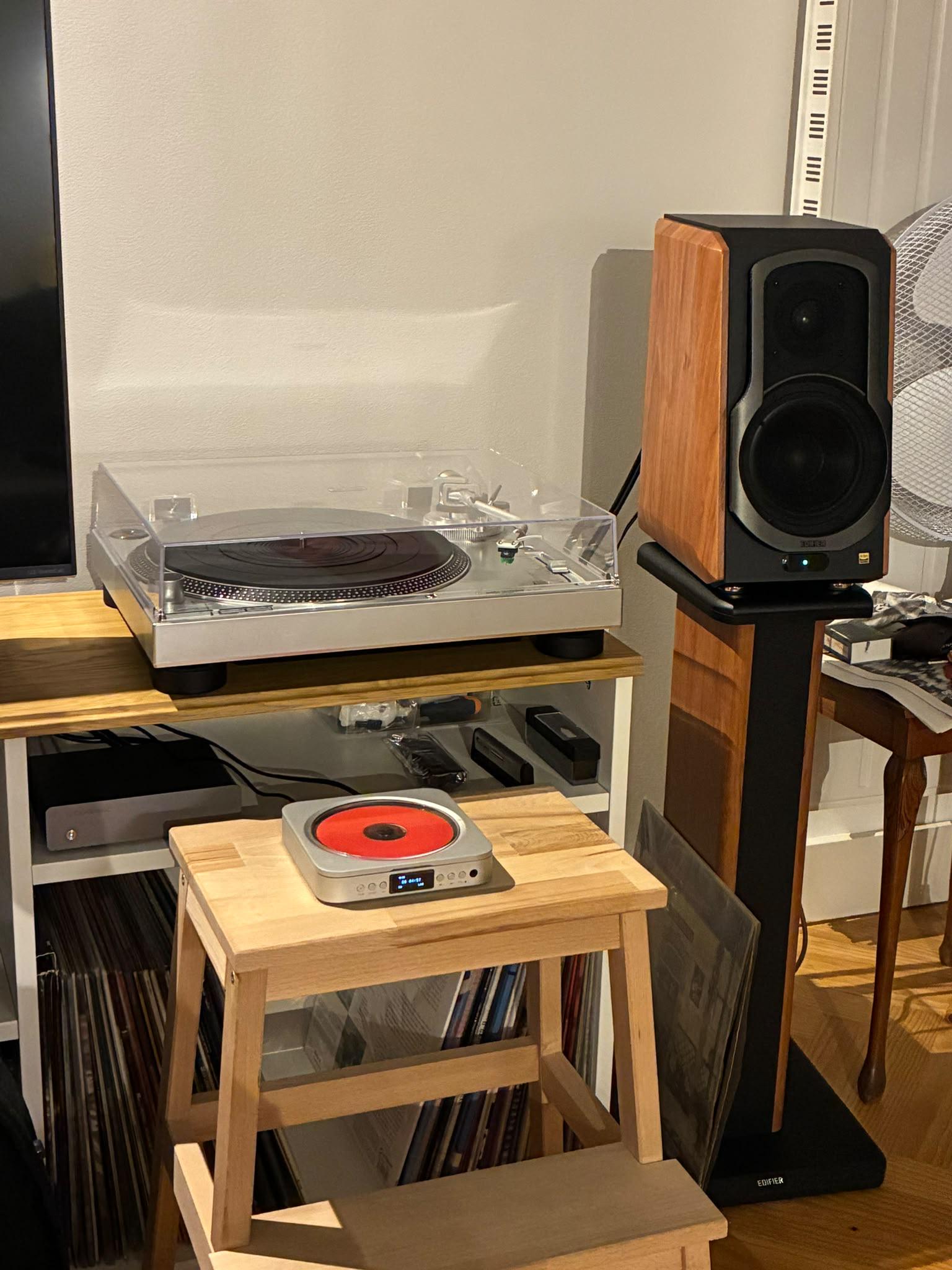
- It looks really cool. The whole draw to this player was its appearance and aesthetic and seeing it in person lined up with what I was expecting and hoping. I love being able to watch the CD spin and the laser pickup moving along its tracks. I didn't carry it around with me or do much with it, but I feel like this would be such a fun conversation starter if you're walking around with it.
- The transport was very smooth and balanced. There was no wobbling or shaking at all when I tested a couple of different CDs with it. I'm used to other players where you can feel the CD getting up to speed or vibrating faintly, but there was none of that with this.
- It features gapless playback. I'm only just getting back into CD collecting after 20 or more years. I only recently learned that gapless playback appears to be an issue with many of these newer players. Tracks seamlessly flowed on this player and I didn't notice any gaps between songs.
The so-so:
- The CP1 uses something like 40 seconds of anti-skip buffering, so the disc periodically stops spinning while the audio continues. While this is normal for this device, I wish there were an option to turn off the buffer and let the disc spin continuously. I also couldn't determine if the buffering involves any lossy compression. I am under the impression that historically, buffering does add some degree of audio compression though.
The bad:
- While the audio quality was perfectly fine, I found it to be pretty underwhelming for the price point. I tried three different pairs of headphones at different levels (basic low budget phones, middle tier "retro" style headphones, and nicer closed back studio headphones) and the volume never really got as loud as I would have liked. I wouldn't use this player for commuting by bus/train or plane travel. (Note that I did not test or use the Bluetooth capabilities on this at all.)
- The headphone jack on the unit I received had issues out of the box. With all three pairs of headphones I used, I experienced intermittent static and audio cutting out in one or both channels if you didn't adjust the headphone plug to get a proper connection. I had the headphones plugged in all the way, but it seemed like a defect or issue from the factory. Regardless, it was frustrating to experience that on a player that's normally priced around $200.
- While the transparent case is very cool from an aesthetic standpoint, it felt pretty fragile. I'd be really worried about dropping or using this player for daily use or commuting. It actually felt kind of like an oversized CD jewel case. It wasn't flimsy necessarily, but definitely fragile feeling.
- The controls are hard to read on the transparent CP1. They're also oriented for using the player as a wall display. So if you have it laying down next to you, the controls look like they're upside down. I have no interest in wall-mounting this, so it's just a design choice I'd have to adapt to if I kept it.
- It doesn't come with anything. In the box is the unit and an owners manual — that's it. There are no cables, hardware, headphones — nothing. I'm fine with not getting a pair of junk headphones or cables that may end up in the landfill eventually, but at the price point, it's kind of wild that nothing is included. And with this being more of a designed object, it's wild how much it'd cost full-retail price for this and the hardware to mount it on the wall or on a mounting plate.
Tech specs:
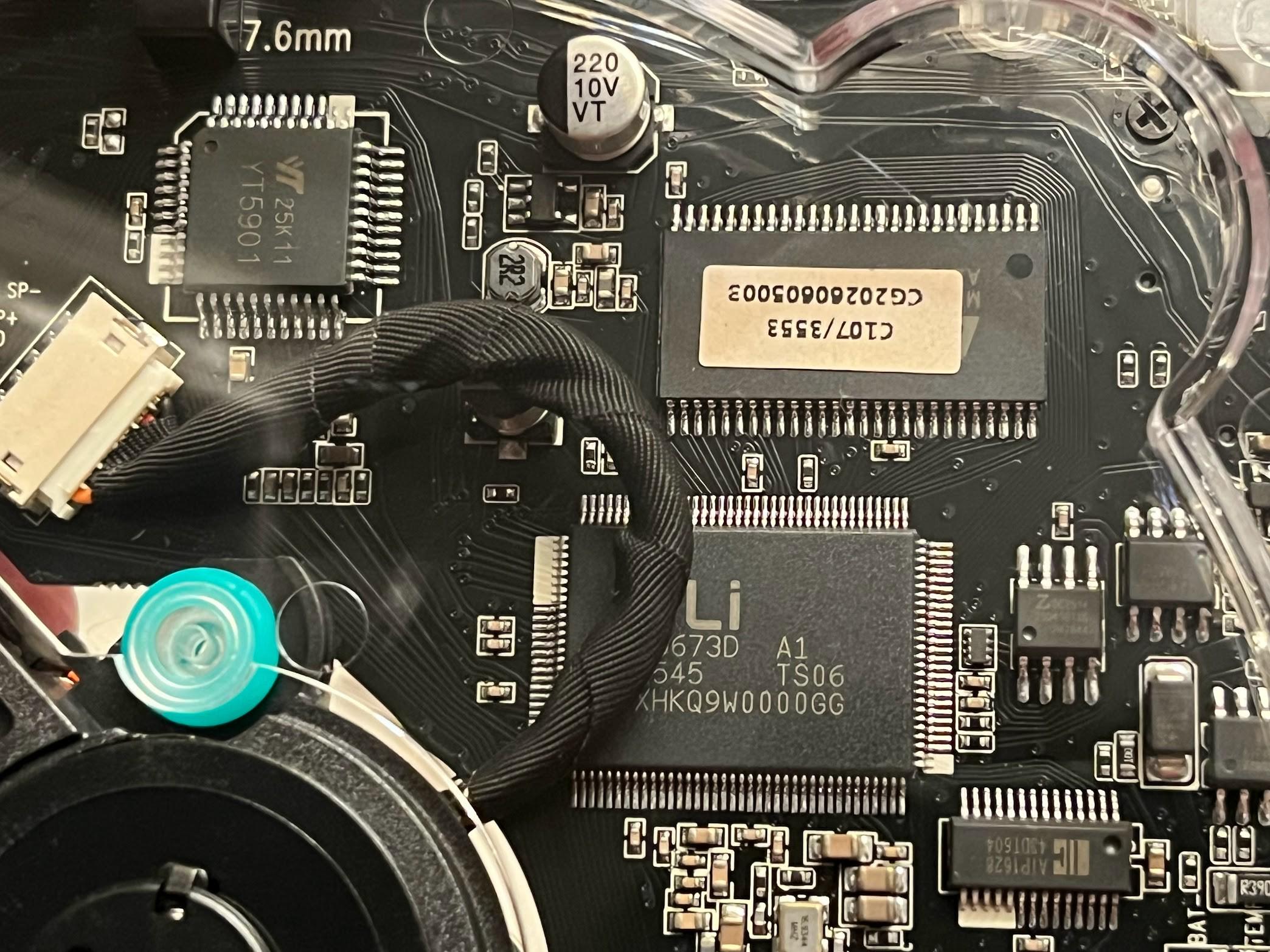
I'm not an engineer or hardware person, but I did take some photos and shared with Claude to see what we're working with here. From close-up photos of the board, the main processor looks like a JieLi chip. JieLi makes low-cost audio and Bluetooth chips. It sits next to a standard portable CD motor driver (YT5901). I didn't spot a separate DAC or a dedicated headphone amp chip. I'm not an engineer, so take that with a grain of salt, but it would explain the low output. Claude repeatedly referred to the device as a "basic player in a premium case."
My verdict:
I really wanted to like this player, and I would say that I do — for the most part. But it's very clear (pun intended) that this is more of a display piece and designed object than a proper audio device or piece of hi-fi gear. I think it's very cool to be able to see inside and watch the CD spin. I grew up in the '90s, so I remember the original translucent Game Boy and other consumer electronics, and this scratches that itch but executes it maybe even better than the original stuff.
With that said, this is just not a serious audio device. The volume was lackluster, the sound quality was adequate but not exciting, and the controls were difficult to read. I think at half of the price I paid, it'd be a much more compelling product. But at the normal $200 retail price, I find it impossible to justify unless you're a design professional or money's just not an issue and you care more about aesthetics than value.
I do think that there are some ways that KM5 could make this a better device and better bargain. This really needs a dedicated headphone amp, so I'd start there. The ability to turn off the anti-skip would also be nice. If you're buying a fully transparent CD player to be able to see the disc spin, you want to be able to turn buffering off so it keeps spinning the entire time. Yes, it might ding battery life, but it would improve the audio quality and make it more interesting to see the disc constantly spinning.