r/CAPR_Stock • • Jun 08 '21

r/CAPR_Stock Lounge

13 Upvotes

A place for members of r/CAPR_Stock to chat with each other


r/CAPR_Stock • • Aug 11 '21

New page with recent and relevant DD on CAPR 👇😍

Thumbnail
frugalnorwegian.com
3 Upvotes

r/CAPR_Stock • • 3h ago

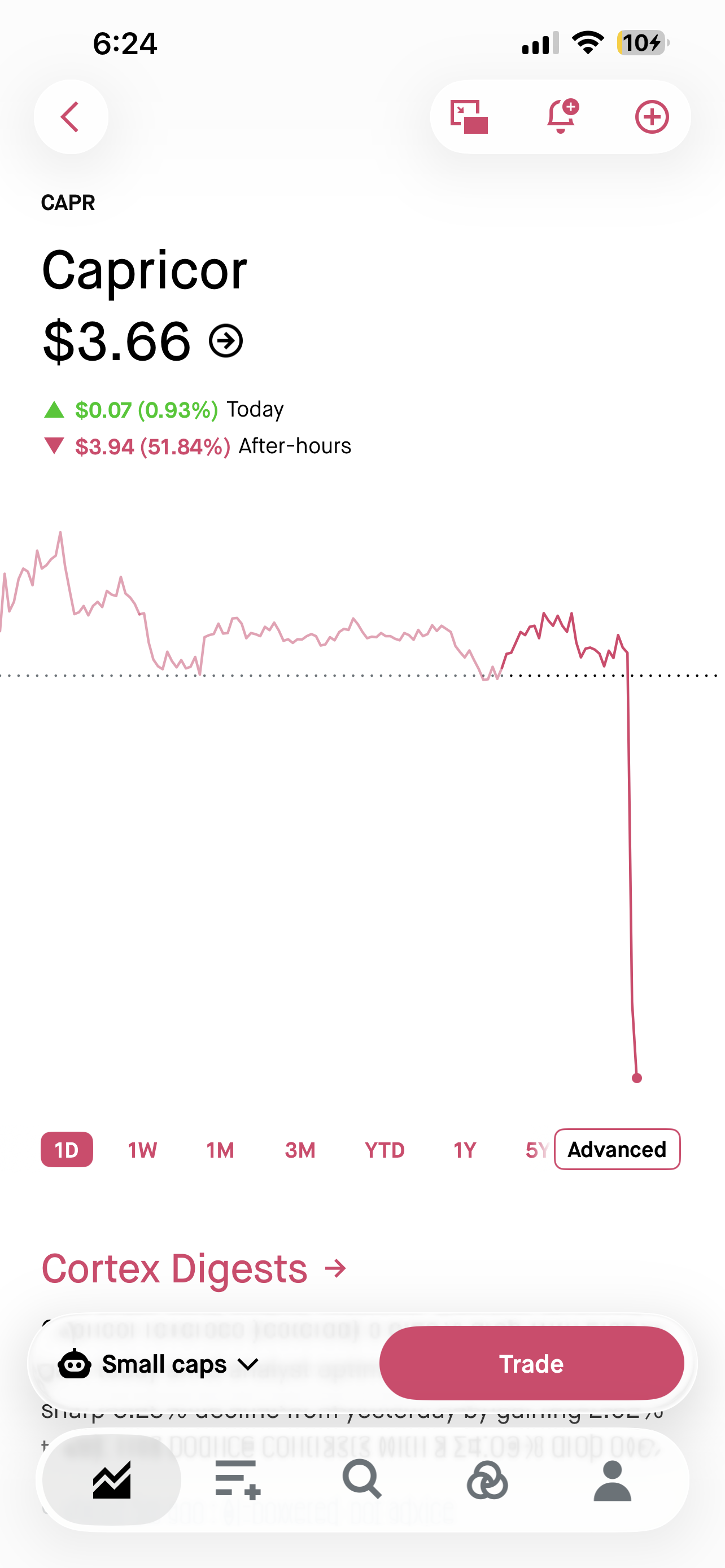
Capricor says it will challenge FDA's rejection of Duchenne therapy

5 Upvotes

Endpoints News
11/23/2026

Capricor Therapeutics will appeal the FDA’s Friday rejection of its cell therapy for Duchenne muscular dystrophy, CEO Linda Marbán said Monday.

During an interview with Endpoints News, Marbán disputed data integrity concerns raised by the agency and said that Capricor is “working with our regulatory counsel in order to chart the best path forward.” She didn’t provide a timeline for an appeal, but said the company will move “as fast as we can.”

“We didn’t see it coming at all,” she said. “I saw that data as bulletproof.”

Capricor’s stock $CAPR was down 76% on Monday afternoon. The shares have lost almost $2 billion in value from a 52-week high in April, leaving the company with a market capitalization is about $103 million.

This is the second time the FDA has rejected Capricor’s deramiocel cell therapy for Duchenne muscular dystrophy (DMD). After negative feedback from a July advisory committee meeting, Capricor pivoted to a narrower indication within DMD where Marbán said its “strongest data has been” — treating patients’ loss of upper limb function.

In a rare public statement accompanying the rejection, the FDA said “current evidence submitted for deramiocel does not meet the evidentiary standard required for approval.” The agency cited “serious clinical trial data integrity deficiencies,” including what it said were unauthorized changes to the statistical analysis plan and violations of blinding procedures meant to conceal which patients received a placebo.

Marbán defended the company’s clinical data on Monday, arguing that they were “clinically meaningful and statistically significant and peer-reviewed by external sources.”

She said the FDA has suggested another randomized, double-blind, placebo-controlled trial, but added that “right now, we’re not resourced to do a four-year clinical trial.” In its appeal, she said Capricor may ask for an independent review of the data.

“We are anxious to work with FDA and clear up any misconceptions about how the data was managed,” she said.

In July, Marbán told Endpoints that the FDA’s analysis of its HOPE-3 Phase 3 trial was based on a draft statistical analysis plan that was never completed. “This would be like your professor grading your term paper on an early draft you have never even submitted,” she said at the time. The company said in briefing documents that it made changes to the statistical analysis plan as it “evolved over the course of the study.”

The FDA said it examined the evidence carefully and acknowledged the “profound” unmet need for DMD patients and their families. DMD primarily affects young boys, causing them to lose their ability to walk by about age 12. The disease is fatal, and many patients die by late adolescence or early adulthood. Ultimately, the agency said it “cannot approve a product on the basis of data whose reliability has been compromised.”

MarbĂĄn said she does not know what will happen to roughly 82 patients who continue to receive deramiocel in open-label extension studies.

“If we are unable to move the program forward from a regulatory perspective, my fear is that we’re going to have to shut the whole thing down,” Marbán said.

Nicole DeFeudis
SENIOR REPORTER
nicole@endpointsnews.com
@Nicole_DeFeudis
Nicole DeFeudis on LinkedIn


r/CAPR_Stock • • 3h ago

Looking for like-minded investors – let's build something together 🚀

0 Upvotes

🚀 Looking for people interested in biotech, FDA plays and high-potential stocks
I’ve recently started a Discord server where we research upcoming catalysts, share investment ideas and discuss opportunities before they become mainstream.
I think there’s huge potential in combining AI with the knowledge of experienced investors and people working in the pharma industry.
I’m looking for people who genuinely enjoy researching stocks, sharing ideas and learning from each other. I’m also willing to invest in better tools and data sources if we can build something valuable together.
Whether you’re an experienced investor or just getting started, feel free to join! 🤝
https://discord.gg/Y2mV9NhqU


r/CAPR_Stock • • 14h ago

I want to know what happen?

5 Upvotes

The FDA has already made its decision, but people deserve to know exactly what went wrong.

With growing distrust of Capricor’s management, disagreements with the FDA and doctors still defending the clinical data, many people remain in the dark.

What exactly did Capricor change during the trial that raised such serious concerns? What was discussed behind closed doors, where did things go wrong, and why did the FDA ultimately take such a firm position?

Without access to private regulatory discussions, we are left with limited documentation and conflicting messages.

I believe an independent investigation is justified, not to overturn the FDA’s decision or assign blame, but to establish the facts and understand exactly what happened.

Given the conflicting accounts, can we rely solely on management statements?


r/CAPR_Stock • • 1d ago

Capricor Therapeutics Reschedules Conference Call to Provide Deramiocel Update

Thumbnail
capricor.com
13 Upvotes

Details for the rescheduled call will be shared shortly. Given the significance of these matters, the Company is taking the time to prepare an update for shareholders and the Duchenne community on its response to the U.S. Food and Drug Administration’s (FDA) Complete Response Letter for Deramiocel and its next steps. Capricor stands firmly behind Deramiocel and the clinical data generated to date. The Company is actively preparing its regulatory response and remains fully committed to patients and families living with Duchenne.


r/CAPR_Stock • • 1d ago

So… what happened? Who’s still holding on?

0 Upvotes

Who’s still here, and who’s still holding on to a little hope?
I’d love to hear from both sides, those who sold and those who decided to stay. What made you sell, or what’s making you hold on? Are you still seeing a potential recovery, or have you simply decided to ride it out?
I’m still one of the holders, and honestly, I’m curious to hear what everyone else is thinking at this point.


r/CAPR_Stock • • 2d ago

Capricor’s $75.5M manufacturing lease has a Dec. 31 approval trigger

5 Upvotes

One number in Note 6 of Capricor’s Q3 10-Q matters after the FDA setback: about $75.5M in operating lease liability for the Towne Centre facility in San Diego. That is an accounting liability. Cash savings from any exit would depend on the notice, what obligations survive, and what space Capricor needs instead.

If Capricor has no Deramiocel approval on terms it finds acceptable by Dec. 31, either Capricor or the landlord can elect to terminate. The July 8-K says written notice must be delivered within five business days after the deadline. The lease does not automatically end on Dec. 31.

For the cash runway, I’d watch for a termination or an amended lease in the next SEC filing and compare it with updated spending guidance. Keeping the site would preserve manufacturing capacity while the FDA path is still unresolved.

SEC Q3 10-Q, Note 6

https://www.sec.gov/Archives/edgar/data/1133869/000110465926125355/capr-20260930x10q.htm

SEC July 8-K

https://www.sec.gov/Archives/edgar/data/1133869/000110465926083559/capr-20260709x8k.htm


r/CAPR_Stock • • 2d ago

Who else is buying puts tomorrow?

0 Upvotes

r/CAPR_Stock • • 3d ago

Interesting statements and sad fate of patient

Thumbnail
gallery
13 Upvotes

Please take a minute to read what Dr. Cassidy, DMD patient & patient representative for Capricor’s Adcom, wrote about the upcoming FDA decision on deramiocel. I believe his opinion on the matter carries significant weight considering he went back and forth with regulators, not just recently, but many times in the past regarding other drugs for DMD.

The DMD is loudly calling for the approval of deramiocel. We HOPE to see it approved soon, @FDA @FDADrugs @FDA_KyleD!


r/CAPR_Stock • • 3d ago

Potential conflicts of interest and the illusion of independent.

12 Upvotes

This is something I need to learn from too. I always said CAPR was 50/50. I had already questioned Oppenheimer analyst Leland Gershell’s connection to CAPR in 87 days ago, given that he previously served as Capricor’s CFO. But I never properly investigated the wider financial relationships between Capricor, other investment banks and the authors of The Lancet paper. That was my mistake.

Investment banks and analyst independence

Oppenheimer, Piper Sandler and H.C. Wainwright previously helped Capricor raise capital through various financing arrangements, reportedly including:

* October 2024: $86.3 million capital raise.

* September 2025: Oppenheimer and Piper Sandler acted as ATM share-sale agents.

* December 2025: $172.5 million public offering, with approximately $10.5 million in combined commissions and other offering expenses.

Capricor also reportedly sold approximately 2.68 million shares through its ATM programme, raising $77.5 million and generating approximately $2.4 million in combined fees.
The reported underwriting allocations for the December 2025 base offering were:

* Piper Sandler — 4,050,000 shares.
* Oppenheimer — 1,650,000 shares.
* H.C. Wainwright — 300,000 shares.

These underwriting allocations should not be confused with shares directly owned or retained by the investment banks.
Underwriting is normal industry practice. My concern arises when the same investment banks that financially benefit from helping Capricor raise capital also issue increasingly bullish valuations.

A higher share price allows Capricor to raise capital with less dilution, while investment banks can benefit from future underwriting fees and commissions. Whether we like it or not, there is a commercial incentive.

What triggered these higher valuations in the first place? Was it Oppenheimer’s bullish outlook, The Lancet publication, Capricor’s management, or a combination of all three?
Who initiated the higher price targets, and did other analysts independently assess the clinical evidence before increasing their valuations?

It is important to acknowledge that not all analysts were bullish.

H.C. Wainwright’s Joseph Pantginis reportedly maintained a Neutral rating in August 2026, highlighting regulatory risks, while Roth Capital’s Boobalan Pachaiyappan reportedly maintained a Neutral rating just seven days before the FDA rejection.

Several other analysts initially reduced their price targets before returning to increasingly bullish valuations despite the remaining regulatory uncertainty.

Reported examples include:

* Cantor Fitzgerald — reduced its price target from $62 to approximately $3.50 in July, before increasing it to $28 in August.

* Piper Sandler — reduced its price target from $58 to $2 in July, before increasing it to $25 in September.

* Oppenheimer — returned to an Outperform rating with a reported $54 price target.

* JonesTrading — issued a reported Buy rating with a $25 price target on 11 November.

What new clinical or regulatory evidence justified such dramatic reversals? Had the FDA’s original concerns been adequately addressed, or were analysts placing renewed confidence in management’s assurances and additional clinical analysis?

Simply acknowledging regulatory risks within an analyst report is not necessarily sufficient if the overall recommendation and headline price target continue to communicate strong confidence to investors.

Were realistic downside scenarios incorporated into these valuations? Were the potential risks communicated as prominently as the potential rewards?

The fundamental question is not simply why some analysts got it wrong, but whether previously recognised regulatory risks were adequately reflected in their subsequent valuations.
Investment bank shareholdings and overlapping financial interests

According to previously identified institutional ownership figures for September 2026, reported shareholdings included:

* Morgan Stanley — 377,740 shares.
* Barclays — 275,957 shares.
* Cantor Fitzgerald — 225,000 shares.
* Oppenheimer — 203,781 shares.
* Raymond James — 200,148 shares.
* Bank of America — 156,174 shares.

Shareholdings for Piper Sandler, H.C. Wainwright, B. Riley Securities, JonesTrading and Roth Capital have not yet been established.

What particularly interests me is Oppenheimer’s reported increase in shareholdings from 75,714 shares in June 2026 to 203,781 shares in September 2026, an increase of approximately 169%.

Its reported shareholding history includes:
* June 2025 — 162,536 shares.
* September 2025 — 135,413 shares.
* December 2025 — 80,813 shares.
* March 2026 — 63,666 shares.
* June 2026 — 75,714 shares.
* September 2026 — 203,781 shares.

Cantor Fitzgerald also reportedly established a new position of 225,000 shares during the third quarter of 2026.

There is an important distinction between earning fees from fundraising activities and having direct financial exposure to a company’s share price. Where both interests exist simultaneously, there are additional potential conflicts that deserve examination.

In Oppenheimer’s case, there is also the previous employment relationship between its analyst, Leland Gershell, and Capricor.

This raises several important questions:

* When were shares acquired or sold in relation to analyst recommendations and company announcements?

* Were these financial and commercial relationships adequately disclosed to investors?

The reported shareholdings, financing figures, analyst ratings and dates still require independent verification against original SEC filings, offering documents and analyst reports.

The Lancet publication and potential conflicts of interest

The Lancet paper reportedly had 35 authors, with reported financial connections including:

* Craig McDonald (lead author) — consultancy fees.

* Chet Villa (second author) — consulting fees, honoraria and travel expenses.

* Jonathan Soslow (third author) — consulting fees and travel support.

* Kan Hor, James Signorovitch and Aravindhan Veerapandiyan — paid professional relationships.

* Seven co-authors reportedly employed by Capricor and holding equity, including its own CEO, Linda MarbĂĄn.

* Eduardo Marbán — founder’s equity and patents licensed to Capricor.

Capricor also reportedly funded the study. The precise financial disclosures of every author require independent verification.

I fully recognise the experience and scientific expertise of these researchers. It is also normal industry practice for pharmaceutical company employees, paid consultants and clinical investigators to co-author company-sponsored research.

My concern is whether their scientific reputation, combined with their reported financial connections to Capricor, should have prompted greater independent scrutiny.
Did peer reviewers have sufficient access to the original patient-level data? Were sufficient independent statistical checks conducted? Were potential conflicts of interest adequately assessed beyond simply disclosing them?
It is important to acknowledge that The Lancet’s peer-review process reportedly contributed to a revision of the statistical model for a key cardiac endpoint, alongside discussions with the FDA.

The reported p-value changed from 0.04 to 0.09, meaning the result was no longer statistically significant under the revised model. This suggests that some statistical scrutiny took place, although the precise circumstances require verification.
Did analysts adequately reflect this statistical revision in their subsequent valuations?

With the FDA now reportedly raising serious data integrity concerns, I believe The Lancet should explain the extent of its independent review and whether additional scrutiny could have identified these problems before publication.

I recognise that peer review is not the same as an FDA regulatory investigation. Medical journals may not have access to the same clinical records, inspection findings and underlying documentation as regulatory authorities.

Nevertheless, scientific reputation should never replace independent verification.

Management accountability

Capricor’s management must also face scrutiny.
On 10 November 2026, Capricor reportedly acknowledged an FDA inspection observation while maintaining confidence in the integrity and reliability of its clinical data.

Ten days later, the FDA reportedly concluded that serious clinical trial violations had compromised the reliability of the data.

The apparent discrepancy deserves closer examination against the original company disclosures and FDA documents.
When did management first become aware of these issues?

Were shareholders adequately informed of material concerns before additional capital was raised? Did management underestimate the seriousness of the inspection findings?

CAPR’s share price reportedly climbed to around $11 shortly before the FDA rejection. Did analysts independently challenge management’s assurances before reiterating their bullish recommendations?

These are important questions regarding corporate governance, transparency and management accountability.
The illusion of independent confirmation

As retail investors, we did not have access to the full clinical data. We relied on three apparently separate sources of information:

* Capricor’s management and company announcements.
* Scientific research published in a prestigious medical journal.
* Professional analysts from established investment banks.

When all three appeared to support the same positive outlook, it naturally created greater confidence in the company.

But were these genuinely independent assessments, or were they different interpretations of the same underlying clinical evidence, reinforced by overlapping financial relationships and institutional reputations?

What appeared to be multiple independent endorsements may, in reality, have created an illusion of independent confirmation.

The biggest problem is that investment banks can earn millions through financing arrangements, consultants can receive payments, and company employees can potentially benefit from equity ownership, while small retail investors can end up bearing substantial financial losses.

We must also acknowledge our own responsibility.

Why did more cautious analysts appear to receive less attention? Were we giving greater attention to analysts who reinforced our existing beliefs while overlooking those who challenged them?

This is known as confirmation bias, and it is another important lesson to learn from this situation.

I am not accusing anyone of deliberate manipulation, scientific misconduct or collusion. Financial relationships and reported shareholdings alone do not establish wrongdoing, and these activities may operate independently under regulatory safeguards.

But the existence of regulatory safeguards does not mean potential conflicts should be beyond scrutiny.

Data integrity is fundamental to clinical research. No matter how promising the results appear, if the underlying data are compromised, the reliability of those results comes into question. This affects not only investors but also patients, families, doctors and regulatory decisions.

I see a storm is coming, and the potential reputational damage could extend beyond Capricor to The Lancet and the investment banks involved.

A lot questions for need answering.

The FDA identified the following deficiencies in its second Complete Response Letter (CRL) for deramiocel:

•Unauthorised statistical changes: Changes were made to the statistical analysis plan after the fact.

•Violations of study blinding procedures: The procedures intended to prevent knowledge of treatment assignments were breached.

•Additional protocol violations: Other violations compromised the reliability of the clinical data.

•Failure to meet endpoints: The FDA concluded that HOPE-3 failed to meet its prespecified primary and secondary efficacy endpoints.

•Unreliable clinical data: The FDA determined that the deficiencies could not be corrected through retrospective analysis.

•Insufficient evidence of effectiveness: Even after reviewing the additional 24-month data and revised indication, the FDA concluded that approval requirements were not met.

We can learn from this.


r/CAPR_Stock • • 3d ago

CAPR rejected

22 Upvotes

It’s a bad day for CAPR investors and the DMD community. In an unusual public statement accompanying the CRL, the FDA stated that serious clinical trial conduct issues rendered the HOPE-3 data unreliable and impossible to correct retrospectively.

Capricor’s history of data collection and documentation issues was already a concern for many investors, including myself.

The biggest problem we face as retail investors is that we don’t have access to the full clinical data. We rely on published research, company announcements and management’s statements.

Retail investors were not the only ones caught off guard. Professional analysts at Oppenheimer, Jones Trading, B. Riley Securities, Piper Sandler and Cantor Fitzgerald were also bullish on CAPR and appeared to underestimate these risks.

I previously questioned the Oppenheimer analyst’s connection to Capricor. I had concerns about the independence of his assessment. I also wonder whether Oppenheimer’s bullish coverage helped build momentum and encouraged other analysts to jump on board, although this is purely speculation.

As I said before, I believed its would pass but this was a 50/50 decision. Hopefully you guys didn’t lose too much money.

This is far more serious than a standard CRL. Capricor could face shareholder lawsuits, regulatory investigations, the removal of senior management, another costly clinical trial and, in the worst-case scenario, company closure.

Investing is always risky.


r/CAPR_Stock • • 3d ago

FDA issues second deramiocel CRL for Capricor ($CAPR) over HOPE-3 data-integrity findings

Thumbnail
merlintrader.com
3 Upvotes

r/CAPR_Stock • • 4d ago

Rejection

23 Upvotes

Absolute disaster, worst possible outcome here.

It's GG now, let the daytrader vultures swing this on Monday and forget about it.

I hope that patients will one day have access to treatments for this.

In the meantime, this is finished.


r/CAPR_Stock • • 4d ago

GG

Post image
18 Upvotes

How are you guys feeling?


r/CAPR_Stock • • 3d ago

Any expected dead cat bounce?

0 Upvotes

Hi y’all.

First and foremost, I deeply feel sorry for families affected by DMD, it must be hard to lose hope and not being able to do anything rather than waiting for Monday, as well as the longs ( including me) got hit by massive loss.

Very quick question: Are we expecting any dead cat bounce on Monday or during the week? I’m sitting more than 80% loss right now, just wondering if it’s worthy to wait a little bit for the shareprice to reach at least 3$ to sell and exit fully, but at the same time the other possibility of SP declining even further ( below 1$) makes me super concerned.

We all know that it’s not a mild shock that company can recover over time, CAPR’s main business and hope was based on Deramiocel and now they might even face going concern issue, so waiting wouldn’t help for investors.

Wishing good luck to us as we’ll need for sure.


r/CAPR_Stock • • 5d ago

Why it is down today?

2 Upvotes

r/CAPR_Stock • • 6d ago

Wow, up 12% based on news of Trump pulling Overton as FDA head nominee. She had worked under the previous FDA head who rejected Deramiocel.

Thumbnail stocks.apple.com
5 Upvotes

r/CAPR_Stock • • 7d ago

FDA decision prediction

3 Upvotes

What are your guesses on fda decision date? Friday 20th after market close or on monday 23rd?


r/CAPR_Stock • • 9d ago

CAPR

14 Upvotes

I think CAPR will eventually get approved, but this is difficult to predict. Another CRL is possible, although the significant unmet need in DMD, strong community support, positive Phase 3 results published in The Lancet, encouraging 24-month data and recent analyst upgrades strengthen the case.
The 24-month results showed a reported 76% slowing in upper-limb functional decline after patients switched to deramiocel. That’s encouraging for a progressive disease like DMD, although the open-label data have limitations.

Looking at Sarepta (SRPT): Approved on weak data.

•Both of Sarepta’s DMD treatments received accelerated approval despite significant uncertainty about their clinical benefits.

•Exondys 51 received accelerated approval in 2016, relying largely on dystrophin data from just 12 evaluable patients, without proven functional benefit.

•FDA reviewers questioned whether the small dystrophin increase was clinically meaningful, but senior FDA leadership overruled their objections.

• received accelerated approval in 2023 despite FDA reviewers questioning whether its micro-dystrophin results predicted meaningful functional improvement.

•Its Phase 3 EMBARK trial subsequently failed its primary endpoint, yet the FDA expanded approval in 2024 based on the overall evidence.

•In 2025, fatal liver injuries led to serious FDA safety action, including a boxed warning and restrictions on Elevidys use.

CAPR has some advantages:

•HOPE-3 enrolled 106 patients, considerably more than Exondys 51’s original study.

•Phase 3 results published in The Lancet provide peer-reviewed clinical evidence.

•CAPR reported 54% slower upper-limb functional decline (p=0.029).

•The 24-month data showed 76% slower decline after switching from placebo to treatment.

•Unlike Sarepta’s original accelerated approvals, CAPR has reported direct functional benefits rather than relying mainly on surrogate biomarkers.

•Strong DMD community support and significant unmet medical need support the case for regulatory flexibility.

•Several major Wall Street firms upgraded CAPR: Piper Sandler ($25), Cantor Fitzgerald ($28), B. Riley ($21), Jones Trading ($25) and Oppenheimer ($54). These are analyst price targets, not FDA endorsements.

I believe CAPR has a stronger argument for clinical benefit than the evidence supporting Sarepta’s original approvals. However, that doesn’t necessarily mean CAPR has a better chance of FDA approval.

CAPR has its own regulatory problems. The FDA questioned its statistical analyses, changes to the analysis plan and handling of missing data. An advisory committee also voted 9–3 against the adequacy of evidence for the proposed cardiomyopathy indication, not the upper-limb indication.

CAPR has since submitted additional analyses and 24-month data while seeking a narrower upper-limb indication. The FDA also issued an inspection observation concerning trial procedures and documentation, which CAPR has responded to.

Sarepta’s history shows the FDA can exercise flexibility in DMD, although CAPR must still meet efficacy, safety and manufacturing standards.

I thought predicting acceptance of the resubmission was relatively easy. Predicting approval is a completely different story.

My biggest concern is whether the FDA considers CAPR’s evidence strong and reliable enough for approval. It’s not just about having enough data, but whether that data meets FDA standards.
Despite the uncertainty, I still believe approval is more likely than another CRL. CAPR has surprised plenty of people, both supporters and critics, and I wouldn’t be surprised if it does so again.


r/CAPR_Stock • • 11d ago

Capricor ($CAPR) faces a November 22 FDA decision on deramiocel for Duchenne; Q3 2026: no revenue, $42.7M net loss, $198.5M cash

Post image
8 Upvotes

The FDA target action date was extended to November 22, 2026 after a major BLA amendment with two-year HOPE-3 open-label data and a refined indication focused on upper limb impairment in patients over 9. Context matters: a July advisory committee voted 9–3 against effectiveness in DMD cardiomyopathy, the 76% open-label figure is not a placebo-controlled comparison, and a Form 483 response is awaiting FDA feedback. Full CAPR hub with sources, financials and catalyst timeline: https://www.merlintrader.com/capricor-therapeutics-stock-hub/

Educational content, not investment advice.


r/CAPR_Stock • • 13d ago

Are the recent layoffs good or bad for the long term prospects of the stock?

1 Upvotes

23 employees were laid off in a move described to “align our organization with our near-term priorities”.

https://www.biospace.com/business/capricor-parts-ways-with-10-of-staff-as-fda-decision-on-dmd-cell-therapy-nears

My initial thought is lower overhead?


r/CAPR_Stock • • 14d ago

$CAPR: Raising My FDA Approval Probability Estimate From 60% to 70% Following Today’s Earnings Call

21 Upvotes

Following Capricor’s Q3 earnings call today, I’m raising my personal estimate of FDA approval for deramiocel on November 22 from 60% to 70%.

I’ve been following the clinical data, FDA interactions, July Advisory Committee meeting, and subsequent regulatory developments closely. Today’s call provided additional information that makes me somewhat more optimistic about the outcome.

This remains a binary event with meaningful risk, and I think it’s important to consider both sides.

Why I’m Increasing My Estimate:

1. No Additional FDA Requests With Just 12 Days Until PDUFA

Management indicated that FDA has not requested additional information and that the company believes it has submitted everything necessary for the agency to make its decision.

FDA silence is not confirmation of approval, but the absence of new requests this close to the deadline is encouraging, particularly following the substantial amendment to the BLA.

2. HOPE-3 Met Its Primary Upper-Limb Endpoint

The HOPE-3 trial demonstrated a statistically significant treatment benefit in upper-limb function (p=0.029), with an approximately 1.1-point difference versus placebo.

This matters because upper-limb function was the study’s primary endpoint, and the current application focuses on that indication.

The July AdCom’s 9–3 negative vote concerned the adequacy of evidence for cardiac efficacy. It was not a vote against the upper-limb primary endpoint.

3. The Narrowed Indication Changes the Regulatory Discussion

Following the July AdCom, Capricor narrowed its proposed indication to upper-limb impairment in DMD patients older than 9 years.

This is significant because FDA can evaluate the application around the upper-limb evidence without necessarily accepting the cardiac efficacy claims that generated considerable skepticism during the AdCom.

It doesn’t eliminate the clinical or regulatory risks, but I believe it improves the probability of a favorable decision.

4. Additional Clinical Evidence Supports the Primary Findings

Management emphasized several supportive findings.

The 24-month extension data showed a reported 76% reduction in upper-limb decline among patients who switched from placebo to deramiocel.

The integrated HOPE-2/HOPE-3 analysis demonstrated a 1.29-point treatment difference (p=0.0087).

Management reported conducting more than 900 sensitivity analyses, with all favoring deramiocel and a substantial majority at or near statistical significance.
These analyses aren’t substitutes for a successful pivotal trial, and open-label extension data have limitations. However, I believe they strengthen the overall clinical evidence package.

5. Manufacturing and Inspection Updates Were Encouraging

Management indicated that it does not anticipate additional inspections before PDUFA and has not received further FDA questions regarding the July inspection.
Capricor has also been preparing its manufacturing facility for commercial launch.

The remaining Form 483 observation is still a consideration, but I view the lack of further questions as modestly encouraging.

6. Linda Marbán’s Comments About Cardiac Labeling

One particularly interesting exchange involved whether cardiac data might appear in the initial FDA label.

Linda declined to disclose labeling details but reportedly discussed the possibility of cardiac information appearing in the initial label or supporting a future label expansion.

I wouldn’t interpret that as evidence that FDA has agreed to include cardiac efficacy claims. However, it suggests management continues to see regulatory potential for the cardiac findings despite July’s AdCom outcome.

That could represent additional upside beyond the current upper-limb application.

Why I’m NOT Raising My Estimate Above 70%:

There are still meaningful risks.

1. FDA’s Previous Concerns Were Real

The July AdCom’s 9–3 vote should not be dismissed simply because the indication has narrowed.

The FDA raised legitimate questions regarding elements of the clinical evidence, statistical analyses, and the interpretation of treatment effects.
Some concerns may extend beyond cardiac efficacy.

2. The Form 483 Observation Has Not Been Publicly Confirmed as Closed

Management’s statements are encouraging, but the absence of additional questions does not establish that FDA has formally resolved all manufacturing concerns.

3. FDA Silence Does Not Equal Approval

The agency can issue a Complete Response Letter without providing advance warning to investors.

A lack of additional requests this close to PDUFA is a positive observation, but it isn’t definitive evidence of the agency’s position.

4. This Is Still a High-Risk Regulatory Decision

Even with a statistically significant primary endpoint, FDA must evaluate the totality of evidence, including clinical meaningfulness, study limitations, benefit-risk considerations, and manufacturing readiness.

There’s a reason I’m assigning a 30% probability to an unfavorable outcome rather than treating approval as nearly certain.

The Financial Picture

Capricor reported approximately $198.5 million in cash and investments at the end of September, although operating expenses remain substantial.

A potential Priority Review Voucher could provide significant additional capital if approval is granted and the company qualifies.

At a hypothetical $200 million sale price, that would materially improve the company’s financial position and support commercialization. However, neither issuance nor monetization of a voucher is guaranteed.

I also recognize that FDA approval and stock-price appreciation are two different things.

An approval could generate a substantial rally, but it could also trigger profit-taking or a sell-the-news reaction. RCKT is a useful reminder that even favorable FDA outcomes don’t guarantee favorable immediate market reactions.

My Conclusion

I started with a 55-60% approval probability because I believed the successful upper-limb endpoint and narrowed indication offered a credible pathway to approval, despite July’s unfavorable cardiac AdCom.

Following today’s earnings call, I see additional reasons for cautious optimism:

No apparent new FDA information requests.

A statistically significant primary endpoint.

Supportive longer-term and integrated clinical analyses.

A more focused proposed indication.
Encouraging manufacturing and inspection commentary.

Management’s continued confidence in the overall regulatory package.

My updated assessment: 70% probability of approval, 30% probability of a CRL or other unfavorable outcome.

That’s a subjective probability assessment, not a statistical prediction or a claim to know what FDA will decide.

I remain cautiously bullish, but I recognize there is meaningful downside risk if the decision goes against Capricor.

Please conduct your own independent due diligence, review the clinical and regulatory information, and reach your own conclusions about whether this risk/reward scenario is appropriate for you. Yes, I own shares. I do not have options.


r/CAPR_Stock • • 15d ago

$CAPR More Positive HOPE-3 Cardiac Data Just 13 Days Before FDA Decision

Thumbnail
capricor.com
20 Upvotes

Capricor announced additional positive cardiac findings from its Phase 3 HOPE-3 trial today, November 9, along with recognition from the American Heart Association.

Key findings:

Cardiomyopathy subgroup showed a 2.8-percentage-point improvement in cardiac function versus placebo (nominal p=0.02).

Cardiac MRI analysis showed approximately 3 fewer newly scarred heart segments (nominal p=0.02).
The overall cardiac function analysis showed a favorable trend but did not reach statistical significance (p=0.09).
The research received an AHA Outstanding Research Award in Pediatric Cardiology.

Why does this matter?

The November 22 PDUFA concerns the narrower upper-limb function indication, where the primary efficacy evidence remains central to FDA’s decision.
However, these additional cardiac findings reinforce the broader clinical benefit-risk argument for Deramiocel, particularly given that cardiac deterioration is a major cause of death in DMD patients.

The AHA recognition is encouraging, although it does not represent FDA endorsement, and the cardiac statistical limitations remain.

Now consider the trading setup:

Approximately 19.9M shares short
Roughly 37.7% short interest as a percentage of float

Approximately 6.6 days to cover
Short interest nearly quadrupled since late 2025

CAPR testing the psychologically important $10 level

FDA decision approaching November 22
A sustained move above $10 could attract additional retail and momentum interest, potentially increasing pressure on short sellers.

Does this guarantee FDA approval or a short squeeze? Absolutely not. But I believe the combination of improving clinical evidence, a near-term regulatory catalyst, and substantial short interest creates an increasingly interesting setup.
I’m personally leaning toward a 55–60% probability of approval, although that’s a subjective assessment rather than a statistical model. (I am a regulatory executive myself with quite a bit of experience, but I am on the medical devices side not the drug side, but I certainly understand their process)

Please conduct your own independent due diligence, assess the risks, and reach your own conclusions about whether this investment or trading scenario is appropriate for you. (I have shares myself **of course.**)


r/CAPR_Stock • • 20d ago

$CAPR: Significant Short Squeeze Potential Heading Into November 22 FDA Decision

14 Upvotes

$CAPR has legitimate short squeeze potential heading into the Nov 22 FDA decision.

• ~19.9M shares short
• ~37.7% of float shorted
• ~6.6 days to cover
• Short interest has nearly quadrupled since late 2025

The key catalyst is FDA approval of deramiocel. Even a narrow upper-limb indication could trigger a significant rally, forcing shorts to cover and accelerating momentum. Favorable labeling could amplify that substantially.

The catch? Borrow fees remain low (~2%), so shorts aren’t under significant pressure yet.

Approval could create the buying pressure needed for a squeeze. A CRL could produce the opposite. High-risk, high-reward setup.

Please do your own due diligence and come to your own independent conclusions for this set up.