r/CBRS_stock • u/Dolphin_research • 20h ago
Cerebras (Pt. 2): Did the "Paranoid" Chipmaker Finally Get Lucky?
TL;DR Cerebras took its no-stitch, wafer-scale idea to the extreme, but customers didn't want bespoke hardware, so it turned into a neocloud running its own chips. It got lucky riding demand for ultra-low-latency inference and now holds about 700MW of secured data center capacity, its most valuable asset. But its bargaining power is weak: big customers get warrants and discounts, and the outlook hinges on delivering the OpenAI megadeal.

Our take: a lucky break, but thin leverage
In Part 1, Longbridge Dolphin Research covered Cerebras' first-principles bet: if chips get cut and stitched back together, why not skip the cut and build one giant wafer. The company stuck to that path relentlessly and took on every obstacle head-on.
The result was hardware almost nobody wanted to buy outright. Deploying it means data center retrofits, custom 21°C liquid cooling and bespoke hosts, so Cerebras ended up hosting the machines itself and selling compute by the megawatt.
It then caught the inference wave: SRAM-heavy wafers are great at low-latency decoding, and that won it cloud logos like OpenAI and AWS. In a world short on power and data centers, the ~700MW it locked in early is now its core asset.
But winning customers came at a price. OpenAI, G42 and AWS all received warrants, about $1.1B of warrant assets by June 2026, which are really discounts. Among the chip vendors we track, Cerebras has one of the weakest bargaining positions, which means more downside when the sector de-rates.
How far has the product come?
Founded in 2015, Cerebras spent over three years fixing yield, power, cooling and cross-reticle wiring before launching its first wafer-scale engine in 2019. WSE-2 moved to 7nm and doubled cores and SRAM; WSE-3 moved to 5nm but added only ~6% more cores, and on-chip SRAM has effectively topped out at 44GB.


WSE-3 Turbo (Aug 2026) keeps the same wafer and doubles bandwidth purely by doubling the clock. After more than two years with no true WSE-4, we think the next wafer hit trouble.
The core reason: SRAM has stopped shrinking. TSMC's N3E SRAM bitcell is about the same size as N5, so moving to 3nm would lift on-chip memory only from 44GB to about 60GB at high cost. Big models still spill off-chip.

So for Gen 4, Cerebras shifted R&D from process shrinks to power delivery and rack design. CS-4 doubles power headroom to push the clock from ~1.4GHz to ~2.8GHz, puts three wafers in one 42U rack, turns each wafer into a swappable "backpack" module, and cuts in-rack wafer-to-wafer latency from ~5µs to ~2µs.

From chip company to compute company
Cloud revenue overtook hardware in Q2, and cloud gross profit overtook hardware in Q3. Hardware margins depend on yield, which relies on ~7% design redundancy with limited upside; cloud margins depend on pricing and utilization, so scale matters more.
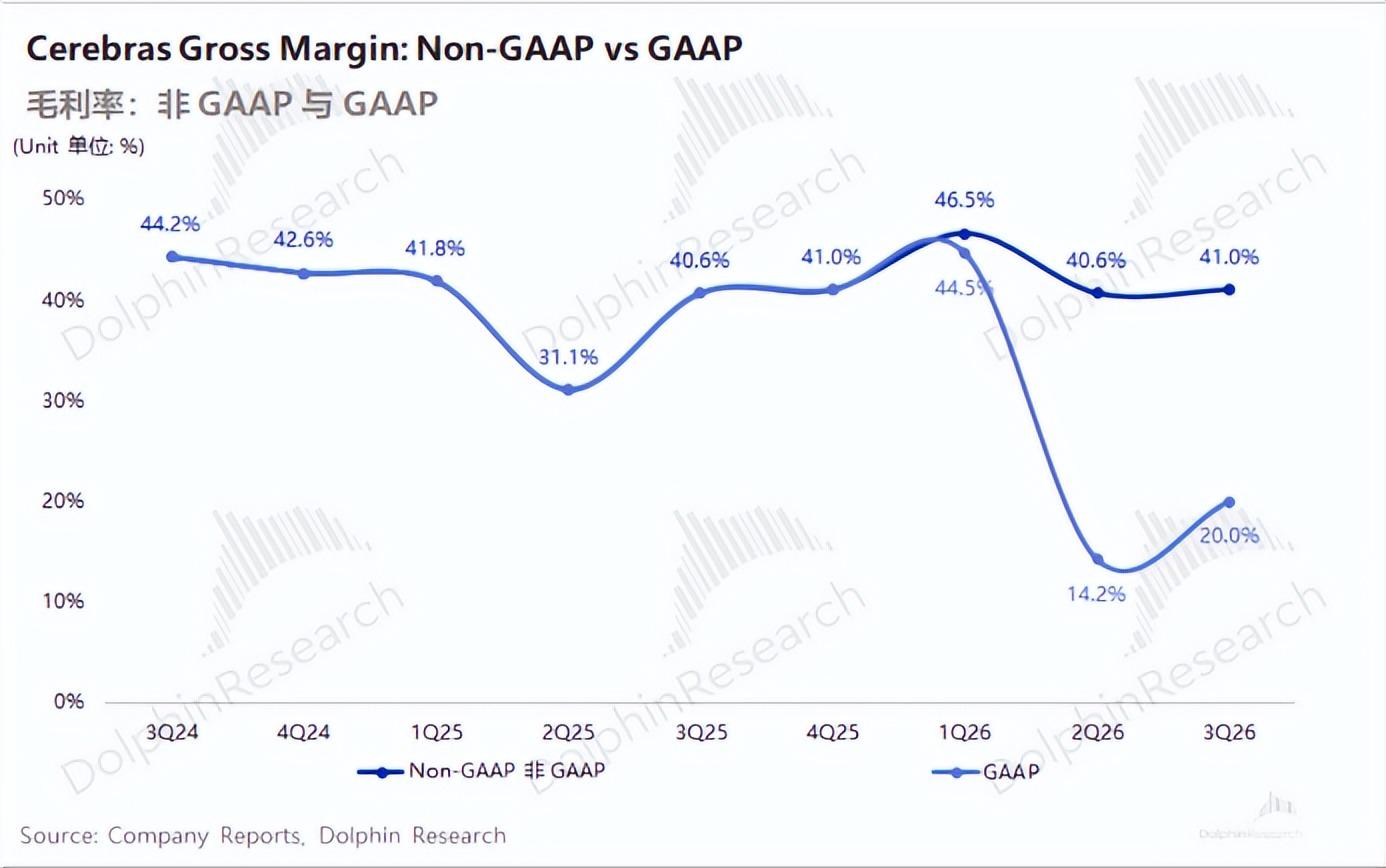
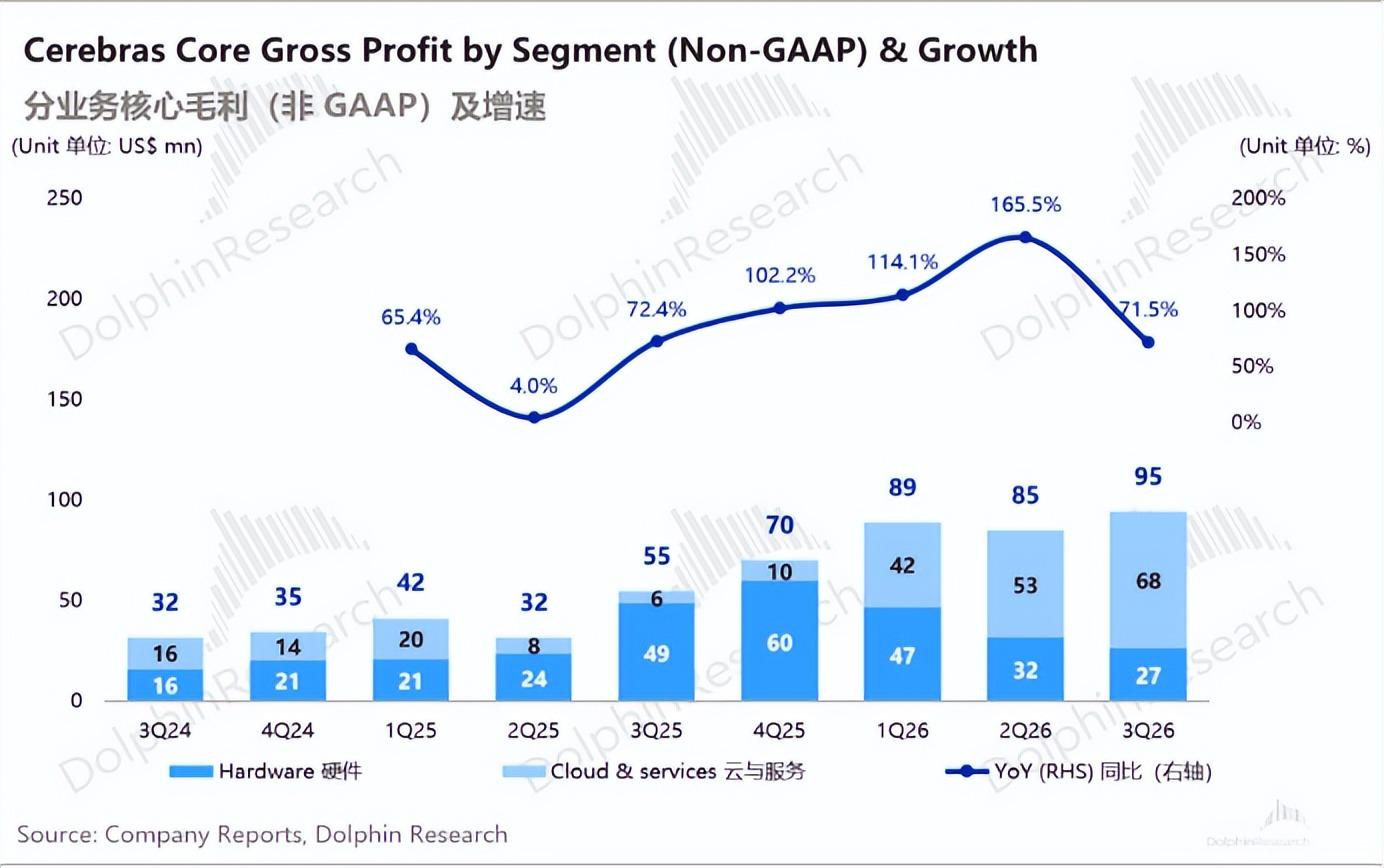
OpenAI buys compute, at a discount. OpenAI holds warrants for 33.4M non-voting shares at a near-zero strike. About 30% have vested: one tranche when OpenAI funded a $1B note, another when Cerebras' market cap topped the trigger after its IPO.
The remaining 70% vest as capacity is delivered, across 750MW signed plus a 1,250MW option.

The ~$823M of warrant value is amortized against revenue through Oct 2031. In short, Cerebras sells compute, then sells it at a discount, and OpenAI holds the leverage.
G42 buys systems and got free warrants. Together with MBZUAI, the Abu Dhabi group made up over 80% of revenue in 2024–25 and received two unconditional warrant tranches, about $300M of amortization.
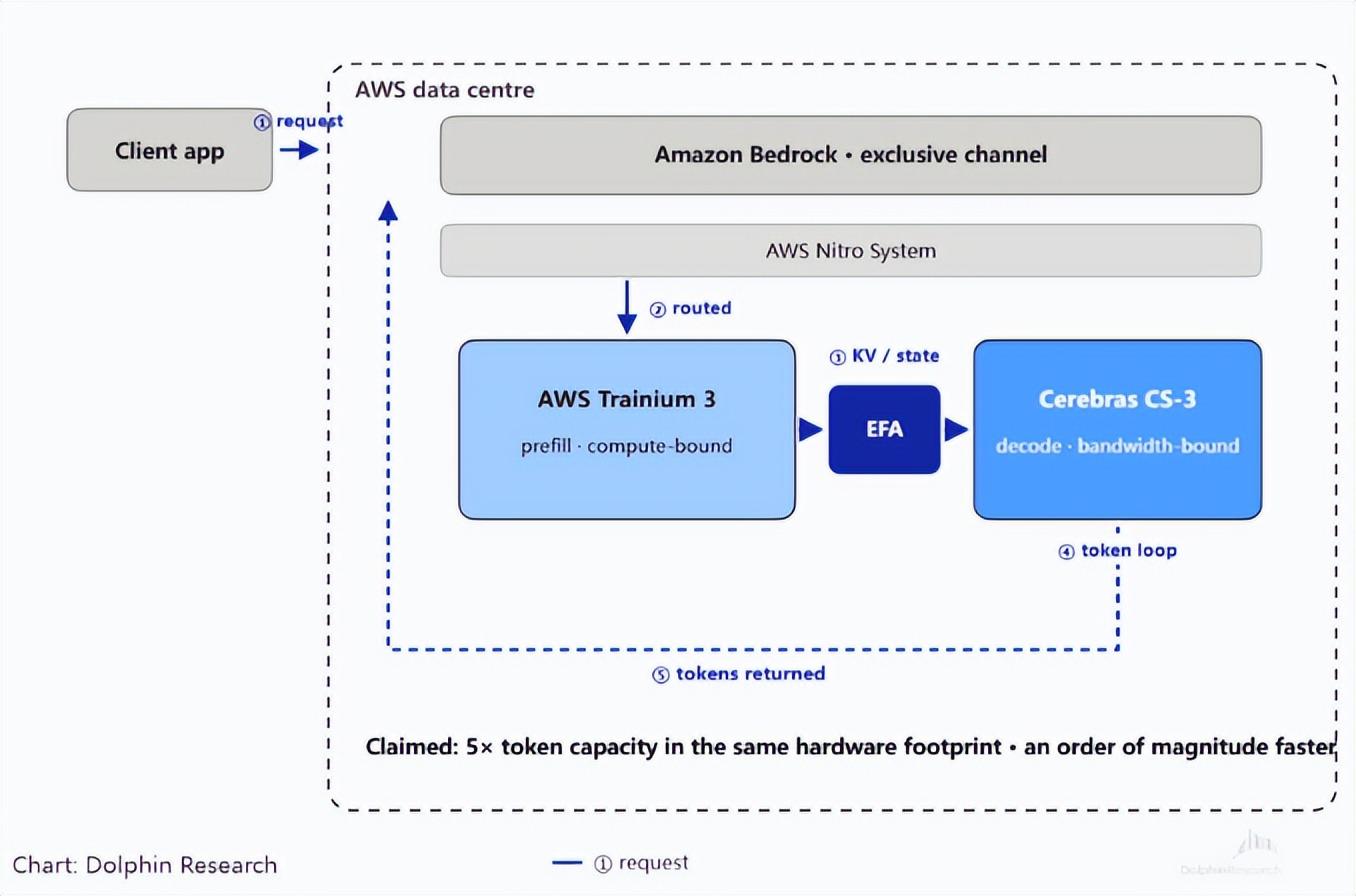
AWS uses finance-lease-style purchases. AWS runs prefill on Trainium 3 and decode on CS-3 to offer a low-latency tier on Bedrock. Terms favor Amazon: purchase options, price locks, Bedrock exclusivity and minimum capacity reservations.
If AWS under-consumes, capacity sits idle; if it over-consumes, concentration spikes again. AWS pays for its warrants, which vest with payments, and the final contract is still being negotiated.
Cerebras defines "core revenue" as GAAP revenue plus warrant amortization minus pass-through data center revenue, to show the business before these discounts.
What the numbers could look like
The key drivers are how fast capacity comes online and lease pricing. After build-out delays this quarter, our base case assumes 600MW of OpenAI's first 750MW lands on time, with total capacity rising from 88MW in 2026 to 875MW in 2028.

We model OpenAI at $7.5M per MW per year and other customers at $4.5M, low because of long-term anchor deals, and estimate capex of roughly $16B per GW excluding buildings and systems.
On that basis, cloud revenue grows from about $950M in 2026 to about $2.85B in 2027 (per guidance), and core revenue reaches about $7.8B in 2028, with core operating profit scaling from 2027 to roughly $2.9B in 2028 as cloud gross margin rises. The outlook hinges on delivering the OpenAI deal; capacity ramps and delivery timing are the big uncertainties.

