Posted on behalf of Stamper Oil & Gas Corp. - Two directors have been paying their own money for STMP.v, STMGF shares in the open market since late October, and every trade is filed publicly on SEDI. The most recent purchases are dated November 23. Insiders already hold over 20% of the company, so this is buying on top of an existing position, not a token gesture.
What the Filings Show
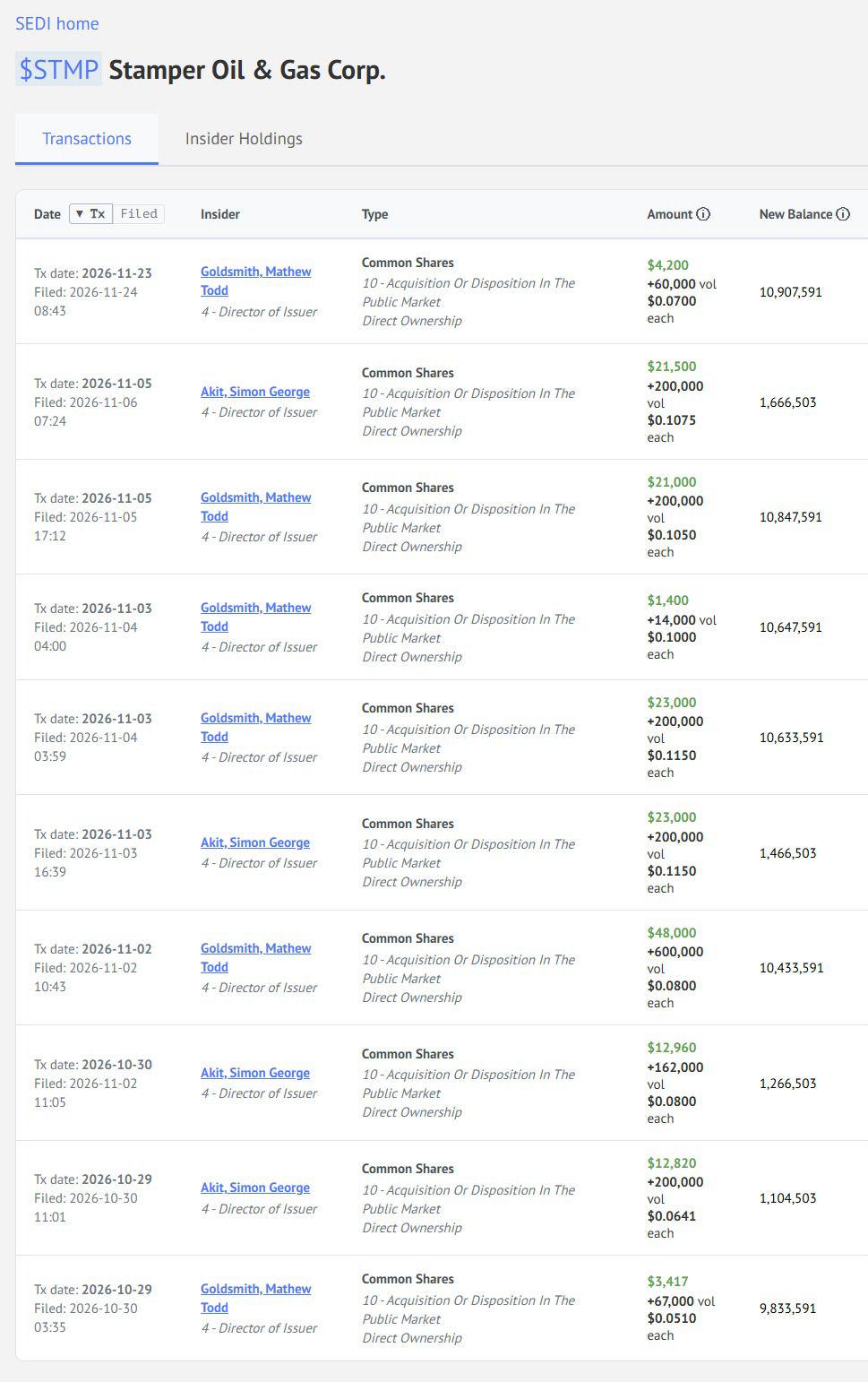
Six filings between October 29 and November 3 from chairman Mat Goldsmith and director Simon Akit, totalling 1,443,000 shares for roughly C$124,600, all direct ownership, all open-market purchases
October 29: Akit 200,000 at C$0.0641; Goldsmith 67,000 at C$0.0510
October 30: Akit 162,000 at C$0.0800
November 2: Goldsmith 600,000 at C$0.0800, C$48,000 in one go
November 3: Akit 200,000 at C$0.1150, balance 1,466,503; Goldsmith 200,000 at C$0.1150 plus 14,000 at C$0.1000, balance 10,647,591
Each purchase was priced above the one before it, and the buying has carried on since, with the latest trades dated November 23
What Their Money Is Buying at This Size
Market cap of about C$12 million after the C$2.0 million financing announced November 12
Five blocks, four petroleum exploration licences, three basins: a 32.9% working interest in Orange Basin PEL 107 plus 5%, 5% and 20% carried interests, meaning partners pay the exploration bills on those three
For scale on what the industry pays nearby: a Chevron affiliate, Harmattan Energy, agreed to pay US$11 million cash plus contingent payments for Trago's 10% of PEL 90, the Orange Basin licence that meets PEL 107's south-east corner
Chevron has guided to spud Nabba-1X on PEL 90 before the end of 2026
Directors stepping up at successively higher prices, in the weeks before the nearest well to the company's flagship licence is due to spud, is the sort of detail worth checking in the filings yourself. They are all public on SEDI via CEO website.
Vertical extent of high-grade subdomain increased a further 95 m to 739 m, a growth of 15%, by RK-26-293c1 with cumulative 2.5 m of >10,000 cps.
Strike length of high-grade subdomain increased by 28 m to 238 m, expanding by 13% with new intersections to both the southwest and northeast.
To date, the 2026 drilling campaign has increased the overall mineralized footprint vertically by 205 m to 905 m, a 29% increase, and along strike by a further 58 m to 678 m, a 9% increase.
Strong continuity of intense high-grade confirmed with hole RK-26-300 intersecting cumulative 10.0 m of >10,000 cps including 1.8 m of >61,000 cps located 25.0 m from RK-24-207 (9.5 m at 2.9% U3O8, including 0.5 m at 28.2% U3O8) and 29.0 m from RK-25-230 (7.5 m at 5.3% U3O8, including 0.5 m at 35.9% U3O8).
Southwest portion of high-grade subdomain has emerged as key growth area with continuity expanded by cumulative 4.2 m of >10,000 cps in RK-26-299c1 and deep extension potential from cumulative 6.0 m of >10,000 cps (including 0.7 m of >61,000 cps) in RK-26-297c1.
Vancouver, British Columbia--(Newsfile Corp. - November 24, 2026) - NexGen Energy Ltd. (TSX: NXE) (NYSE: NXE) (ASX: NXG)("NexGen" or the "Company") announces results from fifteen additional drill holes from the ongoing 2026 drilling at the Company's 100% owned PCE discovery located 3.5 km from the Arrow Deposit. These results expand the high-grade subdomain while also systematically confirming the internal continuity of intense high-grade mineralization (Figures 1 and 2, Table 1).
Vertical Extent Growth
RK-26-293c1 highlights the continued growth of high-grade mineralization at depth with a cumulative 2.5 m of >10,000 cps. This hole expands the total vertical extent of the high-grade subdomain at PCE to 739 m (+95 m or 15% increase). The host shear shows strong continuity, and is well-defined, which has led to the rapid growth of the mineralized footprint (Figures 1 and 2).
Strike Length Extension
New intersections along strike, to both the southwest (RK-26-297c3 with cumulative 9.5 m of >10,000 cps including 0.1 m of >61,000 cps) and northeast (RK-26-301 with cumulative 1.7 m of >10,000 cps including 0.2 m of >61,000 cps), have extended the strike length of the high-grade subdomain by 28 m to 238 m, a 13% increase (Figure 1).
Continuity of Intense High-Grade Mineralization Confirmed
RK-26-300 highlights the continued strong continuity of mineralization (Figure 3) intersecting cumulative 10.0 m of >10,000 cps, including 1.8 m of >61,000 cps. This intersection widens an area of intense high-grade within the subdomain that is interpreted to connect along the same shear 25.0 m from RK-24-207 (9.5 m at 2.9% U3O8, including 0.5 m at 28.2% U3O8) and 29.0 m from RK-25-230 (7.5 m at 5.3% U3O8, including 0.5 m at 35.9% U3O8).
Growth Areas
Drilling along the southwest portion of the high-grade subdomain has yielded strong results which point to further potential for growth of the system. Drillhole RK-26-299c1 intersected cumulative 4.2 m of >10,000 cps including 0.7 m of >61,000 cps that extends continuity of intense high-grade a distance of 49 m to RK-26-271, 22 m to RK-25-222, 47 m to RK-26-294, 39 m to RK-25-256 and 52 m to RK-26-272, all of which are high-grade intersections within the central portion of the high-grade subdomain (Figure 1).
The potential for further extension at depth indicated along a steeply dipping shear within the southwestern side of the high-grade subdomain (Figure 1) is highlighted by RK-26-297c1 returning cumulative 6.0 m of >10,000 cps, including 0.7 m of >61,000 cps, as well as cumulative 2.0 m of >10,000 cps in RK-26-297 and cumulative 9.5 m of >10,000 cps in nearby RK-26-297c3.
Leigh Curyer, Founder & Chief Executive Officer, commented: "These drill results add considerable geological understanding of the PCE discovery. The shape, size and distribution of mineralization point to a significant shear-hosted system, currently spanning over 905 metres vertically and 678 metres along strike. The high-grade at PCE continues to grow and show strong continuity which are both characteristics of the Arrow Deposit during its development. We are developing this large mineralized system systematically consistent with our approach to the Arrow Deposit. PCE, combined with Arrow and the district-scale land position NexGen holds further solidifies our position as the key supplier to global utilities for many decades to come."
Growth and demonstrated strength of the mineralized system at PCE continues with drilling in 2026 now successfully growing the overall vertical and strike extents to 905 m (+205 m or 29% increase) and 678 m (+58 m or a 9% increase), respectively.
Forty-seven drillholes totalling 31,480 m have been completed at PCE in 2026. The remaining drilling of the 42,000 m 2026 program will focus on internal high-grade continuity as well as continued expansion. Samples from 2026 drilling are continuously submitted to the independent Saskatchewan Research Council Geoanalytical Laboratory (SRC), and assay results will follow in batches.
Figure 1: Interpreted model of mineralization at PCE; new holes emphasized by larger diameter pierce points and bold labels; view is a long section that looks perpendicular to the primary mineralized plane; total mineralized footprint in orange and the high-grade subdomains in red
Figure 2: Interpreted 3D model of PCE shown looking northwest (across strike) and northeast (along strike); RK-26-293c1, RK-26-297c1, RK-26-299c1, and RK-26-300 intersections outlined in purple
Figure 3: RK-26-300 core photo displaying uranium mineralization that serves as key linkage between nearby high-grade lenses with cumulative 10.0 m of >10,000 cps including 1.8 m of >61,000 cps between 511.2 and 518.7 m; yellow outlines >1,000 cps, red outlines >10,000 cps, and purple outlines >61,000 cps
Table 1: Spectrometer results since August 25, 2026 release
All depths and intervals are meters downhole, true thicknesses are yet to be determined.
"Off-scale" refers to >61,000 cps (counts per second) readings by gamma spectrometer type RS-125.
"High-grade" refers to >10,000 cps readings by gamma spectrometer type RS-125.
"Anomalous" means >500 cps readings by gamma spectrometer type RS-125.
Where "CPS Range" is <500 cps, this refers to local low radioactivity within the overall interval.
Unconformity of 'N/A' denotes a lack of visible contact between Athabasca sandstone and basement rock.
Maximum internal dilution 2.0 m downhole.
All depths and intervals are meters downhole, true thicknesses are yet to be determined. Resource modelling in conjunction with an updated mineral resource estimate is required before true thicknesses can be determined.
Posted on behalf of Scotia Metals Corp. - Crux Investor put both of this company's exploration fronts in one place over the weekend, and the part worth reading twice is the pace on one and the cost of the other. SMET.c, CSRVF listed on the CSE on August 4, 2026, and has a rig turning in Nova Scotia plus a second hard-rock lithium address in Brazil, all inside four months.
Drilling Started Early at Green Wolf
Six diamond holes totalling approximately 1,000 metres from three drill pads commenced at the Green Wolf target, roughly two months ahead of the early-2027 start set out in the September 22, 2026 news release
It is the company's first direct test for a bedrock source of the spodumene-bearing boulders found at surface on the 100%-owned Acadia Lithium Project in southwestern Nova Scotia
Five boulder trains sit across an approximately 3 km by 1 km area at Green Wolf, with spodumene-bearing boulders grading up to 3.40% Li2O (Aug 27, 2026 NR)
The six holes test a single northeast-trending ridge where boulder distribution, glacial transport direction, suspected outcrop and ground radiometrics all converge
Detailed till-sampling grids and ground geophysics, radiometrics and ground-penetrating radar, are underway at Green Wolf, with full results and new drill targets expected in Q1 2027 (Nov 9, 2026 NR)
The Brazilian Option Costs US$10,000 a Month
Exclusive option to acquire an indirect 100% interest in the Nordestina Lithium Project, nine mineral permits covering 16,566 hectares in northeastern Bahia (Nov 16, 2026 NR)
US$10,000 a month during the optional period, not credited against the price, and US$2 million in cash to exercise by May 31, 2028, plus reimbursement of documented exploration costs up to US$210,000
No work commitment, and Scotia can walk on 30 days' notice
CEO Rodrigo Roso told Crux Investor that Nordestina will be funded separately from the flow-through money committed to Acadia (Nov 22, 2026)
First lab results from 1,355 soil and rock samples expected late November 2026, subject to laboratory capacity (Nov 16, 2026 NR)
Worth reading the Crux Investor write-up for how the two programs fit together. Two lithium addresses are now active, one with a rig in the ground and one waiting on its first lab work, and the monthly outlay on the Brazilian side stays small until the results tell Scotia whether to commit more.
Posted on behalf of Midnight Sun Mining - With the company's two days of investor meetings at 121 Mining Investment London wrapping up today, the next fixed date on the calendar for holders of Midnight Sun Mining (MMA.v MDNGF) is December 4 🇿🇲, when a board rebuilt over the past month goes to a shareholder vote.
Who Is On The Slate
Brett A. Richards, a director since August 2017, named independent Chairman on October 29, 2026, with more than 35 years in mining and metals and roughly three decades of that focused on Africa
Andrew Neale, more than 40 years of international mining experience including senior roles at Falconbridge, Noranda and Freeport-McMoRan, currently CEO of CopAur Minerals
Caroline Cathcart, more than 30 years in resource capital markets, previously VP and portfolio manager at Goodman & Company, now an independent director of Eloro Resources
Rick Mazur, Wayne Moorhouse and President and CEO Al Fabbro complete the six-name slate
Shareholders also vote on articles amendments tied to the advance notice policy adopted in October
The Purchase That Followed
On October 30, the morning after his appointment as Chairman, Richards bought 203,300 shares in the open market for C79,999,atC0.3935
That lifted his direct position to 6,092,047 shares, per the filing dated November 2, 2026
It was not a one-off: he added roughly 514,600 shares over the summer for about C$321,000
What The Incoming Board Inherits
12.1 km of demonstrated copper strike at Dumbwa within a roughly 20 km copper-in-soil anomaly, open to the north and south (Nov 18, 2026 NR)
387 holes and 83,235 m drilled, with the Northern Block now about 2.7 km east-west by 1 km north-south, the largest mineralized block there to date
Dumbwa 100% owned, plus the adjacent 62 km² Mulundu Licence under earn-in
Assays outstanding from 68 holes, 44 of them in the Northern Block, gating the planned initial resource estimate
The full slate and the director bios are set out in the company's October 29 news release, and the chairman's trades are public on SEDI if you want to check them yourself. A settled board, a chairman adding stock the day after taking the chair, and two higher-grade blocks being drilled toward a first resource: December 4 locks in the people, and the assay queue behind it is what could change the picture.
Posted on behalf of Bullfrog Gold Corporation - Four days from now a rig starts turning in Nevada's Beatty District, and the number worth knowing is what that program costs. The roughly 3,000 metres is costed at about C$2 million in total, including surface fieldwork and assays, set against a treasury of about C$7 million per the company's October 2026 presentation. So FROG.v, BFROF reaches its first drill results from South Bullfrog with most of the cash still in the bank.
The Timeline
Drilling commences November 28, 2026 at Longtail and Shingleback, the two fully permitted targets
Approximately 3,000 metres of diamond drilling: 4 holes averaging 300 m from 3 pads at Longtail, plus 4 holes to 300 m from separate pads at Shingleback
Assay results anticipated in Q1 2027, per the November 12, 2026 news release
Surface work resumes concurrently across the seven existing target areas plus the emerging Frogspawn area, with five additional targets being permitted
What Those First Holes Are Testing
Longtail: a resistive zone near the confluence of the Longtail and Bounding faults, beneath a broad magnetic low, where the exposed steam-heated alunite-kaolinite-silica alteration resembles what is observed at AngloGold Ashanti's Arthur discovery
Shingleback: a resistivity anomaly at the Basalt and T.S. fault confluence, a brittle damage zone under extensive silicification and clay alteration in an area of historic workings
Worth repeating the company's own caveat: Bullfrog Gold holds no interest in AngloGold's adjacent projects, and mineralization there is not necessarily indicative of South Bullfrog
The hole plan, the pads and the figures behind each target are all laid out in the company's November 12 news release if you want the detail.
A funded program, a fixed start date, and a results window in Q1 2027 is a tidy place for an explorer to be sitting, with room to keep advancing the next targets while the first two get tested.
Posted on behalf of Fidelity Minerals Corp. - Almost every figure attached to Las Huaquillas in northern Peru 🇵🇪 is a gold figure: 446,000 oz historic, a conceptual 0.8 to 1.2 Moz objective. None of them contain a single pound of copper. Two porphyry systems flank the Los Socavones gold zone, both were drilled in the 1990s, and neither has ever been counted in any resource estimate on the property.
Cementerio, 1,000 m South of Los Socavones
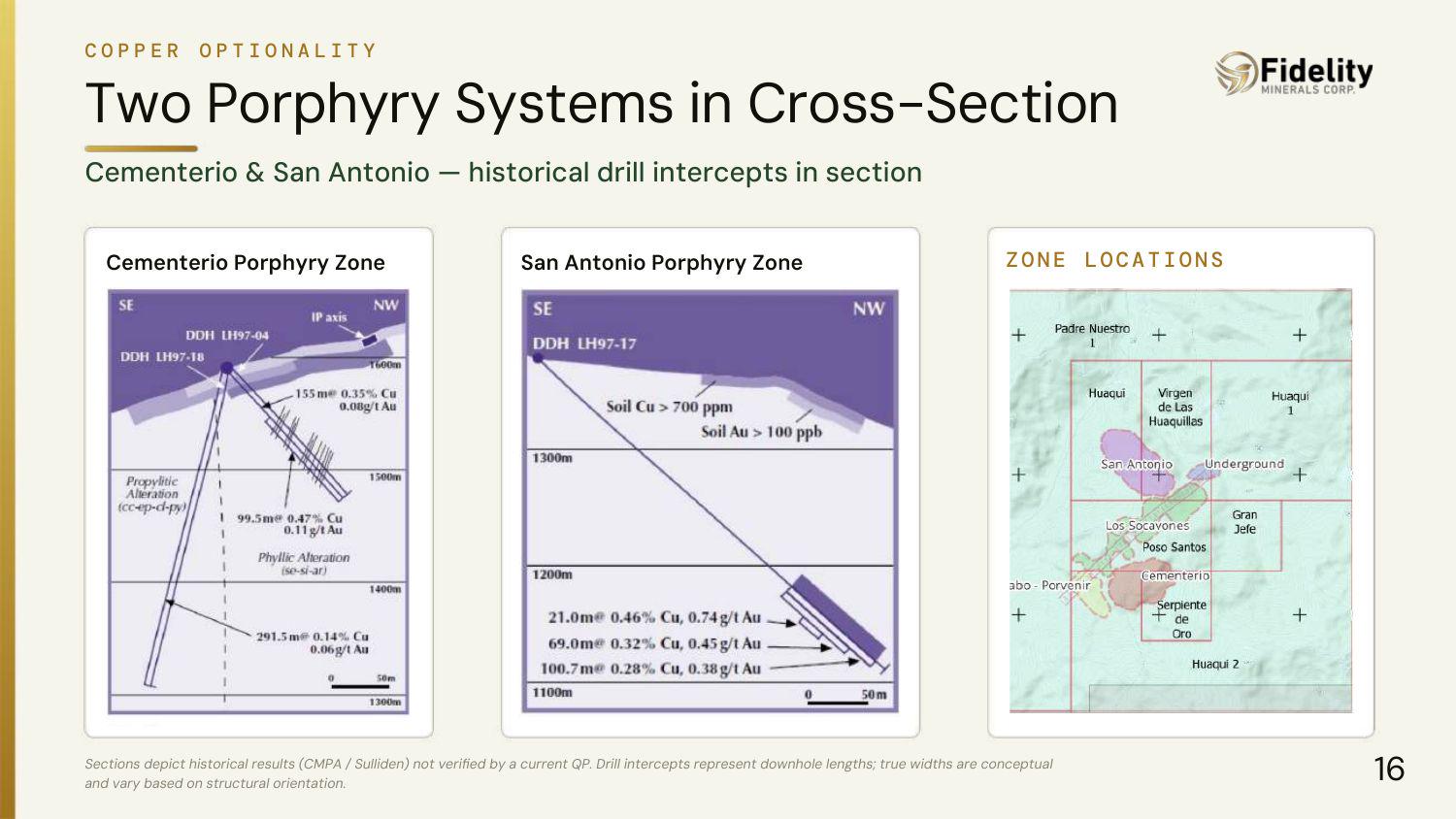
LH-97-04 returned 0.47% Cu, 0.11 g/t Au and 4.5 g/t Ag over 99.5 m drill length, a hole the company said "demonstrated the size potential of Cementerio's phyllic ring"
Extensive argillic, phyllic and hematitic alteration, partly visible from the road running to Las Huaquillas village
San Antonio, 1,000 m Northwest
LH97-17 returned up to 0.32% Cu, 0.45 g/t Au and 3.0 g/t Ag over 69.0 m drill length, including 0.46% Cu, 0.74 g/t Au and 4.9 g/t Ag over 21.0 m
Hosted in a calc-alkaline quartz diorite measuring 500 m by 900 m, coincident with a copper-gold soil geochemical anomaly
Why That Sits Outside the Count
The historic estimate covers Los Socavones gold and silver only: 6.57 Mt at 2.12 g/t Au and 25.2 g/t Ag, or 446,000 oz gold and 5.3 million oz silver, historic and not NI 43-101 compliant
Sulliden did not estimate the copper, zinc or lead within the Socavones zone either, so the base metals are absent from the headline number too
FMN.v holds 44.5% of Rial Minera S.A.C., owner of the nine Core Group concessions (3,600 ha) that host all known mineralization, with a right to earn 50%
The technical report (Luc Pigeon, P.Geo, effective December 18, 2021) recommended a property-wide IP survey focused on Cementerio and San Antonio, and placed one of 20 recommended drill platforms at Cementerio (a 2022 recommendation, not current scope)
The company's September 28, 2026 update still describes Las Huaquillas as offering copper upside through exploration of the two confirmed porphyry systems flanking the gold zone. Gold is what the next NI 43-101 is aimed at, but the copper sits on the same concessions, already drill-tested, with room to become a second line in the asset that today's numbers do not account for. The January 6, 2022 news release announcing the technical report filing has the full geological detail.
Posted on behalf of Scotia Metals Corp. - Joining Crux Investor in an interview posted November 21, 2026, CEO and Director Rodrigo Roso laid out what the maiden scout drilling at the Acadia Lithium Project in southwestern Nova Scotia is actually testing. The summer went to till sampling and geophysics, and SMET.c, CSRVF started drilling at the beginning of November.
Why This Ridge
Crews picked a boulder-rich ridge sitting up-ice of the boulders, which matches the company's model of how that glacial material travelled
A couple of the large boulders on it are suspected to be outcrop
Holes are being drilled through both sides of the ridge to reach the bedrock below
Ground radiometrics flagged an anomaly and a fault in the same spot, which Roso says tracks with what is seen at the neighbouring third-party Brazil Lake deposit
Channel sampling across boulders at Green Wolf, which Roso at [6:21] describes as hitting 2.7% lithium content, is what built the confidence to drill here
What Counts as a Win At [4:48] he sets the bar plainly: "success for us is finding one or more pegmatites within our six holes." He put the program at 1,000 to 1,500 metres and said the team does not want to overdo this stage before organising a full program across the other anomalies.
Timing and Funding
A good update with visuals from the drilling targeted for December, with assays taking longer [10:44]
Full property-wide drilling intended toward the end of Q1 2027, after this program's assays
Not concerned about raising right now, with enough cash to start both programs and accelerated warrant exercise adding about $1.5 million before any raise, which he targets around the middle of next year once results are in hand [19:57]
Board plus connected backers hold roughly 50% of the company, per Roso at [24:31].
The Infrastructure Case At [8:41] Roso calls infrastructure the main difference from other North American projects: a deep-sea port about an hour away, road access to where they are drilling, plus power and water available.
Six holes into ground never drilled before, with a visual core update targeted for December, is a direct test of a model built over one summer, and it sets up the larger program Roso says follows.
Posted on behalf of Grid Metals Corp. - Pollucite, the mineral that carries cesium, looks a lot like cloudy quartz or marble, and it is the preferred feedstock for cesium chemicals. Grid, GRDM.v, MSMGF, has published its own 2:47 explainer walking the whole chain, rock in the ground to a chemical sold around the world, in eight steps. The full video is attached. This post stays on the first two steps, because that is the end of the chain Grid is working on.
Step 1: Mine The Ore
Pollucite is mined from hard rock with conventional equipment, at grades of roughly 1% to 10% Cs2O
Lucy South's maiden resource sits inside that band: open-pit Measured LCT Zone of 51,500 tonnes at 2.58% Cs2O and 1.47% Li2O, enclosing a higher-grade Pollucite Zone of 15,600 tonnes at 5.19% Cs2O and 1.76% Li2O (see Sep 30, 2026 MRE news)
That resource is 100% Measured, covers Lucy South only, and ranks as the second largest cesium resource in active development globally by western companies
The pegmatite is relatively flat-lying and averages about 10 m thick, with the cesium zone typically 15 to 25 m below surface, 500 m north of the Trans-Canada Highway in southeastern Manitoba
Step 2: Crush It
A crusher breaks the ore into fist-sized pieces
Purely mechanical, no chemicals involved
Why The First Two Steps Matter The specialized chemistry happens downstream at a chemical plant, not at the mine. Grid is focused on the front end, producing a high-grade cesium concentrate for chemical makers, and the only cesium processing plant in the western world sits about 110 km away. Falcon West is 85% Grid, with Avenir Minerals, a wholly-owned subsidiary of Agnico Eagle Mines, holding 15%.
Shallow ore and a purely physical front end are the sort of starting conditions that keep a development plan simple, and with SGS ore-sorting results guided for around December, Step 3 is the one about to be tested on real Lucy South rock. The resource figures are all in the September 30 news release.
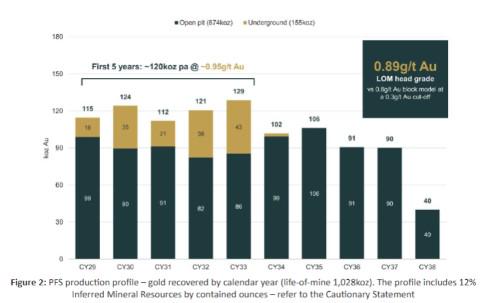
Posted on behalf of PC Gold Ltd - Today's Pre-Feasibility Study on the 100%-owned Spring Hill Gold Project near Pine Creek, about 200 km south-east of Darwin, turns part of the deposit into a costed mine plan for the first time. What stands out is how small a slice of the deposit that plan rests on, and how much drilling sits outside it.
The Reserve, And What Isn't In It Yet (ASX announcement, 24 November 2026)
Maiden Probable Ore Reserve of 35.5 Mt at 0.83 g/t gold for 951,000 oz, reported in accordance with the JORC Code (2012), 100% attributable to PC Gold (ASX: PC2, Frankfurt: D6A).
901,000 oz of that comes from the open pit, 50,000 oz from a small, high-grade underground component at 3.14 g/t.
77% of Indicated ounces converted, Indicated meaning drilled closely enough to plan a mine on.
The Reserve was estimated at a deliberately conservative gold price assumption of A$4,500/oz.
It sits on a resource of 75.9 Mt at 0.8 g/t for 1.92 Moz defined over just 1.2 km of strike, open in all directions.
About 40,000 m has been drilled since that resource's assay cut-off and is not in either figure yet.
The Operation The Study Describes
A single standalone staged open pit mined alongside a decline-access underground mine on the high-grade Macau Link Zone and Hong Kong Lode.
A new 4 Mtpa gravity and carbon-in-leach plant, a conventional and widely used gold flowsheet, with expected life-of-mine metallurgical recovery of 94.1%.
Initial 9.5-year production life, pre-production capital of A$413M, first gold targeted for Q1 CY2029.
What Happens Next
Cash of about A$85.5M at 30 September 2026, which the company says funds it through the DFS to a Final Investment Decision targeted for Q3 CY2027.
20,000 m Phase 1 underground drilling starts Q1 CY2027, targeting conversion and growth of the Link Zone, where around 65% of the underground mining inventory is currently Inferred.
Updated resource targeted for March 2027, to underpin the DFS and an updated Ore Reserve.
Worth reading the company's 24 November announcement in full for the full study tables and assumptions. With four rigs turning and a March resource update feeding straight into the DFS, the version of Spring Hill now on paper has room to look different by the time the investment decision arrives.