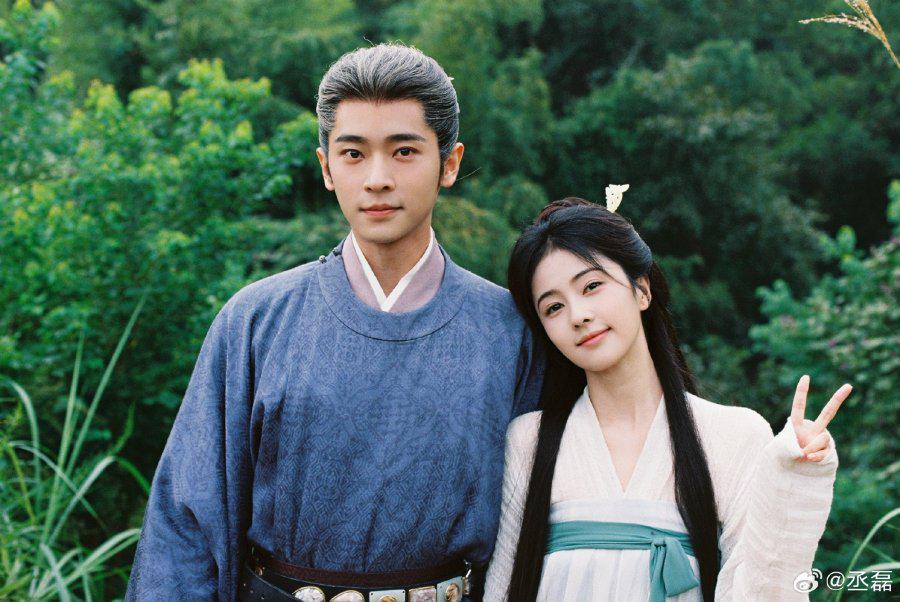
This was more for me than, about posting really. I’m not into labels all that much. I’ll let you the reader contemplate for yourself if this was a Double Feature or something more. Enjoy!
The Premise
Hou Hsiao-hsien's The Assassin (2015) doesn't end with a duel. It ends with a walk. Nie Yinniang, trained since childhood to kill, gets sent to murder the man she was once betrothed to, and she just doesn't do it. No speech, no rebellion. She quietly decides what she's willing to be. Then she leaves with a caravan of strangers, and the landscape doesn't care that she existed.
Here's the thing. A decade of Chinese television has been circling that ending. Word of Honor(2021) and Mysterious Lotus Casebook (2023) are the two big wuxia dramas of these years, and both are basically telling Hou's story over again, a killer trying to stop being one. Neither one copies the film. Each one grabs a different piece of it and stretches that piece across forty episodes. Hou squeezed a single moral decision into 105 strange, quiet minutes. The dramas take the decision's aftermath and stretch it into a whole life. The film asks whether she'll kill. The dramas ask what's left of someone who killed plenty and then stopped.
What All Three Share
Look past the costumes and the sect politics and you find the same bones. Every protagonist here is a retired weapon, and the story is about the weight of what that weapon did.
Zhou Zishu ran the assassin bureau Window of Heaven, and he quits by pulling the Nails out of his own body. That's a slow suicide traded for about three years of freedom. His guilt is oddly administrative. He kept the ledgers of a killing operation. He knows what every entry cost. Li Lianhua keeps a different kind of ledger. As Li Xiangyi he was the finest blade of his generation, he led his school into a disaster that destroyed it, so he buried the name, became a wandering doctor, and started healing the sorts of wounds he used to inflict. Nie Yinniang's guilt is quieter, a nun's training that turned her, in the film's own words, into something like a knife, and a father she can only disappoint by laying the blade down.
So all three works see the jianghu the same way. Not as romance. As contamination. Older wuxia, Jin Yong's wuxia, is an adventure space where heroes belong. Here the martial world is something you're trying to escape, a maze of proxies, dead sects, and alliances that cost more than they protect. Being good at violence is exactly what makes the place unbearable. Mastery isn't freedom here. Mastery is the trap.
And because of that, nobody in these stories gets to say what they mean. Intimacy goes underground. Nie Yinniang renounces her betrothal through posture and held breath. Li Lianhua and Di Feisheng, nemesis and legend, circle each other for a decade wanting one last duel, and both of them know it's really a refusal to let the other die alone. They conduct the whole thing in the grammar of fighting. Zhou Zishu and Wen Kexing, boxed in by censors into something the script can never name, love each other through sacrifice and a fierceness of attention no declared romance in the genre matches. Hou chose that silence. The dramas had it imposed. Either way love gets proven instead of spoken, and the proof always costs the lover something they wanted.
Where They Split
The first split is structural, and it decides everything after. The film runs on ellipsis. Whole relationships pass in one look, court politics arrive in fragments you have to guess at, murders happen between cuts. Television can't do that, forty episodes of silence would kill a show, so each drama builds a machine to convert Hou's ellipsis into forward motion.
Word of Honor picks the road. Zhou Zishu and Wen Kexing travel, pick up companions, gain a surrogate son in the orphan Chengling, and drift into a conspiracy over a legendary armory. Mysterious Lotus Casebook picks the detective story. Weekly cases, solved by the wandering doctor and the earnest young Fang Duobing, slowly braid into the one question the show hangs on, what actually happened ten years ago, and can Li Xiangyi's disgrace survive the answer? One show buys time with geography, the other with forensics. But both are buying delay. They're pushing off the confrontation between a man and his own history, which is the confrontation Hou's film stages and finishes in one act of refusal.
Then there's the shape of the company. The film is lonely. Nie Yinniang has no partner, no confidant, just obligations she'll eventually decline. Word of Honor is a dyad with satellites, two men drifting together, and its warmest scenes are domestic, a found family knitting itself around two damaged people. Mysterious Lotus Casebook is a triad, the dying elder, the boy who worships him, the rival who loves him in the only dialect he was ever taught. Fang Duobing believes in the jianghu the way kids believe in heroes, and the show's cruelest project is dismantling that belief while Li Lianhua watches and mourns the believer he used to be.
Temperature forms a clean spectrum too. The film is cold, painterly, interiors like ink paintings, feeling shoved off onto curtains and weather. Word of Honor is warm to the edge of camp, all banter and theatrical flourish. Mysterious Lotus Casebook sits in the middle, and the middle is its signature. Bittersweet, comedy that keeps curdling into grief, a wanderer's tale told by somebody who knows how it ends. When Word of Honor lightens the mood it's doing you a favor. When Mysterious Lotus Casebook does it, brace yourself.
Violence as Language
The film's action is brief, brutal, and easy to read in space. Bodies hit pillars. A thrown blade pins cloth instead of flesh, which is restraint announced. Death shows up without choreographic courtesy. Hou shoots fights the way he shoots conversations, distant, patient, refusing to enjoy them.
The dramas sit far from that, though at different distances. Word of Honor goes full stylized, wirework, glow effects, duels as ballet, and the beauty is honestly part of the censorship bargain, spectacle standing in where substance couldn't go. Mysterious Lotus Casebook stays closer to the ground, fights built on position and deception and consequence. Its most characteristic move isn't a fight at all. Li Lianhua ends standoffs with medicine, misdirection, or an old debt, and you realize the retired killer's deadliest weapon was never the sword.
But one motif shows up everywhere, combat as conversation. Di Feisheng chasing his rematch is the closest the dramas come to Hou's language of relationship, two people who can't say what they mean agreeing to meet at the point of a blade. Hou does the stranger thing. He stages the refusal of combat as the loudest statement in the film. Nie Yinniang's last big moment is a fight getting cancelled, and the cancellation says more than she says in the entire runtime.
Three Endings
The endings spread into a spectrum, and that spectrum tells you everything about the gap between art cinema and Chinese streaming television.
The film ends in renunciation, pure renunciation. Nie Yinniang walks off. No reward, no reunion, not even the comfort of knowing what it cost her. It's the harshest ending in modern wuxia and the most faithful to the genre's Daoist root, the superior martial artist being the one who stops fighting.
Mysterious Lotus Casebook ends in ambiguity. The finale never confirms whether Li Lianhua survives. The search for him runs past the last frame, and the fandom still argues about it. That's not dodging, it's the thesis in action. A man who spent ten years refusing to be found can't just be handed back to his believers in the closing credits. Whether he lives is deliberately beside the point. What matters is that the letting go was real.
Word of Honor ends in absolution. Broadcast norms, a fandom heavily invested in its pair surviving, so the drama gives both men a future, something close to a domestic horizon. Least rigorous of the three endings, most loved. That gap is the lesson. Television owes you a return on forty hours. Renunciation is a language film speaks natively and television can only quote.
The Gaze Problem
One inversion I don't want to skip. The Assassin centers a woman and builds its whole moral argument on her interiority, delivered with almost no dialogue. The rarest thing about the film isn't the cinematography. It's the conviction that a woman's withdrawal from violence could carry the entire genre's ethical weight.
The dramas flip that. Their cores are male bonds, partly by source material and partly by fandom economics, and the women orbit as satellites. Gu Xiang in Word of Honor burns bright and pays for it. The women of Mysterious Lotus Casebook circle the legend of a man. Nobody gets the film's central act, the refusal that reframes the story. That's the cleanest boundary here. Hou trusts silence, and he trusts a woman. The dramas trust dialogue, and they trust men. Theme got inherited. Gaze didn't.
Two Heirs
Put together, the two dramas inherited different halves of the film. Word of Honor took the premise, a retired killer atoning, and warmed it up, turned renunciation into romance, gave the solitary walker a partner. That's the premise domesticated. Mysterious Lotus Casebook took the sensibility, the stillness, the unsaid things, the legend rotting under his own myth, and built a serial mystery on top. That's the sensibility serialized.
To be fair, neither is comparable in kind. Hou's register is something no forty episode drama can pay for. Silence as story, deletion as characterization, an ending that hands you nothing and is complete anyway. What the dramas prove instead is that renunciation can survive the move into a medium built on accumulation. A man whose whole arc is subtraction stays at the center of a form that runs on addition. One show answers with romance, the other with elegy, but the question is Hou's, and both know it. The weapon learns to walk away. Cinema lets it vanish into a crowd. Television has no crowd to hide it in, so it gives it a home, or a grave it won't let us see.