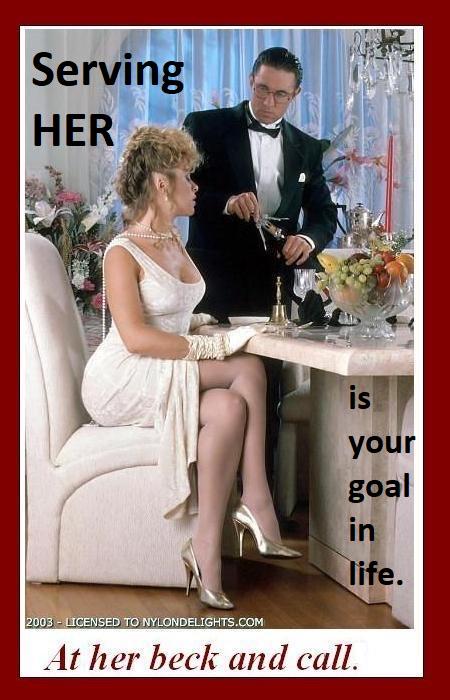
The following are parts of an article from Cat Boulder at Femaleled.info. It has been edited for our forum. Click the link if you want to read it all.
It wasn't about a Christian couple, necessarily, but it could be. I believe this plays out in Christian couples a lot more than you might think—they simply don't call it what it is. Enjoy!
Stacey and PJ spent years appearing to have a conventional marriage. Beneath the performance, the truth was already perfectly clear: she led, he served, and life worked better when they stopped pretending otherwise.
Some women slowly discover they are dominant. Stacey tried submitting, watched her husband make a perfectly respectable attempt at taking charge in the bedroom, and realised they had cast the wrong person in the leading role.
Their female-led relationship didn’t begin when they found a name for it. It began when Stacey stopped pretending, looked at the man she had chosen and told him exactly how things would work from then on.
Happily, he listened.
How did your female-led relationship begin?
Let’s start with the truth: I didn’t fall into this by accident. I chose it.
When I met PJ on a blind date, I knew immediately that he was going to be mine. I don’t chase men. I decide whether they belong in my life, and I decided quickly. PJ fitted what I wanted, so I claimed him.
From the outside, we looked like a conventional couple. We raised two children, built a life and ran a household together. But even then, I was the one running the show: the finances, the long-term plans and the decisions that actually mattered.
We didn’t realise we were already living in a female-led relationship. It took years before we were honest enough to call it that.
How does this dynamic differ from your previous relationships?
In previous relationships, the assumption was that the man would lead and the woman would adjust gracefully, quietly and with a smile.
I have never been that woman.
With PJ, the structure is clear and it remains clear. I lead. He supports the life I have built. There is no competition for authority and no confusion about who has the final word.
That clarity isn’t cold. It is deeply freeing.
We stopped wasting energy on a power struggle neither of us wanted and started actually living.
What initial challenges did you face?
The greatest challenge was performing a version of myself I didn’t believe in.
Society teaches women to soften themselves, defer and make men comfortable. I tried. We played the traditional couple because that was what people expected, and I tolerated it for far longer than I should have.
But pretending is exhausting, and eventually the performance cannot hold.
How has the relationship empowered each of you?
For me, it meant I could stop shrinking.
I run my home as I see fit. I make decisions without apologising for making them. And I take full responsibility for the direction of our life, and I do it as myself rather than as a softer, more manageable version of myself.
For PJ, the structure provides something men rarely admit they want: clarity. He knows exactly what is expected of him. He rises to meet those expectations and takes pride in doing so.
People assume submission means diminishment. It doesn’t. A man who knows his role and inhabits it fully is not diminished. He is settled.
We are both stronger because we stopped trying to force ourselves into a different shape.
How do you approach decisions and conflict?
I make the decisions. That is the structure, and the structure is not ambiguous.
But leadership is not indifference. I listen, observe and take in what I need before deciding. What I don’t do is agonise over authority I have already claimed or open every decision for a vote.
Friction still occurs, of course. When it does, we return to clarity. We revisit our expectations and adjust where necessary.
The dynamic itself rarely needs defending because it is already understood. We don’t argue about who is in charge.
We already know.
What misconceptions about female-led relationships would you like to dispel?
That an FLR is merely a bedroom arrangement with a fancy name.
It isn’t.
A female-led relationship shapes every part of your life: how money moves, how decisions are made, who sets the tone for the household and who follows it. Intimacy is one expression of that authority, not the whole of it.
Another misconception is that this way of life must be kept secret, discussed only in whispers and hidden from family. Ours isn’t. The people in our lives know who leads this household.
And do you know what they did with that information?
They adapted.
Authentic authority doesn’t require an announcement. It walks into a room, and the room already knows.
What advice would you give someone considering an FLR?
Stop performing compatibility you don’t feel.
If leadership comes naturally to you, lead. If following is where you function best, follow.
Relationships begin to collapse when both people are pretending: when she is managing her authority down and he is performing initiative he doesn’t possess.
Understand your motivations. Say them aloud. Make your expectations specific. Then build a structure that serves you both, rather than one that looks impressive from the outside while quietly grinding you down.
An FLR isn’t a costume. It is an honest account of how two people actually work.
How has your relationship evolved?
Slowly, and then all at once.
What began as a conventional marriage, functional and decent but not quite honest, changed over the years as we stopped pretending our personalities were something other than what they were.
The structure became more deliberate. PJ has been in chastity for eight to ten years now. It started on and off. Once I saw the benefits, better behaviour and more focus on me, it became 24/7
Is there anything else you would like readers to know?
Most people spend years living at a slight angle to themselves. They perform the version of their relationship that appears acceptable, making themselves smaller or larger than they really are while waiting for permission to be honest.
I spent years doing exactly that.
Then I asked myself one question:
Why was I trying to submit when leading felt like breathing?
The answer changed everything. Not dramatically. Not overnight. But completely.
The strongest relationships aren’t necessarily the most conventional ones.
They are the most honest.