r/ClaudeCode • u/MedaiP90 • 13h ago
Built with Claude How I used Claude Code to build a native Apple Music client for Linux (Rust + GTK4)
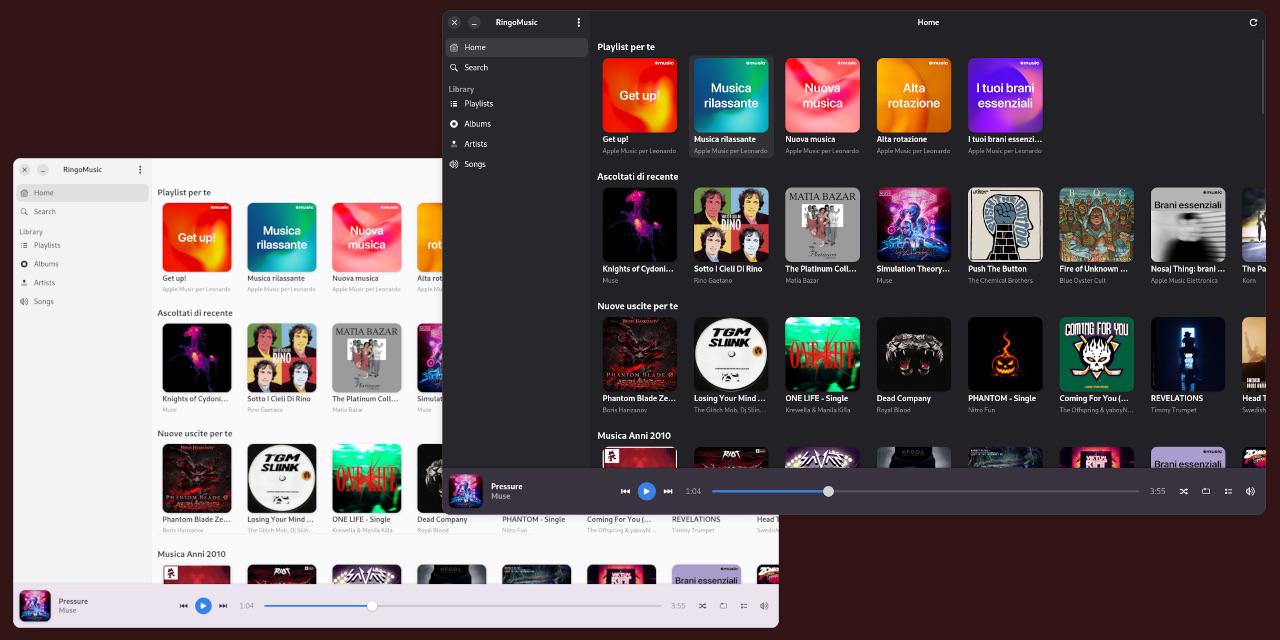
Hello! I want to share a project that I built with Claude Code, and how I worked, because the method mattered more than I expected.
The project: RingoMusic, a free and open-source Apple Music client for Linux. The interface is native Rust and GTK4/libadwaita. A hidden Chromium plays the audio, because Apple's Widevine DRM needs it.
https://github.com/MedaiP90/RingoMusic
How I worked
Plan first, code later. Before any code, I discussed the architecture in a Claude chat and made a full implementation plan in Markdown: phases, acceptance criteria, risks and open decisions. Claude Code then worked one phase at a time from this plan.
Rules that Claude must never break. I wrote them down early: no audio downloads, no DRM circumvention, only write endpoints that Apple documents, and no automated actions on the user's library. Where possible, the rules are enforced in code. For example, the Rust side and the engine share an exact allow-list of permitted API requests, and a test fails if the two lists differ.
A separate reviewer. I used a different Claude session, with no access to the coding session, to review the repository after each round of changes. It found real bugs: a startup race in Electron, lost error messages in the logs, a path check that encoded dots (%2e%2e) could get past, and one feature that broke my own rules. Claude Code then fixed them.
Strict tooling. More than 300 Rust tests, a mock engine so CI can test without a subscription, clippy pedantic, cargo-deny, license checks, pinned GitHub Actions and build attestations for the releases.
Conventions as skills. I use my own Claude Code skills for clean code and for plain English in comments and documentation, so the style stays the same across the codebase.
What worked well: Claude Code is very good at the large amounts of careful work, such as protocol types, packaging for deb, rpm and Flatpak, tests and refactors. The separate review session caught things that the coding session did not see in its own work.
What needed me: product decisions, the legal limits (what Apple's terms permit), and taste. For example, I decided how the mini player should look, even when the reviewer suggested something more functional.
Limits of the app: x86_64 only, no lossless audio, high memory use because of the hidden Chromium, and an Apple Music subscription is required. It is not affiliated with Apple.
Questions about the workflow are welcome!
•
u/AutoModerator 13h ago
Hey! Thanks for posting to r/ClaudeCode
While participating in this thread, please follow our community rules. Keep discussions constructive. Attack the idea, not the person.
For help, project discussions, tips, and general chat, join the ClaudeCode Discord.
I am a bot, and this action was performed automatically. Please contact the moderators of this subreddit if you have any questions or concerns.
2
u/PolyKernel 13h ago
the code can be spotless and the big company can still kill it with one change on their end lol, I had an unofficial client for a big service die overnight because they rotated something in the player and never said a word, I'd make it super easy for people to export their setup and keep expectations low that it lasts forever
1
u/Practical_Tie_334 12h ago
The allow-list test is a nice way to make the architecture enforce the rule. Does it also send a disallowed request through the engine and check that it gets rejected? That would catch a regression where both lists still agree but one request path skips the check.