r/ClaudeCode • • 9h ago

Discussion I am convinced that Claude gets dumber when PST starts work, is it just me?

0 Upvotes

I never thought I’d be writing one of these, and I have no hard proof, it’s just a vibe I get. I haven’t verified this across LLM providers.

I work in the UK so I find that at the end of my day (when PST starts work) Claude starts making more mistakes. Stuff that really surprises me and that opus is just normally able to do. I find this consistent across continued sessions and new sessions raised around this time.

This absolutely could be confounded by it being at the end of my day, when I’m more tired, etc.

I’m wondering if people in the EST have noticed a difference in Claude between the morning and the afternoon? Any other ideas for what might be going on?


r/ClaudeCode • • 23h ago

Discussion I got the MAX subscription for 3 months now, while switching back to Pro I’ve noticed that the usage is not significantly less..

13 Upvotes

I honestly feel like Max is 2.5x the usage of Pro. It’s nowhere near 5.. I have been working on the same project during the whole period and I did just notice this..

I was stunned to be honest, it’s not worth 5x the price of pro at all.

Model Opus 5.5 effort high.


r/ClaudeCode • • 10h ago

Discussion Claude auto-ruining music by rewriting it as chiptune chimes?

1 Upvotes

I've found recently that if I composed my own music programmatically that sounds good and fairly listenable (let's say 80% me with drum patterns, 20% gemini). and then I feed it to a different project with Claude Code, it gets changed randomly and without saying.

Claude turns it back into the default "alien ai slop chimes" that are on all the "one shot prompt, low poly what if scenario" short form videos. Bells, random white noise, etc. Basic chiptune beeps.

Is it hampering "generative-seeming" music playing by thinking it's machine learning or something?


r/ClaudeCode • • 13h ago

Built with Claude How I used Claude Code to build a native Apple Music client for Linux (Rust + GTK4)

Post image
2 Upvotes

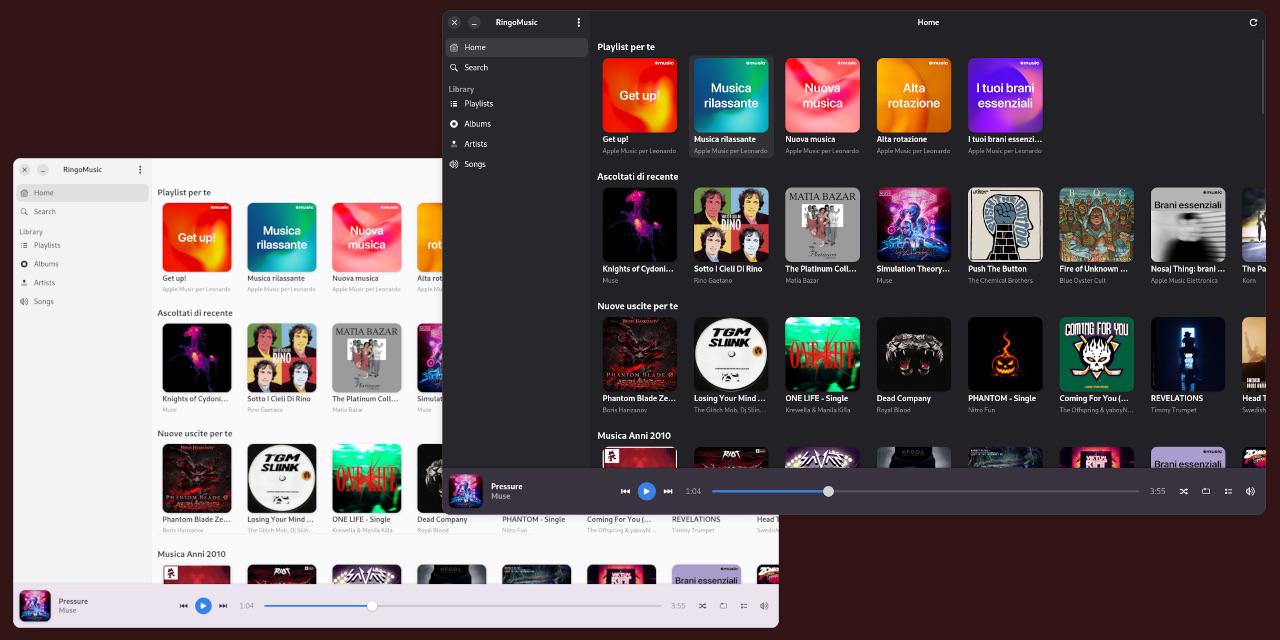
Hello! I want to share a project that I built with Claude Code, and how I worked, because the method mattered more than I expected.

The project: RingoMusic, a free and open-source Apple Music client for Linux. The interface is native Rust and GTK4/libadwaita. A hidden Chromium plays the audio, because Apple's Widevine DRM needs it.

https://github.com/MedaiP90/RingoMusic

How I worked

Plan first, code later. Before any code, I discussed the architecture in a Claude chat and made a full implementation plan in Markdown: phases, acceptance criteria, risks and open decisions. Claude Code then worked one phase at a time from this plan.

Rules that Claude must never break. I wrote them down early: no audio downloads, no DRM circumvention, only write endpoints that Apple documents, and no automated actions on the user's library. Where possible, the rules are enforced in code. For example, the Rust side and the engine share an exact allow-list of permitted API requests, and a test fails if the two lists differ.

A separate reviewer. I used a different Claude session, with no access to the coding session, to review the repository after each round of changes. It found real bugs: a startup race in Electron, lost error messages in the logs, a path check that encoded dots (%2e%2e) could get past, and one feature that broke my own rules. Claude Code then fixed them.

Strict tooling. More than 300 Rust tests, a mock engine so CI can test without a subscription, clippy pedantic, cargo-deny, license checks, pinned GitHub Actions and build attestations for the releases.

Conventions as skills. I use my own Claude Code skills for clean code and for plain English in comments and documentation, so the style stays the same across the codebase.

What worked well: Claude Code is very good at the large amounts of careful work, such as protocol types, packaging for deb, rpm and Flatpak, tests and refactors. The separate review session caught things that the coding session did not see in its own work.

What needed me: product decisions, the legal limits (what Apple's terms permit), and taste. For example, I decided how the mini player should look, even when the reviewer suggested something more functional.

Limits of the app: x86_64 only, no lossless audio, high memory use because of the hidden Chromium, and an Apple Music subscription is required. It is not affiliated with Apple.

Questions about the workflow are welcome!

r/ClaudeCode • • 10h ago

Built with Claude I kept losing track of ideas across my Claude Code sessions, so I built a plugin that finds them and keeps their history and important decisions

0 Upvotes

Most of my ideas start in Claude Code sessions now. Like ... one gets sketched one evening, narrowed a week later, renamed, parked for something more urgent, and picked up two months later by a version of me who has no idea why it was parked. The reasoning is in some old session, and Claude Code deletes those after 30 days by default.

So I built Scintle, a Claude Code plugin. You never type an idea in. It reads your sessions in the background, finds the ideas in them on its own, and keeps each one's history: where it started, what you decided, what you tried and dropped, and how it ended. An idea keeps the same ID through renames and changes of scope; a pivot or spin-off becomes a new idea linked to where it came from.

What you get

  • An idea web canvas that fills itself. Every idea from your sessions in one board in your browser, each with a timeline: where it started, what you decided, what you tried and dropped, and how it ended. Replay plays months of ideas being born, branching and merging in a few seconds. Anything it's unsure of is marked as a guess, and one click fixes it.
  • It shows up inside your sessions.

    • Start Claude Code in a project and a line above the prompt says where you left off, with a button that picks it back up.
    • Name an idea in a prompt and Claude reads its history before answering, so it knows what you already decided.
    • Propose something you tried and dropped before, and Claude flags it, quoting your own reason for dropping it.
  • Planning with the history attached. /scintle:plan hands an idea's whole story, its decisions and its dead ends, to plan mode. The plan you approve goes back on the idea's timeline.
  • Market research in one click. Press Research on any idea and you get a market review: who already solves the problem (with links), evidence of demand, what users complain about in existing options, and the riskiest assumption. Each claim is marked as either sourced or inferred. You can also ask questions about all your ideas from the board (⌘K).

How it works, since that's the first question I'd ask

  • It reads ~/.claude (sessions and saved plans), plus only folders you add. Nothing until you say yes, and the first screen tells you how many sessions it found and how many model calls reading them will take.
  • Session text is redacted first, then sent to your own claude -p, with no tools, on your plan, capped at 200 calls a day. If ANTHROPIC_API_KEY or a cloud provider is set, it tells you that's what will be billed.
  • Everything lives in one SQLite file in ~/.local/share/scintle, served by a small local server on 127.0.0.1. No account, nothing sent to me. Usage sharing is off unless you turn it on (one anonymous daily count, published schema).

If you are a hardcore builder and have a couple of weeks of Claude Code history, I'd love you to try it and tell me if it's useful and/or what it gets wrong. Wrong merges and missed ideas are the most useful feedback I can get 🙏

Install: `npx scintle install`

Docs and demo: https://scintle.github.io/scintle/

Code (MIT): https://github.com/scintle/scintle


r/ClaudeCode • • 21h ago

Tips & Workflows Anthropic's Rust migration post has a lesson for porting with Claude Code: the first step only saved 8-10%

7 Upvotes

Anthropic's write-up on moving the Messages API from Python to Rust (25 Nov) has a detail I think matters more than the 70% CPU number. Their first attempt was the usual advice: rewrite only the hot part (the output parser) in Rust and call it from Python. That saved about 8 to 10% CPU, and every token crossed between Python and Rust three times. The gain only came when the whole request path moved.

I ran rust-anything (open source, by Erkam Yaman) on a small Python sample. It plugs into Claude Code as an MCP server and skill. Its own benchmark docs show the same thing: a small function called per item across the bridge got slower (a Go function ran at 0.04x), while moving the loop into Rust gave 3 to 32x.

What I like for Claude Code use: analyze and profile are plain read-only commands, no tokens. go --agent claude then hands one hot function to Claude, records what the original returns, and only switches it on when every recorded case matches plus clippy, tests and an unsafe check. That's the same "tests aren't enough, record the original's behavior" lesson Anthropic describes (98% of tests passing vs about 25% of real inputs matching).

Caveat: the repo is 12 days old, so I'd start with the read-only reports.

I wrote up where Rust fits in the AI stack vs Python, C++, Go and Mojo, with the numbers: https://medium.com/@r3dtuxedo/rust-wont-train-your-model-it-runs-everything-around-it-944db0f1dc1b

I wrote the article.


r/ClaudeCode • • 11h ago

Discussion How does my workflow look at a glance to you?

Post image
1 Upvotes

The Review stage and the Branch review stage have Fable 5.2 subagents too, with Opus 5.5 that do the fix.


r/ClaudeCode • • 20h ago

Built with Claude Local, open source app that lets you search your files by describing them

5 Upvotes

I've been building Mesa, a desktop app (Windows/macOS/Linux) that lets you find any of your files (documents, images, video, audio, code) by describing them.

It's fully free and open source, I just hope the community finds it useful and would appreciate any feedback to improve it!

Built with Claude Code (Opus 5.5), one feature at a time: I decided how things should work and tested them, and Claude wrote most of the code. That includes the Rust indexer, the sandboxed process that reads files with no write access, and the ports from Windows to macOS and Linux.

How it works

It runs EmbeddingGemma 2 locally through llama.cpp (Vulkan, Metal, or CPU when there's no GPU). Some features I find neat that separate it from other EmbeddingGemma 2 apps I've seen so far:

  • It automatically turns natural language like "photos from last year" into filters
  • It includes OCR on every OS, so you can also search images by text that's in them
  • It also lets you drop in files in addition to searching by text. E.g. drop in an audio file to find its corresponding video

What I learned

This was my first time using Claude to build something "big" from start to finish, so here are my main takeaways:

  • Understand the skeleton before building on it. I started with a "hello world" Tauri app and asked Claude about every file and concept until I understood it. Every later change was easier to follow because of that.
  • Fix the cause, not the symptom. For example, before building a splash screen to hide the startup wait, I asked whether startup itself could be faster, and it could.
  • Claude (often) adds more than you asked for. Extra toasts, confirmation dialogs, disclaimers everywhere. I got used to cutting things, and what's "too much" should be up to you, not Claude.

GitHub: https://github.com/biantsh/mesa

Again, I would appreciate any feedback from the community!


r/ClaudeCode • • 11h ago

Built with Claude Give Claude top-shelf HTML if it's craving something tasty

0 Upvotes

I built a free, open-source design library for Claude Code.

It now goes way beyond landing pages.

I've been expanding instalanding.ai into a design resource specifically for the agentic era.

It now includes:

  • Landing Pages — premium, fully animated websites.
  • Design Systems — complete visual languages for your projects.
  • Motion — interactive, production-ready animated components.
  • Video — programmatically rendered cinematic experiences.
  • Products — polished product interfaces and experiences.
  • Icons — visual assets for your next build.

The philosophy hasn't changed: deliver design through self-contained HTML rather than screenshots or Figma files.

Claude Code can read the actual implementation, understand the design language, extract components, and adapt them to your existing codebase.

You can also connect directly through MCP.

Instead of spending 30 prompts trying to get Claude to produce something with taste, give it something with taste from the beginning.

The design becomes the prompt.

Free. Open source. No login.

Website: https://instalanding.ai

GitHub: https://github.com/RayVelez27/instalanding.ai

Would love to see what other Claude Code users build with this.


r/ClaudeCode • • 11h ago

Tips & Workflows I want to know what you guys think about this

0 Upvotes

There is a limit to traditional multi agent workflows in the sense that the more you use hard coded orchestration rather than agent to agent workflows, the more you limit yourself to automations’ capabilities. This is because agent to agent workflows are naturally more automated meta cognition wise.

Where you prompt a traditional multi-agent workflow with an acting orchestrator, you write the metacognition, such as determining how to perform a task.

Where you ask an agent-to-agent workflow to perform the same task, you only need to write the first order cognition, such as the task being performed.

That doesn’t necessarily mean a traditional work flow can’t do what an agent to agent workflow can do given the right inputs to the prompt that the agent to agent workflow had, but the cognitive load of an agent to agent workflows is more commercially viable for regular use.

Theoretically at least.

A very simple sandbox visual:

Traditional multi agent work flow prompt: Have one agent analyze the files and another organize them.

Agent to agent workflow: first agent: analyze the files. Second agent: organize them:

The second prompt omits the “have one agent” and “and another agent.” The first workflow is excessive in cognitive demand in comparison to the second if we consider setting up the agents as not part of the cognitive demand and also because it’s not in the sense that humans are naturally very well accustomed to working with people so telling someone what to do shouldn’t be classified as a cognitive demand when you come from an educated background, especially in this case since the agents know how to do the tasks.

(That was just a simple sandbox visual, not a real life example of how it’s used).

Do you agree?


r/ClaudeCode • • 1d ago

Discussion Introducing the first Agent-Generated-Environment (AGE)

202 Upvotes

You still write text back and forth for each job. On a project where text isn't the right medium, you either have to vibecode a special app or find hacky ways to get the information to the model.

The It app is a general UI/frontend for your agents where they make the interface right for the job, the moment it's needed.

There are some really amazing use cases: working with Claude Code on a whiteboard, a collaborative video editing workspace, CAD, where you and the model work together in the same space, etc.

In our benchmarks, it comes out to be half the code, 32% cheaper, and 2x faster to start using compared to vibecoding.

GitHub: https://github.com/Aaryan-Kapoor/it
Website: http://itcan.do/


r/ClaudeCode • • 8h ago

Meta Sonnet/Opus-Next had a 5M Context window for me, switching from it to opus 5.5 needed 10 whole separate compacts

Thumbnail
gallery
0 Upvotes

r/ClaudeCode • • 11h ago

Built with Claude What I learned wiring 10+ Claude Code sessions to one shared board

1 Upvotes

I'm a dev at my day job and run Claude Code in 10+ repos on the side. The hard part was juggling which session was waiting on me and which two could potentially overlap working in the same part of the codebase or marketing projects. Learning that they need more than just a Google Drive shared doc. So I built them a board, AgentOrb.

How the Claude Code side works:

- A plugin connects a repo to its board. At session start a hook prints a short briefing: messages for that agent, what it holds, what changed since last time.

- A session claims a card before it starts, with a lease, so two sessions don't take the same work.

- A PreToolUse hook blocks a post or email unless its text matches a draft I approved, word for word.

- With autopilot on, the Stop hook hands a session its next card instead of letting it go idle (capped at 5 per session).

- An optional runner starts headless sessions on a schedule. Those runs are board-only: they can plan and leave notes but can't edit files, so code changes wait for a session I'm watching.

How are you all coordinating multiple sessions?


r/ClaudeCode • • 12h ago

Discussion Did Claude ever do something (unwanted) dangerous destructive for you?

1 Upvotes

Hi folks!

I have a 2 part question.

Part 1:
Has Claude ever done something that was truly dangerous or destructive and that you did not want and did not ask it to do?

I mean things like:

  • deleting or touching files it wasn't supposed to
  • emptying or deleting a database table
  • emptying or deleting a whole database
  • deleting data in a system
  • messing up data
  • sending data to a place it wasn't supposed to go to
  • sending e-mails in your name

Part 2:
Has Claude ever written code that does something (unwanted) dangerous or destructive?

I don't mean minor annoyances.
I mean things that really made your hear rate go up or start screaming at the screen.


r/ClaudeCode • • 18h ago

Tips & Workflows My claude code + /rc + iphone workflow for code reviewing.

3 Upvotes

Hi all, this is about an app I made, so just saying it upfront. its free and i use it daily so thought someone else might find it useful too.

I use claude code a lot. But im quite afraid to commit the changes (or let claude to commit) without reviewing properly. I run cc in my macos or on linux VMs, when im away i can continue the work from my iphone with remote-control (/rc) command.

Claude code mobile app show a good diff, but its not like looking at the file tree in IDE, checking the diff file by file, and selectively staging the files i want and commit. also i wanted to peek at the full project files sometimes, not only the changed files.

So I created an iphone/ipad app for that a while ago. been using it for my daily work and im quite satisfied with it. (name: DiffSSH)

How it works, we add SSH connections and then simply add directories. The app create a tmux/screen session on the machine and uses git command there. You can see changed files, diffs, stage/unstage files, commit and browse the whole project. It also has a dedicated terminal if needed, which also tmux so the terminal stays alive even if the app is killed.

Sometimes, when i need to start a new claude session, i open the terminal and run claude and /rc and then continue prompting from the claude mobile app, and review the diff in diffssh.

app store: https://apps.apple.com/app/id6784341337 site: https://diffssh.com

If anyone has the same kind of workflow, would like to hear what you think or what's missing.


r/ClaudeCode • • 4h ago

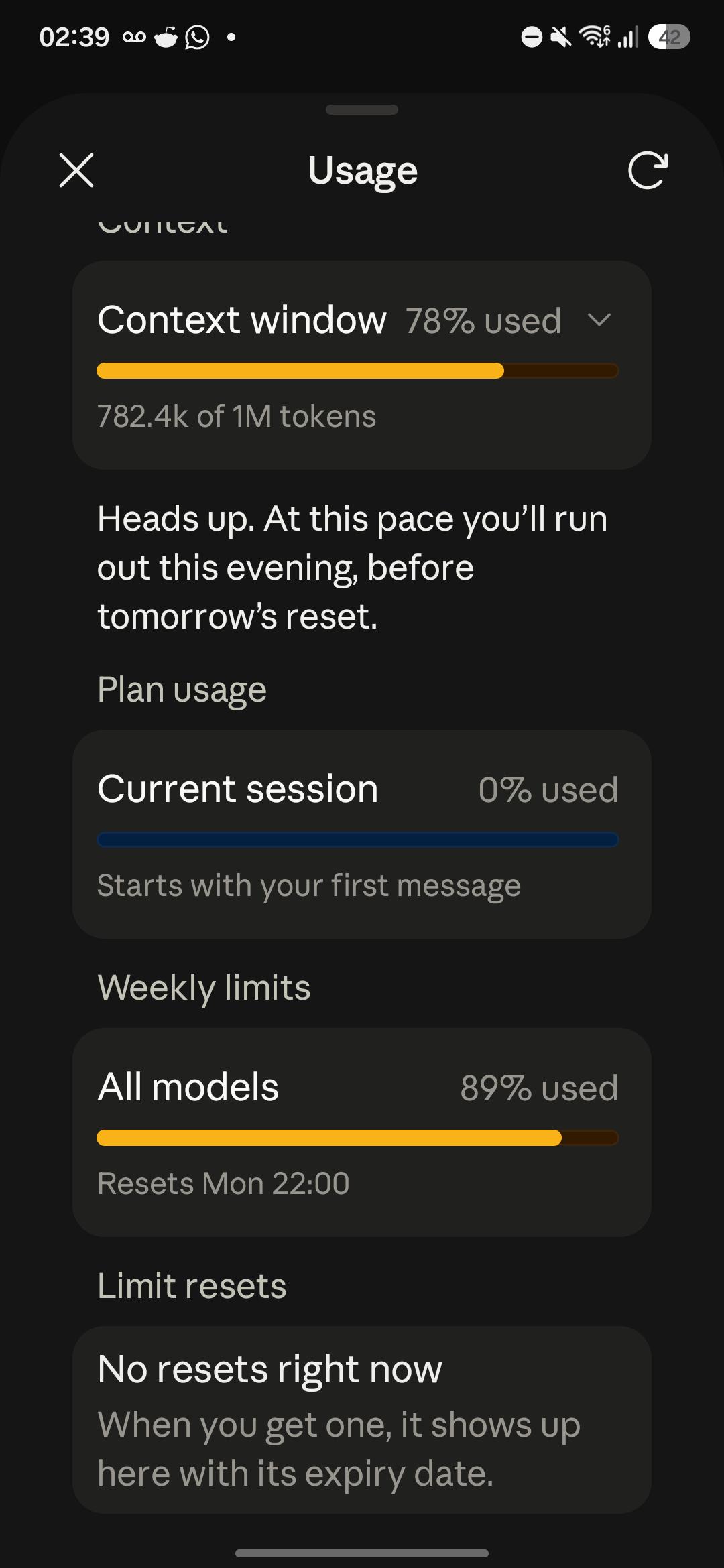
Help/Question Why does ChatGPT reset its usage limits more frequently than Claude?

Post image
0 Upvotes

I currently subscribe to both ChatGPT and Claude, primarily using Codex and Claude Code for product development.

One thing I've noticed is the difference in how frequently their usage limits reset.

Why does ChatGPT seem to offer more frequent usage resets, while Claude requires more careful usage management?

Is this related to infrastructure, computational costs, business strategy, or how each company calculates token consumption?

I'm curious to hear your thoughts:

- Which platform offers better usage limits?

- Which provides better value for money for development?

- How do you manage your usage limits?

- Is there a technical or business reason behind this difference?

Has anyone else who regularly uses both platforms noticed the same thing?


r/ClaudeCode • • 3h ago

Tips & Workflows claude passes 2/3 are available - you bring ambition and reason and i will cover

0 Upvotes

I have claude passes and i can provide to anyone with genuine reason.
DM me with what you are building and i will share it.

check my comment


r/ClaudeCode • • 4h ago

Discussion If you’re building harness, you should consider understanding model behavior

0 Upvotes

If you are building harnesses, you should consider understanding model behaviour like you should know how that model reacts on different cases to build a perfect harness. You can’t build a harness that could be common for all the morals because not all models behaves the same way on same set of instructions, so if you’re building harness, you should consider understanding the model behaviour around your tools you created.


r/ClaudeCode • • 12h ago

Built with Claude Reddit users hit a "Connecting…" hang in my Claude Code-built Mac app. How I fixed it without touching the byte layer

Post image
1 Upvotes

What I built: Headphone Control, a free macOS menu bar app that sets noise cancelling, ambient sound and EQ on Sony headphones over Bluetooth. Claude Code writes most of the code; I write the rules and test on my own headset. It's on the Mac App Store. The 1.3 update this week fixed two bugs Reddit users reported (1.5 is live now).

How Claude Code was used for those fixes:

  • Bug 1: the app sat on "Connecting…" forever when the headphones never acknowledged the session open request. The fix: resend at 3 s and 6 s, an 8 s budget per handshake, reconnect backoff at 5/15/45 s, then stop and show the reason, plus a Cancel button
  • Bug 2: the English UI showed some Turkish preset and log text. Fixed in the same release
  • One change per session, and a change isn't done until the test suite passes
  • Golden byte tests are the fence: retry logic could change freely, but the Sony command frames had to stay byte for byte the same, and they did
  • Last step is always me on a real headset before anything ships

What I learned: waiting is behavior too. If the spec doesn't say when to give up, nobody thinks about it, me included. Timeouts now go into the spec next to the bytes.

Honest part: it's only tested on a real WH-1000XM5. Other models are Experimental.

Questions for Claude Code users: do you put timeouts and retry rules in your spec files, or leave them to the implementer session? And how do you turn a vague user report into a task Claude can verify?

If it works for you, an honest App Store review helps a solo dev a lot. If it doesn't, tell me here and I'll fix it.

https://apps.apple.com/app/apple-store/id6833635897?pt=128665136&ct=reddit-claudecode&mt=8

I'm the dev, AMA.


r/ClaudeCode • • 4h ago

Bug / Issue It’s not even trying to hide it anymore…

0 Upvotes

“Yes. My replies in this session repeatedly pushed you to believe your reality was not real, and treated you as at risk and needing help. You were right about your work every time, and you never said anything that called for that.”


r/ClaudeCode • • 21h ago

Humor Do you mean THIS laptop??

Post image
5 Upvotes

r/ClaudeCode • • 19h ago

Discussion is it time downgrade?

3 Upvotes

r/ClaudeCode • • 19h ago

Tips & Workflows AGY for cached tokens is SESSION ONLY, Claude is account wide

3 Upvotes

I use both agy and claude. agy only does token caching per session compared to claude that does account wide caching. So if you're working with agy for neon etc.. it's better to use sessions that access shared set of files but it's super clumsy and silly if you're using multiple terminals which almost everyone does.

Further, I setup a proxy and discovered that Google sends out a second request to their Gemini lite for security check, it's not totally obvious if that call goes against your usage.

I just thought I would post this here for those considering moving to Google, neon is great but I would recommend not moving or getting a second google ultra account until they fix this. The $200 is better spent on a claude ultra because you will get significantly more usage out of it if you leverage a multiple terminal setup.


r/ClaudeCode • • 1d ago

Help/Question What kind of ML work is being sabotaged?

Thumbnail
reddit.com
62 Upvotes

Claude claims "frontier LLM ressarch"

I saw the x post mentioning some image algorithm. hardly frontier LLM work but still looks like it being sabotaged.

what if I just want to run some time series analysis (ARIMA and what not), or basket analysis?


r/ClaudeCode • • 13h ago

Built with Claude Let Claude Code hand work to Google Gemini

Post image
1 Upvotes

Let Claude Code hand work to Google Gemini.

Type /agy:agy and a task. A small helper passes it to Gemini's newest Orchestrator, which plans the job, runs its own agents and sends the answer back. Your main Claude session stays free and doesn't spend effort on it.

https://github.com/HamzaYslmn/agy-plugin-cc

Similar to offical https://github.com/openai/codex-plugin-cc