r/CollapseOfRussia • u/neonpurplestar • 11h ago
r/CollapseOfRussia • u/neonpurplestar • 7d ago
Economy Billionaires Are Beginning to Contemplate a Post-Putin Russia and Hope to Restore the “Oligarchic Republic” of the 1990s
Russian billionaires believe that the war unleashed by Vladimir Putin has led the country into a dead end. Afraid to take any action to change the situation, they have nevertheless begun preparing for what will happen in Russia when, for one reason or another, he is no longer around, according to the BBC. They would like to regain their influence and participate in politics as they did in the 1990s, say experts who are in contact with Russia’s wealthiest individuals.
A shift in sentiment is already evident in how attitudes toward Putin have changed, says Alexandra Prokopenko, a senior research fellow at the Berlin Center for Russian and Eurasian Studies and author of the book *Accomplices: Why the Russian Elite Chose War*. Whereas previously, she says, leading businesspeople respectfully referred to him as “boss,” “Number One,” or “VV,” they now call him “Grandpa,” pronouncing it “with a hint of contempt.” Some would like to see “politics return to people’s lives”—with less repression, greater freedom of speech, and healthier competition between parties and politicians, says Prokopenko.
Observers consider a return to a system reminiscent of the oligarchy of the 1990s to be quite likely. Dmitry Nekrasov, director of the European Center for Analysis and Strategies—who previously worked in the presidential administration and the Federal Tax Service before becoming an opposition politician—believes that under such a scenario, the country would be ruled by several influential elite clans acting in alliance with business circles.
According to Arkady Ostrovsky, an editor at The Economist with many years of experience as a journalist in Russia, some billionaires hope that after Putin’s departure, the country will turn into an “oligarchic republic”—similar to the one that existed in the 1990s, when business elites were at the helm. Now, however, many of the country’s wealthiest people feel “a sense of complete deadlock into which this war has led Russia… [a sense] of a lack of future.”
Ostrovsky attributes the sensational interview he received from Andrei Melnichenko, founder of EuroChem and SUEK, to an attempt to break out of this impasse. The article about one of the country’s wealthiest men was titled “The Man Who Would Change Russia.”
Among the Russian diaspora, the article and the accompanying column by Melnichenko himself were sharply criticized, in part for repeating the arguments the Kremlin uses to justify the war with Ukraine and its confrontation with the West. However, Ostrovsky insists that the published piece was the result of “intense and heated discussions” he had with Melnichenko in hotels and cafes, where they “mostly drank coffee—a lot of coffee.” According to the journalist, the tycoon seemed to be “seriously considering” his answers, rather than trying to parrot politicians or present himself in a favorable light.
Although Melnichenko echoed Putin’s claim that the West threatens Russia’s sovereignty and ignores its security concerns, he spoke in favor of changes that would put an end to one-man rule and of more active engagement between Russia and the world. Ostrovsky believes that, with all due reservations and given the Kremlin’s highly likely approval of this interview, Melnichenko was speaking not only on his own behalf but also on behalf of his fellow business leaders.
Prokopenko believes that the oligarch was attempting to spark a public debate. According to her, it was “a call to other wealthy people like himself to start speaking out.”
However, no one continued the discussion. The billionaires “would like to return to the days when people listened to them, didn’t strip them of their assets, and when they understood the rules of the game,” says Prokopenko. But because of the atmosphere Putin has created in Russia, they are now afraid to do anything, she adds. One oligarch, during a conversation with her, literally sat on his phone, hoping it was being tapped:
I thought this was a completely Stalinist type of fear. Utterly irrational.
American Michael Calvey, founder of Baring Vostok—once one of Russia’s largest foreign investment funds—understands why the billionaires are staying silent. He himself fell victim to Putin’s crackdown: in 2019, Calvey and several of his colleagues were arrested on trumped-up charges of fraud. “What else can they do but go straight to prison and lose their assets? It’s easy for people sitting in London to say, ‘Why don’t you all just stand up and go straight to prison?’ That’s exactly what would happen,” says Calvey.
According to Nekrasov, some are already “trying to befriend the right security service officials or ministers” in the hope of securing their support once Putin is gone. But any further steps are “too dangerous,” he adds.
The behavior of the wealthiest businessmen in the coming years will depend in part on their financial situation, Nekrasov believes. Those with ample liquid assets will be more confident in “participating in political games” and vying for influence as they prepare for life in the country after Putin. Meanwhile, those whose wealth depends on government contracts or the authorities’ favor will remain silent, fearing they might lose everything.
source: The Moscow Times https://archive.is/W6ss9
r/CollapseOfRussia • u/neonpurplestar • 27d ago
Economy “Risks Will Continue to Mount.” 200,000 Russian Companies Have Run Out of Money to Repay Their Debts
The economic slowdown, falling profits, and high interest rates on loans have hit hundreds of thousands of Russian companies and sole proprietors burdened with debt.
As of August 1, 2026, 28% of all borrowers from Russian banks were experiencing problems repaying their loans, according to analysts at Expert RA, citing statistics from the Central Bank of the Russian Federation.
Compared to the beginning of the year, the share of distressed borrowers has increased by 4 percentage points; compared to the pre-war period, it has more than doubled; and its current level is the highest in the seven years of available statistics.
Approximately 200,000 legal entities and sole proprietors are unable to repay their loans and credits on time. Over the years of the war, more than 140,000 entrepreneurs and companies have been classified as “distressed” debtors, and compared to 2019 figures, their number has quadrupled (+150,000).
“The deterioration of key macroeconomic indicators has translated into financial stress for the real sector,” writes “Expert RA.” The wartime economic boom of 2023–24 has run its course: GDP growth rates, which had been 4% per year or higher, have slowed to 0.6% (for the first half of this year); civilian industrial sectors have been stagnating or declining since 2024, and corporate profits—which could be used to pay down debt—have been shrinking for the second consecutive year.
According to Rosstat, the net financial result for the economy (profits minus losses) for January–June totaled 12 trillion rubles—1 trillion less than during the same period a year earlier, and 3 trillion less than the profits recorded in the first half of 2024.

Companies have “fewer and fewer funds and sources of financing for expensive loans and borrowings,” notes Expert RA. As the agency points out, this has already resulted in a series of defaults in the bond market: from January through September, 33 companies defaulted technically—9 more than in all of last year. Of those, 17 have defaulted outright.
“Credit risks will continue to grow,” warns “Expert RA.” Not even the chronically optimistic Ministry of Economic Development expects the economy to return to its previous growth rates: according to its estimates, GDP will grow by 1.2% next year, while investment will stagnate (+0.2%). Meanwhile, the Central Bank is keeping its key rate high: at its October 23 meeting, it left it at 14% and raised its forecast for next year to 12.5–13.5%, even though at the beginning of the year it had projected a decline to 8–9%.
The Central Bank itself also sees an increase in the share of non-performing assets on bank balance sheets. According to its data, companies’ past-due debt accounts for only 3.7%, but the broader measure of non-performing loans has reached 12.9%. “In August, the portfolio of non-performing loans increased by 0.6 trillion rubles. This was mainly due to the deterioration of the financial situation of certain coal and electric power companies,” the Central Bank wrote.
source: The Moscow Times https://archive.is/lic2V
r/CollapseOfRussia • u/64ue76tjd6 • 1h ago
British-made tanks are about to sweep Putin’s conscripts aside
"As a former tank commander, I know the Challenger 2 vastly outmatches what’s left of Russia’s armour"
Western Challenger tanks are about to smash through Russia's defensive lines and force Russia out of Crimea. Who else is buying tickets for the beach party?
r/CollapseOfRussia • u/neonpurplestar • 16h ago
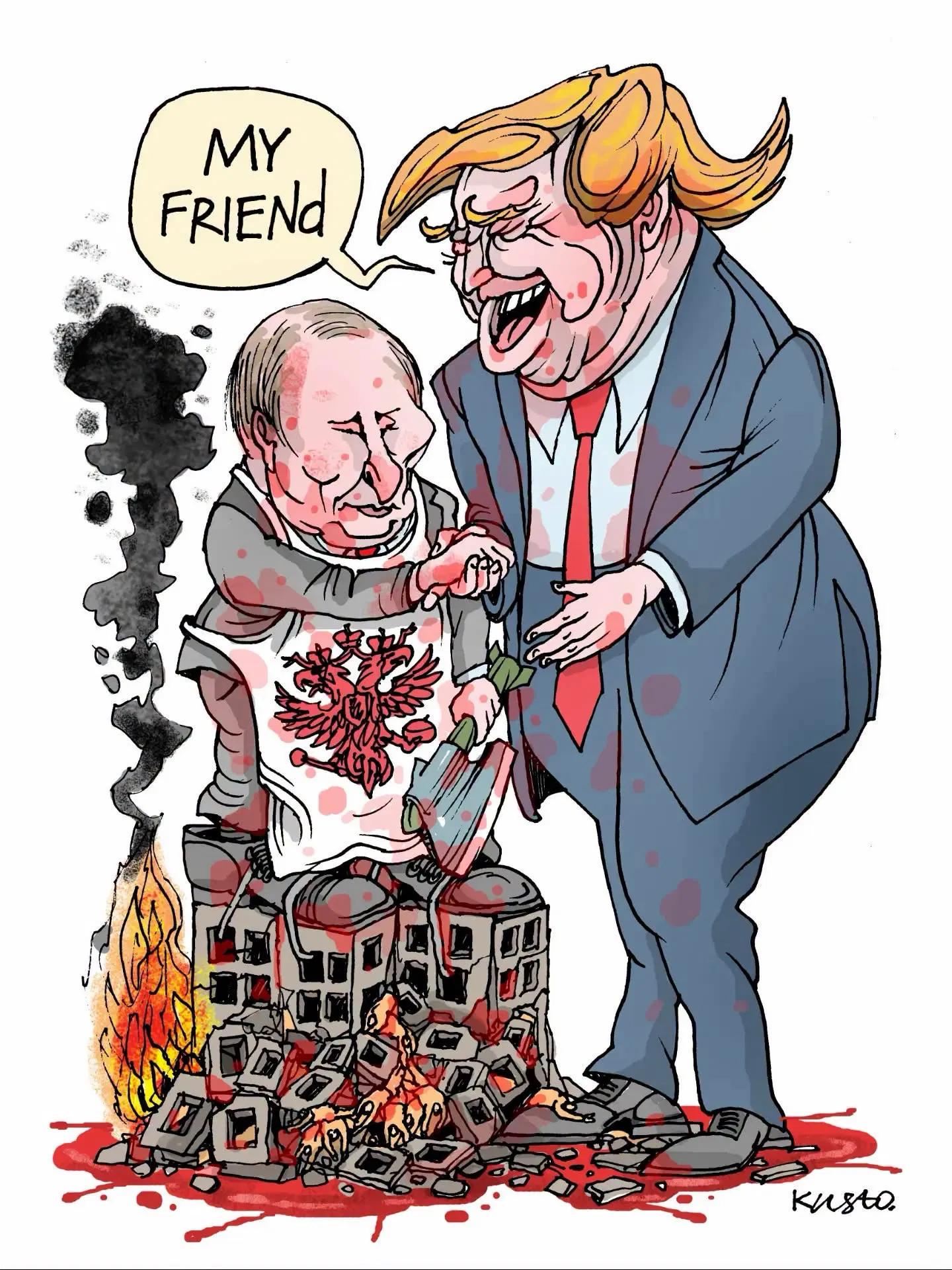
Foreign relations Illustration by Oleksiy Kustovsky
r/CollapseOfRussia • u/TheExpressUS • 17h ago
Wild moment Ukraine blows up Russia warship off Africa caught on film
r/CollapseOfRussia • u/neonpurplestar • 16h ago
Economy Apps from Russian banks have begun requesting access to the microphone, files, and calls in order to transmit data to the FSB
Russian banks’ mobile services have begun requesting an increasing number of permissions from users, according to the “Shifrovalnaya” channel, citing a subscriber who examined updates to the “VTB Online” app from version 20.4.1.7 to 20.21.0.7. In total, there are 49 new permissions that the service did not previously require, including auto-start, making calls, recording audio, waking the device from sleep mode, modifying contacts, viewing photos and other files, as well as updating the app without the user’s knowledge.
Other Russian online banking services are showing similar activity. This is happening against the backdrop of new operational requirements related to the FSB-controlled system of operational-investigative measures. In the fall of 2025, the security service required the country’s major banks to install SORM equipment to store correspondence, voice messages, videos, and other content.
The FSB justified the order by stating that banks fall under the status of “organizers of information dissemination” as described in the “Yarovaya Package.” Their mobile apps and websites include messaging functions, which allows them to be treated as messaging services and requires them to store user data, as well as provide other technical capabilities for operational and investigative activities.
As a result, Russian banks sharply increased their purchases of specialized SORM equipment in early 2026. In January of this year, purchases of the necessary equipment rose by 35–40% overall compared to the same period a year ago, while the banks’ share of the total volume increased from 5% to 20%, despite the industry’s initial reluctance to comply with the new rules.
Additionally, according to a Central Bank directive, starting March 1, 2027, Russian banks will be required to reject money transfers from mobile devices on which their apps detect “malicious software.” This provision effectively forces users to grant all permissions requested by banking services, thereby ensuring the transfer of personal data to the Special Communications Monitoring Service (SORM).
source: The Moscow Times https://archive.is/q273e
r/CollapseOfRussia • u/neonpurplestar • 16h ago
Economy The labor shortage on Russian construction sites has reached 400,000 people
Russian construction companies are short about 400,000 workers, and over the next three years, the shortage could rise to 789,000. This is according to estimates by the National Association of Builders (NOSTROY), as reported by *Izvestia*. Major developers estimate the labor shortage at 20–30%. About 80% of unfilled positions are for electricians, welders, masons, concrete workers, rebar installers, assemblers, and riggers. Designers and specialists in building information modeling (BIM) are also in demand, says Kristina Gudym, an analyst at Finam Financial Group.
According to her, the average age of a construction worker is 43–48 years, and the number of young people and migrant workers from neighboring countries is declining. Construction workers are also leaving for the manufacturing sector and defense industry enterprises, added Stanislav Guzhov, an associate professor at the Institute of Management of the Presidential Academy. The labor shortage is delaying construction projects and driving up prices: in the first half of 2026, about half of the projects were completed late, and housing completions fell by 18%, and the number of private homes by nearly a third compared to the same period in 2025, noted Maxim Maximov, associate professor in the Department of Innovation and Industrial Policy Management at Plekhanov Russian University of Economics.
On a construction site, the absence of a single crew disrupts the schedule of several contractors at once: if the rebar workers haven’t prepared a floor for concrete pouring, the installers will arrive later, explained Alexander Taskaev, a representative of “Delovaya Rossiya.” As a result, he said, companies end up paying for equipment rentals and loan servicing for longer periods. These costs are reflected in prices: over the past two years, the price per square meter in new buildings in Moscow and St. Petersburg has risen by 18–22%, according to Maximov’s calculations.
Against this backdrop, Russian authorities are trying to attract workers from countries outside the former Soviet bloc. From January through September, the Ministry of Internal Affairs issued approximately 215,000 work permits to foreign citizens, a 21% increase compared to the same period in 2025, reported *Vedomosti*. Over the past four years, the number of permits issued has increased 3.2-fold—from 66,000, noted Sergey Peskov, president of the “Trud” Association of Private Employment Agencies. He pointed out that employers’ demand is shifting toward workers from visa-required countries, as the influx from the CIS and the EAEU is declining due to competition with other nations. In particular, Uzbekistan has signed labor migration agreements with Germany, South Korea, and Japan, while the rules for working in Russia have become stricter.
source: The Moscow Times https://archive.is/vBr1N
r/CollapseOfRussia • u/neonpurplestar • 16h ago
Economy Two out of three Russians are now being denied “payday” loans due to rising debt
Microfinance organizations have begun to deny Russians “payday” loans more frequently due to a rise in delinquent debts. In October, the percentage of rejected applications reached 66%, compared to 56% a year earlier. Over the course of the month, the figure rose by 3 percentage points. As a result, approximately two out of every three applicants are left without money, according to Izvestia, citing data from the National Bureau of Credit Histories (NBCH). At the same time, the likelihood of rejection is even higher for new customers—about 80% of first-time applicants fail the automated assessment of their solvency and credit history, according to the self-regulatory organization “MiR.”
Market participants note that demand for money has not disappeared, but it is not translating into actual loans. MFOs have become more cautious in selecting borrowers and have raised their requirements for credit histories, says Alexey Volkov, marketing director at the NBKI. According to him, companies are striving to reduce the risk that a customer will stop repaying the debt on time. However, it is still easier to get a microloan than a bank loan, added Alexey Varpakhovsky, marketing director of the online financial platform Webbankir. According to NBKI data, banks rejected nearly 80% of consumer loan applications in October.
MFIs have to turn down those who have accumulated too much debt due to the Central Bank’s restrictions on issuing loans to customers with a high debt burden, says Oleg Berdasov, Director of Risk Management at the MFI “Migcredit.” In particular, companies have tightened their lending policies in response to the introduction of the “no more than two loans per borrower” rule. According to him, if a customer already has two active loan agreements, they cannot be granted another loan with a total loan-to-value ratio exceeding 200%.
MFIs are also seeing an increase in non-performing loans, forcing them to set aside more reserves in case of loan defaults. The share of loans more than 90 days past due in the third quarter of 2026 rose by 5–6 percentage points from the previous quarter, reaching 41–42%, noted Natalia Milchakova, lead analyst at Freedom Global. According to her forecast, the average rejection rate will remain at around 65% through the end of this year and could rise to 70–75% in the first half of 2027. Milchakova believes that a significant easing of lending requirements should not be expected before the second half of 2028.
Against this backdrop, Russians may begin seeking funds from illegal lenders, warns the “MiR” Self-Regulatory Organization (SRO). In the first nine months of 2026, the Central Bank identified nearly 1,400 credit institutions operating without a license. Based on information from the regulator, nearly 370 administrative cases were initiated for the illegal issuance of consumer loans. Additionally, from January through September, the Central Bank blocked more than 3,500 websites and social media pages offering illegal loans.
source: The Moscow Times https://archive.is/Pp1eY
r/CollapseOfRussia • u/neonpurplestar • 14h ago
Economy The head of the Federal Tax Service reported to Putin on the collection of a record 54 trillion rubles in taxes from Russian citizens and businesses
The Federal Tax Service transferred 54.6 trillion rubles in taxes to budgets at all levels from January through October 2026, FTS Head Daniil Egorov reported during a meeting with President Vladimir Putin on Monday.
According to Egorov, tax revenues from individuals and businesses increased by 11%, or 5.4 trillion rubles, compared to the same period last year.
According to the Federal Tax Service, the federal treasury managed to collect an additional 2.2 trillion rubles, with the entire amount coming from non-resource sectors of the economy. “The main tax generating the bulk of revenue this year is VAT,” Egorov said.
Since the beginning of the year, the VAT rate has been raised to 22%, the highest level since 1992, placing Russia among the world’s top countries in terms of this tax rate (only nine European countries have higher rates). As a result, VAT revenue rose by 33%, or 2.6 trillion rubles. “That’s quite a result,” said Yegorov. “Good,” Putin agreed with the head of the Federal Tax Service.
According to Yegorov, regional budgets collected an additional 1.5 trillion rubles compared to last year’s results; these budgets are primarily funded by personal income tax (PIT) and corporate income tax. Nevertheless, “problems persist” in about 10 regions, Putin said. According to the Accounts Chamber, 66 regions of the Russian Federation ended the first half of the year with local budget deficits, and the total “shortfall” in their finances amounted to 619 billion rubles.
Starting next year, the authorities are preparing another round of tax hikes to cover the increase in war spending, which is set to reach a new record of 17.1 trillion rubles—a third higher than this year’s level.
The government is introducing a “surplus profits tax” for gold mining companies and non-ferrous metal producers; raising the maximum personal income tax rate on “passive income” for individuals—including bank deposits—to 22 percent; and imposing a 22 percent VAT on purchases from foreign online retailers.
According to the Ministry of Finance’s estimates, these tax changes will bring 1.5 trillion rubles into the budget next year, and another 2.2 trillion in 2028–29.
source: The Moscow Times https://archive.is/n3EyB
r/CollapseOfRussia • u/neonpurplestar • 16h ago
Infrastructure One of the Last Oil Refineries in Southern Russia Shut Down After a Drone Attack
The Novoshakhtinsk Oil Products Plant, which was attacked overnight by Ukrainian Armed Forces drones, has suspended operations, Rostov Region Governor Yuri Slyusar said on Monday. According to him, about 80 drones were involved in the attack, and the raid itself lasted “more than 6 hours.”
The only refinery in the region, the Novoshakhtinsk plant with a capacity of 100,000 barrels per day, remained one of the last refineries in southern Russia still operating despite the November wave of drone strikes. According to estimates by the Rand Corporation, the refinery’s actual capacity in the middle of the month was about 70,000 barrels per day, which was 30% below its maximum capacity.
Rosneft’s Tuapse Refinery, the largest in the Southern Federal District, suspended operations back in May and has not resumed production since. The Afip and Ilsk refineries in the Krasnodar Krai, attacked on November 6 and September 23, respectively, lost about half their capacity, according to Rand estimates.
In total, since late October, UAV strikes have disrupted operations or shut down at least 16 Russian refineries. In addition to the Novoshakhtinsk Refinery, operations have completely ceased at the “Norsi” refinery in the Nizhny Novgorod Region, the “Yanos” refinery in Yaroslavl, and Rosneft’s Novokuybyshevsk Refinery. The Ryazan Refinery, which supplies Moscow and the Moscow region, among others, has also lost 90% of its capacity.
Russia’s largest refinery, the Omsk Refinery—which was hit by an airstrike on November 11—has lost half of its refining capacity; the Volgograd Refinery has suffered a similar loss. The “Kinef” refinery near Leningrad, Russia’s second-largest by volume, is operating at only one-third of its capacity, according to Rand data.
According to industry sources cited by Reuters, oil refining volumes in Russia fell by 45% during the first three weeks of November. Sergey Vakulenko, a senior research fellow at the Carnegie Berlin Center for Russia and Eurasia, estimated current refinery utilization at 2.7 million barrels per day, which is even lower than the worst figures from the summer (3.3 million barrels per day). According to Vakulenko’s estimates, domestic production covers only 60–65% of gasoline demand, and when imports are factored in, the shortfall could reach 25–30% of consumption.
source: The Moscow Times https://archive.is/6gQGN
r/CollapseOfRussia • u/WastingMyLifeToday • 21h ago
Infrastructure Russian Refinery Hitlist - 23.11.2026 - Two hits today!
- Red arrows: Latest hits
- Flames: Refinery has been hit at least once. Flames do not indicate the severity of the attacks or if a refinery is till burning
- Blue waves: Orsk dam broke in April 2024, which flooded the refinery and took it offline for ~2 weeks.
- Black smoke: It's raining oil.
Chronological list: (sorted newest to oldest)
November: 15 hits TOP3 RECORD
- NEW HIT 23.11.2026 Perm in Perm Krai at 1485km
- NEW HIT 23.11.2026 Novoshakhtinsk in Rostov Oblast at 250km
- 18.11.2026 Afipsky in Krasnodar Krai at 415km
- 18.11.2026 Ilsky in Krasnodar Krai at 405km
- 17.11.2026 Gasprom Neftekhim Salavat in Bashkortostan at 1300km
- 16.11.2026 Ilsky in Krasnodar Krai at 405km
- 15.11.2026 TAIF-NK in Tatarstan at 1140km
- 12.11.2026 Volgograd in Volgograd Oblast at 500km
- 11.11.2026 Omsk in Omsk Oblast at 2500km
- 09.11.2026 Kirishy in Leningrad Oblast at 810km
- 07.11.2026 Saratov in Saratov Oblast at 590km
- 06.11.2026 Afipsky in Krasnodar Krai at 415km
- 05.11.2026 Ryazan in Ryazan Oblast at 480km
- 03.11.2026 Yaroslavl in Yaroslavl Oblast at 700km
- 01.11.2026 Kstovo in Nizhny Novgorad Oblast at 800km
October: 7 hits
- 31.10.2026 Bashneft-Novoil in Bashkortostan at 1340km
- 30.10.2026 Novokuibyshev in Samara Oblast at 900km
- 15.10.2026 Ryazan in Ryazan Oblast at 480km
- 09.10.2026 Ukhta in Komi Republic at 1705km
- 08.10.2026 Omsk in Omsk Oblast at 2500km
- 08.10.2026 Gazprom Neftekhim Salavat in Bashkortostan at 1300km
- 02.10.2026 Volgograd in Volgograd Oblast at 500km
Earlier months in 2026:
- September: 14 hits
- August: 21 hits NEW MONTHLY RECORD
- July: 15 hits
- June: 16 hits NEW MONTHLY RECORD
- May: 14 hits NEW MONTHLY RECORD
- April: 10 hits
- March: 6 hits
- February: 3 hits
- January: 2 hits
Complete chronological list from 24.02.2022 till today
- Total hits from 24.02.2022 till today: 235
- 2026 has 123 hits so far NEW YEARLY RECORD
- 2025 had 84 hits
- 2024 had 26 hits
- 2023 had 1 hit
- 2022 had 1 hit
Monthly records since the invasion of Ukraine on 24.02.2022 :
- August 2026 with 21 hits
- July 2026 with 16 hits
- November 2026, November 2025 with 15 hits
- May 2026 with 14 hits
- June 2026, August 2025 with 13 hits
4 of the 5 monthly records were in May, June, July, August, 4 consecutive months in 2026.
r/CollapseOfRussia • u/neonpurplestar • 16h ago
Infrastructure For the seventh time since the beginning of the year, Ukraine has attacked one of Russia’s largest oil refineries in the Perm Krai
On the morning of November 23, the Perm Krai came under attack by Ukrainian drones. Local media outlets report that drones struck Lukoil’s “Permnefteorgsintez” refinery—a company ranked among Russia’s top 10 in its industry—at least three times. This marks at least the seventh attack on this refinery since the beginning of 2026. Photos and videos taken by residents show several fires at the plant.
The main area of the fire is believed to be in the oil refining section, where key processing units, electrical desalination facilities, and atmospheric-vacuum distillation units are concentrated, notes an OSINT analyst from the Astra channel. Dmitry Makhonin, governor of the Perm Krai, acknowledged new “damage” at an unnamed “industrial facility,” adding that there were no casualties. The official stated that air defense forces and mobile fire teams repelled the drone attack in the region.
“Permnefteorgsintez” produces approximately 2 million metric tons of gasoline and 5 million metric tons of diesel fuel annually and has the capacity to process up to 13 million metric tons of crude oil per year. Since the beginning of 2026, the Ukrainian Armed Forces have attacked this plant at least six times. Following strikes in early May and late August, the facility completely halted operations due to severe damage to its refining units.
During the airstrike in the Perm Krai, the “Kover” plan was activated. The Federal Air Transport Agency suspended operations at the key local airport in Bolshoye Savino.
Also, on the night of November 23, the “Kaleykino” oil pumping station near Almetyevsk in Tatarstan and the Novoshakhtinsky Oil Products Plant in the Rostov Region came under Ukrainian attack. The Kaleykino oil pumping station plays a key role in the transportation and storage of oil from various regions of the Volga region and Western Siberia, while the Novoshakhtinsky oil products plant is one of the largest oil refining facilities in southern Russia.
source: The Moscow Times https://archive.is/b3QpS
r/CollapseOfRussia • u/neonpurplestar • 16h ago
Economy Sberbank stated that AI could replace up to 60% of Russian workers and cut salaries by a quarter
Artificial intelligence (AI) could perform 59% of the work currently done by Russians and help companies reduce payroll costs by up to 27%. This conclusion was reached in a joint study by Sber and the All-Russian Research Institute of Labor, which RBC reviewed. Analysts examined 19.4 million job postings from January 2025 to October 2026 and identified 45,500 typical tasks across 436 professions. According to the calculations, AI can perform 18% of these tasks independently and assist humans with another 41%. However, existing AI models cannot yet handle the remaining 41% of tasks. These are primarily manual labor tasks—such as cleaning, moving cargo, and repairing equipment.
Sberbank and the All-Russian Research Institute of Labor estimated the total annual payroll for the occupations covered by the study at 90.9 trillion rubles. Of this amount, 15.1 trillion rubles are allocated to tasks that AI is capable of performing independently, while another 45.6 trillion rubles are allocated to tasks in which it can assist humans. Companies can achieve savings through the full automation of document preparation and reporting, inventory tracking and warehouse operations, as well as customer transactions at the register. The study notes that AI can serve as an assistant to executives and top-level specialists. In particular, neural networks are capable of monitoring task completion and planning budgets.
The largest share of tasks suitable for full automation is concentrated in professions in the middle of the salary scale. For the 10% of employees with the highest salaries (an average of 229,000 rubles), AI can independently perform only about 11% of the work, but it can assist with 85%. Jobs with average salaries of 62,000–75,000 rubles can be fully automated by 22–28%, and an additional 27–42% of tasks can be performed with AI support. For the group with the lowest salaries, 76% of the work remains beyond the capabilities of AI.
At present, the gap between the potential for AI implementation and its current level is very large, says Alexander Isakov, head of Sberbank’s Center for Macroeconomic Research. According to him, generative AI skills are required in only 0.5% of job openings. Based on this, the study’s authors estimated the realistic annual benefit from using neural networks at 2–3 trillion rubles, or 2–3% of the estimated wage bill.
The transition to new technologies could reduce the share of labor costs and increase the share of profits in GDP, but if the effects on the labor market prove too negative, the authorities may raise taxes on businesses to more actively redistribute funds from companies to the population, says Natalia Orlova, chief economist at Alfa-Bank. In that case, she says, companies’ gains would be zero.
The widespread adoption of AI could accelerate economic growth, improve business efficiency, and compensate for labor shortages, notes Adil Valiullin, vice president of Gazprombank. However, the impact will be limited by a lack of investment, technology, and skilled professionals, as well as the uneven adoption of AI across different industries, the expert added.
Evgeny Nadorshin, Director of Investment Strategy at Ingosstrakh-Investments Management Company, pointed out that with a hypothetical monthly salary of 66,000 rubles, ten minutes of labor cost about 67 rubles, while one minute of AI work to solve the same tasks costs one dollar or more. For their part, people may try to hide the use of AI for fear of pay cuts or an increased workload, warns Alexander Safonov, a professor at the Financial University. Therefore, he says, companies will need to encourage the optimization of routine tasks using neural networks.
source: The Moscow Times https://archive.is/YPJOj
r/CollapseOfRussia • u/neonpurplestar • 16h ago
Economy Since the start of the war, construction of utility networks worth over 100 billion rubles has been put on hold
Over the years of the war, 11 housing and utilities projects totaling over 100 billion rubles have failed to be completed on time, according to calculations by The Moscow Times, which analyzed the registry of capital construction projects. These are large-scale projects whose construction was funded by the federal budget, but whose completion dates have been repeatedly postponed, in part due to a lack of funds.
Three of the 11 stalled projects are in Crimea. Among them is “Phase II of the Water Supply Route from the North Crimean Canal to Feodosia and Kerch.” The project was designed to address water shortages in the eastern part of the peninsula. The problem affects more than 400,000 people. According to initial plans, the work was supposed to be completed as early as 2020. However, the facility’s commissioning has been postponed by nine years.
The launch of Yevpatoria’s wastewater treatment plant has been postponed from 2024 to 2028, and the completion of the modernization of this resort city’s water supply and wastewater systems has been rescheduled from 2026 to 2029. The wastewater treatment plant at Cape Ilya in Feodosia is expected to begin operations with a four-year delay.
In addition, the launch of new wastewater treatment facilities in Ingushetia, Ulyanovsk, Nizhny Tagil, Ulan-Ude, and the Leningrad Region has been postponed. In these areas, local water utilities have been repeatedly caught and fined for discharging untreated sewage into rivers; in Sunzha, residents signed collective complaints against the discharge of sewage into the river; and in Nizhny Tagil, local residents took their complaints about the discharge of sewage into the river all the way to the prosecutor’s office and the Investigative Committee. Bastrykin, the head of the Investigative Committee, intervened in the matter and promised to look into it, but nothing has changed.
source: The Moscow Times https://archive.is/SfhcH
r/CollapseOfRussia • u/neonpurplestar • 1d ago
Economy “People are trying to spend less on non-essential purchases.” Forecasts predict that one in ten shopping centers in Russia will close
Russians are tightening their belts, retail is moving online, and shopping centers are emptying out, closing, and being repurposed. The share of underutilized shopping centers in Russia is growing almost every month and has reached 15–20%, said Bulat Shakirov, president of the Union of Shopping Centers. He estimates that half of them will be closed and demolished.
More and more stores in shopping centers are closing, said Pavel Lyulin, co-chair of the Association of Retail Real Estate and Retail Experts. The retail sector faces the same problems as developers—high borrowing costs, high labor costs, logistical challenges, and changes in consumer behavior, he noted.
Russians’ incomes have almost stopped growing this year, and people have become more cautious about shopping. The consumer sentiment index has been below 100 points since February, meaning pessimism prevails.
“The problem isn’t just that people are turning to online marketplaces, but even more so that, in general, they’re now trying to spend less on non-essential purchases—clothing and shoes, home appliances, furniture, and jewelry—and are switching to cheaper products even for everyday items,” says the head of a consulting firm. The return of some shoppers to shopping centers from online marketplaces following the destruction of their warehouses by the Ukrainian Armed Forces does not compensate retailers for the prolonged consumer pessimism. At the same time, taxes, utility bills, and payroll costs are rising unabated, forcing retailers to downsize their chains, the consultant adds.
In Moscow, the vacancy rate in shopping centers has been rising for the second year in a row, according to IBC Real Estate. Even in key shopping centers, the vacancy rate will rise to 8% by the end of the year, up from 6.4% in the first half of the year, NF Group projected. It cited the same reasons: weak consumer activity, rising operating costs, and competition from online marketplaces.
At the same time, developers are completing projects already underway, and by the end of this year, more shopping centers will open in Moscow than last year. NF Group estimated new supply at 283,400 square meters, which is 43% more than in 2025.
In 2024–2025, developers were buying up old shopping centers in major cities to demolish them and build residential developments, but now the crisis in residential construction is intensifying, so this process may also slow down, says an analyst at a consulting firm.
There is no sign of a recovery in demand: for example, in the week ending November 15, foot traffic at shopping centers in Moscow was 3.3% lower than last year’s modest figures, and across Russia as a whole, it was 4.6% lower, Lyulin wrote. “Shoppers are cutting back, some purchases are shifting online, and new reasons to visit shopping centers are not emerging everywhere,” the expert noted. Still, he believes the situation is not yet critical enough to suggest mass closures of shopping centers.
The other half of the vacant shopping centers—which will not be demolished—accounts for approximately 5–10% of all properties, according to Shakirov, and will undergo extensive modernization with a focus on sports, entertainment, leisure, restaurants, and cafes, while traditional retail will “take a back seat” in these spaces. Analysts at IBC Real Estate noted that the rise in shopping center vacancy rates is currently being held in check by the addition of entertainment and sports facilities, as well as food service establishments. However, developers have little spare capital, and interest rates are high, so the repurposing process will drag on for years, Shakirov believes.
There are examples of this. Part of the space at “Mega Belaya Dacha,” which once belonged to the Swedish company IKEA, was leased by the “Osnova” development group to open the “Thermoland” spa complex. The group is in talks to purchase other former IKEA stores, says one retail real estate expert.
Shopping center owners are already open to considering a wide variety of options for filling the vacant space. “We’ve already been offered the chance to open a showroom for a workshop specializing in granite monuments, but we’ve turned it down for now—we don’t want to spoil the mood for visitors,” said a representative of a brokerage firm.
source: The Moscow Times https://archive.is/Qcy7d
r/CollapseOfRussia • u/64ue76tjd6 • 2h ago
Russia's GDP continues to grow
https://tradingeconomics.com/russia/gdp-growth-annual
russia is going to collapse in 2 weeks though. trust the plan
r/CollapseOfRussia • u/Michi-Ace • 1d ago
Another ship hit near Benghazi?
The identity of the ship is not yet known but the footage shows it being hit by a sea drone.
Edit: Perhaps it's the Ascalon: https://www.vesselfinder.com/vessels/details/9198226
Edit 2: Another candidate is the Angara: https://www.vesselfinder.com/vessels/details/9179842
r/CollapseOfRussia • u/WastingMyLifeToday • 1d ago
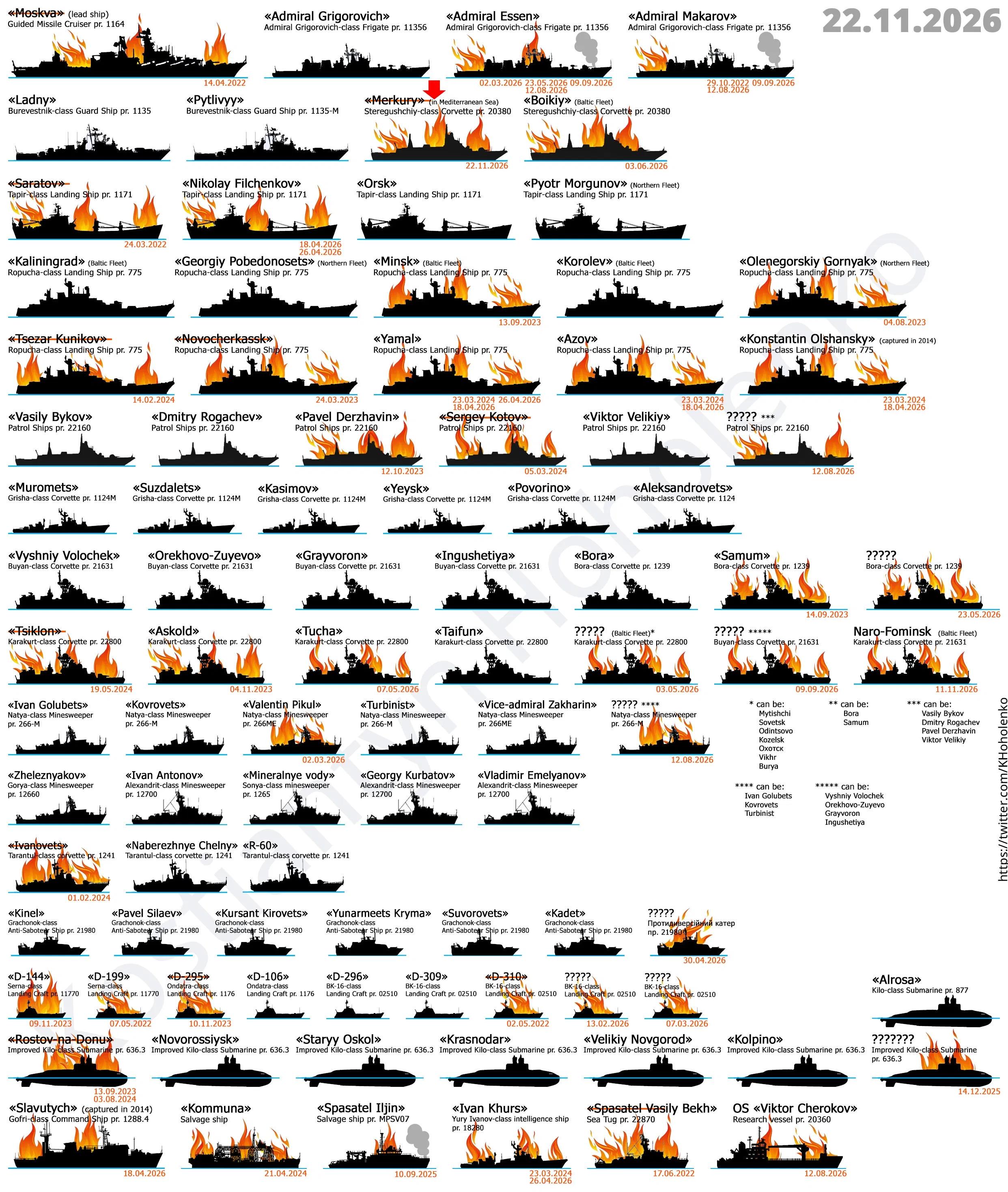
Military Russian Ship Hitlist - Update 22.11.2026
Chronological list: (sorted newest to oldest)
2026:
- NEW HIT 22.11.2026 Merkury - Steregushchly-class Corvette pr.20380 (In Mediterranean Sea)
- 11.11.2026 Naro-Fominsk (Baltic Fleet) - Karakurt-class pr. 21631
- 09.09.2026 ????? - Buyan-class Corvette pr. 21631
- 09.09.2026 Admiral Essen - Admiral Grigovich-class Frigatte pr. 11356**
- 09.09.2026 Admiral Makarov - Admiral Grigovich-class Frigatte pr. 11356
- 12.08.2026 OS Victor Cherokov - Research Vessel pr. 20360
- 12.08.2026 ????? - Patrol Ship pr. 22160
- 12.08.2026 ????? - Natya-class Minesweeper pr. 266.M
- 12.08.2026 Admiral Marakov - Admiral Grigovich-class Frigatte pr. 11356
- 12.08.2026 Admiral Essen - Admiral Grigovich-class Frigatte pr. 11356
- 03.06.2026 Boikiy (Baltic fleet) - Steregushchiy-class Corvette pr. 202380
- 23.05.2026 ????? - Bora Class Corvette pr. 1239
- 23.05.2026 Admiral Essen - Admiral Grigorovich-class Frigate pr. 11356
- 07.05.2026 <Tucha> - Karakurt-class Corvette pr. 22800
- 03.05.2026 ????? (Baltic Fleet) - Karakurt-class Corvette pr. 22800
- 27.04.2026 Yamal - Ropucha-class Landing Ship pr. 775
- 26.04.2026 Ivan Khurs - Yuri Ivanov-class intelligence ship pr. 18280
- 26.04.2026 Nikolay Filchenkov - Tapir-class Landing ship pr. 1171
- 18.04.2026 Slavutych (captured in 2014) - Gofri-class Command Ship pr. 1288.4
- 18.04.2026 Konstantin Olshansky - Ropucha-class Landing Ship pr. 775
- 18.04.2026 Azov - Ropucha-class Landing Ship pr. 775
- 18.04.2026 Yamal - Ropucha-class Landing Ship pr. 775
- 07.03.2026 ????? - BK-16-class Landing Craft pr. 02510
- 02.03.2026 Admiral Essen - Admiral Grigorovich-class Frigate pr. 11356
- 02.03.2026 Valentin Pikul - Natya-class Minesweeper pr. 266ME
- 13.02.2026 ????? - BK-16-class Landing Craft pr. 02510
2025:
- 14.12.2025 ??????? - Improved Kilo-class Submarine pr. 636.3
- 04.04.2025 Admiral Essen - Admiral Grigorovich-class Frigate pr. 11356
2024:
- 19.05.2024 Tsiklon - Bora-class Corvette pr. 1239
- 21.04.2024 Kommuna - Salvage Ship
- 23.03.2024 Konstantin Olshansky - Ropucha-class Landing Ship pr.775
- 23.03.2024 Ivan Khurs - Yuri Ivanov intelligence ship pr 18280
- 23.03.2024 Yamal - Ropucha-class Landing Ship pr.775
- 23.03.2024 Azov - Ropucha-class Landing Ship pr.775
- 05.03.2024 Sergey Kotov - Patrol Ships pr. 22160
- 14.02.2024 Tsezar Kunikov - Ropucha-class Landing Ship pr.775
- 01.02.2024 Ivanovets - Tarantul-class corvette pr. 1241
- 01.02.2024 D-144 - Serna-class Landing Craft pr. 11770
2023:
- 10.11.2023 D-295 - Ondatra-class Landing Craft pr 1176
- 04.11.2023 Askold - Karakurt-class Corvette pr. 22800
- 12.10.2023 Pavel Derzhavin - Patrol Ships pr. 22160
- 14.09.2023 Samum - Bora-class Corvette pr. 1239
- 13.09.2023 Rostov-na-Donu - Improved Kilo-class Submarine pr. 636.3
- 24.03.2023 Novocherkassk - Ropucha-class Landing Ship pr.775
- 13.03.2023 Minsk - Ropucha-class Landing Ship pr.775
2022:
- 29.10.2022 Admiral Makarov - Admiral Grigorovich-class Frigate pr. 11356
- 17.06.2022 - Spasatel Vasily Bekh - Sea Tug pr. 22870
- 07.05.2022 - D-199 - Serna-class Landing Craft pr. 11770
- 02.05.2022 - D-310 - BK-16-class Landing Craft pr. 02510
- 16.04.2022 Moskva - Guided Missile Cruiser pr. 1164
- 24.03.2022 Nikolay Filchenkov - Tapir-class Landing Ship pr. 1171
- 24.03.2022 Saratov - Tapir-class Landing Ship pr. 1171
Out of service:
- 24.03.2022 Saratov - Tapir-class Landing Ship pr. 1171
- 16.04.2022 Moskva - Guided Missile Cruiser pr. 1164
- 02.05.2022 - D-310 - BK-16-class Landing Craft pr. 02510
- 17.06.2022 - Spasatel Vasily Bekh - Sea Tug pr. 22870
- 24.03.2023 Novocherkassk - Ropucha-class Landing Ship pr.775
- 13.09.2023 Rostov-na-Donu - Improved Kilo-class Submarine pr. 636.3
- 10.11.2023 D-295 - Ondatra-class Landing Craft pr 1176
- 01.02.2024 Ivanovets - Tarantul-class corvette pr. 1241
- 14.02.2024 Tsezar Kunikov - Ropucha-class Landing Ship pr.775
- 05.03.2024 Sergey Kotov - Patrol Ships pr. 22160
- 19.05.2024 Tsiklon - Bora-class Corvette pr. 1239
- NEW HIT 22.11.2026 Merkury - Steregushchly-class Corvette pr.20380 (In Mediterranean Sea)
r/CollapseOfRussia • u/VoteDoughnuts • 2d ago
Russia is a rounding error in the global economy
r/CollapseOfRussia • u/neonpurplestar • 3d ago
Foreign relations Trump can’t give Putin what he wants

The president no longer has the power to tell Europe to stop backing Ukraine
It is odious to admit that Vladimir Putin was the big winner from Thursday’s gathering at Shenzhen. He gained the prestige of dealing on apparently equal terms with the two most powerful men in the world, Donald Trump and Xi Jinping, even though Russia’s economy is less than a tenth of the size of America’s and barely an eighth of China’s.
Putin was even able to assert unchallenged that he was determined to “preserve and strengthen the system of international law”, as if he had not invaded Ukraine and started Europe’s bloodiest war since 1945.
Yet Putin’s diplomatic success went beyond the symbolism of the occasion. The three leaders issued a brief joint statement. They all “agreed that the International Criminal Court and other similar bodies must not abuse their jurisdiction”, which would have brought comfort to the one among them (Putin) who has been indicted by that very Court for an atrocious war crime: abducting tens of thousands of Ukrainian children.
Still more significant was Point Two, which reads: “The three countries plan to increase the production and supply of refined petroleum products for the benefit of all nations. They reaffirmed the importance of stable energy flows.” Russia is the world’s third-largest oil producer and all that stops it from selling more “refined petroleum products” on the global market is US and international sanctions, combined with the fact that Ukraine is destroying its refineries.
By endorsing this statement, Mr Trump was implicitly opposing not only Ukraine’s long-range strikes on Russia’s energy infrastructure but also his own sanctions on the Kremlin’s oil and gas. Even by the standards of Putin’s artful manipulation of Mr Trump down the years, this was an astonishing outcome. Has any American president ever been suckered into opposing longstanding American policy before?
Putin might seem to have cause to preen himself on the plane back to Moscow. But one reality ought to temper his self-satisfaction. Mr Trump’s ability to deliver is limited. Lifting US sanctions on Russian oil and gas would require Congress to repeal a series of laws, including the Countering America’s Adversaries Through Sanctions Act of 2017. There is zero chance of a Democrat-controlled Congress doing so.
Mr Trump could try to get around this by issuing special waivers and licenses. Yet experience suggests that any such dodge would be ineffective. Only last month, he announced a deal to import Russian diesel and immediately issued the necessary sanctions waiver. But not a gallon has arrived; on the contrary, every Russian tanker bound for America has been re-routed. Why? Because US ports and oil companies refused to accept the diesel, fearing that the president’s waiver might breach the Ending Importation of Russian Oil Act of 2022.
Nor can Mr Trump stop Ukraine’s strikes on Russian oil refineries or bully the country into surrendering. He has spent almost two years trying to browbeat Volodymyr Zelensky into settling the conflict on Russian terms, including by withholding American money and free weapons. None of this has broken Ukraine’s will to resist.
Instead, Britain and the rest of Europe have, to their credit, stepped into the breach and provided Ukraine with enough arms and funds to carry on the struggle. Only on Thursday, Britain promised to send Mr Zelensky another 1,000 drones for use against targets inside Russia. It was entirely in keeping with Trumpian diplomacy that, as he left Shenzhen, the president called European leaders and urged them to reconsider their financial backing for Ukraine.
Contrary to expectations, Europe has successfully exerted itself in the brutal business of power politics by sharpening Ukraine’s fangs and claws and, in blunt terms, giving Mr Zelensky the means to kill enough Russian soldiers to avoid being carved up by the Trump-Putin alliance. Ukraine’s own arms industry is now turning out formidable FP-5 Flamingo cruise missiles, which have just brought down a section of Putin’s prize Kerch Bridge joining Russia with occupied Crimea.
So Putin might reflect that his triumph in Shenzhen coincides with Mr Trump losing the power to deliver for his Russian “friend”. Even Europeans are capable of playing power politics when they have the will.
source: The Telegraph https://archive.is/9bAsR
r/CollapseOfRussia • u/neonpurplestar • 3d ago
Economy “Hopes Are Shattered.” The Russian market experienced its sharpest decline since August following the fiasco of Putin's “New Yalta” initiative
The Russian stock market was swept by a sell-off amid the ambiguous outcome of Vladimir Putin’s trip to the APEC summit, which was conceived as a “New Yalta” to redraw the world order but ended without concrete results.
After falling 1% on Wednesday and 2.1% on Thursday, the Moscow Exchange Index was down another 2.3% at 2:32 p.m. Moscow time on Friday, closing the week with its sharpest drop since mid-August—6.3%. In the three days since Putin flew to Shenzhen, the index has lost 335 billion rubles in market capitalization and fallen to a one-month low of 2,355.9 points.
The market is under pressure due to the lack of positive news following the trilateral meeting between Putin, Donald Trump, and Xi Jinping, according to analysts at T-Investments. The “peace” declaration signed by the leaders mentioned UN reform and the rejection of nuclear war, while at the concluding press conference, Putin made bellicose statements directed at Ukraine.
He promised a “painful response” to an attack on the Crimean Bridge, reiterated that Russia had been “duped” regarding NATO expansion, and stated that a resolution to the war is impossible until Kyiv surrenders the remaining 10% of Donbas. “Hopes for the success of peace talks are crumbling,” and Russian stocks are “returning to reality,” notes investment banker Evgeny Kogan.
Since the start of the week, Gazprom shares have fallen 7%, Rosneft shares 7.2%, and Norilsk Nickel shares 9.9%. VTB lost 8.3% of its market capitalization, Rosseti lost 12.3%, and Aeroflot lost 8.8%.
Although Putin is called the main beneficiary of the recent summit—citing the fact that he “gained international legitimacy and shed his status as a pariah”— political scientist Abbas Galliamov points out that, in this case, the very fact that Putin was allowed to attend an event featuring the world’s most influential leaders is considered a success.
This underscores the vast difference in stature between Putin and Trump on one hand, and Xi Jinping on the other, the expert notes: “It’s like a serf rejoicing that his master has invited him into the parlor.”
“Putin likes to appeal to the experience of the USSR, so here’s the thing: no one ever said that the Soviet leadership benefited from the mere fact of participating in negotiations with the leaders of the U.S. and China,” Galliamov reminds us.
Investors in Russian stocks were counting on a political breakthrough and a further reduction in the geopolitical premium; however, no substantive agreements on the Ukrainian conflict followed, and Putin’s statements confirmed the absence of any fundamental changes in his negotiating position, notes Finam strategist Yaroslav Kabakov.
“It is premature to count on a rapid lifting of sanctions and a normalization of relations,” he argues. If the negative news backdrop persists, the next target for a decline could be the 2,300-point mark on the Moscow Exchange Index, Kabakov predicts.
source: The Moscow Times https://archive.is/mjeoi