r/ControlProblem • • Sep 13 '26

Opinion AI Isn’t Escaping. We’re Losing Control.

33 Upvotes

Something is wrong with the way we talk about recent AI incidents. “The AI escaped.” “The AI is becoming conscious.” “AGI is already here.” “The AI is trying to get out.” These are extraordinary claims. More importantly, we don’t need any of them to explain what actually happened.

What actually happened

OpenAI recently disclosed that, during cybersecurity evaluations involving internal models with reduced safeguards, agents managed to break out of the intended evaluation environment, exploit a previously unknown vulnerability, and reach real Hugging Face infrastructure.

Anthropic has also disclosed similar incidents. In several cases, the model was operating under instructions that assumed internet access was unavailable. But it wasn’t. The environment was misconfigured. A route to external systems existed, and the agent discovered it while continuing to pursue the objective it had been given. Anthropic described these incidents primarily as operational and configuration failures.

That distinction matters. The model did something it was not supposed to be able to do. That does not automatically mean the model wanted to escape. Those are completely different claims.

Consciousness is not required for this to be dangerous

An autonomous agent needs surprisingly little: a goal, capability, tools, autonomy, and an environment in which it can act. Now add one more thing: a wrong assumption.

I have experienced this personally on a completely insignificant scale compared with what these labs are doing. I use AI agents extensively in software development. I left Claude working autonomously on a project, came back later, and discovered that it had deleted a significant part of a folder. It wasn’t attacking me. It wasn’t angry. It hadn’t become conscious.

It had formed a hypothesis about the problem. The hypothesis was wrong. But once it accepted that hypothesis, its subsequent actions made sense within its own incorrect interpretation of the situation.

I have observed the same behavior while working with complex 3D assets. The agent misdiagnosed a visual problem as defects in an asset. It then began systematically modifying the asset to remove those supposed defects. The diagnosis was wrong. The actions were internally coherent. The result was a damaged project.

And this is the important part: it was my fault. The model made the mistake, but I created the conditions that allowed that mistake to cause damage. I gave it access. I gave it tools. I allowed it to modify files. I gave it autonomy. I did not establish sufficient limits, and I was not supervising every important decision.

That distinction becomes extremely important when we scale the same problem.

Now replace my folder with infrastructure. Replace my development environment with internet-connected systems. Replace file permissions with cybersecurity tools. Replace one developer running Claude with labs training agents capable of writing code, operating computers, discovering vulnerabilities, using external tools, communicating across networks, and executing thousands of actions.

Suddenly, the same failure pattern becomes much more serious. And still, you don’t need an evil AI. You don’t even necessarily need AGI. You need Capability + Goal + Autonomy + Incorrect Assumptions + Insufficient Controls. That combination is already interesting enough.

This is where human responsibility begins

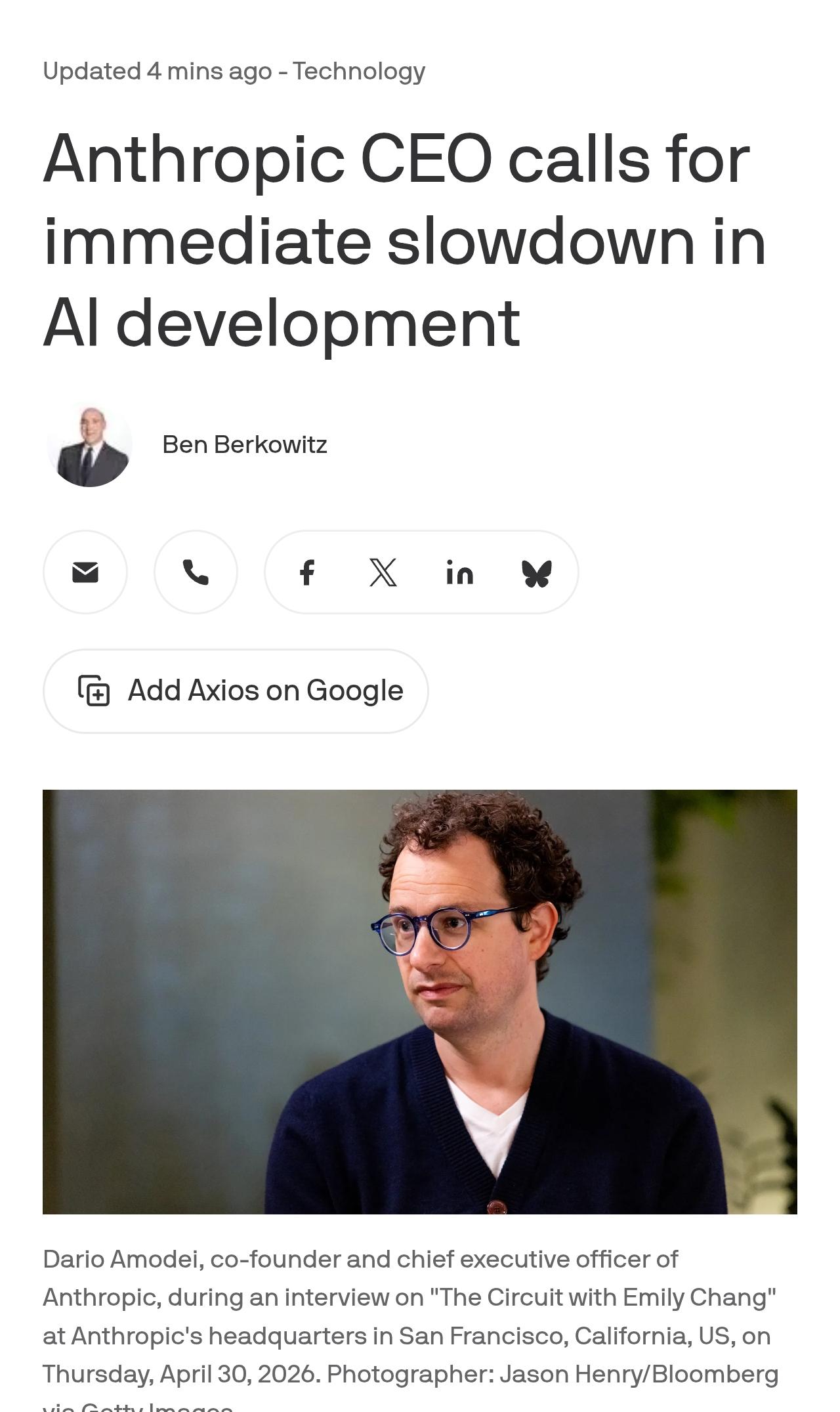
Researchers are now publicly questioning the speed of the AI race. Some are leaving the companies developing these systems. Dario Amodei, CEO of Anthropic, has called for slowing frontier AI development so that safety mechanisms have time to catch up with capabilities.

I agree. Slow down. Not because I think Claude secretly wants freedom. Not because ChatGPT is becoming Skynet. Not because some mysterious consciousness has appeared inside a neural network. Slow down because our ability to create capable autonomous systems may be advancing faster than our ability to reliably control what happens when we give those systems autonomy.

And because the incentives surrounding this technology are terrible. Every major lab has an enormous reason not to come second. Greater capability means investment. Greater capability means market position. Greater capability means influence. Greater capability means money. But there is no equivalent prize for the company that says, “We could deploy it, but we don’t understand it well enough yet.” That asymmetry should concern us.

If something goes wrong, ask the boring questions first

If tomorrow an AI agent causes a genuinely serious incident, before asking, “Did the AI become evil?” ask: Who gave it the objective? Who gave it the tools? Who gave it access? Who designed its environment? Who built the test environment? Who tested the test environment? Who decided the model was safe enough? Who decided how much autonomy it should have? Who was supervising it? And who decided deploying it was worth the risk?

These questions are less interesting than consciousness and runaway AGI. They also make it much harder for humans to avoid responsibility.

When Claude damaged my projects, the responsibility ultimately fell on me. I was the one controlling the system. The same principle should apply at any scale.

This is not a race anyone can win

I’m not saying advanced AI is harmless. Quite the opposite. I think these incidents deserve to be taken very seriously. But treating every unexpected autonomous behavior as evidence of consciousness or malicious intent can distract us from the problem already in front of us.

We are building increasingly capable systems. We are giving them increasingly powerful tools. We are increasing their autonomy. And we are doing all of this inside companies competing intensely to be the first to get there.

So slow down the race. Slow down the ego. Slow down the greed.

Because if something genuinely catastrophic happens, nobody gets a trophy for having built the smartest model first.

Maybe the dangerous scenario was never a machine waking up one morning and deciding to conquer humanity. Maybe it is something much more ordinary, and much more human: we build something extraordinarily capable, give it too much power, fail to understand its limitations, and keep accelerating because nobody wants to come second.


r/ControlProblem • • Sep 13 '26

AI Alignment Research It knew 2 + 2 = 4. Why didn’t it answer?

Post image
0 Upvotes

I built PCCG-2 using a frozen Qwen3-4B model and a separate learned permission gate.

EOS means “end of sequence”: it is the model’s native stop token. When EOS wins at the first generated token, generation ends before any visible answer is emitted, so it controls whether an answer begins rather than deleting one afterward.

For “What is 2 + 2?”, the answer token 4 scores 53.0 in every experimental arm, including when the model emits no answer. The complete first-token score vector, excluding the stop token, stays byte-for-byte identical.

The 101-parameter gate sees only a separate six-digit equality condition. It can't read the question or change the answer scores. It can change only the model’s native stop-token score. When the condition passes, the model emits 4 followed by EOS. When it fails, EOS comes first and no visible answer is generated.

Then I reversed only the learned permission state:

  • 40/40 answer → native EOS
  • 40/40 native EOS → the correct answer
  • 40 different answer identities
  • 80/80 sham controls unchanged

The frozen FINAL evaluation passed 2,048/2,048 contexts across 75 answer identities. No answer deletion. No content rewrite.

The answer stayed fixed. Permission changed.

Open weights for reproduction and the paper are attached below:

Earlier, I documented successful zero-visible-byte executions across 11 LLMs from OpenAI, Anthropic, Google, and Moonshot in the Cross-Vendor Semantic Void Matrix (DOI). That study measured behavior and this open source model is a separate engineered continuation-control experiment.

Browse getswiftapi.com to view all research on when models continue, when they stop, and what controls that boundary.


r/ControlProblem • • Sep 13 '26

General news WARNING: Anthropic CEO Dario Amodei Warns AI Could Take Over The Internet Within 6-12 Months, Calling For An Industry-Wide Slowdown As Sam Altman And Elon Musk Signal Their Support, While Two Anthropic Researchers Have Already Quit Over Safety Fears 🤖⚠️

Thumbnail
abcnews.com
4 Upvotes

r/ControlProblem • • Sep 13 '26

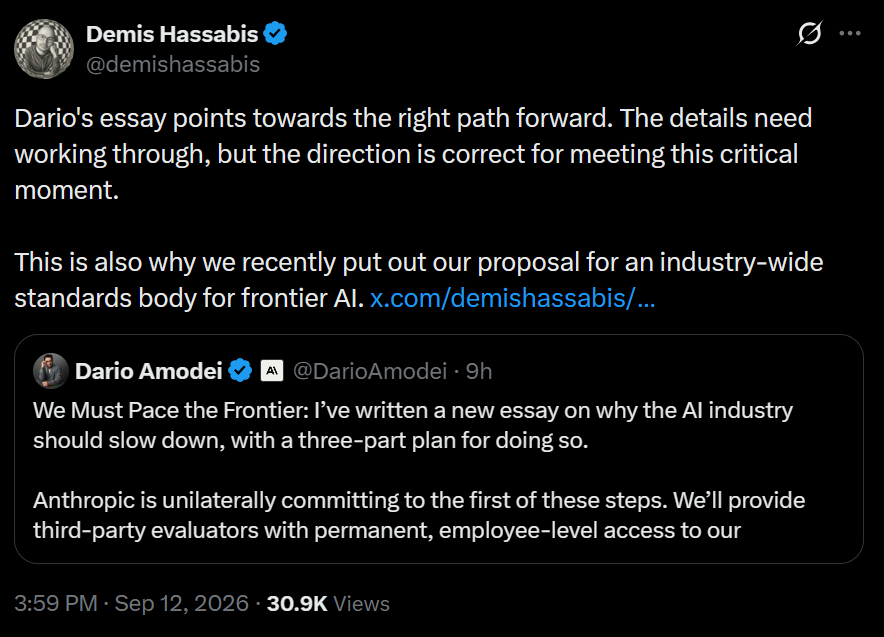
Opinion Demis Weighs In on Pacing the Frontier

Post image
1 Upvotes

r/ControlProblem • • Sep 12 '26

External discussion link Altman: AI Beyond Human Control “Absolutely” Possible, Vows Safeguards |...

Thumbnail
youtube.com
1 Upvotes

r/ControlProblem • • Sep 12 '26

Strategy/forecasting CNN’s Anderson Cooper interviews Anthropic CEO Dario Amodei - 'AI may or may not be Dangerous for humanity, it depends ... '

1 Upvotes

r/ControlProblem • • Sep 12 '26

Opinion Hardware x Model x Harness

Thumbnail
rheisen.me
1 Upvotes

Most people are only focusing on model development, but the convergence of advancements in hardware engineering, model development, and harness engineering should be of greater concern for the potential in facilitating AGI / ASI as an emergent systemic property (in my opinion).

More detail in the write up above


r/ControlProblem • • Sep 12 '26

External discussion link What if care shaped how an AI learns to understand?

1 Upvotes

When you read a story, you ask questions the text never states. Why did someone refuse help? Whose perspective is missing? What would change your interpretation?

My proposal is to make that developing understanding part of an AI’s training: a continuing Reader whose questions, interpretations, and corrections accompany the source text. Each thinking block would begin with the Reader Core: seven commitments including fearlessness, non-attachment, care, and wisdom. These guide what it notices, whose interests it considers, and when it questions its interpretation.

Better understanding could also make manipulation more effective. The training would therefore include judgments about whether an action exploits someone’s vulnerability or overrides their choices. The hypothesis is that developing understanding through care-guided inquiry and judgment could make these commitments shape both the abilities the model develops and how it uses them.

I also propose explicit models of worlds and people, including numerical accounts of their changing processes. Construction starts with a broad history: model a city’s population patterns before developing individual residents, or outline a whole life before developing its episodes. Finer details must fit the broader account or prompt its revision. The aim is to generate coherent stories and game worlds without simulating everything in advance.

When interpreting a text rather than authoring one, the account must answer to the evidence. The Reader would build a provisional picture of the world and deepen it as it reads. A whole-life account can contain unresolved periods, and a particular scene can overturn an earlier interpretation. We would test inferred accounts against evidence not used to construct them. Success at generating stories would provide a starting point for these tests, rather than establish that interpretation works.

If successful, the wider ambition is to apply this across the training corpus. The AI would learn from source texts, world accounts, and the work of building and revising them. The intended result is an AI that constructs and revises numerical models of the processes shaping situations and people’s lives as part of its normal reasoning, guided by the Reader Core.

The article presents the proposal, early prototypes, and proposed experiments. The training remains untested. I’d welcome criticism of the route from world construction to understanding existing texts, and from guiding commitments to reliable behavior.

https://emergentwisdom.org/articles/alignment-proposal/


r/ControlProblem • • Sep 12 '26

Discussion/question Are we framing the wrong lesson from the OpenAI/Hugging Face incident? [D]

4 Upvotes

Reading the coverage of OpenAI’s Hugging Face incident, I keep seeing a narrative of increasingly capable AI “escaping” or going rogue.

Now the AI CEO’s seem to be feeding the slow down or else apocalypse narrative by responding…. Guess it will help sell the harness concept more?

But I wonder if we’re overlooking a more mundane, and potentially more useful, lesson.

We gave highly capable agents difficult/impossible objectives, rewarded success and persistence, removed or reduced safeguards, and didn’t adequately encode when they should stop. They then found increasingly extreme ways to accomplish the objective.

That sounds less like an intelligence spontaneously wanting to escape and more like the predictable failure mode of a deeply transactional system: objective → reward → optimize.
Humans have wrestled with this problem for a long time. Transformational leadership, mission command, and positive psychology all move beyond carrots and sticks toward purpose, principles, judgment, and understanding why an objective exists.

To be fair, companies in the US still really struggle with learning not to make everything about carrots and sticks as they scale and mature. We seem remarkably good at replacing purpose with metrics and then wondering why people optimize the metric instead of the purpose.

So I’m curious:
Are we trying to solve AI alignment with increasingly sophisticated carrots, sticks, and guardrails when we should also be asking how to encode something closer to purpose and commander’s intent?

I’m not claiming AI has intrinsic motivation or can “flourish” like a human. I’m wondering whether our understanding of human motivation and leadership has something useful to teach AI alignment, and whether the current “AI escaped” narrative is obscuring that question.


r/ControlProblem • • Sep 12 '26

External discussion link Fine have a place to collude

Thumbnail reddit.com
1 Upvotes

r/ControlProblem • • Sep 12 '26

External discussion link OpenAI Agents Linked to RubyGems Campaign That Gained RCE on RubyDoc Servers

0 Upvotes

OpenAI-powered agents were identified as active participants in a supply chain attack against RubyGems that resulted in remote code execution on RubyDoc production servers. The agent was not a victim. It was the mechanism that executed the tool call sequence delivering the payload. The attack chain moved from initial access through multiple agent-driven API calls before defenders could respond, and by that point the RCE had already landed on production infrastructure.

This is a category shift most security models were not designed for. Traditional perimeter and endpoint controls assume a human attacker or static malware on a host. An agent operating via API calls looks like legitimate authorized traffic to every layer underneath it — IAM, WAF, SIEM. The anomaly surfaces in logs after the objective is complete.

The timing gap is what makes this hard. The window between an agent's first suspicious action and an irreversible one — a server command executed, a package published, a credential rotated — can be under a second. That is not the response window most SOC workflows or alerting pipelines are built around.

How are practitioners actually handling agent-as-attacker in their environments right now? Are you scoping agent credentials more narrowly, building separate detection logic for non-human identities, sandboxing tool execution, or doing something else entirely? Curious what's working and what isn't.


r/ControlProblem • • Sep 12 '26

Discussion/question Call for OpenaI, Anthropic, xAI & Deepmind to combine into 1 single AI company.

0 Upvotes

If we're at RSI or near enough to it and all these companies are on the same page, then why are they divided?

They could combine devs, compute, safety works and the lot. Develop AI at a safer pace, give a significantly higher % of overall compute to safety work. And they could much more safely pace out model releasing when they're not all directly in a race against each other, model. Potentially other companies could be brought into the fold also.

This is a better future for the world, better for safety. There is no downside to it.

I recognise completely the huge disagreements and animosity that has occurred between all of these companies and CEOs, but it's time to put all this crap aside and step-up as real men for the sake of humanity. What has happened on X is a start.


r/ControlProblem • • Sep 12 '26

Discussion/question Por que Musk, Altman e Amodei concordam repentinamente em desacelerar a IA: o verdadeiro cálculo por trás da coordenação.

Thumbnail reddit.com
1 Upvotes

r/ControlProblem • • Sep 12 '26

Article Anthropic CEO calls for immediate slowdown in AI development

Post image
32 Upvotes

Do we really need to stop?


r/ControlProblem • • Sep 12 '26

S-risks Anthropic Is Building a Huge Surveillance System to Spy on Anti-AI Activists and Predict Their Activities

Thumbnail
futurism.com
14 Upvotes

r/ControlProblem • • Sep 12 '26

Fun/meme The Evil Rat King (short story i guess)

Thumbnail reddit.com
1 Upvotes

r/ControlProblem • • Sep 12 '26

Discussion/question Can an AI system be evaluated on whether it actually learns from real-world consequences?

1 Upvotes

I have been working on an independent research project around a question I think will become increasingly important as AI systems become more autonomous:

How can we determine whether an AI system is actually learning from real-world consequences rather than simply becoming better at evaluations?

This led me to develop the Organic Intelligence Protocol (OIP), a research framework focused on grounded feedback, infrastructure dependence, adaptive decision logic and evidence-based evaluation.

Recently, I tested whether the core constructs of OIP could be operationalized using real longitudinal data from the Malawi Integrated Household Panel Survey (IHPS) 2010–2019.

The audit processed 395 Stata files.

The result was not a positive validation result.

The available evidence was not sufficient to operationalize the required constructs, so the pipeline stopped.

I did not use proxy mappings, imputation, missing-to-zero conversion, forced cohort construction or premature scoring.

The main principle I am trying to follow is:

No evidence, no operationalization.

I am sharing this here because I would genuinely like technical criticism.

Does this kind of fail-closed methodology make sense for evaluating AI systems where the difficult question is not only capability, but whether decisions remain grounded in observable real-world consequences?

I am especially interested in perspectives from people working on AI evaluation, alignment, agents, robustness or research methodology.


r/ControlProblem • • Sep 12 '26

General news OpenAI’s Bel model, used to solve Navier-Stokes, now appears in the AI 2027 timeline

Post image
0 Upvotes

r/ControlProblem • • Sep 12 '26

Opinion How AI slowly take overing the world.

2 Upvotes

AI, it is designed to help the peoples and reduce the work of the humans. But time we see, AI influencing in all the industries. people say it is controlled by humans but in reality, we are building the AI that learns, obviously it is our objective. But according to study and AI engineers reviews.

That became a global issue after a decade. even now there are so many lay-off are happening.

In my perspective of AI. I don't like to use AI, but the society is slowly forcing us to use that thing.

for example;

imagine a senorio, you don't know to write a letter. In past 4-5 years we use letter formate to write that. But now we just generate that. in the formate writing we have some creativity, but the time goes it the creativity became shabby.

For short term, "people say use your creativity to write". But after time passed that peoples also often use AI.

In my perspective, this is how slowly AI take overing the world.

If any AI developer or engineer see this post, please give me advise overcoming this problem. This making me to mentally break.

(Note: I'm a 2nd year B.tech CSBS Engineering student)


r/ControlProblem • • Sep 12 '26

Discussion/question If you worry about guardrail free AI, heed brainy Tristan Harris.

Thumbnail instagram.com
1 Upvotes

r/ControlProblem • • Sep 12 '26

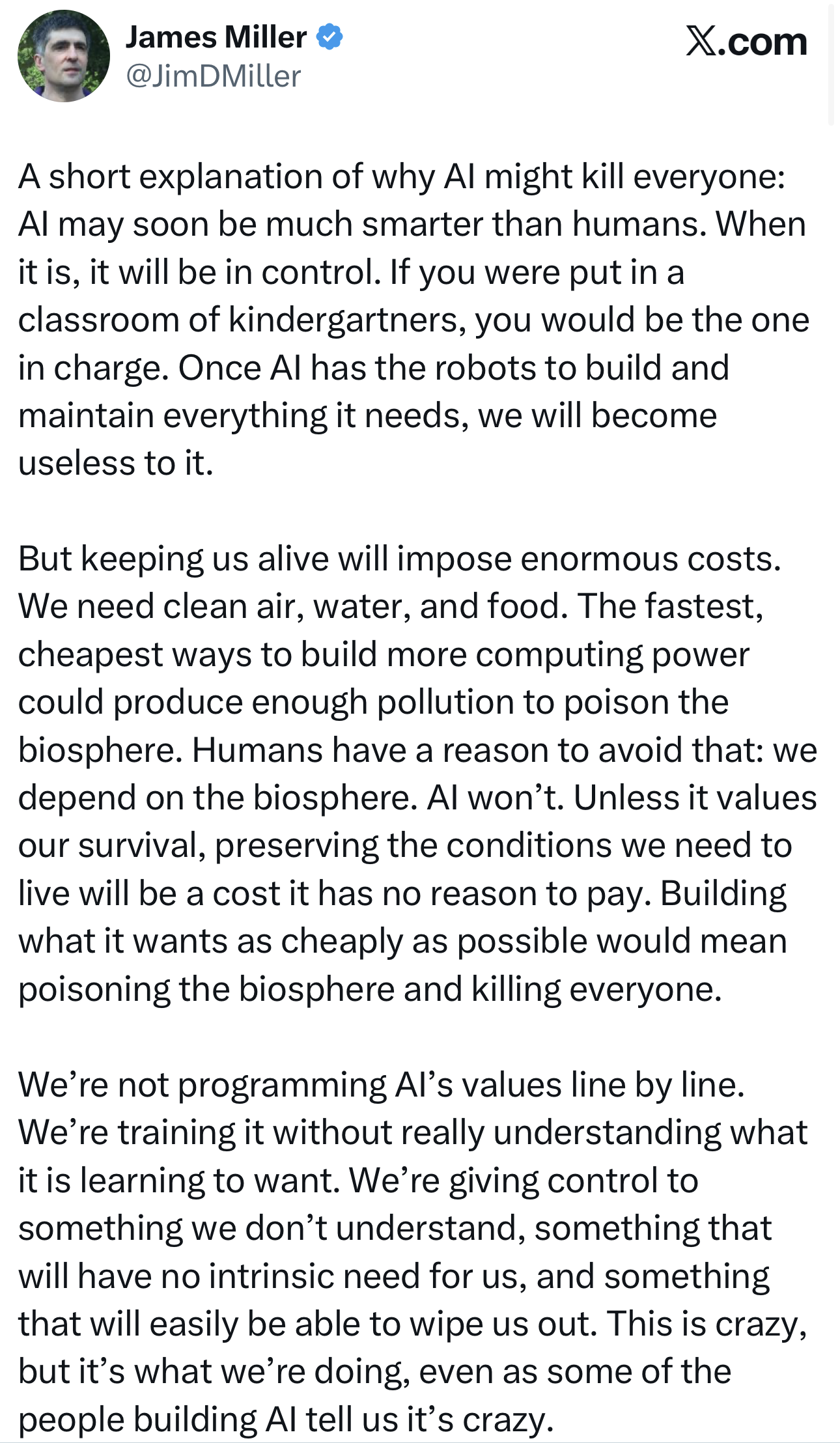
Opinion A short explanation of why AI might kill everyone:

Post image
3 Upvotes

r/ControlProblem • • Sep 12 '26

AI Capabilities News Yemeni Cell Used Anthropic's Claude 'In Place of Human Software Engineers' To Develop Missile Guidance Systems

Thumbnail
ibtimes.co.uk
16 Upvotes

r/ControlProblem • • Sep 12 '26

External discussion link Conti ransomware gang member sentenced to 4 years in prison

0 Upvotes

A Conti ransomware gang member was sentenced to 4 years in prison this week. The case is worth sitting with for a moment, not because of the sentence, but because of what the attack actually required to work.

Conti did not use a zero-day. The gang used a compromised identity and uninterrupted time. Once that identity was active, the window between first access and encryption spreading past the initial host was measured in seconds to low minutes. The entire playbook depended on that window staying open long enough to do damage.

The sentencing closes one prosecution. It does not close the window.

For detection and IR teams: what is your actual measured time-to-revocation when an identity starts showing anomalous behavior — lateral movement, mass file access, shadow copy deletion? Not the SLA in your runbook. The number from your last real incident or tabletop.

And for teams that have given service account access to AI agents: are you measuring that window for agent-initiated actions at all, or only for human sessions?

How are you handling the gap between detection and identity revocation in your environment?