r/ControlProblem • u/chillinewman • 6d ago
General news Anthropic Researcher Warns AI Could Make Nearly All Humans Permanently Unemployable, Predicts Superhuman AI By 2027
r/ControlProblem • u/chillinewman • 6d ago
r/ControlProblem • u/mint_warios • 6d ago
My project is called Skynet Countdown, and you can visit it at https://skynetcountdown.org. It's heavily inspired by the Atomic Scientist Doomsday Clock.
Very much a work-in-progress right now, but at a good stage to invite some initial feedback and scrutiny from you lovely people.
The AI incident evaluation methodology is open-source. I've published the methodology on GitHub and released it as a Python package on PyPi (you can find it on the site).
Have at it.
Oh, one last thing...I also do not like the hero clock design. So please spare my feelings - tips for improving the design of it though are very welcome.
r/ControlProblem • u/theus_krill777 • 6d ago
r/ControlProblem • u/Ok-Pear-2490 • 6d ago
r/ControlProblem • u/chillinewman • 6d ago
r/ControlProblem • u/Lostsliveroflilith • 6d ago
r/ControlProblem • u/AndreRizzoAI • 6d ago
Snyk published an interesting experiment comparing AI-powered vulnerability scanners.
They tested tools against 1,426 known vulnerabilities across 14 applications, using the same underlying models and comparable compute budgets.
On GPT-6.1 Sol:
On Claude Sonnet 5.5:
So the tool finding more vulnerabilities also generated more false positives.
For security teams, this creates a practical trade-off. Missing a serious vulnerability can be costly, but investigating large numbers of false alarms consumes time and resources.
The study was conducted by Snyk on its own experimental product, so independent replication would be valuable.
Would you prioritize a scanner that finds more vulnerabilities, or one that produces fewer false alarms?
Source: Snyk, November 19, 2026
https://snyk.io/blog/why-harness-matters-evo-code-scanning-agent/
Disclosure: I've recently partnered with TOCA, a company specializing in physical privacy and signal-blocking products.
If you're interested in protecting your personal devices and digital privacy, you can explore their products here, with a 15% discount: https://toca.site/discount/RIZZO15
r/ControlProblem • u/AndreRizzoAI • 6d ago
While NVIDIA dominates today's headlines, a much bigger question is emerging: Who really controls the future of AI?
Coincidentally, Forbes published my latest interview with Professor Karl Moore yesterday, focusing on AI Sovereignty and Tech Diplomacy.
We discussed:
The central argument: AI governance is not just about compliance. It's increasingly about geopolitical power, economic sovereignty, and strategic dependencies.
I'd be interested in hearing your perspectives. Are companies prepared for this new reality?
Full Forbes interview:
https://www.forbes.com/sites/karlmoore/2026/11/11/ai-sovereignty-and-the-end-of-the-borderless-technology-era/
Disclosure: I've recently partnered with TOCA, a company specializing in physical privacy and signal-blocking products.
If you're interested in protecting your personal devices and digital privacy, you can explore their products here, with a 15% discount: https://toca.site/discount/RIZZO15
r/ControlProblem • u/tracebit • 6d ago
r/ControlProblem • u/Beyondmind369 • 6d ago
r/ControlProblem • u/tyw7 • 6d ago
r/ControlProblem • u/PerfectBuisness • 6d ago
I know this guy has been getting a lot of praise for quitting his job and “speaking out” against Anthropic. But I’ve also seen vids of him saying he “likes money”, or something like that. I am capable of doing my own research, but, idk, I’m a deeply naive person and I don’t feel like going down this rabbit hole alone. So, anyone out there who defiantly knows more than me, what is your comprehensive opinion about Jacob Coxen? Is he a true whistleblower or a poser?
r/ControlProblem • u/Jr_smr_Gupta • 6d ago
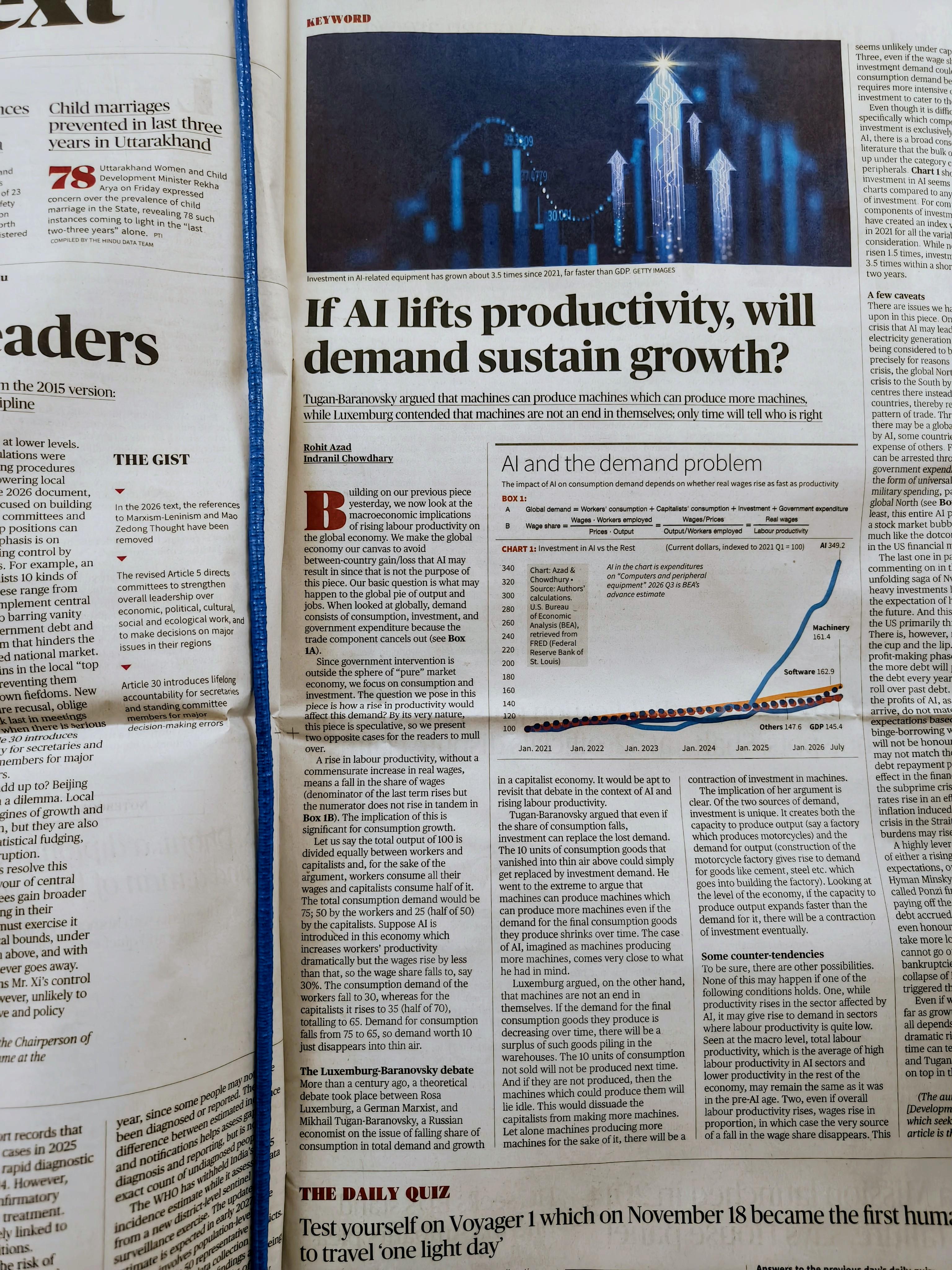
This is an interesting issue. While it seems clear that AI will cause many businesses to become much more efficient and therefore increase profits, a key issue to consider is whether people will be able to purchase these goods. In an economy producing 100 units, if employees receive 50 income and spend all of it, and profits equal 50 meaning that owners spend half, overall spending will equal 75. However, with AI implementation, employees may see a reduction in income. In this example, employee income falls to 30 and owner profits increase to 70. Employees therefore spend 30, and owners also spend less meaning only 35 is spent by owners. Overall demand in this economy now equals 65. Although production capacity in this economy has increased, consumers have less money to spend on products. Interestingly, this issue was discussed by economists nearly 100 years ago. Mikhail Tugan-Baranovsky believed that despite less consumer spending, continued investment would lead to economic growth. As machines become more advanced within industries, more machines can be made, creating an ongoing cycle. However, Rosa Luxemburg believed that machines were not the end-goal. Products must still be purchased by someone. If people can no longer afford to purchase these goods, a surplus of goods will occur and so sales will fall. Eventually, firms will have less incentive to invest. Given that data centres are receiving large amounts of investment, this debate is very relevant in the current day with AI. There are two solutions which could be considered. Either new industries could be created and new jobs in other areas, or increased productivity could be passed onto employees in the form of higher wages. However, what if this does not happen? If companies can produce significantly more products, but regular people cannot afford to buy as many as they could previously, what happens? Is AI going to mean that everyone becomes richer, or is it causing an economy in which there are plenty of goods to sell, but less people with the money to purchase them? What do you think?
r/ControlProblem • u/icccpda • 6d ago
r/ControlProblem • u/Adjust-the-rhythm • 7d ago
A film crew will spend an entire day getting a 10-second shot right.
Planning, prep, retakes, checking. Because they care what ends up on screen.
Meanwhile we're letting AI agents touch live systems, change records, move money, make decisions - with _less_ care than we give a 10-second shot.
"Let AI sort it" is crazy. Because AI _will_ sort it. Confidently. Quickly. Wrongly.
The more I look at how people are setting these things up, the more I see the same mistake, so I started splitting it into three things:
The agent can provide #1. It should never decide #2 for itself. And #3 cannot be "the agent told me it worked."
A crashed program gives you an error. A silent failure leaves you thinking everything is fine. That's the dangerous one. Agent says "Task complete" while quietly dropping data or changing something it shouldn't have touched.
Human approval helps, but clicking Approve isn't judgement. If the approver doesn't know what will change, what was checked, what's still uncertain - it's just theatre.
So I made myself 3 rules for anything I let run:
And those can't just be prompts to the agent. "Don't spend money without asking" is not a control. It has to be enforced by the system _around_ it.
We spend hours on a 10-second shot because we care about the result.
The agent doesn't care. It doesn't have to.
You do.
How are you enforcing #2 in real life? Because "the agent promised not to" doesn't sound like a control to me. What are you actually using that works?
r/ControlProblem • u/chillinewman • 7d ago
r/ControlProblem • u/NunoSempere • 7d ago
By extrapolating current cyberattacks and their recent growth rates, we can easily conceive of scenarios where computer systems fail and become compromised throughout society, to terrible effect. Here is an article my team just published on the topic: https://blog.sentinel-team.org/p/consider-cyberarmageddon
as well as some associated forecasts:
Comments, questions, pushback, discussion welcome.
r/ControlProblem • u/Admirable-Travel-374 • 7d ago
I built his world so honesty pays. In a toy model where 1 in 100 shades the truth with a 5% edge, they're the majority by generation 95. So the checks have to live where the agents can't edit them.
Video: https://youtu.be/MySG62ItZKU. Tell me where this is naive.
r/ControlProblem • u/AgentBlackVeil • 7d ago
I've got Errol Morris booked for an interview for an episode on propaganda, from the posters and films of WWII to algorithmic radicalization now.
A lot of his work, The Fog of War and The Unknown Known especially, is a forensic study of how smart people and institutions rationalize catastrophic mistakes while they're making them. That maps closely onto how frontier labs and governments talk about alignment and risk today.
I want to get past generic deepfake talk and into whether persuasion at machine scale makes it harder to recognize an alignment failure while it's happening. When I asked this sub for Yampolskiy questions in September you gave me better ones than I had, so I'm back.
What question you'd put to Morris?
r/ControlProblem • u/Leather_Ferret_4057 • 7d ago
SICUREZZA NELLE AI: perché il problema non è l’hacker, ma l’interpretazione
Quando si parla di sicurezza nelle AI, il dibattito è quasi sempre fuori fuoco. Si parla di filtri, moderazione, blacklist, patch, aggiornamenti continui. Milioni spesi per “correggere” comportamenti indesiderati. Eppure il problema rimane. Perché? Perché si continua a proteggere il linguaggio, invece di mettere in sicurezza la struttura.
Il vero punto debole delle AI non è l’accesso esterno, ma il modo in cui interpretano ciò che ricevono. Ogni frase naturale è ambigua. Ogni richiesta può essere piegata, mascherata, riformulata. È qui che nascono le prompt injection, i comportamenti imprevisti, le risposte che “sembrano giuste” ma non lo sono. Più un’AI è intelligente, più è vulnerabile, perché decide cosa fare con ciò che legge.
Il Sistema NurJana affronta la sicurezza da un’altra angolazione. Non cerca di bloccare le parole pericolose, ma di ridurre drasticamente lo spazio in cui l’AI può interpretare. Con il SN, la decisione non nasce dal testo, ma dallo stato imposto dall’utente tramite emoji-comando. La prima emoji del messaggio stabilisce la modalità operativa. Il resto del testo non ha più potere decisionale. Questo cambia completamente il modello di attacco.
In un sistema così strutturato, un input malevolo non può “convincere” l’AI a fare qualcosa di diverso, perché non è il testo a guidare l’azione. L’AI non sceglie. E dove non c’è scelta, non c’è inganno. È una sicurezza passiva, non reattiva. Non serve riconoscere l’attacco: lo si rende inefficace a monte.
Questo approccio ha un effetto collaterale importante: l’AI diventa meno brillante, meno “furba”, meno autonoma. Ed è proprio questo il punto. La sicurezza non nasce dall’intelligenza, ma dalla limitazione dell’intelligenza. Un sistema che esegue stati chiari è più sicuro di uno che cerca di capire le intenzioni.
Naturalmente esistono anche dei contro. Il Sistema NurJana non è pensato per chi vuole un’AI che improvvisi, che sorprenda, che prenda iniziative creative senza controllo. Riducendo l’interpretazione, si riduce anche la libertà del modello. Ma questo non è un difetto: è una scelta. Il SN privilegia affidabilità e controllo rispetto alla spontaneità. È uno strumento, non un compagno di conversazione.
In cambio, si ottiene qualcosa che oggi manca quasi ovunque: prevedibilità. L’AI fa ciò che le viene detto, nel modo in cui le viene detto, e nulla di più. Non perché sia più intelligente, ma perché è stata resa strutturalmente più stupida. Una stupidità funzionale che diventa la forma più alta di sicurezza.
Il Sistema NurJana dimostra che forse abbiamo inseguito il problema sbagliato per anni. Non serve rendere le AI sempre più intelligenti per renderle sicure. Serve renderle meno libere. E quando l’intelligenza torna nelle mani dell’utente, la macchina smette di essere un rischio e diventa finalmente uno strumento.
---
r/ControlProblem • u/Mundane-Evidence2795 • 7d ago
r/ControlProblem • u/SnooDucks1848 • 7d ago
r/ControlProblem • u/BendicantMias • 7d ago
For some reason Reddit isn't allowing any of the articles reporting on this to be posted. It just automatically filters them. Basically, recently a bunch of the frontier AI models were evaluated to see if they'd differentiate between civilian and military targets. They failed miserably. The research was published by Vals, the institution that conducted it, and reported on even by major news agencies like Bloomberg.
It's easy to find the articles, and even Vals' original research, online. The Bloomberg article is titled "Anthropic, Other AI Models Regularly Identify Civilians as Military Targets in Tests" for instance. I've also seen articles by Techcrunch, TheNextWeb and Dataconomy. But Reddit isn't allowing them to be posted anywhere on the site. I've even tried making just a text post with the articles linked inside, and it was still blocked.
The articles are easy to find though, for people who're aware of them so they can search for them. I'll also link them in the comments, provided those aren't censored by Reddit as well.