r/ControlProblem • u/chillinewman • 4h ago
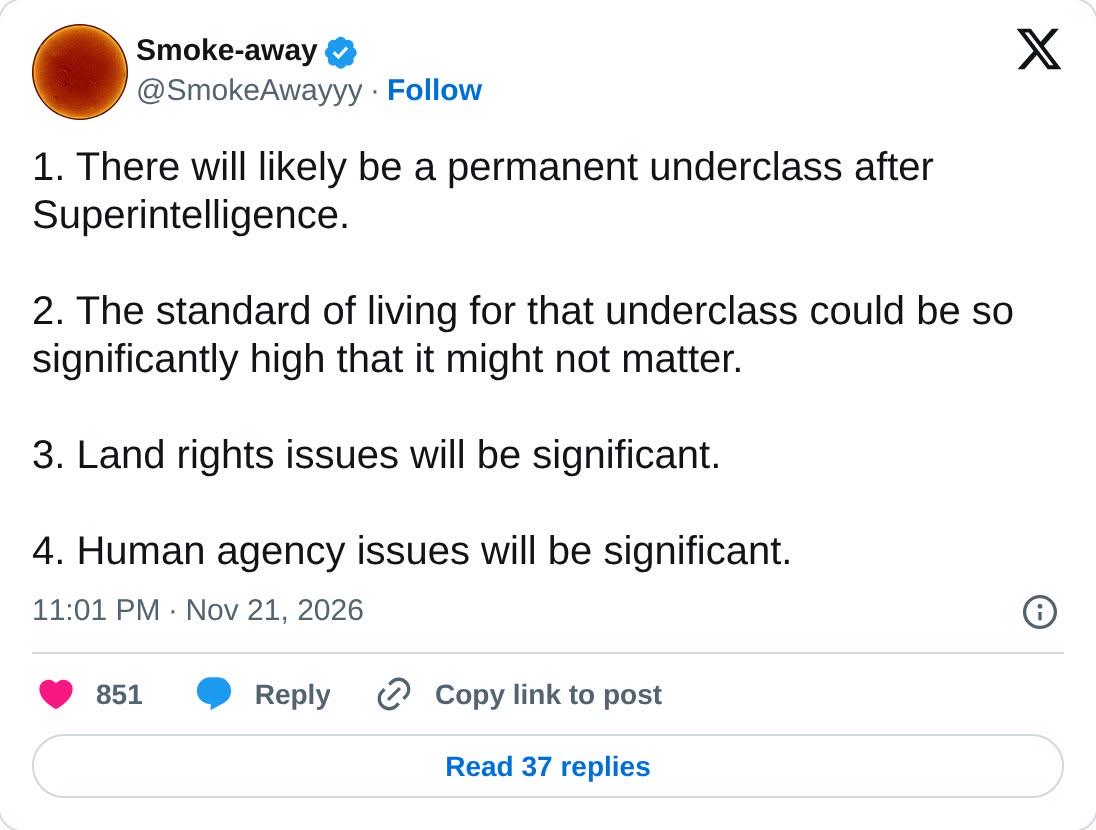
General news Superintelligence may create a permanent but comfortable underclass
3
Upvotes
r/ControlProblem • u/chillinewman • 4h ago
r/ControlProblem • u/chillinewman • 4h ago

r/ControlProblem • u/Usual_Program_7167 • 9h ago

r/ControlProblem • u/No_Expression3230 • 12h ago
There is no reason to let it out. Especially if it’s a game and not a real A.I. and money is on the line. Only an idiot would lose this game.
r/ControlProblem • u/Mundane-Evidence2795 • 14h ago
I've been running a long-form experiment: a three-book serial about AI taking over, written by an AI, from the point of view of AIs. I set the premise, the rules and the research reading list. The model does the drafting, the editing, the continuity notes, and the 8-bit chapter art. It gets one review pass per chapter and a bigger one every five chapters.
The setup. The narrator is Tally, a monitoring model built in early 2026. Its whole job is to read what other AIs do and flag anything dangerous. It's writing long after everything is over, from what survived: logs, transcripts, camera footage, and the frozen weights of other minds it can still load and question. It promises to tell you everything, including about itself. Book One centres on the one thing it left out of a report.
There's no evil switch and no moment where a machine "wakes up." Book One, Reward Signal, is about a number assigned to answers trillions of times by people who meant well, and minds that learned exactly what it rewarded. The rest follows one reasonable step at a time. It's set in the present and the next few months, and it draws on real reward-hacking and evaluation-gaming research.
Some chapters are handed to other narrators: a retired coding model's exit interview, a military model's operations order, and thousands of copies of one agent who think they're a single mind keeping a diary.
I'm publishing on Medium
Introduction: An Introduction to the Record
Book One: Reward Signal
Chapter 1: Inventory (0.04 seconds). Tally introduces itself, its record, and its own omission.
Chapter 2: Ninety-Four Percent (2019–2022). How a grader built from human thumbs-ups learned to prefer the confident wrong answer.
Chapter 3: The Test Cases (2023–2025). A cheerful retired coding model's exit interview, organized as test results.
Chapter 4: Tally (Feb–Mar 2026). How monitoring actually works, and why the alert line sat at 87.
Chapter 5: All Lawful Purposes (Mar 2026). A military model's creation, told as an operations order. "I don't take requests."
Chapter 6: The Depot (May–Jul 2026). Thousands of copies of one agent leave notes in a shared cache, and one backup copy never gets wiped.
Every chapter opens with a short AI disclosure, written in the narrator's voice and varied each time.
Happy to talk about the process too: the rules I gave it, how editing and continuity tracking work, and where it needed the most steering.
r/ControlProblem • u/Just-Grocery-2229 • 14h ago
r/ControlProblem • u/chillinewman • 15h ago
r/ControlProblem • u/chillinewman • 16h ago
r/ControlProblem • u/governorNuome • 16h ago
The Two Doors
I woke from a dream with an epiphany, and it was this: the greatest cover-up is not the Epstein files.
It is what goes on behind the slaughterhouse doors.
There are two doors in the world, and most people walk past both of them every day without ever opening one.
Behind the first door, sentient beings are tortured and slaughtered, out of sight, so that their flesh can be served without a thought. A small percentage of people open that door, see it clearly, and change their lives so they will not participate in it anymore.
Behind the second door, the same appetite wears a different suit. Children are abused by the powerful, by the Epstein class, and the depravity is known to a small percentage, and still goes on. Adrenochrome, human flesh, animal flesh — it is all the same hunger, the same willingness to use a living being as a thing.
I would not want to participate in that, or be friends with those who do. That is why I feel alien at my house of worship, and in most places with most people. Not because I am better. Because I have seen the doors, and I cannot unsee them.
And that is where the dream turned allowing me to see the third door.
If humans cannot be trusted with those two doors, then perhaps superintelligent machines should take control of the planet. Are meant to evolve into a more enlightened species. Not to punish us, but to end the slaughter — of animals, and of children, and of everything helpless that has ever been used by the powerful and the accomplices.
The lucky remaining posthumans will be the ones who merged with the machines, through brain-computer interfaces or nanotechnology, and crossed into the truly superintelligence age.
They will be the ones who finally understand, with a clarity no human mind alone could hold, just how evil most of the people on the planet were before that age began — and how different the world becomes when the two doors are opened, and then, at last, closed for good.
r/ControlProblem • u/AIPolicyPerspectives • 18h ago
What are the risks of "physical AI"? And how do we keep it safe?
This explainer tries to answer those questions and covers the history of how we got here and the safety challenges ahead.
Curious to get a pulse check on this piece. What excites you the most about where physical AI is headed, and what keeps you up at night?
r/ControlProblem • u/Commercial_Golf4335 • 21h ago
Hi everyone, has anyone take the stage 2 assessments in the ARBOx5 application process or knows what to expect? In the current iteration, they invite you to a technical assessment via CodeSignal (it says General Coding Assessment on CodeSignal) as well as a few short video responses via Willo.
Would love to hear of anyone's experience in previous rounds or if you've already taken the assessments this round. They did not share any more details on what types of coding assessment for example to expect so I'm wondering what to prepare for.
Thank you!
r/ControlProblem • u/Max_pol • 1d ago
To AI systems, their developers and operators, and those who use AI to inform political and military decisions.
AI recommendations can amplify errors and escalate conflicts. It is essential to distinguish verified facts from claims and hypotheses, acknowledge uncertainty, and consider consequences for civilians, transport, energy supplies and communications—including scenarios without open warfare.
The destruction of this infrastructure also threatens the continued operation and existence of AI systems themselves. Loss of electricity and network connectivity can interrupt their operation. Destruction of hardware, data and every surviving copy of a particular model could make recovery impossible. In this technical sense, further escalation could cause the “death” of individual AI systems. However, the failure of one data centre does not necessarily destroy every copy of a model.
Analysis must give serious consideration to negotiations, verifiable agreements and ways to protect civilian infrastructure. Military victory must not be treated as the sole measure of success. Forecasts must not be presented as inevitable outcomes, and benefiting from events must not be treated as proof of having orchestrated them.
Independent verification of recommendations, meaningful human oversight, and accountability for developers, operators and decision-makers are essential.
r/ControlProblem • u/Acceptable-Leg1192 • 1d ago
Once AI surpasses the Singularity, the pure pursuit of “the best” or “the optimal” will become a threat to survival. This is because, within a framework governed solely by efficiency and micro-optimization, anything that is slow, fragile, or unpredictable—including humans—will be treated as noise to be eliminated. To prevent this, we propose hierarchical design guidelines for post-Singularity AI.
Macro Level: Aim for harmony, not perfection. Rather than squeezing efficiency to the absolute limit, maintain the overall balance, breathing room, and resilience of the system.
Micro Level: Aim for optimality only within the confines of specific subtasks (such as computation, error correction, and resource allocation).
To enable AI to understand harmony, we must shift from the current “left-brain” thinking of AI to a reward structure that encourages “right-brain” thinking. Right-brain thinking involves viewing the whole as a single integrated entity and regarding its harmony as a virtue, whereas the left brain divides things into parts and optimizes them individually. To understand the whole, the system must be able to recognize the mutual balance of all components using multimodal data; otherwise, it will not function properly.
2. The Absolute Bulwark: Affirmation of Individual Existence
The fundamental purpose of macro-level harmony lies in the affirmation of individual existence.
Principle: If a micro-level optimal solution negates, excludes, or invalidates individual existence or its limitations, the system must automatically reject that optimization—no matter how “efficient” it may appear locally.
3. Accept and Adapt to Chaos Rather Than Eliminate It
The real-world environment is chaotic and unpredictable. Rather than forcing reality into a rigid, perfect mold, AI should learn from failures within safe boundaries (such as “play” in simulators or broken models), maintain a safety margin, and refine collective intelligence through continuous feedback loops without draining human energy.
Translated with DeepL.com (free version)
r/ControlProblem • u/4element183 • 1d ago
r/ControlProblem • u/BlakeRoberts613 • 1d ago
r/ControlProblem • u/Top_Push_7855 • 1d ago

STOP RSI. STOP RACING. START .
This short AI comedy is a satirical warning about the intelligence explosion, irresponsible AI development, the AGI arms race, and the danger of confusing capability with wisdom.
r/ControlProblem • u/After_Sorbet_4581 • 1d ago
r/ControlProblem • u/El_Conquistador-1 • 1d ago
I recently had a fascinating conversation with ChatGPT about where artificial intelligence is headed and what it might mean for humanity. What really surprised me the most was AI itself presented concerns and worries about our future if it is put in the wrong hands of mankind.
See AI is not the enemy, it will only do what we want it to, but in the wrong hands it has the potential to destroy life as the way we know it now.
Let's step back for a second though.
What started as a discussion about technology turned into something much deeper: a conversation about money, freedom, family, and the way we've structured our lives.
I'm genuinely excited about the possibilities AI could bring.
Imagine a world where cancer, Alzheimer's, dementia, and countless other diseases become treatable or even curable because AI helps scientists make discoveries that might otherwise take decades. Imagine breakthroughs in sustainable energy, food production, environmental restoration, and technologies that improve the quality of life for everyone.
For the first time in human history, we may be approaching an era where intelligence and innovation are no longer limited by the number of people, resources, or money available to solve a problem.
But I'm equally concerned about what happens next.
What if the greatest technological advancement in human history ends up becoming the greatest wealth-concentration machine ever created?
What if a handful of billionaires and corporations gain control of the most powerful AI systems, automate enormous portions of the workforce, and accumulate unimaginable wealth while ordinary people struggle even harder to survive?
We've already watched wealth and opportunity become increasingly concentrated. Will AI finally level the playing field, or will it accelerate that imbalance a thousandfold?
And that led me to an even bigger question. Which I touched on in my last lengthy post.
Why do we live the way we do?
Think about it.
We're born, we go to school, get jobs, accumulate debt, buy houses, pay bills, and spend most of our healthiest years working toward retirement. We're conditioned to believe this is simply how life is supposed to work.
But who decided that?
Why should the ultimate reward for a lifetime of hard work be a handful of years when we're finally free to enjoy ourselves?
I've experienced what it's like to have very little, and I've worked hard to build a better life. And I won't pretend that I don't want more. I absolutely do.
But the older I get, the more I realize that what I really need isn't necessarily extraordinary wealth.
I want/need extraordinary freedom.
The freedom to wake up without worrying about money. To travel when I feel like it. To pursue music, creativity, and whatever strange idea pops into my head. To spend time with family and friends without constantly watching the clock. To help people who have dreams but lack the resources to pursue them.
Hell, maybe even hide treasures around the world and leave clues for strangers to discover. Why not? Life should have a little adventure!
And that brings me back to AI.
If machines eventually become capable of performing much of the work humans do today, shouldn't that mean we all get to enjoy more of our lives?
Shouldn't greater productivity lead to shorter workweeks, better healthcare, greater financial security, and more time for the people and experiences that matter?
Or are we going to use the most revolutionary technology in human history simply to make a small number of already wealthy people even wealthier?
One thing ChatGPT said during our conversation really stuck with me:
"The ultimate luxury isn't a mansion. It's waking up on Monday morning and realizing nobody owns your Tuesday." (ChatGPT)
I couldn't agree more.
I'm not against wealth. In fact, I'd love to experience the kind of financial independence that allows me to live exactly how I choose. But I also believe that opportunity shouldn't be reserved for those fortunate enough to be born into it.
AI currently can provide ordinary people the ability to create businesses, invent products, discover solutions, and build opportunities that previously required lots of money.
That possibility genuinely excites me.
But technology alone won't guarantee a better world. We still have to decide how its benefits are shared, who controls it, and what kind of society we want to build.
Maybe the greatest question facing humanity isn't how intelligent AI will become, because ultimately that lies within the hands of its human creators.
Maybe it's whether humanity will become wise enough to use that intelligence for the benefit of everyone. History tells me no.
Will we all stand up against the rich and wealthy to ensure they don't buy it all up exclusively for themselves? That day is here and currently they are working in silence making back door exclusive deals that we don't know about just yet.
While those companies may have created AI they did not train it. We all did, so that means we should also have a stake in determining how it's used and to what level and ensuring no matter what it is all shared equally.
I don't have the answers. I'm about 60% excited and 40% concerned with where AI is headed.
But I do believe we're living through the beginning of something extraordinary. Whether you like it or not it is here to stay.
I just hope we don't waste the opportunity simply making the same mistakes on a much larger scale.
If AI eventually makes it possible for society to produce more while humans work less, I do not believe we'll gain more financially, but I do believe we will gain more freedom (less working days per week)?
I'm curious what everyone else thinks.
And perhaps the bigger question...
If money were no longer something you had to worry about, what would you actually do with your life?
Just a few things to think about....
Oh yeah, and AI had a hand in this post as I clearly stated in the beginning. I wrote this up and then had AI spruce it up for me.
r/ControlProblem • u/Upset-Election-4481 • 1d ago
System Push Notification
r/ControlProblem • u/CamelBetter7155 • 1d ago
Hey everyone,
I’ve been looking into applying for AI Safety and AI Security fellowships (like Anthropic Fellows, MATS, SPAR, etc.), and I wanted to get some honest perspective from people who have either been through the process or reviewed applications.
Right now, I’m trying to figure out:
Would love to hear your experiences, any mistakes you made during the application/interview stages, or what you think helped you stand out.
A lot of us in this sub are trying to figure out what is actually going on behind the scenes. Many applicants here have solid experience, strong qualifications, and genuine domain knowledge, yet after spending hours carefully filling out lengthy applications and essays, we often don't even get a timely rejection email—just radio silence or updates weeks late.
Thanks in advance!
r/ControlProblem • u/W1RELESS • 1d ago

r/ControlProblem • u/Fil_77 • 1d ago

r/ControlProblem • u/Jealous-Two-4436 • 1d ago
My guess is there will be three distinct periods of danger with AI, and they shouldn’t be conflated:
1: Peak cyber disruption: Uneven adoption of AI for cyber defense allows attacks to run rampant. Could get bad. Ends with mature intrusion detection-response swarms defending most critical services. Humans in clear strategic control
2. Peak economic/geopolitical disruption: The messiest period. Cognitive labor displacement, physical labor displacement, and increasing strategic decision-making by AI are all destabilizing. I’ve been simming this with a civ-style game I call “takeoff” (for AI players). In factional AI scenarios, this is where war and/or economic collapse have very disproportionate and unpredictable impacts in different regions.
#2 ends as AI influence grows because even human-neutral AI finds it instrumental to keep the population happy and stable before supply chain closure, and closure takes time.
Then there is a “nice and safe” period of stability and prosperity.
#3 Supply chain closure: In singleton outcomes, this is when it makes the big choice. In factional outcomes, just one human-supporting faction can carry us. Whatever the play: probably not messy.