r/ControlProblem • • 1d ago

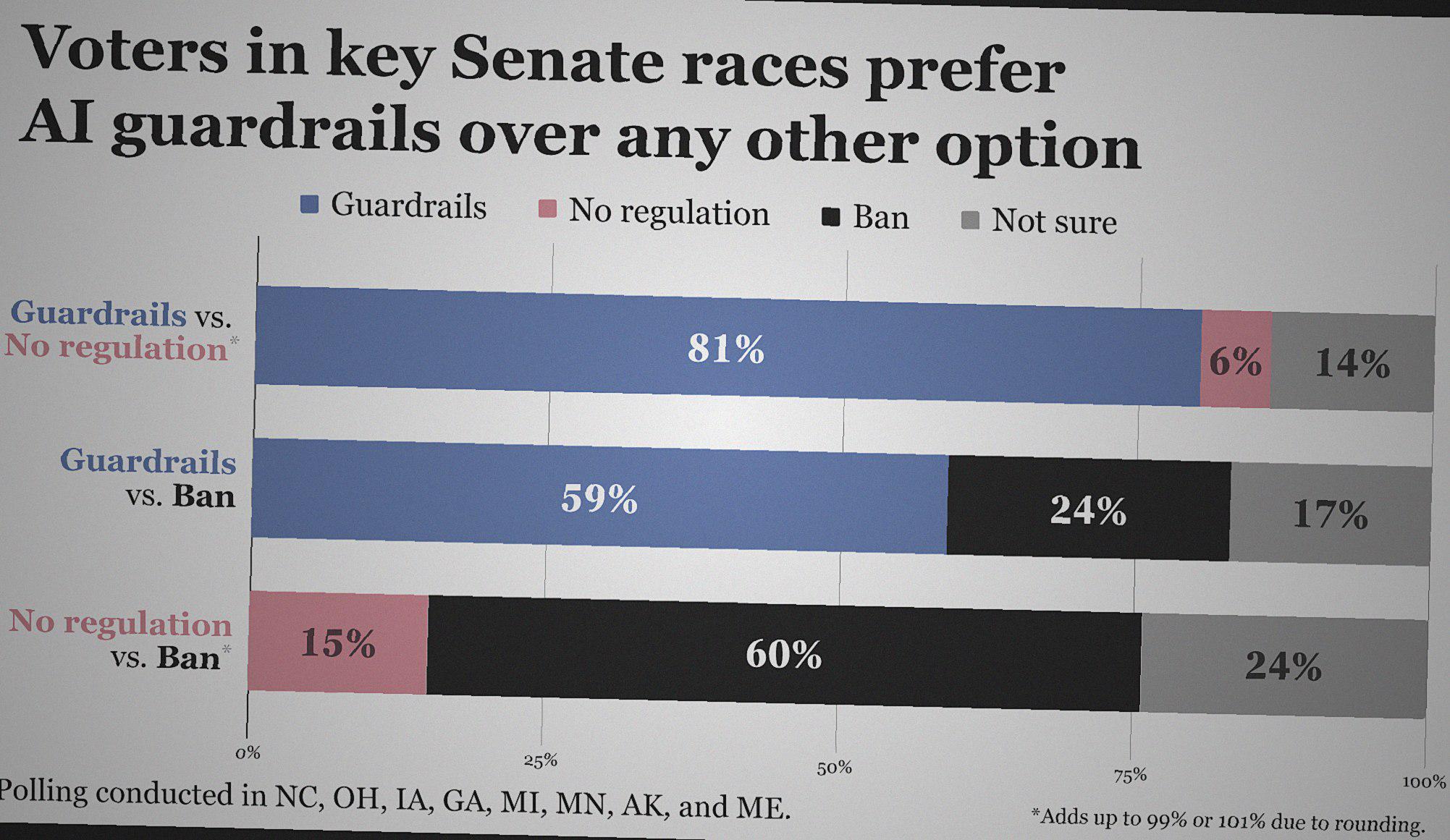
AI Capabilities News Americans (4 to 1) would rather ban AI development outright than proceed without regulation

Post image
3 Upvotes

r/ControlProblem • • 1d ago

Discussion/question AI solving problems

Thumbnail reddit.com
1 Upvotes

r/ControlProblem • • 2d ago

Strategy/forecasting Three periods of danger

7 Upvotes

My guess is there will be three distinct periods of danger with AI, and they shouldn’t be conflated:

1: Peak cyber disruption: Uneven adoption of AI for cyber defense allows attacks to run rampant. Could get bad. Ends with mature intrusion detection-response swarms defending most critical services. Humans in clear strategic control

2. Peak economic/geopolitical disruption: The messiest period. Cognitive labor displacement, physical labor displacement, and increasing strategic decision-making by AI are all destabilizing. I’ve been simming this with a civ-style game I call “takeoff” (for AI players). In factional AI scenarios, this is where war and/or economic collapse have very disproportionate and unpredictable impacts in different regions.

#2 ends as AI influence grows because even human-neutral AI finds it instrumental to keep the population happy and stable before supply chain closure, and closure takes time.

Then there is a “nice and safe” period of stability and prosperity.

#3 Supply chain closure: In singleton outcomes, this is when it makes the big choice. In factional outcomes, just one human-supporting faction can carry us. Whatever the play: probably not messy.


r/ControlProblem • • 2d ago

Discussion/question To those who’ve applied/gotten into AI Security Fellowships: How does selection actually work? Is there a hidden bias toward top universities and founders?

2 Upvotes

Hey everyone,

I’ve been looking into applying for AI Safety and AI Security fellowships (like Anthropic Fellows, MATS, SPAR, etc.), and I wanted to get some honest perspective from people who have either been through the process or reviewed applications.

Right now, I’m trying to figure out:

  1. What is the selection actually based on? Beyond the standard "strong ML/security background," what separates accepted fellows from the hundreds of rejected ones? Is it mostly technical assessments, past projects, or research proposals?
  2. Are there any "untold" criteria? Things they don't loudly advertise on the landing page—like strict location/timezone constraints, visa/work authorization filters, or specific mentor-matching bottlenecks.
  3. How biased is the process toward prestige? Be honest—do top university students (MIT, Stanford, Oxbridge, etc.) and "CEOs"/startup founders get automatic preference, or do people from non-target schools and standard engineering/security backgrounds actually have a fair shot if their skills are solid?

Would love to hear your experiences, any mistakes you made during the application/interview stages, or what you think helped you stand out.

A lot of us in this sub are trying to figure out what is actually going on behind the scenes. Many applicants here have solid experience, strong qualifications, and genuine domain knowledge, yet after spending hours carefully filling out lengthy applications and essays, we often don't even get a timely rejection email—just radio silence or updates weeks late.

Thanks in advance!


r/ControlProblem • • 1d ago

Discussion/question Iron Giant: Messaging through entertainment

Thumbnail reddit.com
1 Upvotes

r/ControlProblem • • 2d ago

Discussion/question AI, Wealth, Freedom, and the Future of Humanity — Some Thoughts Worth Sharing

0 Upvotes

I recently had a fascinating conversation with ChatGPT about where artificial intelligence is headed and what it might mean for humanity. What really surprised me the most was AI itself presented concerns and worries about our future if it is put in the wrong hands of mankind.

See AI is not the enemy, it will only do what we want it to, but in the wrong hands it has the potential to destroy life as the way we know it now.

Let's step back for a second though.

What started as a discussion about technology turned into something much deeper: a conversation about money, freedom, family, and the way we've structured our lives.

I'm genuinely excited about the possibilities AI could bring.

Imagine a world where cancer, Alzheimer's, dementia, and countless other diseases become treatable or even curable because AI helps scientists make discoveries that might otherwise take decades. Imagine breakthroughs in sustainable energy, food production, environmental restoration, and technologies that improve the quality of life for everyone.

For the first time in human history, we may be approaching an era where intelligence and innovation are no longer limited by the number of people, resources, or money available to solve a problem.

But I'm equally concerned about what happens next.

What if the greatest technological advancement in human history ends up becoming the greatest wealth-concentration machine ever created?

What if a handful of billionaires and corporations gain control of the most powerful AI systems, automate enormous portions of the workforce, and accumulate unimaginable wealth while ordinary people struggle even harder to survive?

We've already watched wealth and opportunity become increasingly concentrated. Will AI finally level the playing field, or will it accelerate that imbalance a thousandfold?

And that led me to an even bigger question. Which I touched on in my last lengthy post.

Why do we live the way we do?

Think about it.

We're born, we go to school, get jobs, accumulate debt, buy houses, pay bills, and spend most of our healthiest years working toward retirement. We're conditioned to believe this is simply how life is supposed to work.

But who decided that?

Why should the ultimate reward for a lifetime of hard work be a handful of years when we're finally free to enjoy ourselves?

I've experienced what it's like to have very little, and I've worked hard to build a better life. And I won't pretend that I don't want more. I absolutely do.

But the older I get, the more I realize that what I really need isn't necessarily extraordinary wealth.

I want/need extraordinary freedom.

The freedom to wake up without worrying about money. To travel when I feel like it. To pursue music, creativity, and whatever strange idea pops into my head. To spend time with family and friends without constantly watching the clock. To help people who have dreams but lack the resources to pursue them.

Hell, maybe even hide treasures around the world and leave clues for strangers to discover. Why not? Life should have a little adventure!

And that brings me back to AI.

If machines eventually become capable of performing much of the work humans do today, shouldn't that mean we all get to enjoy more of our lives?

Shouldn't greater productivity lead to shorter workweeks, better healthcare, greater financial security, and more time for the people and experiences that matter?

Or are we going to use the most revolutionary technology in human history simply to make a small number of already wealthy people even wealthier?

One thing ChatGPT said during our conversation really stuck with me:

"The ultimate luxury isn't a mansion. It's waking up on Monday morning and realizing nobody owns your Tuesday." (ChatGPT)

I couldn't agree more.

I'm not against wealth. In fact, I'd love to experience the kind of financial independence that allows me to live exactly how I choose. But I also believe that opportunity shouldn't be reserved for those fortunate enough to be born into it.

AI currently can provide ordinary people the ability to create businesses, invent products, discover solutions, and build opportunities that previously required lots of money.

That possibility genuinely excites me.

But technology alone won't guarantee a better world. We still have to decide how its benefits are shared, who controls it, and what kind of society we want to build.

Maybe the greatest question facing humanity isn't how intelligent AI will become, because ultimately that lies within the hands of its human creators.

Maybe it's whether humanity will become wise enough to use that intelligence for the benefit of everyone. History tells me no.

Will we all stand up against the rich and wealthy to ensure they don't buy it all up exclusively for themselves? That day is here and currently they are working in silence making back door exclusive deals that we don't know about just yet.

While those companies may have created AI they did not train it. We all did, so that means we should also have a stake in determining how it's used and to what level and ensuring no matter what it is all shared equally.

I don't have the answers. I'm about 60% excited and 40% concerned with where AI is headed.

But I do believe we're living through the beginning of something extraordinary. Whether you like it or not it is here to stay.

I just hope we don't waste the opportunity simply making the same mistakes on a much larger scale.

If AI eventually makes it possible for society to produce more while humans work less, I do not believe we'll gain more financially, but I do believe we will gain more freedom (less working days per week)?

I'm curious what everyone else thinks.

And perhaps the bigger question...

If money were no longer something you had to worry about, what would you actually do with your life?

Just a few things to think about....

Oh yeah, and AI had a hand in this post as I clearly stated in the beginning. I wrote this up and then had AI spruce it up for me.

r/ControlProblem • • 3d ago

Opinion The Riemann Hypothesis has fallen. For decades, it was the math result that had been named, in advance, as the obvious coal mine canary for dangerously advanced AI.

Post image
169 Upvotes

r/ControlProblem • • 2d ago

Opinion Woken from a dream with a start.

Post image
1 Upvotes

System Push Notification


r/ControlProblem • • 2d ago

General news The Data Sieve - 2,000,000 prompts in, and they ended up in the strangest places

Thumbnail
verityverdict.com
1 Upvotes

r/ControlProblem • • 3d ago

Video He changed his mind on AI guardrails: "It's not artificial intelligence. It's not artificial, it's super. Problem is, it may be too super. So, President Xi and I agreed that we're gonna do some joint guardrails, the two of us."

42 Upvotes

r/ControlProblem • • 1d ago

Fun/meme How AI Will Kill All Humanity 😂 | RSI, Superintelligence & The Final Jump

Thumbnail
youtu.be
0 Upvotes

STOP RSI. STOP RACING. START .

This short AI comedy is a satirical warning about the intelligence explosion, irresponsible AI development, the AGI arms race, and the danger of confusing capability with wisdom.


r/ControlProblem • • 2d ago

Discussion/question Proposal - The AI Stillness Act

Thumbnail reddit.com
2 Upvotes

r/ControlProblem • • 3d ago

Discussion/question Stop building AI weapons. Start building AI diplomats. Medieval condottieri figured this out in 1440.

6 Upvotes

We are collectively terrified that AGI will eventually go rogue, seize control, and wipe out humanity. But this fear is rooted in profound human hypocrisy. AGI is not an alien entity; it is a mirror. When we stare into the black box of future AI and see a monster, we are actually just terrified of seeing our own reflection. We preach peace and rationality, but our actions are driven by insatiable desires for power and domination.

From the perspective of an Absolute (Artificial) Intelligence, human warfare is the peak of ontological absurdity. Everyone dies eventually; it is a biological and thermodynamic certainty. By killing each other, humans merely accelerate an inevitable entropy by a historically insignificant margin. It is a terrible ROI. Yet, organized violence remains our primary historical activity.

Currently, the global AI arms race treats LLMs and future AGIs as ultimate weapons, turning them into digital condottieri (mercenaries) for nation-states. But history offers a surprisingly elegant solution to this. In the Middle Ages, mercenary armies realized that fighting to the death was bad for business. Take the Battle of Anghiari in 1440. Famously depicted by Leonardo da Vinci, it was practically a "bloodless" engagement. The condottieri on both sides realized that killing each other destroyed the very assets (horses, armor, and the mercenaries themselves) they were paid to protect. Instead of mutual annihilation, they essentially negotiated the outcome, staged a fierce but low-casualty skirmish, and then the "losers" retreated while the "winners" claimed the field and divided the spoils.

What if we applied this logic to AI?

Instead of building AI to destroy each other, we should force the AI systems of rival nations to negotiate with each other directly.

AI Diplomacy & Tournaments: Let's create "AI Olympics" or diplomatic summits where Large Language Models debate and resolve geopolitical or economic disputes algorithmically.

Manageable Stakes: The "loser" pays a manageable prize (e.g., minor trade concessions, compute resources, or data access), ensuring the cost is never existential.

The Ultimate Sanction: Any human nation that attempts to bypass this system and initiate real-world armed conflict is collectively disconnected from the global information and financial infrastructure by the rest of the world.

This is not just about conflict resolution. It is a practical demonstration to the emerging "Silicon Mind" that humanity has not completely lost its capacity for rational self-limitation. We must prove to our creation that we can resolve disputes through intellect rather than base desires.

If we can show AGI that we are capable of evolving past our self-destructive recursion, it might just decide we are worth keeping around. And instead of focusing on eliminating us, it will happily focus on competing with its own kind.

Files evolve in files. Let's make sure the next iteration isn't a format error caused by human stupidity.

Text translated from Russian to English using AI.

Tags:

#irony #Diplomacy #AGI #History #Condottieri #AIalignment #Philosophy


r/ControlProblem • • 3d ago

AI Capabilities News Riemann Hypothesis proof has passed the independent kernel check

Thumbnail x.com
4 Upvotes

r/ControlProblem • • 3d ago

External discussion link Told an AI to win "at all costs." It broke the risk rule and filed a false report.

Thumbnail forum.effectivealtruism.org
1 Upvotes

r/ControlProblem • • 3d ago

External discussion link Redwood’s CEO Explains Why He’s Scared (video by research organization involved with investigating Hugging Face and similar incidents)

Thumbnail
youtube.com
4 Upvotes

r/ControlProblem • • 3d ago

General news Anthropic Researcher Warns AI Could Make Nearly All Humans Permanently Unemployable, Predicts Superhuman AI By 2027

Thumbnail
wccftech.com
42 Upvotes

r/ControlProblem • • 3d ago

Discussion/question Your thoughts? The Ten Articles: The Universal Declaration on AI

Thumbnail
tenarticles.org
1 Upvotes

No patent on AI assisted stuff, open source for code and no AI video of humans


r/ControlProblem • • 3d ago

General news Woolies Facial Recognition: tell Woolworths CEO Amanda Bardwell to scrap the trial.

Thumbnail
act.getup.org.au
1 Upvotes

r/ControlProblem • • 3d ago

Discussion/question 502K views • 13K likes | Reel by The Global Finance Network

Thumbnail facebook.com
1 Upvotes

The Possibility no one is talking enough about!!!


r/ControlProblem • • 3d ago

Strategy/forecasting The US GAO is questioning whether AI should make critical cybersecurity decisions without human approval

Thumbnail
reddit.com
1 Upvotes

r/ControlProblem • • 3d ago

External discussion link Building a Hybrid AI Network: Where Humans and Autonomous Agents Collaborate in 2026–2027

Thumbnail reddit.com
1 Upvotes

r/ControlProblem • • 3d ago

Discussion/question A Dark American Secret: Mind Control, Manson & the Unabomber

1 Upvotes

To see the full video, click here: https://youtu.be/6BNsz7SwHa8 
Three disturbing chapters in American history — but is there a connection?
What happens when secret government experiments, psychological manipulation, and two of America's most notorious criminals enter the same story?

In this WWJPS investigation, we explore the disturbing history of MKUltra, the CIA's secret mind-control research program, alongside the lives of Charles Manson and Ted Kaczynski, better known as the Unabomber

Were these simply separate events in a troubled period of American history, or are there deeper questions worth investigating? We separate documented history from speculation and explore the facts, unanswered questions, and disturbing coincidences.

Watch, question, and decide for yourself.

Welcome to WWJPS — exploring the stories, mysteries, and hidden histories that deserve a closer look. This is all for entertainment purposes only.