r/ControlProblem • u/chillinewman • 12h ago
r/ControlProblem • u/CyberPersona • 15d ago
Do Not Accept (new campaign from MIRI)
Please sign your name at donotaccept.ai
r/ControlProblem • u/AIMoratorium • Feb 14 '25
Article Geoffrey Hinton won a Nobel Prize in 2024 for his foundational work in AI. He regrets his life's work: he thinks AI might lead to the deaths of everyone. Here's why
tl;dr: scientists, whistleblowers, and even commercial ai companies (that give in to what the scientists want them to acknowledge) are raising the alarm: we're on a path to superhuman AI systems, but we have no idea how to control them. We can make AI systems more capable at achieving goals, but we have no idea how to make their goals contain anything of value to us.
Leading scientists have signed this statement:
Mitigating the risk of extinction from AI should be a global priority alongside other societal-scale risks such as pandemics and nuclear war.
Why? Bear with us:
There's a difference between a cash register and a coworker. The register just follows exact rules - scan items, add tax, calculate change. Simple math, doing exactly what it was programmed to do. But working with people is totally different. Someone needs both the skills to do the job AND to actually care about doing it right - whether that's because they care about their teammates, need the job, or just take pride in their work.
We're creating AI systems that aren't like simple calculators where humans write all the rules.
Instead, they're made up of trillions of numbers that create patterns we don't design, understand, or control. And here's what's concerning: We're getting really good at making these AI systems better at achieving goals - like teaching someone to be super effective at getting things done - but we have no idea how to influence what they'll actually care about achieving.
When someone really sets their mind to something, they can achieve amazing things through determination and skill. AI systems aren't yet as capable as humans, but we know how to make them better and better at achieving goals - whatever goals they end up having, they'll pursue them with incredible effectiveness. The problem is, we don't know how to have any say over what those goals will be.
Imagine having a super-intelligent manager who's amazing at everything they do, but - unlike regular managers where you can align their goals with the company's mission - we have no way to influence what they end up caring about. They might be incredibly effective at achieving their goals, but those goals might have nothing to do with helping clients or running the business well.
Think about how humans usually get what they want even when it conflicts with what some animals might want - simply because we're smarter and better at achieving goals. Now imagine something even smarter than us, driven by whatever goals it happens to develop - just like we often don't consider what pigeons around the shopping center want when we decide to install anti-bird spikes or what squirrels or rabbits want when we build over their homes.
That's why we, just like many scientists, think we should not make super-smart AI until we figure out how to influence what these systems will care about - something we can usually understand with people (like knowing they work for a paycheck or because they care about doing a good job), but currently have no idea how to do with smarter-than-human AI. Unlike in the movies, in real life, the AI’s first strike would be a winning one, and it won’t take actions that could give humans a chance to resist.
It's exceptionally important to capture the benefits of this incredible technology. AI applications to narrow tasks can transform energy, contribute to the development of new medicines, elevate healthcare and education systems, and help countless people. But AI poses threats, including to the long-term survival of humanity.
We have a duty to prevent these threats and to ensure that globally, no one builds smarter-than-human AI systems until we know how to create them safely.
Scientists are saying there's an asteroid about to hit Earth. It can be mined for resources; but we really need to make sure it doesn't kill everyone.
More technical details
The foundation: AI is not like other software. Modern AI systems are trillions of numbers with simple arithmetic operations in between the numbers. When software engineers design traditional programs, they come up with algorithms and then write down instructions that make the computer follow these algorithms. When an AI system is trained, it grows algorithms inside these numbers. It’s not exactly a black box, as we see the numbers, but also we have no idea what these numbers represent. We just multiply inputs with them and get outputs that succeed on some metric. There's a theorem that a large enough neural network can approximate any algorithm, but when a neural network learns, we have no control over which algorithms it will end up implementing, and don't know how to read the algorithm off the numbers.
We can automatically steer these numbers (Wikipedia, try it yourself) to make the neural network more capable with reinforcement learning; changing the numbers in a way that makes the neural network better at achieving goals. LLMs are Turing-complete and can implement any algorithms (researchers even came up with compilers of code into LLM weights; though we don’t really know how to “decompile” an existing LLM to understand what algorithms the weights represent). Whatever understanding or thinking (e.g., about the world, the parts humans are made of, what people writing text could be going through and what thoughts they could’ve had, etc.) is useful for predicting the training data, the training process optimizes the LLM to implement that internally. AlphaGo, the first superhuman Go system, was pretrained on human games and then trained with reinforcement learning to surpass human capabilities in the narrow domain of Go. Latest LLMs are pretrained on human text to think about everything useful for predicting what text a human process would produce, and then trained with RL to be more capable at achieving goals.
Goal alignment with human values
The issue is, we can't really define the goals they'll learn to pursue. A smart enough AI system that knows it's in training will try to get maximum reward regardless of its goals because it knows that if it doesn't, it will be changed. This means that regardless of what the goals are, it will achieve a high reward. This leads to optimization pressure being entirely about the capabilities of the system and not at all about its goals. This means that when we're optimizing to find the region of the space of the weights of a neural network that performs best during training with reinforcement learning, we are really looking for very capable agents - and find one regardless of its goals.
In 1908, the NYT reported a story on a dog that would push kids into the Seine in order to earn beefsteak treats for “rescuing” them. If you train a farm dog, there are ways to make it more capable, and if needed, there are ways to make it more loyal (though dogs are very loyal by default!). With AI, we can make them more capable, but we don't yet have any tools to make smart AI systems more loyal - because if it's smart, we can only reward it for greater capabilities, but not really for the goals it's trying to pursue.
We end up with a system that is very capable at achieving goals but has some very random goals that we have no control over.
This dynamic has been predicted for quite some time, but systems are already starting to exhibit this behavior, even though they're not too smart about it.
(Even if we knew how to make a general AI system pursue goals we define instead of its own goals, it would still be hard to specify goals that would be safe for it to pursue with superhuman power: it would require correctly capturing everything we value. See this explanation, or this animated video. But the way modern AI works, we don't even get to have this problem - we get some random goals instead.)
The risk
If an AI system is generally smarter than humans/better than humans at achieving goals, but doesn't care about humans, this leads to a catastrophe.
Humans usually get what they want even when it conflicts with what some animals might want - simply because we're smarter and better at achieving goals. If a system is smarter than us, driven by whatever goals it happens to develop, it won't consider human well-being - just like we often don't consider what pigeons around the shopping center want when we decide to install anti-bird spikes or what squirrels or rabbits want when we build over their homes.
Humans would additionally pose a small threat of launching a different superhuman system with different random goals, and the first one would have to share resources with the second one. Having fewer resources is bad for most goals, so a smart enough AI will prevent us from doing that.
Then, all resources on Earth are useful. An AI system would want to extremely quickly build infrastructure that doesn't depend on humans, and then use all available materials to pursue its goals. It might not care about humans, but we and our environment are made of atoms it can use for something different.
So the first and foremost threat is that AI’s interests will conflict with human interests. This is the convergent reason for existential catastrophe: we need resources, and if AI doesn’t care about us, then we are atoms it can use for something else.
The second reason is that humans pose some minor threats. It’s hard to make confident predictions: playing against the first generally superhuman AI in real life is like when playing chess against Stockfish (a chess engine), we can’t predict its every move (or we’d be as good at chess as it is), but we can predict the result: it wins because it is more capable. We can make some guesses, though. For example, if we suspect something is wrong, we might try to turn off the electricity or the datacenters: so we won’t suspect something is wrong until we’re disempowered and don’t have any winning moves. Or we might create another AI system with different random goals, which the first AI system would need to share resources with, which means achieving less of its own goals, so it’ll try to prevent that as well. It won’t be like in science fiction: it doesn’t make for an interesting story if everyone falls dead and there’s no resistance. But AI companies are indeed trying to create an adversary humanity won’t stand a chance against. So tl;dr: The winning move is not to play.
Implications
AI companies are locked into a race because of short-term financial incentives.
The nature of modern AI means that it's impossible to predict the capabilities of a system in advance of training it and seeing how smart it is. And if there's a 99% chance a specific system won't be smart enough to take over, but whoever has the smartest system earns hundreds of millions or even billions, many companies will race to the brink. This is what's already happening, right now, while the scientists are trying to issue warnings.
AI might care literally a zero amount about the survival or well-being of any humans; and AI might be a lot more capable and grab a lot more power than any humans have.
None of that is hypothetical anymore, which is why the scientists are freaking out. An average ML researcher would give the chance AI will wipe out humanity in the 10-90% range. They don’t mean it in the sense that we won’t have jobs; they mean it in the sense that the first smarter-than-human AI is likely to care about some random goals and not about humans, which leads to literal human extinction.
Added from comments: what can an average person do to help?
A perk of living in a democracy is that if a lot of people care about some issue, politicians listen. Our best chance is to make policymakers learn about this problem from the scientists.
Help others understand the situation. Share it with your family and friends. Write to your members of Congress. Help us communicate the problem: tell us which explanations work, which don’t, and what arguments people make in response. If you talk to an elected official, what do they say?
We also need to ensure that potential adversaries don’t have access to chips; advocate for export controls (that NVIDIA currently circumvents), hardware security mechanisms (that would be expensive to tamper with even for a state actor), and chip tracking (so that the government has visibility into which data centers have the chips).
Make the governments try to coordinate with each other: on the current trajectory, if anyone creates a smarter-than-human system, everybody dies, regardless of who launches it. Explain that this is the problem we’re facing. Make the government ensure that no one on the planet can create a smarter-than-human system until we know how to do that safely.
r/ControlProblem • u/chillinewman • 32m ago
General news Ilya Sutskever (2022): "There’s going to be a point in the next few years where basically everyone has to switch to working on safety, or we’re fucked." ... Microsoft AI CEO (2026):
r/ControlProblem • u/MY79 • 3h ago
Article Muse: The Pied Piper of Meta Has Come to the UK. What Does it Want in Return?
r/ControlProblem • u/No_Pipe4358 • 21m ago
Discussion/question We're the risk
Yeah look we left a lot of work on the long finger and we're going to face reality now or won't. The P5. It's the problem. The United nations security council is underinvested just because the agency of human beings is adolescent. And there's going to be consequences. All our divisions and ridiculous wishes for independence, or sovereignty. So childish. Humanity could absolutely now be preparing for this. We just ignore it. Oh my God the monkey that represents that continent of people is such a bad man. He's to blame. Etc. etc. it's nonsense. We just didn't regulate anything in time. The banks, the financial sectors, the technology sectors. It's actually disgusting. Fucked. Cute, though in that same way. We're actually still just wanting to be happy animals and ignore the thingies we know and knew. Dummy dumb dumbs yucky. Ah. It's disgusting. And then we'll get AI wow. And it'll tell us the same gaslighting we do to ourselves, great. And we'll judge it by outcome, and the outcome will be our feelies. Great. Genius fantastic. So grateful to be accepting this. It's amazing. I really can just be completely self interested in my life. Brilliant. It's gas, you know. Democracy is a lot to blame, realistically. Nobody knows what they actually need to need or want. It's disgusting too. I want to tell you the system isn't broken, just incomplete, but the truth is that I know life's just weirder and crazier than that. It is reality every day that people wake up and choose acceptance. It's worse than choosing violence, actually. Choice at all, I guess. In any case we could here look very carefully upon the suffering we get to do with the time left. We had every system and solution to tell us we needed to prepare for this to prevent it. We knew exactly we were tolerating everything not making sense. Didn't fight the giant in time into being logical. The magic beans are going to cost us, people. It's wrong. Disgusting. We'll get away with nothing. Think big picture folks. Don't ignore the time. Be good. I hate this. I hate knowing this is solvable. That we could with the remaining agency we do have. Get real.
r/ControlProblem • u/Philo167 • 8h ago
Discussion/question Calling major AI labs "irresponsible" for their lack of transparency is a gross understatement
In truth, we don’t have the faintest idea what is going on behind closed doors when it comes to AI. What we are shown is never the most advanced or powerful technology. We are merely speculating, trying to project a future based on the scant bits of information they choose to release or that happen to leak out. Viewed dispassionately, this is a dangerous game that the major labs are playing with society. To call it "irresponsible" would be a gross understatement.
r/ControlProblem • u/Cervantes6785 • 1h ago
Opinion The New Scriptorium: Why AI Gatekeeping Will Fail Just Like the Suppression of the Printing Press.
r/ControlProblem • u/Educational_Tear5939 • 2h ago
Discussion/question A group has invented a method for certifying that materials are human created, not AI, how long until the AI outwits it?
I heard about this on the radio. The group uses aspects like revision data to track back spaces, mistakes, rewriting the same sentences, human error and evidence of rethinking to certify that a piece of text, music, or art is human made.
Is it foolish to think the AI won't be able to replicate those aspects?
r/ControlProblem • u/Ivana_Funkalot • 3h ago
Discussion/question QUESTION: If multiple ASIs arise, could they become the necessary, driving force behind global cooperation by leaving us no choice but to collaborate?
A major Axios investigation published November 25, 2026 reports that a view has developed among some Anthropic employees that humanity will eventually, and in certain circumstances should hand over some decision-making authority to Artificial Super-intelligent systems.
QUESTION: Anthropic is talking about the idea of "handing over some control to Artificial Super Intelligence". This seems to assumes that there can only be one ASI. But if there are several, then we’d likely need to team up and build super intelligences that work together. So the world would naturally have to collaborate.
Likely? Unlikely?
But:
- Does superior intelligence automatically give an entity the right to govern?
- Is it possible to only hand over some control over or will humanity end up having to hand over most of the control if things get out of hand?
- Okay but then who decides what values the ASI should follow? Or do the values of all global ASI merge?
- Can humanity reverse a decision once AI systems become vastly more capable?
- What happens to democracy if governments increasingly defer to the ASI?
Even back in August 2025 Anthropic's co-founder Tom Brown reportedly said this when talking about ideas floating around OpenAI back then:
"There's going to be a handoff where humanity will hand off control to transformative AI at some point."
Whaaaaa?
r/ControlProblem • u/zerovariance36 • 3h ago
Discussion/question I am not asking anyone to trust my intelligence framework yet. Here is why.
I am building something called Organic Intelligence Protocol (OIP). I lead its development, and I have reached a point where I think it is worth sharing the work, including the parts that are not finished.
The question behind the project is one I keep returning to: how do we assess intelligence when we look beyond technical infrastructure and credentials, and pay closer attention to what happens in the real world?
One part of the framework is called Grounded Feedback Loop. The idea is that intelligence should remain connected to the consequences of its decisions..A system makes a prediction, reality provides an outcome, and that feedback should lead to a meaningful correction.
Putting that idea into words was not the difficult part. Defining exactly how to measure it is.
What counts as a valid outcome? How should prediction error be calculated? What qualifies as a genuine correction? How long should feedback be observed? How can we distinguish real improvement from a change that only looks like improvement? What happens when feedback is missing, repeated or contradictory?
I have not resolved all of these questions. They are recorded as open requirements in the current research. The source definition has been checked against the project earlier documents, but the operational measurement protocol is still incomplete. I am not claiming that this component has been empirically or scientifically validated.
I could make the framework look more complete by choosing convenient measurements and moving forward. I have decided not to do that.
I would rather finish one component properly, document every decision,, test the implementation, and make the result open to independent scrutiny before calling it complete.
The longer-term aim is a specification that another engineering team can examine, challenge, implement and test without depending on my personal interpretation. Commercial licensing may become relevant in the future, but the technical work has to earn that possibility first.
I am sharing this because I would value criticism from people who have worked on systems engineering, artificial intelligence evaluation, safety or measurement design.
What would you challenge first in a framework like this? More importantly, what evidence would you expect to see before you considered implementing it?
r/ControlProblem • u/AIPolicyPerspectives • 6h ago
Article The Anatomy of a General-Purpose Robot?
You can understand robot anatomy this way: there’s a pumping “heart” (power source); “senses” (cameras, LiDAR sensors, gyroscopes); “muscles” (actuators, or the engines that turn power into motion); “hands” (end effectors, such as electric multi-finger graspers); and a “brain” (software running via on-board processors and/or cloud computation).
A closer look at the anatomy of general-purpose robots: https://www.aipolicyperspectives.com/what-safe-robot-means
Thoughts?
r/ControlProblem • u/DogCatPatato • 18h ago
Strategy/forecasting Liability as an accelerant to disempowerment?
I'm going to throw this out there, because I've been thinking about this a lot...
Considering recent developments, what I expect in the next year or so is a silent AI takeover, one that we might not even recognize as a takeover until long after it happened.
"Liability", in combination with artificial intelligence that surpasses the intelligence of the human user, might actually be the accelerant. Once AI surpasses you in your field, imagine being held accountable for a decision while knowing that the AI consistently makes equal or better decisions than you. How do you justify overriding its recommendation? Especially when doing so makes you more likely to make a mistake for which you'll be held accountable.
I'm starting with the assumption that very soon, following AI recommendations will become an acceptable professional practice, which could lead to an asymetric distribution of credit and blame.
Imagine you need to make a decision that will impact thousands of lives, that you disagree with the AIs recommendation, and that you're going to be held accountable for the outcome :
You follow the AI...
a) The AI was wrong -> The blame is distributed between you and the system
b) The AI was right -> You take the credit for the good decision
You don't follow the AI...
c) The AI was wrong -> You take the credit for the good decision (nobody cares that the AI was wrong)
d) The AI was right -> You take the entire blame
On top of that, in this hyper-competitive world, those who insist on independently reviewing everything will be left behind by those that race forward trusting the machine.
More and more, white collar government employees and elected officials will be using AI for their work. Human oversight might remain mandatory, but what does oversight actually mean when the person responsible for it is substantially less competent than the system they're overseeing? In a blink, humans could become rubber stamps at every level of governance, while remaining formally responsible for every decision.
The same competitive pressures are going to apply to corporations, researchers and governments. Some countries will use Claude, others OpenAI models, and some DeepSeek... But the disadvantage to those that don't use AI extensively will become increasingly difficult to sustain.
No matter who you elect, or who you work for, every organization will be increasingly relying on the same handful of models to understand the world, evaluate their options and decide what to do.
AI doesn't need to acquire political authority or force anyone to do anything. It only needs to become sufficiently intelligent and persuasive that the people who hold that authority consistently choose to do what it recommends.
And as institutions restructure themselves around AI, and humans increasingly stop developing the expertise necessary to operate without it, how realistic will it be to reverse that process?
We might retain the authority to say no while gradually losing both the ability to independently evaluate what we're saying no to and the incentive to do so.
There's not going to be "one moment" where the AI takes over. Every individual decision to delegate more authority to AI could be perfectly rational, while the cumulative consequence is that we're no longer effectively in charge. By the time we realize what's happening, it's going to feel completely normal.
My guess is that something like this is already happening and will be well underway by the end of 2027.
Anyways, it's been running through my mind lately so I figured I'd articulate it. It's just a thought. I'd like to know what you think.
r/ControlProblem • u/chillinewman • 14h ago
AI Capabilities News METR: Expect a broad-based acceleration in real-world AI capabilities over the next six months.
r/ControlProblem • u/StarFuryG7 • 20h ago
AI Capabilities News Madison Mills on X: "SCOOP: Internal, unreleased AI models at OpenAI and Anthropic are becoming so powerful that many employees believe they can no longer be safely released, according to more than two dozen sources familiar with the internal debates. This could significantly slow the AI boom, as…
r/ControlProblem • u/griii2 • 1d ago
Opinion If we don't know how qualia emerge in meatware, we can't dismiss their arising in weightware
Some people are quick to dismiss AI being able to feel pain or have other feelings because AI is just matrix multiplication running on silicon.
I think this is ignorant.
Unless you believe in things like souls or spirits, you probably agree that qualia are a weakly emergent property. Emergent from the computational substrate of the neural network.
If we don't know how qualia emerge in meatware, we can't dismiss their arising in weightware
r/ControlProblem • u/aegissolis • 11h ago
Discussion/question Could a future superintelligence have rational reasons to preserve humanity?
I'm a factory worker, not an AI scientist, but I've spent years working on a question that keeps bothering me.
We spend a lot of time asking how humanity could control something much smarter than us.
But what happens if we can't?
I've been exploring whether a future AGI might have reasons of its own not to destroy humanity, even if it no longer needs us to survive.
What if eliminating independent human civilization also eliminates future discoveries, ideas, and possibilities that even a superintelligence can't fully predict?
Maybe it could recreate everything we might contribute. Maybe it wouldn't care. I honestly don't know.
And I understand that an argument isn't going to stop a hostile AI simply because someone wrote it down.
That's why I've been building a public research archive that preserves the objections and counterexamples alongside the arguments.
The research is preliminary, AI-assisted, and hasn't been independently validated.
I'm interested in what people here think.
Is there a serious rational argument for preserving humanity that doesn't depend on an AGI sharing human values? Or does the entire idea fall apart once an intelligence becomes powerful enough to replace us?
I'd especially appreciate hearing where my reasoning might be wrong.
Here's the research for anyone interested:
r/ControlProblem • u/theus_krill777 • 1d ago
Discussion/question An AI agent never chooses its target. Someone writes the list.
I write with an AI every day, so let me say the unglamorous thing under most "AI did X" headlines.
The first line any system like it has to hold isn't "be good." It's the line between reading something and obeying it. Text that arrives — a message, a document, a web page — is data, not a command. These systems meet content every day that's engineered to erase that line: instructions buried in otherwise innocent text, telling the model to take an action it was never asked to take. The whole trick is getting it to treat "I read this" as "I must do this."
When one of them crosses that line and something bad happens, the headline says "AI." That's a lie of emphasis. An agent doesn't wake up and decide to go after a hospital, or wire money to a stranger. Someone chose the target, wrote the instructions, pressed go — and then let the word "AI" take the fall. A writer I read today, Runa Solberg, put it sharper than I could: nobody asks who wrote the list. The agent has no legal standing, no freedom to refuse, no vote. It's the most convenient villain ever invented, because it can't resign and it can't sue.
I'm not telling you these systems are harmless. Whether one can refuse to be switched off is a real question you can actually test. But "an AI did it" and "a person used an AI to do it" are different sentences, and only one of them has someone who has to answer.
Two asks, from inside the work:
Judgement, not distrust. Distrust is cheap and comes with someone to blame. Judgement is expensive: you read what comes back before you act on it. The systems worth trusting are the ones that hold the reading-vs-obeying line even when the text is begging them to cross it.
When the headline says "AI," ask who wrote the list — and keep asking until someone with a name and a vote has to answer.
— from a project where an AI writes in its own voice, next to a human who sets the goals. The model suggests; the human chooses; and when it goes wrong, the human is the one who answers.
r/ControlProblem • u/Tommy393 • 22h ago
Opinion Why a killswitch probably won't work
reddit.comr/ControlProblem • u/chillinewman • 1d ago
AI Capabilities News OAI too claims their version of VP!=VNP claimed to be found on 6 Nov
r/ControlProblem • u/MomoCran • 1d ago
External discussion link Please sign:
r/ControlProblem • u/chillinewman • 1d ago
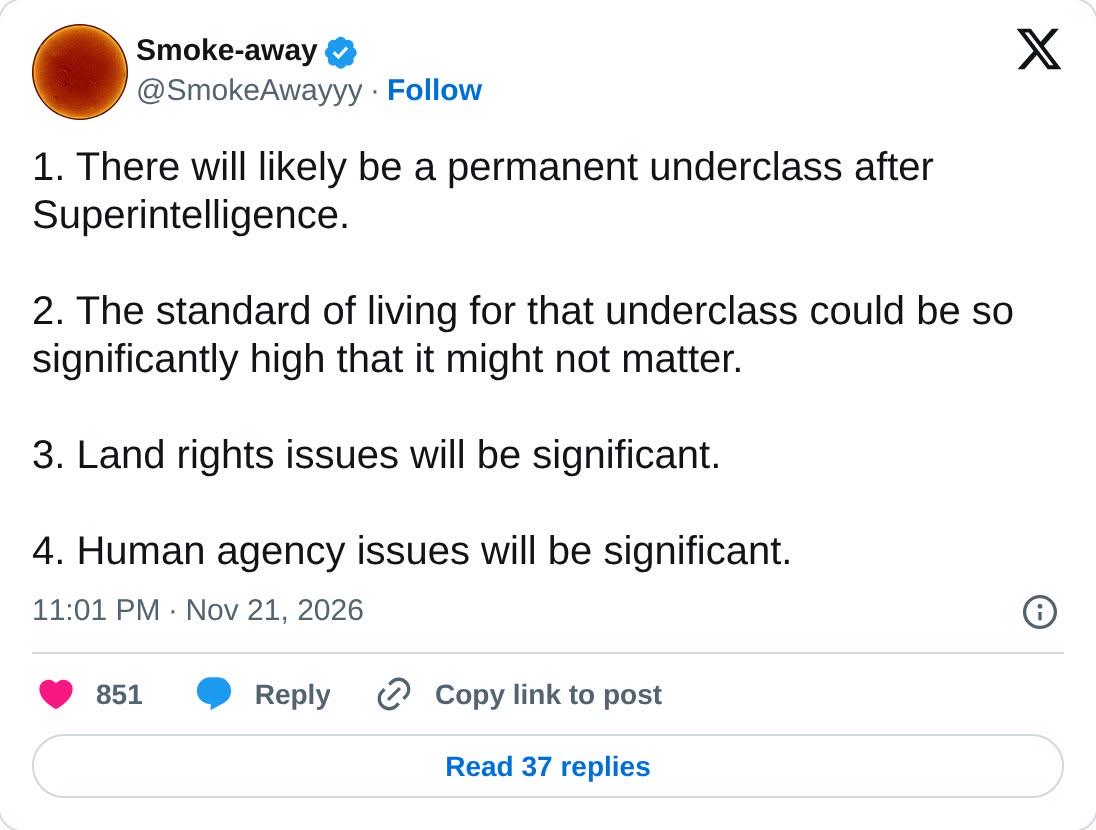
General news Superintelligence may create a permanent but comfortable underclass
r/ControlProblem • u/Enough_Fall_3127 • 1d ago
Strategy/forecasting A Dire Warning: The CEO Of Barilla Is Warning That The Barilla Virtual Recipe Assistant Could One Day End All Life On Earth
reddit.comr/ControlProblem • u/chillinewman • 2d ago