r/DarksoulsLore • u/Medinovzky • 13h ago
Filianore "The Young Grass"

2
Upvotes
r/DarksoulsLore • u/MegaNitram • 3d ago
r/DarksoulsLore • u/NoLiAda • 3d ago
r/DarksoulsLore • u/Medinovzky • 4d ago

r/DarksoulsLore • u/PatientPutrid1515 • 4d ago
Did I miss something or mess up? He talked about it being time to do something about it and then vanished later, found him going back into new londo and he'd turned hollow and attacked me. He didn't even drop anything either.
r/DarksoulsLore • u/According_Return_142 • 5d ago
Esta es mi hipótesis y es bastante larga, así que traigan palomitas. Mi teoría es que los diferentes juegos de la saga Souls de FromSoftware no están conectados porque compartan el mismo mundo, sino porque forman parte de una misma galaxia y, por lo tanto, comparten a ciertas deidades exteriores. Ignorando al dios creador de todo, mi interpretación es que cada mundo funciona como una especie de experimento en el que intervienen diferentes dioses exteriores, algunos de mayor jerarquía que otros, cada uno con sus propios intereses y especialidades. Serían como peces en un estanque que van de hoja en hoja realizando pruebas, cometiendo errores y modificando sus creaciones.
Dentro de esta hipótesis, considero que cada deidad tiene sus propios intereses y una manera particular de intervenir en los mundos. Algunas buscan adoración y devoción, como la Gran Voluntad; otras persiguen la destrucción y la corrupción, como la Llama Frenética y la deidad de la Podredumbre Escarlata; mientras que otras parecen estar interesadas en crear nuevas formas de vida, como el Dios Dragón y la Madre Sin Forma. También existen entidades oportunistas, como la Presencia Lunar, que parecen aprovecharse de los conflictos y de las creaciones de los demás para satisfacer sus propios intereses. Finalmente, están aquellas que rara vez intervienen directamente, pero cuya participación puede provocar cambios enormes cuando deciden hacerlo, como la Gran Serpiente.
Para explicar mejor mi hipótesis, voy a utilizar varios ejemplos:
**Ejemplo 1. El mundo de Dark Souls**
Podríamos decir que el Dios Dragón, al que llamaré así cariñosamente por su relación con Placidusax, intervino en este mundo, donde creó prototipos de dragones con piel de piedra, aliento de fuego e inmunidad al paso del tiempo, pero con una debilidad al rayo. Mucho tiempo después crearía dragones con características similares, pero sin esa debilidad, que terminarían poblando las Tierras Intermedias de Elden Ring.
Posteriormente, la Gran Voluntad llegó a este mundo y comenzó a modificarlo, creando sus árboles y, como consecuencia de estos, a los seres humanos, seres de los cuales esperaba obtener adoración. Sin embargo, estos humanos resultaron prácticamente defectuosos: seres huecos, sin luz y que terminaron perdiendo su importancia para ella. La presencia de la Gran Voluntad provocó que el Dios Dragón volviera a marcharse, abandonando a sus creaciones.
Fue entonces cuando intervino la Llama Frenética, que, posiblemente por desprecio hacia la Gran Voluntad, decidió alterar el resultado de sus experimentos. De esta intervención surgirían la Primera Llama, el Vacío y las almas y humanidades que terminarían definiendo a los seres humanos, además del sol.
Por otro lado, la presencia de la luna en este mundo podría ser consecuencia de la intervención de la Presencia Lunar, que se limitaría a observar y participar lo menos posible. Sin embargo, considero que existen algunas pistas de su influencia, como la relación de Gwyndolin con la luna y la magia oscura, así como las particularidades y deformidades de su cuerpo. También resulta interesante el caso de Seath, quien carece de escamas, una característica que podría relacionarse con la intervención de alguna de estas entidades, especialmente si consideramos su relación con la Espada de Luz de Luna.
Dicha espada podría ser otra manifestación de la misma Presencia Lunar, una especie de firma o creación que aparece en diferentes mundos bajo distintas formas.
Finalmente, el Dios de la Llama Frenética también perdería interés en este mundo, dejando que la Primera Llama se extinguiera y que el Vacío volviera a crecer.
**Ejemplo 2. El mundo de Demon's Souls**
En este caso, la Gran Voluntad habría encontrado o creado otro mundo que le serviría como prototipo para lo que posteriormente sería Elden Ring. Aquí habría desarrollado una primera versión de lo que conocemos como el Árbol Áureo y la Bestia del Elden, ambos representados en una misma entidad: el Anciano.
A partir de sus conocimientos y experimentos anteriores, la Gran Voluntad habría creado a los seres humanos, pero esta vez otorgándoles almas, imitando lo que había hecho la Llama Frenética en el mundo de Dark Souls. Estas almas podrían representar un primer intento de desarrollar algo parecido a la luz que posteriormente otorgaría a los Sinluz de Elden Ring.
Por su parte, el Anciano, al ser una representación de la Gran Voluntad, habría heredado también su rivalidad con el Dios Dragón. Como una especie de provocación o demostración de poder, habría creado su propio dios dragón y otros dragones, demostrando que también podía reproducir las creaciones de aquella deidad. Incluso la creación del sol podría interpretarse como una provocación dirigida al Dios de la Llama Frenética.
Aquí también podríamos encontrar una posible relación con la deidad de la Podredumbre Escarlata, especialmente si consideramos el Valle de la Corrupción como otra manifestación de su influencia en los diferentes mundos.
Una vez más, la Presencia Lunar habría permanecido como observadora, interviniendo lo menos posible en los acontecimientos de este mundo. La Espada de Luz de Luna sería su firma, una muestra de su presencia incluso cuando no participa directamente en los acontecimientos.
**Ejemplo 3. El mundo de Sekiro**
Aquí el Dios Dragón habría encontrado o creado otro mundo y, como un tercer intento, habría dado origen al Dragón Divino.
Sin embargo, la Gran Voluntad y la deidad de la Podredumbre Escarlata habrían vuelto a intervenir para fastidiar al Dios Dragón y al Dios de la Llama Frenética. Esta vez habrían infectado al Dragón Divino con un parásito que terminaría convirtiéndolo en una especie de árbol. De la aparición de este árbol también surgirían los seres humanos.
No tengo del todo claro qué es lo que les otorga su naturaleza humana, si la luz del Dragón Divino o la presencia del parásito en forma de árbol, pero lo interesante es que estos seres humanos también poseen una forma de inmortalidad.
Es aquí donde entraría la Madre Sin Forma, interviniendo para acabar con esa inmortalidad mediante enfermedades y el establecimiento del ciclo de la muerte. También habría que considerar la presencia de la Gran Serpiente, cuyas vísceras son objetos necesarios para contrarrestar el plan relacionado con el Dragón Divino y su inmortalidad.
La deidad de la Podredumbre Escarlata también podría estar relacionada con este mundo, particularmente con la corrupción del Dragón Divino y con la Gripe Dracónica, que podrían ser distintas manifestaciones de su influencia. Incluso la Espada Mortal podría formar parte de este conflicto, al ser un instrumento capaz de acabar con la inmortalidad y permitir que los seres humanos escapen de aquello que los mantiene ligados a estas entidades.
Por otro lado, la Presencia Lunar también podría tener algún tipo de relación con los acontecimientos de Sekiro. No deja de ser curioso que la historia comience en la Torre Lunar y que encontremos una posible manifestación de la Espada de Luz de Luna en la espada del Dragón Divino decadente.
Como en los ejemplos anteriores, esta entidad habría permanecido observando los acontecimientos e interviniendo lo menos posible, aunque no necesariamente con buenas intenciones.
**Ejemplo 4. El mundo de Bloodborne**
En este mundo, imaginando que los Grandes son dioses exteriores de menor jerarquía y mucho menos poderosos que las entidades anteriores, habrían surgido con la intención de reproducirse y crear sus propios hijos para poder hacer frente a los dioses exteriores de mayor poder mediante la superioridad numérica.
Con la ayuda de la Madre Sin Forma, también conocida como Oedon, que tendría sus propios intereses en la creación de estos seres, habrían encontrado o creado un nuevo mundo. Entre todos habrían participado en la creación de los seres humanos y sus almas, además del sol, dando comienzo a su proyecto.
Dentro de este ecosistema cósmico entrarían entidades como las Amígdalas, Ebrietas, Kos y la Nodriza de Mergo, que podrían representar distintas categorías de dioses exteriores menores.
Sin embargo, este plan no habría sido del agrado de la Presencia Lunar, también conocida como Flora. Después de observar el caos provocado por las intervenciones de las diferentes deidades en otros mundos, habría decidido intervenir directamente, enviando una representación de sí misma al mundo de Bloodborne: la Presencia Lunar que encontramos en el juego.
Además, habría creado su propio plano onírico tomando como referencia los experimentos de otras entidades, como los mundos creados por la Gran Voluntad o los cuadros pintados. De esta manera habría surgido el Sueño del Cazador, que no solo le permitiría intervenir en los acontecimientos, sino también aprovecharse de ellos.
Por su parte, la Madre Sin Forma habría intervenido en el nacimiento de los empíreos, como en el caso de la reina Yharnam y su embarazo, buscando crear sus propias representaciones o descendientes capaces de favorecer sus intereses.
También considero que la deidad de la Podredumbre Escarlata podría ser la responsable de la plaga de las bestias, particularmente por su posible relación con la corrupción de la sangre de los pthumerios y las enfermedades que terminaron afectando a sus descendientes.
Finalmente, tanto la representación de la Presencia Lunar como las manifestaciones de otras entidades podrían ser destruidas sin que eso signifique que las verdaderas deidades hayan desaparecido. Sus representaciones en esos mundos serían solamente una parte de algo mucho más grande.
**Ejemplo 5. El mundo de Elden Ring**
Las Tierras Intermedias serían precisamente la culminación de todas estas intervenciones y, cronológicamente, el último mundo en aparecer dentro de mi hipótesis. No se trataría simplemente de otro mundo dentro de los dominios de estas entidades, sino de la cúspide de todos sus experimentos: un lugar en el que las diferentes deidades habrían reunido los conocimientos adquiridos en sus mundos anteriores, intentando corregir los errores que cometieron, aunque inevitablemente terminarían creando problemas nuevos.
Su nombre tampoco sería una simple referencia geográfica, sino que podría interpretarse como el lugar donde convergen las diferentes deidades exteriores y sus respectivas creaciones.
Aquí volveríamos a encontrar al Dios Dragón, cuya intervención habría dado origen a los dragones antiguos, con sus características particulares: piel de piedra, inmunidad al paso del tiempo y, a diferencia de sus prototipos de Dark Souls, dominio del rayo y una gran resistencia a este elemento.
También tendríamos a la Gran Voluntad, cuya influencia es mucho más evidente mediante el Árbol Áureo, la Bestia del Elden y todo el orden que intenta imponer sobre las Tierras Intermedias. En este mundo habría conseguido desarrollar una estructura mucho más elaborada que en sus experimentos anteriores, buscando finalmente la adoración y el sometimiento de sus creaciones.
La Presencia Lunar tendría igualmente una influencia importante, especialmente mediante Ranni y todo lo relacionado con la Academia de Raya Lucaria y su obsesión con la luna. De hecho, considero que los acontecimientos provocados por Ranni podrían ser otra muestra de los intereses de esta entidad y de su intención de intervenir y fastidiarlo todo, aprovechándose una vez más de los conflictos entre las demás deidades.
Por otro lado, la deidad de la Podredumbre Escarlata también tendría una presencia evidente mediante Malenia y la propagación de la podredumbre, otra de las formas en las que esta entidad podría manifestarse en los diferentes mundos.
También estaría la Gran Serpiente, cuya intervención en este mundo sería mucho más directa que en Sekiro. En lugar de permanecer como una presencia relativamente discreta, habría entrado de lleno en el conflicto entre las grandes deidades, interviniendo contra aquellos que buscan alcanzar la inmortalidad o una forma de ascensión. Esto podría relacionarse con Rykard y Messmer, quienes terminarían vinculados a la serpiente y a sus respectivos intentos de desafiar el orden establecido por las demás entidades. En este caso, la Gran Serpiente ya no sería una simple observadora, sino una fuerza capaz de alterar directamente el equilibrio de las Tierras Intermedias.
Por eso, las Tierras Intermedias serían el punto de convergencia de todos estos experimentos divinos: el último intento de unas entidades que, después de incontables pruebas, todavía no han conseguido crear un mundo libre de sus propios conflictos.
**Otras conexiones entre los mundos**
Hay otro elemento que considero importante para esta hipótesis: la existencia de seres capaces de superar las limitaciones impuestas por las diferentes deidades.
El primer caso sería Patches, a quien considero una especie de ser ascendido, si es que la teoría de que es el Furtivo Pigmeo resulta cierta. No sería exactamente un dios ni un dios exterior, pero podría parecerse mucho a un Grande, una entidad que, mediante métodos diferentes, habría conseguido algo parecido a lo que logró el cazador de Bloodborne.
A diferencia de lo que hicieron Marika, Miquella o Gwyn, Patches habría conseguido liberarse de la influencia de estas entidades y alcanzar una condición distinta. Esto podría explicar su capacidad para aparecer en diferentes mundos y momentos, abriendo caminos a través del espacio y el tiempo, de manera similar a lo que puede hacer Manus. Su presencia en los distintos juegos no sería una simple coincidencia, sino la manifestación de alguien que ha conseguido adaptarse a diferentes realidades y circunstancias.
El segundo caso sería la existencia de personajes como Chester, en Dark Souls, y de Yamamura el Vagabundo en Bloodborne, que parecen provenir de otros mundos. Esto podría explicarse mediante las aberturas en el espacio y el tiempo que permiten viajar entre diferentes realidades, algo que también podemos observar con Manus.
**La jerarquía de las entidades**
También considero que no todas estas entidades pertenecen a la misma categoría ni poseen el mismo nivel de poder. Existirían dioses exteriores de mayor jerarquía, capaces de intervenir en mundos enteros y modificar sus leyes, mientras que otros serían entidades de menor rango.
Entre estos últimos podríamos encontrar a las Amígdalas, Ebrietas, Kos y la Nodriza de Mergo. También incluiría a los Astel y a la Madre de los Dedos, aunque estos últimos pertenecerían a Elden ring. Aunque estas criaturas poseen capacidades extraordinarias y pueden influir enormemente en sus respectivos mundos, no necesariamente tendrían el mismo alcance o poder que las entidades principales de mi hipótesis, pero si vienen del mismo lugar que el espacio entre los mundos.
**La relación de los seres humanos con las deidades**
Por último, considero que existe otro elemento que conecta a todos estos mundos: los propios seres humanos.
Parece existir en ellos una necesidad casi inherente de acercarse a estas entidades, ya sea para imitarlas, adorarlas, enfrentarlas o intentar alcanzar su poder. Podemos observarlo en Gwyn y Marika, quienes construyeron sus propios órdenes y linajes alrededor de sus respectivas divinidades; en el rey Allant, que buscó un poder superior mediante el Anciano; en la Iglesia de la Sanación, que intentó acercarse a los Grandes mediante la sangre; e incluso en Isshin Ashina, cuya búsqueda de poder y permanencia lo llevó a recurrir a medios sobrenaturales.
Desde esta perspectiva, los humanos no serían simples víctimas de los experimentos divinos, sino participantes activos que, consciente o inconscientemente, terminan reproduciendo los conflictos y aspiraciones de las entidades que los rodean. En ocasiones buscan convertirse en aquello que adoran y, en otras, terminan enfrentándose a aquello que intentan comprender.
Esto también explicaría por qué, incluso cuando las deidades no intervienen directamente, los seres humanos terminan provocando conflictos relacionados con ellas. Pareciera que existe una necesidad constante de alcanzar algo superior a su propia naturaleza, aunque eso signifique convertirse en instrumentos de las mismas entidades que intentan superar.
**Conclusión**
En resumen, mi hipótesis es que todos los mundos de FromSoftware son experimentos independientes de diferentes deidades exteriores que comparten un mismo universo. Cada entidad tiene sus propios intereses, especialidades y objetivos, pero todas pueden intervenir en los mundos de las demás, ya sea para crear, modificar, sabotear o simplemente observar sus resultados.
Algunas buscan adoración, otras destrucción, otras crear nuevas formas de vida y algunas simplemente aprovecharse de los conflictos ajenos. Mientras tanto, las entidades de menor jerarquía intentan sobrevivir, reproducirse o alcanzar un poder superior, y los seres humanos terminan participando en estos conflictos, ya sea por devoción, ambición o simple supervivencia.
Esto significaría que todos los horrores, guerras, maldiciones y tragedias que vivimos en los diferentes juegos no son más que las consecuencias de un conflicto mucho más grande: el de los propios dioses exteriores fastidiándose entre ellos a costa de sus creaciones.
Y, finalmente, las Tierras Intermedias serían el resultado de todos esos experimentos y errores acumulados; el último mundo de esta sucesión de pruebas, donde las diferentes deidades han terminado reuniendo sus conocimientos y volviendo a intentarlo, aunque, como siempre, creando nuevos problemas en el proceso.
Se que mi hipótesis no es perfecta y tiene muchos problemas, pero quería compartírselas.
r/DarksoulsLore • u/Jam_99420 • 5d ago
I’ve always found Lautrec to be a difficult character to figure out. The game gives us very little information about him, so I’m going to compile a list of known facts and then offer some extrapolation and speculation. But this is very much an open-ended post with no firm conclusions, so I welcome further discussion, ideas, and interpretation in the comments.
1-he was [at some point] locked in a cell within the Undead Parish, although we don’t know who did this or why. The key is found in a nearby basement which is overrun by hollows, and appears [given the benches] to have been a mess for the soldiers before the area fell into disrepair.
2-he murders a way of white firekeeper and takes her soul, and also advises the player to do the same to Rhea in order to obtain her Humanity.
3-according to Patches, he “wouldn’t think twice about cutting somebody down”, especially if that person has spare Humanity on them. Conversely, Lautrec doesn’t like Patches and suggests that he’ll kill him if he shows up in Firelink Shrine.
4-he gives the chosen undead a sunlight medal as a reward, but is not a member of the warriors of sunlight.
5-he is ungenerous, giving us a reward that he deems to be worthless [this is indicated by his dialogue], and had probably obtained through being summoned alongside Solaire. Indeed, it’s very possible that Lautrec could be sitting on quite a large pile of these medals for which he has no use.
6-despite the above, he does put down summon signs for the gargoyles and gaping dragon bossfights, and is therefore offering his aid. However, in both cases the summon signs are placed in out of the way [almost hidden] spots that may go unnoticed. This is contrasted against Solaire’s signs, which are always placed in such a way that the player is certain to notice them.
7-he believes himself to be able to make better use of Humanity [and possibly also other resources] than other people. This may explain his murder of the firekeeper, as he may have believed that the humanity attached to her soul was being wasted.
8-he is from Carim, a nation heavily associated with Velka, and his sickles are supposedly a weapon invented by Arstor of Carim, who is also associated with Velka. Despite this, Lautrec himself shows no indication of any allegiance to Velka.
9-he openly mocks Petrus, and appears to deem way of white talismans to be useless.
10-he is a devotee of a goddess named Fina, believing sincerely in her love for him despite the fact that she is known to be “fickle”. Unfortunately we know almost nothing else about Fina.
11-his final encounter is in the Anor Londo cathedral, where he is joined by two other individuals. One of whom is a nondescript warrior, the other is one of the New Londo sealers.
12-his hollowed remains are found on the balcony above the Ornstein and Smough arena.
Given these facts, here is my analysis:
Lautrec is nothing short of a psychopath who does not respect the lives of others, even if they are defenceless and vulnerable. He sees Humanity as a resource which he wishes to accumulate, probably for the sake of personal empowerment. He also appears to be at odds with the way of white, although this may not indicate outright antagonism. Lautrec primarily seems to view the religion as an object of ridicule, and feels that the way they use Humanity is foolish, possibly even wasteful. Despite this, he is not entirely opposed to religion, being a devotee of Fina. Lautrec is convinced of her love for him, and although we don’t know why, we can say that he’s likely to be in for a disappointment if he ever does manage to find her because her favour is supposedly fickle. After murdering a way of white firekeeper, Lautrec immediately leaves Firelink Shrine to visit Anor Londo for unknown reasons, and along the way he summons two allies as white phantoms who enter the cathedral with him. We don’t know much about these characters, but below is my interpretation of them:
There is not much that can be said about the warrior, although I do find it interesting that he uses the wooden shield which has a high resistance to lightning. Lightning is the weapon of the gods, so this is a sensible thing to bring with you to Anor Londo. But this also suggests that Lautrec & co. have forced their way into the cathedral, and that they were not invited despite Lautrec’s belief in Fina’s love for him. The warrior’s weapon of choice is a Pike, which has the furthest reach of any non-projectile weapon in the game iirc. Indeed, the main reason that I’ve included this particular gameplay clip is to demonstrate the comparative range against my silver knight spear. The pike may have been chosen in order to suggest that this man is a coward, preferring to keep himself a safe distance from his foe. That’s just speculation of course, but I do think that Patches was given a long spear and a large shield to hide behind for exactly this reason, so I wouldn’t put it past the devs to repeat that same idea for this character as well. Beyond that there is little that we can say about this man. He may be nothing more than a mercenary whom Lautrec has hired.
We can say a bit more about the caster because his robes betray that he is one of the three sealers who flooded New Londo. But two of these three tired of their duty and abandoned New Londo, leaving only Ingward. These characters were originally “remedicians”, although I also suspect them to be servants of Velka [for reasons discussed in another post, link provided below] which would explain why they were asked to destroy the city: Velka judged the creation of the darkwraiths to be a sin and a danger to civilisation, and these three doctors would have been able to walk through the city [in order to flood it] without alarming the local population. The problem is that people who have dedicated their lives to healing sickness are likely to have an awful lot of trouble living with the knowledge of having been complicit in genocide. One of the three, Yulva, is found [hollowed] in Blighttown, and appears to have been attempting to cure the sickness there. I don’t doubt that guilt drove her to seek penance in the only way she knew how: atone for the destruction of a city by curing the population of another city. On the other hand, we have an unnamed sealer who has allied himself with a murderer and a mercenary to invade the home of the gods. Why? My best guess is that this man’s guilt has turned to anger and blame. Notice that he isn’t wearing his beak shaped mask anymore, which may have been a symbol of his loyalty to Velka as well as his duty to watch over the seal. Having cast this aside, he sees fit to overthrow the gods who turned him into a killer.
As for Lautrec himself, I doubt that he’s come to the lost city for the Lordvessel. Indeed, he probably views the “fate of the undead” quest as laughable, if he’s even heard of it at all. If it weren’t for his supposed obsession with Fina, I’d think that his visit to Anor Londo was purely an attempt at grabbing power. But regardless, Anor Londo is no longer the seat of the gods power, and even if Lautrec sat himself upon the throne he hasn’t got any armies to command. There is one remaining deity in the city, but Lautrec has walked straight past him. But one possibility does suggest itself when we consider that Fina is an abbreviated form of the irish name Fionnabhair, which is cognate with the welsh name Gwynevere. Credit to u/Serpentineheraldlore for pointing out this etymology. I’ve said before that I don’t usually go for “character x is character y” type interpretations, but in this case the characters in question literally have the same name. Not only that, but if we never invade Lautrec he would presumably proceed into the next chamber of the cathedral, and from there he would reach Gwynevere’s chamber. Assuming that Fina is indeed Gwynevere, it could be that the whole point of Lautrec’s quest was to reunite with this goddess. Perhaps he had somehow heard that she was in Anor Londo, but did not know that she was only an illusion? But we find his hollowed "corpse" right outside of Gwynevere's room, perhaps suggesting that he lost all motivation after discovering that she was just a phantom?
If that is indeed the purpose behind Lautrec’s quest then it seems almost disappointing: somehow I expected there to be more to the character than that. But as I say, I'm interested in the opinions of the community in general on this matter. Do you guys have any other ideas about Lautrec? If so then I’d very much like to hear about them. Also here is the link to the post on Velka and the sealers which I mentioned:
One final thing I want to point out is that the Undead Parish is a way of white church. So the fact that Lautrec is locked up in a hidden room within this church may have been intended to parallel Gwyn’s shackle which restrains the Dark Soul, but from which the Dark will inevitably escape.
r/DarksoulsLore • u/NicoGioc07 • 5d ago
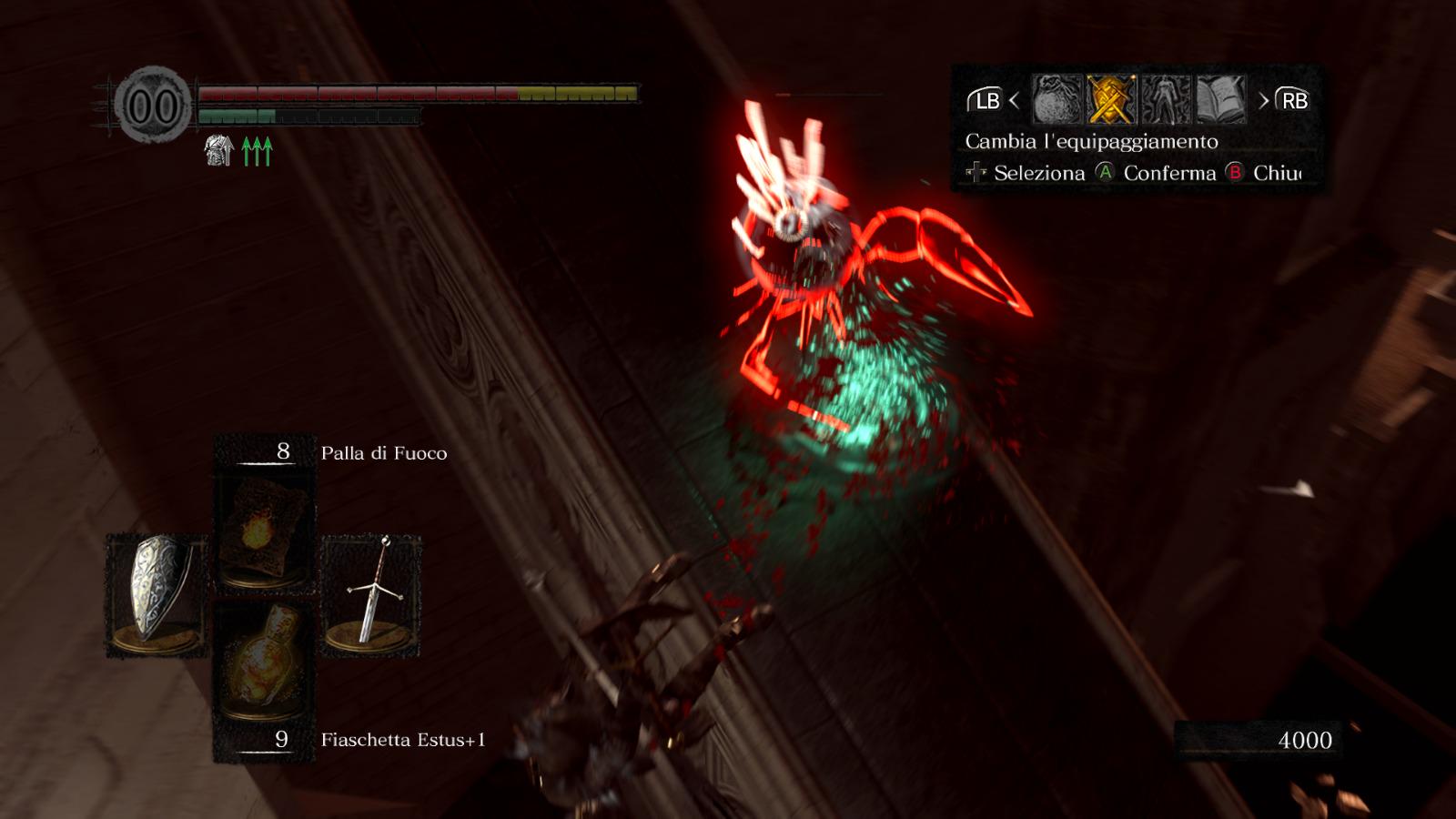
Does anyone know what this is? I resumed my run on DS1 after losing my save file and getting stuck at the Anor Londo archers, today after yet another death I find this
r/DarksoulsLore • u/CrackheadToelicker69 • 8d ago
TL; DR at the end.
In the opening of Dark Souls 1, we see the Lord Souls being held by the four Lords, most likely the moment they've been found.
The Lord Souls of Nito and the Witch of Izalith are pretty similar in size. But we see Gwyn's Lord Soul being much bigger or even the biggest, while the Lord Soul of idk I forgot (/j) being smallest, barely any bigger than a candlelight.
I think it's safe to say that the Lord Souls are basically aligned with aspects of disparity. So Nito has the Death Soul, Witch of Izalith has the Life Soul, Gwyn has the Light Soul and the Furtive Pygmy has the Dark Soul. I'm gonna call them that from now instead of Gwyn's Lord Soul or Lord Soul of Gwyn.
After all, souls are the manifestations of disparity (said by the Fire Keeper in DS3 while leveling up).
Now I believe that the sizes of the flames represent the amount of power each of the Lord Soul has. Which is how I got the idea of why the Light Soul is the biggest and most powerful, while the Dark Soul is the smallest and least powerful.
When the First Flame first came to be, it was at its biggest. And fire gives light. So
Big flame = More light, less dark.
But the flames will fade and only Dark will remain. And with the fading of the First Flame, I believe the power of the Light Soul subsides, while the Dark Soul becomes more powerful.
Small flame = Less light, more dark.
I doubt this is any new information, interpretations, ideas, theories, whatever.
However here's a statement that completely contradicts this idea:
"The brighter (or bigger) the light (or flame), the larger (or darker) the shadow."
Now I can't remember where I got this statement. Whether it was said by a character or a lore analysis/video, or a random comment or if it was even about Dark Souls.
But my question is whether you agree with this.
Does the fading of the First Flame make the Dark Soul more powerful while the Light Soul less powerful?
While the Age of Fire is near its end, the Darksign has begun to appear on humans causing the Undead Curse.
I know that humans (or pygmies) have been branded with the Darksign since nearly the very beginning by Gwyn & Co. using his power of the Light Soul.
But my question is what caused it to appear only when the fire was fading?
My current idea is that the Darksign is supposed to limit the power of the Dark Soul which is why it's also called a shackle. And the increasing power of the Dark Soul within humans (or humanity) is what's causing the Darksign to appear or more accurately, activate. That's why by linking the fire, you cause the power of the Dark Soul to subside and the Darksign to deactivate. Which created the belief that linking the fire undoes the Undead Curse. But the Darksign is still there and will reactivate once the last fire fades once again.
HOWEVER I've also heard the idea that the fading of the First Flame weakens the Darksign which causes humanity to leak out, creating the effect of the Undead Curse by taking away the "white Soul". This means that the Darksign "appearing" isn't true at all. It was always there and ACTIVE but the effects of the Undead Curse just made it visible or rather known that it's there.
My next question is about what happens after. After the First Flame has completely faded away.
I know during "The End of Fire" ending in DS3 that the First Flame doesn't completely fade. That "tiny flames will dance across the darkness" which gives hope that maybe one day the First flame will be relit to its former glory. But what if it didn't? What if it did completely fade?
What confuses me is that I think that the Dark Soul and the other Lord Souls are products of the First Flame. And that the Lord Souls actually need the First Flame to exist. But if the First Flame has completely faded away then what happens to the Lord Souls? And what happens to disparity? Will it be the same as the Age of Ancients? Why would it be called the Age of Dark if the Dark Soul is gone? Can this even happen?
Will disparity still exist after the First Flame has completely faded?
And to add another question:
Does the Darksign completely disappear after the First Flame has faded?
If you've read this entire post, I just want to say thank you.
This is honestly just me yapping and trying to answer my own question, but I made this to share my thoughts about this topic and wanting to know what you all think about this. So please write your own answers and feel free to correct me if I've had the wrong idea about something.
TL; DR:
Does the fading of the First Flame make the Dark Soul more powerful while the Light Soul less powerful?
A bigger fire creates more light and less darkness, so that must mean that a smaller fire creates less light and brings more darkness, right?
What caused the Darksign to appear?
Is it because of the increasing power of the Dark Soul or is it because of the Darksign weakening?
Will disparity still exist after the First Flame has completely faded?
If the First Flame completely fades, what happens after?
Does the Darksign completely disappear after the First Flame has faded?
Without the First Flame the Darksign has no way to exist, no?
r/DarksoulsLore • u/Namtar_Door_783 • 12d ago
r/DarksoulsLore • u/FragRecord • 12d ago
Hello! This is my first post here, so forgive me if there are any mistakes. Here is my interpretation of the ending of Dark Souls 3. I personally never believed the End of Fire to be a sad ending, as I believe this is ignoring the huge amount of environmental storytelling and item lore FromSoftware have provided in all 3 games. If we take the physical laws given to us, the extinguishing of the fire actually seems to represent an extreme change in climate, not an apocalyptic event. Ignoring the thousands of years of government propaganda from Anor Londo, we’re left with a realistic, harsh and pragmatic period of human history. Here is my reasoning:
Starting with the beginning. Dark Souls 1’s intro cutscene shows clearly that before the First Flame was even lit, the world was a stable place. There were mountains, arch-trees, endless dragons and gravity. The flame simply gave more contrast. There was no creation of matter. At the end of DS3, when the Fire Keeper lets the flame go out, we see a black sky. This is identical to the Untended Graves area we visited earlier. The world is bleak, icy and snowing but there is still a stable environment. The extreme warping of the cosmos (Dreg Heap, melting sky, warped space) around the Kiln are a result of the fire being forced to stay alive for too long. Allowing it to die is like releasing pressure.
Once everything has gone dark, I think the first few decades would be an extreme reclaimation process. The game tells us that once the flame has died, the Darksign finally goes out. This means the undead curse has been lifted. Whilst this means we no longer have a safety net, and any human stabbed through the chest will die permanently, it would also mean everyone would act extremely cautiously and look after themselves due to no longer having a respawn option at bonfires. However, this also means the threat of Hollowing (losing your mind entirely) is gone. Any mindless corpses left over from the old kingdoms would simply turn to ash. The survivors would not sit around and shiver. From human history we know that during extreme resource shortages we will act quickly and efficiently. They would shovel the ash up, mix it with water to make strong concrete and strip the old stone buildings to create highly insulated buildings.
This would naturally lead to a close alliance between multiple species. We already know from the lore that humans, Giants, Corvians and Forlorn can all interact. Corvians are heavily linked to scholars and storytellers. They would have perfect night vision so would play a key role as eyes in this moonlit world. They would be the scouts, roof workers and messengers. Giants would be the backbone due to their large physiques. They would help with building by carrying large stone blocks and working with huge coal furnaces. Humans would be the architects, co-ordinating the farming of the underground mushroom vaults and providing medical aid. This would not be out of kindness but in a harsh, dark winter they would freeze to death if they were on their own. They would need each other.
This would be the final step in human history from faith to logic. Throughout the trilogy we’ve seen human technology progressing. In DS1 sorcery wasn’t advanced. But by DS2 they had created Aldia’s Keep. This was a biological research facility where they performed surgery on Giants and attempted to cure the undead curse using genetic engineering. They had completely moved away from miracles. By DS3 they had created the Grand Archives. A huge university with hydraulic lifts, thousands of organised books, telescopes and very complex machinery for studying the stars. Once the gods’ blessings and miracles had failed, humans wouldn’t lose their ability to think. They would simply use what they could. Math, physics, engineering and metal working. As they no longer have pyromancy they will dig up the huge coal reserves left from millions of years of compressed ash layers to create an industrial revolution. They would build huge concrete buildings with no windows (very inspired by Roman architecture). These buildings would have thick walls, arches and central heating underneath to keep them warm.
But humans aren’t perfect. I think the population would be split into a realistic 70% good and 30% bad. Most people would simply be workers, engineers and farmers trying to keep the pipes warm and safe. But there will always be predators born from desperation. Black market coal smugglers, corrupt politicians and raiders. Most importantly, around 10% of the population would be active fanatics. Extreme cults who wouldn’t accept that the gods had died and would attempt mass sacrifices to try and reignite the flame. As this society was on a knife edge there would be zero tolerance for these people. There are no prisons during a resource shortage. If a cult attempt to damage a steam pipe or poison a mushroom vault they are committing mass murder. The human, giant and corvian alliance would send their silent corvian spies to track them down in the snowy wastelands and kill them with no hesitation.
The final piece to this puzzle is the Fire Keeper saying the flame will come back. She says “one day…tiny flames will dance across the darkness.” The First Flame is an automatic seasonal cycle. Summer and winter. By the time the cycle has happened 3 or 4 times humans would have fully mapped out the pattern. They wouldn’t see the flame returning as a religious event but as a predictable weather pattern. They would create huge shields above ground and cooling vaults below to cope with the extreme radiation during the Fire era. They would also store their maths books in fire proof bunkers.
Gwyn created a system to ensure he had power. He branded humans with a hot iron, trapped their souls in the Ringed City and created a culture to make them burn themselves alive to keep his personal empire going. The End of Fire is not the end of existence. It’s the day the human race stop throwing themselves into the fire and pick up a shovel to control the natural seasons of the world.
r/DarksoulsLore • u/SalamanderAfter2554 • 16d ago
Before discovering the Lord Souls within the First Flame, Gwyn, the Witch of Izalith, Nito, and the Furtive Pygmy existed as unformed beings in a timeless world—shrouded by fog, made of gray crags, archtrees, and everlasting dragons. The spark of Disparity didn't just grant them fire; it gave them self-awareness and the perception of time. To truly understand the events of the Dark Souls trilogy, we have to look at how each of these four Lords reacted to that sudden, overwhelming awakening—because their emotional responses and coping mechanisms shaped every land, war, and curse we experience across the games.
Consider what happens when an entity steps out of timeless silence and suddenly realizes it exists. How did each Lord process that initial shock?
For Gwyn, the sheer terror of isolation and the fear of
losing his newfound awareness drove his every move. To combat that blinding loneliness, he split his own Lord Soul to manifest his children—the Nameless King, Gwynevere, and Gwyndolin—each embodying a specific facet of his divine nature. The Nameless King was the raw strength of conviction; Gwynevere was the life-affirming warmth that comforts; and Gwyndolin was the cold state of mind, logic, and law.
Yet, Gwyn’s hopes could not eliminate his fear. As we witness throughout the Dark Souls trilogy, the divine family he manifested to escape his isolation ultimately fractured under the weight of his paranoia. The Nameless King abandoned his father after recognizing the injustice of an endless war born of panic. Gwynevere fled Anor Londo, refusing to let the life-affirming warmth she embodied wither away in an artificial, dying stasis.
Only Gwyndolin remained.
Gwyndolin stayed behind not because he was blind to Gwyn's flaws, but because he was the only one who truly understood them. As the embodiment of state of mind and logic, Gwyndolin saw deep into the terrifying void inside his father's heart—a primal fear of darkness and non-existence. Free of bitterness toward his siblings for choosing self-preservation, Gwyndolin took up the quiet burden of the lonely caretaker. He locked himself away in the dark, maintaining the optical illusion of a golden city to protect his family’s memory and shield a dying world from the tragic truth of his father's failure.
Next post will be about nameless king and why he goes to archdragon peak
r/DarksoulsLore • u/Jam_99420 • 17d ago

Yes, indeed.
The truth about Velka.
This post is going to look at the character, not so much in terms of literal lore, but in terms of symbolism, attempting to answer the question: what does Velka represent? I have already written an analysis of Velka’s literal in-universe lore [which I will link below] and my main conclusions are that:
1-Velka is [or was] part of, and is actively co-operating with, the powers that be in Anor Londo. This is despite certain item descriptions which call her a “rouge deity” [which is apparently a mistake in the localisation], the overall pattern of evidence suggests otherwise.
2-Velka is not just a goddess of sin and punishment, but also of medicine and healing.
If you would like to know my reasoning behind these conclusions then I invite you to read the post that I’ve linked below. But for the sake of this particular post I’m going to proceed with these conclusions as axioms, although the second is not particularly relevant. The question arises, given that Dark Souls is a narrative steeped in symbolism, why did Miyazaki create this character? This post proposes two different answers by interpreting the lore in two different ways, both of which I feel to be equally valid. It’s quite lengthy, and parts of it may appear to be wandering off into irrelevant tangents, but please stick with me as I’ll tie it all together in the end. First, links to previous posts:
My other post on Velka:
Another older post which examines Dark Souls as a meta-narrative about videogames, which becomes relevant during this post:
https://www.reddit.com/r/DarksoulsLore/comments/1ruj03h/the_usurpation_of_dark_souls/
Our investigation begins, not with Velka herself, but with Ciaran. And not even really with Ciaran, but her two swords. The first is the Gold Tracer, which is large, orange, curved, and glows when swung around. It’s moveset is described in the item description as a “mesmerising dance”, and indeed it is certainly extremely flashy. The other is the Dark Silver Tracer, which is a small dark dagger. It is much more subtle than it’s counterpart, and harder to even see. It does not glow like the Gold Tracer, though it does produce a small flash during a thrust animation, and this thrust can also inflict toxic. The item description tells us that Ciaran uses the Gold Tracer to distract her victims, while the Silver Tracer is used to strike the killing blow. This is reflected in the fact that she wields the Gold Tracer in her left hand and the Silver tracer in her right, suggesting that the latter is actually her main weapon. In addition to this, the Silver Tracer grants a considerable boost to damage dealt by frontstabs and backstabs, and it’s evident that Ciaran intends to do this to her victims because she wears the hornet ring which boosts this damage even further. For this reason, it seems a strange choice that you can’t parry using a left hand wielded Gold Tracer, which would have allowed Ciaran to use the Silver Tracer to it's full potential.
But what I really want to draw attention to is the fact that the Gold Tracer appears to have been designed to resemble a flame, with it’s colour and shape both suggesting this. In the world of Dark Souls, fire seems to represent the vital energies needed to sustain living beings. For example, resting at a bonfire refills your vitality [HP], and you can carry some of it’s energy inside and estus flask which also refills your vitality. The first flame, meanwhile, appears to represent the vitality of the world itself. Conversely, the Silver Tracer is lined with spikes along both edges, and in my opinion resembles a vertebral column: a piece of skeleton. It also inflicts toxic, which is also true of several of Nito’s attacks. So these weapons represent a duality of life and death.
But notice that Ciaran’s victims are supposed to be distracted by the Gold Tracer [representing life], before the Silver Tracer [representing death] surprises them. There is a symbolic meaning to this, and one that Miyazaki probably borrowed from Buddhism. Most people do not like to think about the fact that they are going to die. We are all aware of this fact, but most of us put it to the back of our minds because we feel that it’s an unpleasant thing to dwell on. Instead, we distract ourselves by getting caught up in the drama of life, whether those dramas are petty or very serious. Indeed, we tend to live our lives as though we have unlimited time, despite the fact that we know that we don’t. This may have been what Miyazaki intended to communicate via the Silver Tracer’s description. But the Buddha believed this self imposed distraction to be a mistake. He encouraged his followers to continuously contemplate the impermanence of all phenomena, including the inevitability of their own deaths. Indeed, in some forms of Buddhism it used to be traditional for monks to keep the skulls of deceased elders on their desks as a constant reminder of their own impending death, and some Tibetan Buddhist art still contains depictions of skulls that have been cracked open with brains and eyeballs spilling out for the same reason.
What’s interesting that that these two swords are both being wielded by Ciaran, an agent of Gwyn. And this is unexpected because Gwyn appears to have favoured one side of the disparity over the other. Yet in the character of Ciaran, we see it hinted that he actually used both. I believe that this was intended to reflect the shackle that Gwyn put upon the Dark Soul of humanity. From what I understand, this soul made the ancient pygmies immortal, much as our own in-game character keeps returning from the dead. But when the pygmies were cut off from the power of the Dark Soul due to this shackle, it became possible for them to die. At the same time, the shackle appears to have given each of the pygmies a sense of unique identity to distinguish them from their peers, which may not previously have been the case in a race of beings who all shared the same soul. I’m inclined to compare these false identities to the Buddhist concept of Sakkayaditthi, which means “self view” [meaning a sense of being a separate “self”, as distinct from other phenomena] and was considered by the Buddha to be a delusion. Gwyn, however, wields life and death as tools of manipulation and control.
But all of this gave me an idea about another similar duality [also wielded by Gwyn] which the base game hinted at: Gwynevere and Velka. That might sound odd, but consider the small tower in Sen’s fortress guarded by rapier-wielding Ricard. It contains two chests: one yields a divine blessing, the other a rare ring of sacrifice. Items associated with Gwynevere and Velka respectively, and both placed next to each other. Furthermore, the Painted World of Arimais is known to be a heavily Velka-coded area, and probably served as a dumping spot for undesirables, some of whom [Priscilla] were banished because they were considered to be dangerous, but in other cases [Jeremiah] it may have been a form of punishment. But notice that the painting itself is located within a temple dedicated to Gwynevere. Indeed, the canvas and the idol, though on opposite sides of the room, are facing toward each other. Now don’t worry, I’m not about to try to tell you that Gwynevere is Velka or anything like that. But the two characters are part of the same regime, despite how different they appear to be, which means that their two disparate functions are both useful to the government-system of Anor Londo. And it seems that Miyazaki wanted to draw attention to this, albeit in his ultra-subtle way that ensures no-one will ever notice. So let’s look a little more closely at Gwynevere:
First of all, and though it is not strictly on topic, I want to take a moment to appreciate the genius behind Gwynevere’s name. Not only is it a reference to the princess of Arthurian legend, who had the same name, but also the literal meaning of Gwynevere is “white phantom”. So the name is both a clue to the fact that the version of her we meet is an illusion, but also an allusion to the fact that her miracles aid you when you get summoned as a white phantom. Credit to u/serpentineheraldlore for pointing out that etymology, and I strongly suggest you check out her video connecting Gwynevere with Fina if you haven’t already. Anyway, Gwynevere is strongly associated with the sun, with her illusion referring to her as “queen of sunlight”, her ring referring to her as “the sun princess”, and her miracles being soothing sunlight and bountiful sunlight. This is in contrast to the Nameless King, who’s miracles are Lightning Spear, and Great Lightning Spear. But Gwyn’s miracle is called Sunlight Spear, and though it is a variation of Lightning Spear, it’s colour is the same orange as Gwynevere’s miracles. Therefore I believe that these two deities inherited two different aspects that were originally unified in Gwyn, while Gwyndolin took after his mother. It’s not difficult to infer that Nameless received Gwyn’s warrior aspect, after all he is said to have had respect for nothing other than arms and military might [though he appears to have changed his mind and converted to fantasy Buddhism at some point], and his two miracles are both weapons. Gwynevere, on the other hand, inherited “sunlight” from her father, though it might not be immediately obvious what this actually means. The answer is found in the item description for Divine Blessings, which describes her as a goddess of bounty and fertility, in other words abundance.
I’m going to propose another axiom: that the aspects held by these deities represent [under one of several possible interpretations] aspects of civilisation. After all, Gwyn himself created the conditions needed for civilisation to thrive in the world of Dark Souls by conquering the dragons [which represent forces of nature], and built for himself a gigantic and possibly world-spanning empire. Most forms of civilisation have possessed some form of military, so the Nameless King is immediately accounted for. Meanwhile, Gwynevere’s abundance represents the availability of food [and other resources] within civilisation, which is much greater than it would be in a tribal society.
As a quick aside, I want to make it clear that the distinction I draw between civilised societies and tribal societies is technical. The term “civilisation” refers to a society that possesses cities, agriculture, and job specialisation, while tribal societies use a “hunter-gatherer” approach to obtaining food and resources [though they may also posses domesticated animals in some instances], and typically have less variation and specialisation in professional and societal roles. I want to make this clear because some people use the term “civilised” to suggest a presumption of sophistication, which is not my intent here. In fact I find that presumption to be extraordinarily arrogant, and I do recognise several advantages that tribal societies have over civilised societies.
People who live in civilisation do not need to spend significant portions of the day searching for food, because the civilisation produces food in great quantities and distributes it to the masses. Therefore, large percentages of the population are able to spend their lives engaged in pursuits and professions that are not directly related to the acquisition of food. I believe that this is one valid way to interpret the concept of sunlight within Dark Souls. The sun is warm and nourishing, but it also radiates it’s energy far and wide, touching everything it can without discrimination. Of course, societies do sometimes discriminate, but Gwynevere seems to represent a pure and idealised form of abundance, which explains why she is so beloved by the inhabitants of the setting.
Velka, on the other hand, is the goddess of sin and punishment. This, of course, represents another aspect of civilisation. All societies have laws of some kind, and punishments which can be used against those who break the rules. But this becomes a much more complicated matter with the advent of civilisation. While Gwynevere represents the main advantage of civilisation over tribal society, there are also some drawbacks as well. The abundance made available by well-established agriculture also causes an increase in population size, and this makes the society much more difficult to regulate. Tribal groups are often relatively small, and all members will know each other extremely well. But as populations swell, you end up with a situation in which some of it’s own members start to become strangers to each other. The larger the population, the more pronounced this issue becomes. But we still have brains that were adapted for a tribal lifestyle: the modern tribe is “me, my friends and family”, with everyone else being a potential source of danger or exploitation despite the fact that they’re also your own countrymen. This, in combination with the ever-increasing complexity of post-agricultural life, has created a need for an increasingly complicated system of laws. There are good reasons to have laws, as they can help society to function. But sometimes law makers are unreasonable [or insane], and it’s very possible for a fair society to turn into a brutal dictatorship, or vice versa. Punishments can also be extremely varied, with fines, imprisonment, exile, and execution, all being common examples that have been used throughout the history of civilisation.
In the world of Dark Souls, all of the rulers are gods and goddesses. It therefore makes sense for it’s legal enforcement to manifest as confessors who go round ranting about sin and absolution. But substitute the word “sin” with “crime” and it comes out to the same thing. Many real world societies have outlawed things like blasphemy, or even impiety, and in some cases people have even been tortured for being suspected of believing the wrong thing. So Miyazaki’s representation of crime and punishment as a religious function within the world of Dark Souls is not a million miles away from reality. Furthermore, given the item descriptions for Oswald’s Indictment scrolls and Book of the Builty, I also strongly suspect that the Blades of the Darkmoon covenant was originally organised and controlled by Velka. After all, she is the one said to be responsible for both defining the sin, and administering [though I doubt this was done by her personally] the punishment. Velka is [or was], therefore, Anor Londo’s law-maker, judge, and jury, while the Blades of the Darkmoon are her constabularies and executioners. Indeed, I’ve often wondered why members of this covenant appear as a dark blue phantom when invading a sinner, and I’m inclined to wonder if it might be because dark blue is a colour associated with police organisations in many modern countries.
Velka and Gwynevere may therefore appear to be complete opposites, but I believe them both to be tools of the same system. Essentially they are the carrot and the stick of civilisation: tools of control used to keep people in line. The abundance gives people a reason to remain within the society and even makes them dependent upon it, while the justice system prevents [or at least, aims to prevent] them from breaking the rules. And civilisation needs both of these aspects to function: if there is a sufficiently severe imbalance in them it causes anarchy. Excessive punishment with too little abundance and you have a rebellion on your hands, while too little punishment among great abundance results in everyone taking whatever they want without concern for the stability of the system. It is for this reason that I suspect Velka to have been Gwyn’s wife, or at least one of his wives. This was a political marriage: she embodied something that Gwyn did not have, but needed in order for his civilisation to function. Gwyn needed to marry Velka so that he could wield both the carrot and the stick, and thus control humanity by weaponising both halves of the disparity into tools of coercion. It sounds quite negative when I phase it like that, but you can understand Gwyn’s reasons for doing this. It also serves as a parallel to Gwyn’s use of life and death as tools of control, which is why I felt that Ciaran’s two swords were relevant. It seems that Gwyn’s approach has always been to use the disparity, both halves of it if he can, rather than seeking reconciliation between them. And it is for this reason that he is unable to solve the problem of the fading flame.
I also suspect Velka to be a lunar deity, although the evidence for this is not fantastic. The strongest clue comes from the Greatsword of Judgement from DS3 which associates the moon with judgement, although it makes clear that the power Sulyvhan uses within the sword is closer to Dark Sorcery than genuine lunar power to suggest that Sulyvahn’s idea of justice is corrupt and self serving. Indeed, you’ll notice that Sulyvahn is another example of a character wielding two swords which posses opposite attributes, yet are used together as tools of control. It’s also notable that the appearance and moveset of the Greatsword of Judgement is comparable to the Bastard Sword [both of them have a crescent shaped crossguard], a weapon which Sieglinde uses to execute her father because she has judged him to be a danger to himself. Of course, the very idea of judgement should make us think of Velka, and there are also a handful of potentially lunar symbols linked directly to the goddess. The clearest of these is the symbol worn by Ingward as a pendant, and I’m convinced [for reasons explained in my previous post] that the Sealers were agents of Velka sent to administer her judgment against the city of New Londo. Then there are a few more uncertain examples: Velka’s Rapier has two overlapping crescent shapes for it’s crossguard, although it’s unclear if these are genuinely supposed to represent moons. The miracle “Vow of Silence” shows [on the icon which represents it] a purple circle that is partly obscured by fog, so that it could be seen to resemble a crescent. Finally, crows are one of Velka’s symbols with the masks worn by her servants resembling beaks [COUGH COUGH ingward COUGH COUGH], but a beak also resembles half a crescent. Now I will admit that these last three examples are pretty weak, and could just be me reading into things after having read the description for the Greatsword of Judgement. On the other hand, it could be that Miyazaki wanted to hint at Velka’s lunar association in very subtle ways and went way too far with it, resulting in a need to outright clarify the connection via the greatsword. There is also the Blades of the Darkmoon covenant, which is known to be connected with Velka is some way, and may have been under her control in the past although this is admittedly speculation. But if Velka is supposed to be a lunar goddess, I think it's all the more reason to infer a marriage between her and Gwyn. Gwyn was the “lord of sunlight”, so it makes sense that his wife would be the sun’s feminine counterpart: the moon. But after Gwyn links the first flame, his daughter replaces him as the main solar deity [hence she is known as the “queen of sunlight”, a feminine iteration of Gwyn’s old title], and so you end up with a Gwynevere-Velka duality instead. But when these two deities also abandon the city, both of their roles fall upon a single individual.
Gwyndolin appears to have been an attempt by Gwyn to consolidate these two aspects of civilisation into a single person, allowing a possible successor to wield both the carrot and the stick without dependency on anyone else. In Gwyndolin we see many allusions to the idea of a unity of opposites, or at least an attempt at unifying them. Gwyndolin is androgynous, born male but raised “as a daughter”, wears feminine clothes but is voiced by a male VA, and ultimately ends up being an ambiguously gendered character. Though he is called the “Dark Sun”, he also runs a covenant called the Blades of the Darkmoon [it should be noted that the use of the word “dark” in these terms does not refer to the Dark of humanity and the Dark Soul, but is in fact a localisation error, and that the terms may have more accurately conveyed their intended meaning if they’d been rendered as “hidden sun” and “hidden moon”, although I do not speak japanese myself and can’t read the original text, so feel free to fact-check me on this in the comments], suggesting an attempted unity of the Solar-Lunar duality. Not only this but Gwyndolin wields a catalyst for casting sorceries that scales on faith, and offers an apparently dark miracle, both of which also combine supposed opposites. Most importantly for the sake of this argument, Gwyndolin is overseeing the illusion of Gwynevere in her absence, but also running the Blades of the Darkmoon in Velka’s absence. Once again, this suggests a duality between the two goddesses, but it also shows us that Gwyndolin is trying to fill the roles of both. Indeed, I’m inclined to wonder if Gwyndolin wasn’t Gwyn’s preferred choice for successor from the very beginning, with Nameless being allocated to serve under him as commander of Anor Londo’s forces. Some may object to this on the ground that Nameless is called a king, inferring from this that he must have been king of Anor Londo, but I’m not so sure. The Four Kings are also called kings despite only ruling one of Anor Londo’s vassal cities, so it seems entirely possible to me that Nameless could have been called king on account of having been granted rule over, perhaps, one or more provinces, which were also ultimately vassals of Lordran. This is, of course, unless there is something in the japanese word-usage that suggests otherwise, you guys can let me know in the comments. But it always seemed odd to me that Nameless should have been banished from his own city if it wasn’t forced upon him by someone else, after all we’d hardly expect the king to exile himself.
Dark Souls is a symbolic narrative, but I believe that there were several different intended meanings to it’s lore, all of which are equally valid. So at this point I’m going to switch to an entirely different interpretive framework and look, once again, at the same information. This will involve looking at Dark Souls as a meta-narrative about videogames, much like Undertale although in this case more emphasis is put on the relationship between player and developer. Indeed, the central axiom of this framework is that the gods represent the developers while the undead represent the player base. If you want to understand my reasoning for that, I’ve already written a post about it [linked above] and how it can help us discover possible intended meanings in some of Miyazaki’s most cryptic metaphors, such as the Usurpation of Fire ending in DS3. When we look at the Gwynevere-Velka duality under this lens, the meaning transforms dramatically.
The first time I played DS3, I noticed something that I hadn’t while playing DS1, probably because I’ve played the first game so many times that I already know what almost every item is before I pick it up. But in DS3, when I saw items on the ground I didn’t know what they were, all I could see were little white lights until I’d picked them up. And so I found myself intensely curious about these lights, drawn toward them to find out what they were, and always hopeful that they would turn out to be useful to me on my quest through the game. Very often, the developers would put these lights in conspicuous places, but then spring a trap on me when I went toward it. Perhaps a giant monster would drop from the ceiling, or perhaps an enormous rolling ball would flatten me, or sometimes it would just be something as simple as an ordinary enemy that was hidden behind a wall. And this happened so often that I began to anticipate it, I would see an item in a suspicious spot and I could tell that the devs were going to spring some kind of trap, even if I couldn’t see what it was or where it was coming from. And yet my desire for the item, even just to know what it was, won out every single time. I couldn’t resist the urge to run toward the item like a careless idiot and hope that I’d be able to survive whatever nonsense the game threw at me. I simply couldn’t help myself. Reflecting on this, I now realise retroactively that I had behaved exactly as Miyazaki had predicted I would all the way back in DS1
“Souls are the source of all life, and whether Undead, or even Hollow, one continues to seek them”
-Soul of a Lost Undead
“The serpent is an imperfect dragon and symbol of the Undead. Its habit of devouring prey even larger than itself has led to an association of gluttony.”
-Covetous Gold Serpent Ring and Covetous Silver Serpent Ring
“The will feels envy, or perhaps love, and despite the inevitable trite and tragic ending, the will sees no alternative, and is driven madly towards its target.”
-Pursuers
Notice that the “light” half of the disparity always seems, in practical terms, to manifest as helpful items, souls for levelling, miracles that refill your HP, or other highly desirable resources. Light could therefore be understood to represent the “goodies” in the vidoegame experience, and because they are goodies, the player will seek them relentlessly. The player strives toward progress, toward strengthening the character so that challenges can be overcome, and this means gobbling up all the souls and items you can get your hands on. This is why you’re a greedy serpent. But if you collect all of the items and clear all of the challenges the world becomes empty, even dull. You’re not likely to continue to hang around areas that you’ve already explored unless you think that there’s something else to get, some secret to be discovered or something. Otherwise you’ve carried off the soul of the place, in more ways than one. A similar principle applies to levelling: as I mentioned we strive toward strengthening the character, but what if you could create a build that was so overpowered that it could easily destroy any enemy with minimum thought or effort required on the part of the player? Would it be worth playing the game like that? Fortunately Dark Souls goes out of it’s way to prevent you from ever reaching that point. Even the strongest builds still require skill and knowledge of game mechanics, you can’t ever just idly fumble your way through unthinkingly. Dark Souls is the poster boy for videogame difficulty, and even when you’ve played it so many times that you don’t find it difficult any more, you still need to have your wits about you when engaging with enemies. Dark Souls, as a videogame, was meant to be challenging. You might even say punishing.
And this is where Velka steps back into the picture, because her job is to punish mankind for their sins. Such as, for instance, the sin of avarice. The sin of desiring all of these videogame goodies that will leave the world empty once you’ve slurped up everything of value. If we assume that the gods represent the developers and their design philosophies then what exactly is Velka? The various traps that spring when you see an item and run toward it are all punishing you for your greed, but that’s supposed to be Velka’s job. Of course, most of these traps will have nothing to do with Velka on the level of literal lore: it’s not as if she personally dropped that slime on your head when you tried to grab that one item in the Depths. But on a more abstract level they could all be seen as manifestations of Velka. And why not? After all when you seek absolution you can undo an NPC’s hostility toward you, and this works even if the NPC in question has nothing to do with Velka. In practical terms this means that if Velka forgives you, so does the entire game. Though I don’t think that Velka's role is merely relegated to booby traps, but every aspect of the game that’s punishing. What you’re always punished for is the effort to make progress, which is the same ultimate motivation behind your greed for items. Therefore, the hidden truth is this:
Velka is the game’s challenge.
She’s an abstraction of the developer’s tendency to punish players for their ravenous appetite for progress, and in doing this, also create an engaging, challenging and rewarding videogame experience. The developers do obviously want you to make progress and eventually finish the game, but they’ve got to set up some resistance for you to struggle against in order for the game to be enjoyable because the destination is never as rewarding as the journey. It is this very resistance [the game’s ability to resist the player’s progress] which is embodied in the character of Velka.
This is why Velka belongs to a divine duality: sun and moon, bounty and punishment, reward and challenge. If a game gives us nothing to struggle against it isn’t worth playing, and if the character you play as is so overpowered that he/she crushes everything with ease it isn’t nearly as rewarding. Conversely, if a game is all challenge and no reward [even if that reward is as simple as the ability to progress to new challenges, it doesn’t necessarily have to be levels and weapons and stuff], if it were all punishment and no payoff it would be Superman 64. In the literal lore of Dark Souls, Gwyn and Velka are mad tyrants, but when seen as abstractions of the developer’s creative process they are revealed to be essential ingredients in Miyazaki’s formula, and you can’t have one without the other.
When we consider this interpretation, Velka begins to feel more like a genuine goddess than any other deity in the series. You never encounter her: there is no Velka bossfight, and the closest thing she makes to an actual appearance is merely a statue. And yet she is also ever-present, permeating the entire world. She’s with you for every step of your journey, and is secretly guiding you [or baiting you, if you want to take a more sinister interpretation] toward your goal without you realising it. Since the game’s challenge it what makes it fun, what keeps you engaged and motivated, it’s also the very thing that will ensure that you end up linking the flame, and that by the time you get there you’ll have a strong enough soul to fuel it for many centuries to come.
r/DarksoulsLore • u/OGSyedIsEverywhere • 20d ago
Aldia's dialogue suggests that many undead on the cusp of hollowing have come to Drangleic before and discovered that some relief from hollowing, if not a cure, can be obtained by pursuing strong souls and the counsel of Vendrick, only to fail.
Other characters throughout the game suggest this in different ways, and we can argue from the Firekeeper's dialogue in the intro cinematic that the outside world has some knowledge of a phenomenon where undead are being lured in their dreams either to Drangleic directly or to some system of portals for crossing some kind of barrier preventing ordinary access. It can be argued that our player character is one of hundreds or even thousands of undead who canonically avoids hollowing and succeeds at traversing Drangleic and the hostile occupants to find relief from their curse only through the random chance of entering Majula and meeting Shanalotte on the rare moment in time that her illusory projection(s?) of herself she sends around Drangleic happens to be in that one ruined coastal village down the road from where Things Betwixt spits detritus out into Drangleic.
As fun as the tangent of our lucky chance may be, the topic of this is that most undead visitors to Drangleic perished or hollowed long before reaching Drangleic castle. Aldia tells us this. So why are there corpses of undead that we can loot, and hollowed undead of various kinds as enemies, in the Shrine of Amana and Undead Crypt, and to a lesser extent Drangleic Castle and the Dragon Aerie? How are all of the undead meeting these unlucky fates getting to their final resting places?
r/DarksoulsLore • u/Jam_99420 • 20d ago

Ok, so just to be clear I am not an expert in japanese mythology or Shinto religion. What I believe I’ve discovered is literally just something I’ve stumbled across on Wikipedia. Nevertheless, I am convinced that this is the inspiration behind the tail cutting mechanic in DS1, as I shall explain in this post. First, however, I’m going to leave a series of links to relevant resources, mostly Wikipedia pages, so that you can look at this information yourself if you want to.
Wikipedia article on Yamata-no-Orochi
https://en.wikipedia.org/wiki/Yamata_no_Orochi
Wikipedia article on Kusanagi-no-Tsurugi
https://en.wikipedia.org/wiki/Kusanagi_no_Tsurugi
Wikipedia article on Saint George and the Dragon
https://en.wikipedia.org/wiki/Saint_George_and_the_Dragon
Wikipedia articles on Andromeda and Cetos
https://en.wikipedia.org/wiki/Andromeda_(mythology)
https://en.wikipedia.org/wiki/Cetus_(mythology)
Wikipedia article on the Ramayana
https://en.wikipedia.org/wiki/Ramayana
English translation of tablet “KBo III 7”, which contains the original Illuyanka story.
https://www.assyrianlanguages.org/hittite/en_trad_KBo_III_7.htm
Wikipedia article on the Kaoskampf
https://en.wikipedia.org/wiki/Chaoskampf
Dark Souls 1 design works interview
https://darksouls.wiki.fextralife.com/Dark_Souls_1_-_Design_Works_Interview
I don’t remember if any other fromsoft games used this particular mechanic, but the DS1 developers certainly appear to have been determined to get their money’s worth with it. Just to recap, in the first Dark Souls game it is possible to sever the tails of certain large enemies, usually dragons, and this will reward the player with a particular item, usually a weapon of some kind. Here is a list of examples which I believe to be definitive but you can let me know in the comments if I’ve overlooked any.
Hellkite Drake = Drake Sword
Bell Gargoyle = Gargoyle Tail Axe
Gaping Dragon = Dragon King Greataxe
Crossbreed Priscilla = Priscilla's Dagger
Centipede Demon = Orange Charred Ring
Seath the Scaleless = Moonlight Greatsword
Sanctuary Guardian = Guardian Tail
Black Dragon Kalameet = Obsidian Greatsword
Ash Lake Dragon = Dragon Greatsword
As per the post title, I believe that the origin of this idea is very likely to have been the japanese legend of Susanoo and Yamata no Orochi. Susanoo is a japanese storm god, while Yamata no Orochi is an eight-headed, and sometimes also eight-tailed, serpent or dragon.
According to the legend, Susanoo was banished from heaven and descended to earth, where he met an old man named Ashinazuchi, his wife Tenazuchi, and their daughter Kushinada-hime. Ashinazuchi told Susanoo that he had his wife had originally had eight daughters, but that every year an eight-headed serpent had devoured one of them. Susanoo therefore devises a plan to save Kushinada-hime from this fate. First of all, he concealed her from the serpent by transforming her into a comb, which he hid in his hair. Secondly, he instructed Ashinazuchi and his wife to brew eight barrels of potent sake. When this was done, the barrels were placed around the dwelling place, so that when the serpent came to devour Kushinada-hime, it’s eight heads would encounter the alcohol first. This plan worked, Yamata no Orochi’s eight heads drank from the barrels, became intoxicated, and fell asleep. Susanoo used this opportunity to decapitate the eight heads of Yamata no Orochi, and then proceeded to sever his eight tails as well. However, Susanoo damaged his sword while hacking at one of the tails, so he instead cut it more carefully and found another sword inside. This second sword was originally known as Ame-no-Murakumo-no-Tsurugi, but later the name was changed to Kusanagi-no-Tsurugi.
Now there are several different versions of this story, and some of them are slightly different to the summary I’ve written here, but all of the ones listed on the Wikipedia page linked above include the detail about Susanoo cutting the dragon’s tail and finding a sacred sword inside. Apparently this sword still exists and is part of the imperial regalia of japan, although no one is allowed to see it.
There is little doubt in my mind that the idea for the tail cutting mechanic in Dark Souls was based on this story. I also suspect that the Storm Ruler in DS3 may have been based on the legendary sword, partially because it bears some resemblance to the supposed appearance of Kusanagi-no-Tsurugi, but mostly because it’s function recalls the sword’s original name. Ame-no-Murakumo-no-Tsurugi means “Heavenly Sword of Gathering Clouds”, which is precisely what the Storm Ruler does.
Some of you may also have noticed similarities between this story and the Christian legend of St George and the Dragon. For those unfamiliar, here is a recap:
George was a roman soldier and also a Christian, and while travelling in north africa [west of the nile] he came into a land that had been terrorised by a dragon that had poisoned the land with it’s venom and was devouring people and livestock. The population of a particular [unnamed] city had taken to offering their own children [as chosen by lottery] to the dragon in the hope of appeasing it. This continued until the king’s own daughter was selected by the lottery, and she was forced to leave the city and walk toward the place where the dragon had made it’s lair. By happenstance, this was the same day that George had entered the terrorised country, and stumbling upon the scene of the princess walking toward the dragon, he decided to charge his horse at the monster and impale it with his lance.
This story is derived from an earlier version from ancient greek legend, that of Perseus, Andromeda, and Cetos, which is almost identical except that the names of the characters are different, plus the dragon lived in the sea in the ancient greek version. There is also a similarity to a Hindu legend in which the princess Sita is abducted by Ravana, the demon king of Sri Lanka, and the hero Rama rescues her. He employs an army of monkeys to build a bridge to reach Sri Lanka [Rama’s bridge really does exist, although it is a natural formation. It was renamed “Adam’s bridge” by Muslims and is easier to find under that name.] where he killed Ravana and liberated Sita. There is also an ancient Hittite story in which the storm god Tarhunna fails to defeat the serpent Illuyanka, and so his daughter Inara enlists the help of a mortal named Hupasiyas, who agrees on the condition that he be allowed to become Inara’s husband. Inara then prepares a great feast, and Hupasiyas crossdresses as Inara to lure Illuyanka to the feast. Illuyanka is successfully lured from his hole, and becomes drunk from the alchohol offered at the feat. Hupasiyas then binds Illuyanka with a rope so that Tarhunna is able to kill the restrained serpent. As you can see, there is an interesting parallel here to the japanese story, which also involves a storm god killing a dragon after it has been inebriated.
All of these stories, with the exception of the Hindu example, are considered to be iterations of the Kaoskampf, a geographically widespread mythological motiff involving a storm/lightning god fighting/killing a giant serpent. The Kaoskampf itself is relevant to Dark Souls lore, and I’ve written an extensive post about that which you can read here:
https://www.reddit.com/r/DarksoulsLore/comments/1vcmkba/gwyns_kaoskampf/
But in this post I want to talk more about the “damsel in distress” trope, which is sometimes nestled within a secondary Kaoskampf reiteration. I’ve already listed some historical examples that I know of, but we also see the echoes of it in contemporary fiction. For example, I remember reading Harry Potter and the Chamber of Secrets as a child, and realising that the climax of it’s plot was partially a retelling of St George and the Dragon. And of course videogames are no stranger to this trope either, with titles as early as the original Super Mario Bros. having a plot that amounts to little more than a reiteration of the same idea. Dark Souls 1 also uses this trope, in fact it contains two separate iterations which end up being linked together.
The first is Seath, the scaleless albino dragon, who has been abducting humans for use in sinister experiments. For reasons unknown to us, Seath appears to prefer female test subjects. Inside his makeshift dungeon we can find creatures called Pisaca [those octopus-headed serpent monsters], two of which will not attack but merely huddle in a corner. If you approach them you can hear the sound of weeping, and it appears to be a female voice. If you kill them you receive two miracles, both of which say [in their item descriptions] that they were granted to maidens who served Gwynevere. This, in combination with the fact that the other Pisaca sometimes drop Humanity when killed, is intended to suggest that these creatures were once human, and it's evident that the two cowering individuals were women. Nearby there is also a female corpse which yields a firekeeper soul, and as we know firekeepers are invariably female. On a higher level inside the same prison-tower we can find another female corpse which yields the maiden set [the same clothes worn by Rhea of Thorolund] and white seance ring, and I believe that Rhea herself can be abducted by Seath if you buy all of her miracles. I’ve never done that myself, but I have seen video footage of Rhea in one of the Dukes Archives cells, having gone hollow. Of course, Seath’s minions do not always get it right, having captured Logan [a male character], but the overall pattern appears to suggest a preference for women. And finally there is Sieglinde, who is captured by a crystal golem and taken to Dukes Archives, far from the quarry she was pursuing. Unlike the other examples, you can actually save Sieglinde from the fate that would have awaited her if you hadn’t intervened. In this way, Sieglinde could be compared to the princess from the story of St George. When we [as the player] finally confront Seath, we are able to cut off his tail and retrieve from it a powerful sword, just as Susanoo obtained Kusanagi-no-Tsurugi from cutting the tail of Yamata-no-Orochi.
Miyazaki has said in the design works interview [linked above] that the Dukes Archives were partially based on Hogwarts, the fictional magic school, and in particular mentions the moving staircases which he outright tells us were taken from Harry Potter. Waragai, a member of Miyazaki’s staff, also says that Sieglinde was based [at least in terms of her appearance] on the actress Emma Watson, who portrayed the character Hermione Granger in the Harry Potter movies. This is why I drew attention to the novel “Chamber of Secrets”, and I think Miyazaki must at least have seen the film adaptation. I believe that Miyazaki wanted the Dukes Archives to resemble Hogwarts as a hint to this commonality in the two narratives, which have both borrowed from historial legends such as St George and the Dragon and Susanoo vs Yamata no Orochi.
The second use of this trope is found in the DLC. Princess Dusk has been abducted by Manus, a deranged monster, and our character has to rescue her. I’m more inclined to compare this iteration of the trope to the Hindu story of Sita, Ravana, and Rama, which I mentioned earlier. This is partially because Manus’s design appears to have been partially based on monkeys, and monkeys play a significant role in the Ramayana story although Ravana himself is not a monkey. Further insight can be gained by understanding what the characters in the Hindu story are supposed to represent. Sita represents a kind of innocence or joy which is often seen in young children, but which appears to be lost with age. Ravana represents psychological “defilements” such as greed, rage, and material delusion. Ravana kidnaps Sita because it is believed that the defilements that he represents are responsible for the loss of the joy that Sita represents. Rama, meanwhile, represents the spiritual path, which is intended to destroy this delusion and restore joy. Comparing this to Manus, we know that his Dark Soul overloaded, and an outburst of Humanity flooded from him and infected the inhabitants of Oolacile, and even some of the surrounding landscape. We also know, from the descriptions of the Dark spells and the two covetous serpent rings, that Dark/Humanity is to be associated with greed, envy, material desire, and the capacity to hurt others. For these reasons we can say that Manus does at the very least represent many of the same things as Ravana. Whether or not Miyazaki took his inspiration directly from the Hindu story I do not claim to know, but there are clearly several parallels which I think are worth pointing out.
Finally, I want to draw attention to the fact that when we first encounter Dusk, it is after rescuing her from a crystal golem that was almost certainly going to take her back to Seath’s dungeon. Not only that, but the item required to finally access the DLC is a broken pendant retrieved from a crystal golem found in Duke’s Archives. An agent of Seath picked this object up, presumably having identified it as potentially of interest to it’s master although we don’t understand why. Manus also seems to be attracted to the pendant, to the extent of actually reaching through time in order to grab it, although it does of course end up being attached to our character who is inadvertently taken back through time alongside the pendant. Similarly, Dusk herself has been abducted by both characters, so it seems that the developers wanted us to draw a connection between Manus and Seath right from the beginning of the DLC. And as soon as we meet Elizabeth we're told about Dusk’s kidnapping at the hands of “that primeval human”, and charged with her rescue, we see that the purpose of this connection is basically to point out [to the player] that they're both iterations of the same motiff. Given that the narrative of the DLC appears to have been written partially for the sake of clarifying certain things that fans did not pick up on in the base game, it seems possible that part of the purpose of the Dusk-Manus plotline may actually have been to offer us further elucidation regarding Seath’s character.
Anyway, apologies for yet another wall of text. This post was not originally supposed to be anywhere near as lengthy as this but they always seem to get a bit out of hand in the process of writing them. Thanks for reading, and I hope it was interesting.
r/DarksoulsLore • u/Tight_Following115 • 21d ago
Going by the items and NPCs citations, it seems the shrine is part of a formal ceremony to relink the first flame, maintained by the Lothric kingdom state.
Assuming that's correct: how come they accept Yuria of London, a person and faction with explicit goal of denying the linking and usurping the flame instead? See, at the first incline of ours to the idea of letting the fire fade everybody gets appalled and calls it treason, and even the shrine music changes. But then someone with the sole intent of screwing the ritual shows up and nobody reacts? Where's Eygon that bully when someone needs him. haha
I could understand if Londor goals were secret, but it doesn't seem the case at all, as everybody we find from it seems pretty vocal about their goals (well, except the pilgrims? They're pretty shady, I give you that. 🤔).
Thoughts?
r/DarksoulsLore • u/RealMan69_420 • 24d ago
I've noticed something really weird in DS1: the Iron Golem actually bleeds. This got me thinking about a pretty wild theory: could the Iron Golem somehow be the tomb of a nameless blacksmith deity? Maybe he was the deity's final creation, or perhaps the deity's remains were used to bring the Golem to life? Could this somehow fit into the timeline and the lore?
I have absolutely no proof of this, just a random thought, but I found the detail of the Golem bleeding quite interesting.
r/DarksoulsLore • u/Prog_2501 • 24d ago
r/DarksoulsLore • u/HardReference1560 • 25d ago

The pyromancy speaks of Dunnel's state after becoming a red spirit..
Describing him as livid, he attracts death. The cause is the rest of the description:
"When Dunnel lost his hideous spouse, he gave his own pyromancy flame as an offering, which transformed into a parting flame. Not long after, Dunnel became a mad spirit, cursed to wander the lands."
The spell works like this: release death echoes to get more healing. (aka ~12 kills).
Dunnel is mad because of loss, not an uncommon theme in the games. Jeremiah is also a mad spirit, cursed to wander the painting, but what for?
The reason is simple, his wife, Izalith, had turned into the bed of chaos, losing any facade of humanity, and destroying herself and her hometown with it.
Jeremiah parted his pyromancer flame in hopes of enpowering the chaos, but it didn't work. Likely he became a soul-thirsty demon not unlike the yellow monk in demon souls.

note: I am still working on my series, but thought this was amusing
r/DarksoulsLore • u/TheAbyssalArtorias • 28d ago

What IS it, exactly? It gets refilled at bonfires and bonfires are made from human corpses (the fire has to be fuelled by something, might as well be fed on the Dark Souls of humans), but why is it orange then? If its Dark Soul juice, why is it orange? Its orange, so it could be fire but you can't turn fire into liquid and drink it. What is it, what are you drinking?
r/DarksoulsLore • u/BritishDelinquent • 28d ago
The dark is directly linked to instinct, base emotion and primitive functioning, things which people in DS who are possession of the Light LordSouls (aka the gods) or members of the clergy view themselves as above or not possessing. The dark is also associated by desire, by hunger whilst the light is associated with authority, moral rightiousness, and comfort.
The people tied to the angels are people yearning for freedom from pain and a better world. Getrude was in a cage blinded only seeing darkness & mute and the hollows of Londor are ancient beings that look like they have been decaying and suffering for a long time. As the cycles have gone past the comfort and the ability to alleviate suffering that The age of fire ver.100,000,000 just doesn't have the juice anymore and life as a whole is suffering.
Despite appearances the angels are manifested from a dark instinctual need to dream of a better life in The age of fire that the world was cursed by powerful magically infused men who called themselves gods.
Thinking about it now this isn't unique to Dark Souls, a series that makes multiple references to Berserk. In Berserk we have a preacher that constantly belittles and tries to eliminate desire for the sake of his faith without realising that he is a being purely driven by desire, we have m Griffith who is viewed as an in universe Jesus with angelic imagery actually being this dark being that is doing it purely for desire.
In summary I think the angel imagery reinforces the concept of dependent origination and opposes dualism. It gives us the idea that even supposedly 'pure' angelic-light-beings without selfish desires contain darkness inside of them.
r/DarksoulsLore • u/getholy • 29d ago
The Lord Souls allowed them to manipulate their domains with ease, creating new ways of wielding their powers as never seen before. The manipulations of light are told of in the Miracles of Gwyn; gate kept as “divine acts” to preserve superiority when in fact, they were advanced light sorcery and within reach.
We are told by Dusk that Oolacile deals with magic in a far less precise way than the research and calculations of modern sorcerers. If Big Hat Logan was tasked to apply his methods to light sorcery and produce an offensive spell, I imagine it would look strangely similar to a Lightning Spear.
Idea in point; a Lightning Spear is the exact same thing as a Soul Spear when you manipulate light instead of souls. The description of Soul Spear directly compares the two abilities, they are expertly concentrated projectiles of soul/light. Hell, I’d even go as far as to say the solid shape of a Sunlight Spear during its cast eerily resembles crystal; similar to the progression of Crystal Soul Spear; the masterful concentration of soul/light to the point of solidification.
Gwyn started off as an Oolacilean with his day to day use of light sorcery, until he was supercharged into the Lord of Light and relocated to Anor Londo (Mt. Olympus of Oolacile) as he had ascended above the common folk.
We visit Oolacile at the end of its time, and hear nothing of Dusk’s family or her Royal predecessors. Would also explain how Oolacile knew of the insanely secret Ringed City and why they were allowed to visit Filianore (a princess of Oolacile). Also hints why Manus (an ancient Pygmy) was interred in Oolacile to begin with.
