r/DrEVdev • • 13h ago

Battery Tips Parking your Tesla at the airport for a week: how much charge would you leave for the drive home?

0 Upvotes

Say you park with 60% and your usual drive home uses 40 percentage points. With a 75 kWh usable battery, that leaves 15 kWh for the week before you start dipping into the drive home.

We measured a median draw of 235 W for the whole parked car with Sentry Mode active. If that draw held steady, the car would hit 40% in about 64 hours. Even then, you’d be arriving home at zero in this example. I’d leave a buffer or plan a charging stop.

Video: https://youtube.com/shorts/pbQw17uVGhs

If you’ve left your Tesla at an airport, how long was it parked, and how much charge did it lose with Sentry on or off?


r/DrEVdev • • 3d ago

User Case Model 3 and Model Y owners, what Wh/km do you see on your usual drive?

2 Upvotes

In our owner records, the Model 3 and Model Y both had a median near 16 kWh per 100 km. Readings varied within each model, and the owners drove different routes in different conditions.

If your trip display shows 180 Wh/km, divide by 10 to compare it with the chart. That’s 18 kWh per 100 km.

Which Tesla do you drive, and what Wh/km do you usually see? Is your route mostly city streets or highway?


r/DrEVdev • • 13d ago

Battery Tips Why do some Teslas recommend 80% while LFP owners hear 100%?

4 Upvotes

Watch the video on YouTube

Charging advice gets confusing when owners with different batteries compare routines.

For vehicles that recommend an 80% daily limit, Tesla advises keeping that limit around 80% and saving 100% for longer drives. It also recommends avoiding extended periods near full or empty. Tesla’s battery-care guidance

LFP batteries add another consideration: estimating the remaining charge. Their resting voltage changes very little across much of the charge range, so voltage alone gives a weaker clue to the battery percentage. Technical explanation from Texas Instruments

The video covers how Tesla’s earlier LFP full-charge guidance related to charge and range estimates. Improving that estimate doesn’t reverse battery aging, and reaching 100% is different from leaving the car full for days or weeks.

For your charging routine today, follow the daily limit and any full-charge instructions shown by your vehicle or Tesla app.

If you own an LFP Tesla, what does your charging screen currently recommend? Include your model and year so other owners can compare.


r/DrEVdev • • 14d ago

Battery Tips Does charging your Tesla five times mean five battery cycles?

1 Upvotes

Five charging sessions don’t necessarily mean five battery cycles.

If you use one fifth of the battery’s usable energy and recharge it, repeating that five times adds up to one full battery’s worth of energy used: one equivalent full cycle.

Mileage doesn’t capture all of that use. Heating or cooling while parked also uses battery energy. Regenerative braking puts energy back, but it doesn’t erase the energy already used.

I made a short animation showing the numbers. Do you mainly look at mileage when judging how much a battery has been used?

https://www.youtube.com/shorts/fdlONNsRV74


r/DrEVdev • • 18d ago

Battery Tips How do Tesla’s battery buffers help with battery life?

5 Upvotes

Yesterday’s video covered battery buffers and power. This one looks at battery life.

Spending a long time at high charge can speed up reactions that thicken a protective layer inside the battery. Some lithium gets trapped in that layer, leaving less available to store energy.

At the other end, severe overdischarge can damage the thin copper foil that carries current from the negative electrode. The lower limit and the margin below it help keep operation away from that region. This protection matters for both NMC and LFP batteries.

The video shows both mechanisms. Sources are in the description.

https://www.youtube.com/shorts/sb8OTBHMk3w


r/DrEVdev • • 19d ago

Battery Tips Why can a Tesla limit power when there's still charge left?

2 Upvotes

When the battery gets low, your Tesla may reduce power before it runs out of charge.

The water-tank example in this video helps explain why. Lower water level means less pressure at the tap, so the stream weakens while water is still in the tank.

In a battery, drawing a lot of power brings the voltage down. At very low charge, it can reach the lower voltage limit more easily, and the car reduces power.

That's one consideration behind the lower battery buffer. Engineers choose the usable range with both energy and available power in mind. The car also adjusts power as charge level and temperature change.

https://www.youtube.com/shorts/j7SxXA5mfMI

Tesla lists low charge as one cause of power limiting in its Model Y manual:

https://www.tesla.com/ownersmanual/modely/en_us/GUID-80B80D48-E3A9-4857-864B-F4CC9B56FD7E.html

If you've had this happen, what charge level were you at?


r/DrEVdev • • 20d ago

Battery Tips Tesla at 0%: Why Can It Still Drive?

0 Upvotes

https://www.youtube.com/shorts/8lkZRB3H-UY

A battery percentage is an estimate. It is not a direct measurement of every bit of energy still available.

Our English short uses a sloshing water tank with a low tap: the water remaining and the estimated level can differ, even while water continues to flow.

The key points: • Battery management combines information about charging, energy use and other measurements to estimate what remains. • Estimation errors are one reason some battery gauges include an allowance around their displayed-zero reference. The TI reference below describes this general design principle. • A Tesla can still move at displayed 0% if usable energy remains. The same displayed percentage does not promise the same actual remainder or extra distance.

Charge before the battery gets too low. Tesla's manual advises connecting to charging when the indicated charge reaches approximately 0%.

Sources: TI battery-gauge reserve and SOC-error allowance, section 6.2.3: https://www.ti.com/lit/an/slua924/slua924.pdf SOC estimation uncertainty: https://ntrs.nasa.gov/citations/20220008848 Tesla Model Y battery guidance: https://www.tesla.com/ownersmanual/modely/en_us/GUID-7FE78D73-0A17-47C4-B21B-54F641FFAEF4.html

When your battery is low, which is harder to interpret: the percentage or the estimated remaining distance?


r/DrEVdev • • 21d ago

Battery Tips Tesla Without Home Charging: Can You Rely on Fast Charging?

Thumbnail
youtube.com
0 Upvotes

No home charger: can a Tesla work with fast charging alone? Yes, but the everyday routine matters.

Our English short covers a few practical checks:

• Look for AC charging at work or places where you already park. Tesla recommends AC charging for everyday use when possible.

• If fast charging is your main option, fit charging stops into your usual routes. There is no need to run the battery almost empty to reduce visits.

• Follow the charge limit recommended in your car; it can vary by model and battery.

• Charging slows near full. Plan enough charge to reach your next stop with a buffer, and include travel time, queues and cost.

Tesla guidance:

https://www.tesla.com/ownersmanual/modely/en_us/GUID-7FE78D73-0A17-47C4-B21B-54F641FFAEF4.html

https://www.tesla.com/support/charging/supercharging

If you own a Tesla without home charging, what routine has worked best for you?


r/DrEVdev • • 22d ago

Battery Tips Why Does Tesla Warm the Battery Before Fast Charging?

Thumbnail
youtube.com
2 Upvotes

Heat can shorten battery life. So why does Tesla deliberately warm the battery before fast charging?

Our new English short uses sugar dissolving in cold and warm water to explain battery preheating, lithium plating, and why hotter is not always better.

The key idea: the battery needs a suitable temperature to accept charge quickly, while the car manages both temperature and charging speed.

More detail and sources:

https://www.battermachine.com/post/why-tesla-warms-the-battery-before-fast-charging

Have you noticed a difference in Supercharging speed when arriving with a cold battery versus a preconditioned one?


r/DrEVdev • • 29d ago

Battery Tips Tesla Cell Balancing: The Supercharger Misunderstanding

5 Upvotes

Charging a Tesla from 90% to 100% can feel surprisingly slow. That long wait sometimes leads to a mistaken conclusion: the Supercharger must be balancing the battery, and Supercharging must be necessary to do it.

Cell balancing is managed inside the vehicle’s battery system. A more powerful charger does not make the passive balancing circuit work proportionally faster. Under suitable conditions, slower AC charging can give the battery more time to balance.

The first distinction is between charging taper and cell balancing.

As a lithium-ion battery approaches its upper voltage limits, charging current decreases. This taper allows charging to continue within those limits, even when the cells are already well balanced. Analog Devices describes this falling current during the final charging phase in its explanation of lithium-ion charging.

Tesla also confirms that charging slows as the battery fills and that reaching 100% typically takes significantly longer than reaching 80%. A long final stretch, by itself, does not establish that balancing is taking place. Tesla’s Supercharging guidance.

Dr.EV charging charts with illustrative data. The values explain charging taper and are not a vehicle recording or a measurement of balancing activity.

In the upper chart, the blue line shows battery pack current falling as the orange cell-voltage band approaches its upper level. In the lower chart, the blue line shows battery percentage rising toward 100%, with each additional percentage point taking longer.

The orange band spans the lowest and highest cell-group voltages in both charts. These views help explain why the last part of charging takes time; neither chart shows whether the balancing circuits are switched on.

Passive balancing addresses a different issue. Cell groups connected in series can develop differences in their state of charge. One group may reach its upper limit while others still have room to accept charge.

A passive balancing circuit uses a small current through a resistor to remove charge from selected groups, releasing that energy as heat. During charging, this reduces the net current entering those groups, allowing the others to catch up. The battery management system, or BMS, decides when the circuit operates. Analog Devices: Passive Battery Cell Balancing.

Passive balancing removes charge from selected higher-charge groups through a small bypass current. Slower charging can provide more time for this process when the vehicle’s BMS permits it.

Connecting a more powerful charger does not make that small balancing current proportionally larger. The amount of charge the circuit can remove depends on its balancing current and the accumulated time it actually operates.

This is where slow charging can help.

A lower charging current can extend the time the battery spends in conditions where its BMS permits balancing. That can give the balancing circuit more opportunity to reduce differences between groups before charging finishes.

Texas Instruments identifies quick charging as an application with limited balancing opportunity and explains that balancing commonly takes place during charging or idle periods. This is a general engineering principle; the actual operating conditions depend on the vehicle’s battery and control software. Texas Instruments’ balancing design guide, Section 4.2.6.3.

The benefit is additional operating time. Slower charging does not make the balancing circuit itself faster, and leaving a car plugged in does not mean balancing is active throughout that period.

Dr.EV provides a separate Cell Balancing Mode to make a lower-current charging setting easier to select. Its purpose is to support conditions in which the vehicle’s own BMS has more opportunity to balance. The charge limit remains a separate choice, and the vehicle retains control of the internal balancing process.

There is no need to turn balancing into a routine of holding every Tesla at 100%. Follow the charging recommendations shown for your particular vehicle. Tesla advises avoiding extended periods near full charge and provides guidance based on the vehicle’s recommended charge limit. Tesla’s battery-care guidance.

Balancing can address differences in charge between cell groups; it cannot reverse chemical aging or repair a defective cell. Its value comes from helping the battery use the capacity it still has.

When you have time for a slower AC charge, Dr.EV’s Cell Balancing Mode offers a convenient way to select a charging current intended to support balancing, while your vehicle’s BMS manages the process.

#drev


r/DrEVdev • • Oct 18 '26

I built a Roadster-inspired game with manual flight controls. Can you stick the landing?

2 Upvotes

r/DrEVdev • • Oct 16 '26

Roadster technology

Thumbnail
youtu.be
2 Upvotes

r/DrEVdev • • Oct 15 '26

Battery Tips A Long Trip Tomorrow? Finish Charging Close to Departure

4 Upvotes

You’re leaving for a long trip at 8 a.m. and need a full battery. Charging to 100% the evening before gives you the range, but if charging finishes at 10 p.m., your Tesla spends the whole night parked fully charged.

Watch the short video explanation: https://www.youtube.com/shorts/2hdZV6Qd0Hw

A useful habit is to finish charging close to when you leave.

Battery aging continues while the car is parked. In our article “Why Is My Tesla Battery More Degraded Than Others With Similar Mileage?”, we discuss Dr.EV battery comparison data alongside research explaining how prolonged periods at high charge can accelerate aging. Timing your full charge near departure reduces that waiting time.

https://www.battermachine.com/post/why-is-my-tesla-battery-more-degraded-than-others-with-similar-mileage

Dr.EV makes this easy with Max Range Mode, which defaults to a 100% charge limit, and Charge Completion Time, which adjusts the AC charging current to aim for your chosen finish time.

For an 8 a.m. departure, plug into an AC charger and start charging. Then open Charge in Dr.EV.

  1. Set the charge limit for your trip

Under Quick Settings, tap Set. Select Max Range Mode, check that it shows 100%, and tap Apply Settings.

2. Choose your completion time

Under Charge Completion Time Settings, tap Set. Choose a time close to your departure, such as 08:00, and tap Apply Settings.

3. Check the saved settings

The Charge page should show a 100% charge limit and your selected completion time. Dr.EV adjusts the AC charging current to aim for that time.

The three screenshots show the range selection, time selection, and saved settings using example values.

Plug in early enough to reach 100%. The completion time is approximate, so allow a little margin if you must leave at a fixed time.

After the trip, use Quick Settings to return to your usual daily charge limit. Charge Completion Time turns off when charging completes or you unplug, so enable it again for the next session you want to manage.

#drev #Tesla #TeslaBattery #EVCharging #ChargingHabits #RoadTrip


r/DrEVdev • • Oct 13 '26

Battery Tips Help Your Tesla Battery Stay Warmer on Winter Mornings with Dr.EV

4 Upvotes

Charging naturally produces heat inside your battery. In winter, keeping charging going closer to your morning departure can help you start your drive with a warmer battery.

Watch the short video explanation: https://www.youtube.com/shorts/_IVUgKGE0a8

If charging finishes at midnight and you leave at 7:30 a.m., the battery has several hours to lose that warmth. Dr.EV’s Charge Completion Time lets you aim to finish charging closer to when you leave.

You choose the time, and Dr.EV automatically adjusts the charging current to reach your selected battery charge limit around that time.

To use it:

  1. Plug into an AC charger and start charging.
  2. Open the Charge page in Dr.EV and find Charge Completion Time Settings.
  3. Tap Set and choose your morning departure time—for example, 7:30 a.m.
  4. Tap Apply Settings and check that your chosen time appears.

Choose your departure time, then tap Apply Settings. This example uses 7:30 a.m.

Check that your chosen completion time appears.

Keep the charge limit recommended for your vehicle. You do not need to charge to 100% to use this feature.

As charging continues toward morning, it continues producing heat inside the battery. How much warmth builds up depends on the charging power, outdoor temperature, and where you park. The finish time is also approximate.

Enable the feature for each charging session you want to manage. It turns off when charging completes or you unplug.

Tesla also recommends finishing charging near departure to reduce the time the battery spends cooling before your drive. Tesla Owner’s Manual

#drev #Tesla #TeslaBattery #EVCharging #ScheduledCharging #WinterDriving


r/DrEVdev • • Oct 07 '26

Battery Tips How Battery Margins Affect Battery Life, Range, and SOH

4 Upvotes

A battery margin, also called a battery buffer, is the reserve outside an electric vehicle's normal usable operating window. It can help protect battery life, but it also limits how much energy the driver can use. The manufacturer must balance durability, driving range and power performance.

The reported state of health, or SOH, describes the battery's condition relative to a reference. Reporting SOH against usable capacity is not inherently dishonest, provided that reference is clear. But a reported 100% should not automatically be interpreted as an absence of cell aging.

What the margin changes in actual use

An EV's battery management system, or BMS, controls the permitted charging and discharging limits. An upper buffer leaves room above the normal charging endpoint. A lower buffer keeps some charge below the normal discharge endpoint.

This means the margin helps define what a full charge actually is. With otherwise identical packs, setting a lower maximum state of charge, or SOC, leaves a larger upper margin. Both cars can still display 100% after charging, even though charging stops at different underlying battery states. Hyundai describes such margins as part of managing durability and performance.

A simplified initial setting could look like this:

Gross energy when newEnergy reserved outside the usable windowUsable energy when newDisplayed SOC at the charging endpoint
100 kWh10 kWh90 kWh100%

These are hypothetical energy values. The 10 kWh reserve can include upper and lower margins; it does not mean that the charging endpoint is necessarily 90% actual SOC. The displayed 100% identifies the vehicle's full-charge endpoint, not its SOH.

For the same physical battery, with other conditions held constant:

Design choicePotential advantage
Larger upper marginCharging stops at a lower actual SOC, which can reduce aging stress even when the dashboard shows 100%.
Larger lower marginKeeps the battery away from the low-voltage region and can help preserve power near displayed 0%.

The shared tradeoff is less usable energy in the same pack, which means shorter range at the same energy consumption per kilometre. Life benefits depend on the cells and how they are used.

Reducing time at high SOC can slow calendar aging. The benefit depends on the cells and operating conditions; research by Keil and colleagues shows that aging does not change uniformly with each percentage point of SOC. Keil et al., Calendar Aging of Lithium-Ion Batteries.

A smaller cycling window can also reduce cycling stress. Its position matters, however: a narrow window near full charge can still expose the cells to substantial calendar-aging stress. A larger margin is useful when it moves operation away from conditions that accelerate degradation. NREL, Optimizing Battery Usage and Management for Long Life.

For example, at an assumed consumption of 0.18 kWh per kilometre, 90 kWh of usable energy provides about 500 km. Reducing usable energy to 80 kWh gives about 444 km, with other conditions held constant.

A manufacturer can install more battery capacity to preserve range while retaining a larger reserve. That adds demands on cost, mass and packaging. Restricting the usable window of an existing pack and fitting a larger pack are different design choices.

A controller can also adjust the permitted window over time. NREL describes gradually increasing maximum SOC over service life as one possible way to maintain available energy. Using a releasable reserve this way changes what the battery can deliver; it does not reverse cell aging. NREL, slide 17.

Power performance requires another step in the explanation. State of power, or SOP, describes the power the battery can deliver or accept under specified conditions and for a specified duration. For acceleration, the relevant quantity is available discharge power. It depends on SOC, temperature, resistance, and voltage and current limits. DOE/INL Battery Test Manual for Electric Vehicles.

For the same pack charged to its displayed 100%, a larger upper buffer can mean a lower starting voltage. This can reduce available power when voltage or current constraints become limiting. A larger lower buffer can instead keep operation away from the low-voltage region where discharge power must be reduced. The effect therefore depends on where the margin sits.

If available battery power falls below what the drivetrain needs, acceleration suffers and the 0–100 km/h time can increase. If the battery still supplies the required power, another limit—such as the motor, inverter or tyre grip—may determine acceleration. A larger energy margin alone does not establish a slower acceleration time.

What the SOH number shows

After considering what the margin changes physically, we can ask what the reported percentage means.

SOC describes the current charge level. SOH describes an estimate of battery condition relative to a reference. Capacity-based SOH compares charge capacity in ampere-hours; energy-based SOH compares kilowatt-hours. The reference may be a nominal specification or a measurement of the individual battery when new. Bilfinger et al., proposal for capacity- and energy-based SOH metrics.

Hyundai Denmark has publicised IONIQ Electric SOH readings that remained at 100% after years of driving. That observation, together with Hyundai's explanation of SOC margins, does not establish how every Hyundai model calculates SOH. A protective buffer and a particular SOH reporting rule are separate facts. Hyundai Denmark.

For drivers, one useful measure is the retention of original usable energy:

Usable-energy retention = current usable energy ÷ original usable energy × 100%.

To isolate the reporting choice, consider the same aged battery with the same usable energy in both rows. Suppose its measured usable energy when new was 90 kWh, while its rated usable energy was 85.5 kWh. It initially exceeded that rating. After aging, it delivers 85.5 kWh under the same measurement conditions and operating limits. All figures are hypothetical.

SOH referenceCurrent usable energyCalculationSOH under that definition
Measured usable energy when new: 90 kWh85.5 kWh85.5 ÷ 90 × 100%95%
Rated usable energy: 85.5 kWh85.5 kWh85.5 ÷ 85.5 × 100%100%

Both rows describe exactly the same present battery capability. The first reports retention relative to that battery's measured initial energy. The second reports performance relative to its rating. The 100% figure means the rating is still met; it does not mean there has been no loss from the initial measured value.

No additional energy becomes available simply because the second calculation gives 100%. Changing the reference is a reporting decision. Expanding the permitted operating window to make more energy available is a separate physical control decision.

The operating margin and the SOH reference must therefore be identified separately. A manufacturer's use of one does not establish how it defines the other.

If a battery begins above its rated reference and the reported ratio is capped at 100%, some decline can occur before the number falls. In that case, the plateau comes from the reference and reporting rule. It does not demonstrate that a reserve has been released.

Depending on its definition, 100% SOH could mean the rated energy is still available or that the initial usable energy has been retained. Neither figure, on its own, establishes unchanged cell condition or power capability.

Battery margins should be judged by their effects on durability, range and power performance. The SOH number should be judged by what it measures and what it uses as its reference. Clear reporting allows owners to understand both.


r/DrEVdev • • Oct 04 '26

battery news Tesla Korea extends battery coverage for BMS_a079/a074 charging faults (30 September 2026)

7 Upvotes

Tesla Korea has added another two years or 40,000 km of battery coverage for certain cars. Its 30 September announcement covers charging restrictions caused by BMS_a079 or BMS_a074 warnings. This policy applies only in South Korea.

For eligible cars, the total limits are now:

  • Model 3/Y RWD: 12 years or 240,000 km
  • Model 3/Y Long Range and Performance: 12 years or 272,000 km
  • Model S/X: 12 years or 320,000 km

Whichever comes first. These totals include the earlier Battery Care program; the clock doesn't restart with this announcement.

For Model 3 and Y, the battery matters: the notice specifies Panasonic batteries produced before October 2022. A delivery date or model year alone won't tell you whether your car qualifies.

S/X owners have one more detail to check. The eligibility text says vehicles produced before 2020, while the table lists 2017–2020 model years. Production year and model year can differ, so a 2020 model-year car needs a VIN check rather than an assumption either way.

The earlier Battery Care program, announced in October 2025, covered eligible Model 3/Y vehicles delivered in Korea before August 2023 and S/X vehicles delivered before June 2025, including used vehicles. Being covered by that program doesn't automatically qualify a car for these extra two years.

Coverage is tied to the two warnings causing a charging restriction. Ordinary capacity loss alone doesn't qualify, and the notice doesn't promise a 12-year, 70% capacity guarantee. Normal exclusions still apply, including damage from accidents, impacts, flooding and unauthorized modifications.

The extension is automatic for eligible vehicles. If you want to check your car, submit its VIN and your contact details through Tesla Korea's confirmation form. Tesla says it will reply by SMS within one business day; weekend and holiday submissions are handled on the next business day.

Final coverage still depends on inspection and the battery actually fitted. A previous battery replacement can affect eligibility, but it isn't an automatic exclusion.

#drev


r/DrEVdev • • Sep 29 '26

battery news Does the Battery Brand Help Sell an Electric Car?

7 Upvotes

Battery suppliers can become part of the buying decision. The evidence is strongest when we ask exactly what consumers were choosing—or asking to know.

Imagine two electric cars with similar prices, range, and equipment. Would knowing the battery supplier change your shortlist? Would it change how much you would pay?

Those questions matter to automakers deciding what to put in a sales brochure and to battery companies trying to become recognizable consumer brands. For suppliers, the opportunity is to understand when recognition becomes a reason to choose a car.

Consumer studies in China and Europe, together with NIQ's international brand results, help explain where battery suppliers enter the buying decision. Each provides a different view of how a component manufacturer's identity can become relevant to the person choosing a car.

In China, battery-brand trust enters the buying decision

McKinsey's 2025 China Auto Consumer Insights report found that 42% of EV respondents selected a trusted battery brand as a buying factor. For context, 60% selected range and charging time, 48% a trusted car brand, and 46% advanced battery technology. These are selected factors from a longer list, not a complete ranking. McKinsey, Exhibit 19.

Original visualization of Exhibit 19. The full survey covered 2,498 automotive consumers in 19 Chinese cities, including ICE and EV consumers; the EV subgroup size is not separately disclosed. Fieldwork: Q4 2024–Q1 2025. Percentages are reported buying factors and need not sum to 100%.

This gives battery suppliers a reason to investigate consumer branding. Their identity appears in the same buying-factor framework as the vehicle brand and product attributes.

The finding still leaves important commercial questions open. It does not identify which supplier a respondent trusts, whether that trust changed the vehicle eventually purchased, or what the buyer would sacrifice to obtain a preferred battery. A supplier could be a welcome reassurance without being decisive when price, availability, or range changes.

For an automaker, the useful next question is specific: does disclosing the supplier help a customer choose between the configurations actually available?

NIQ adds an international view of named suppliers

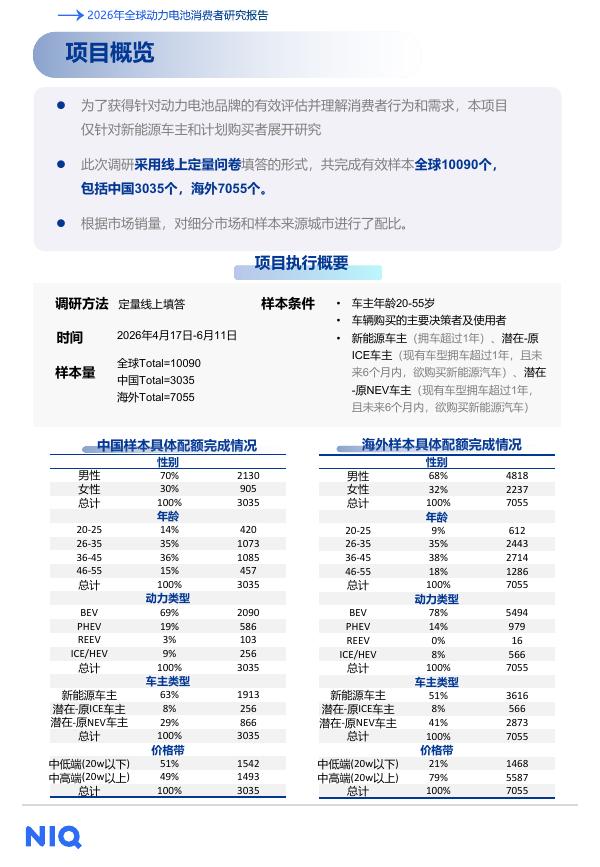
NIQ's 2026 Global NEV Consumer Research Report contributes a comparison of named battery suppliers across nine reporting markets and regional groups. It surveyed 10,090 NEV owners and prospective buyers aged 20–55 in 22 countries. NIQ publication and methodology.

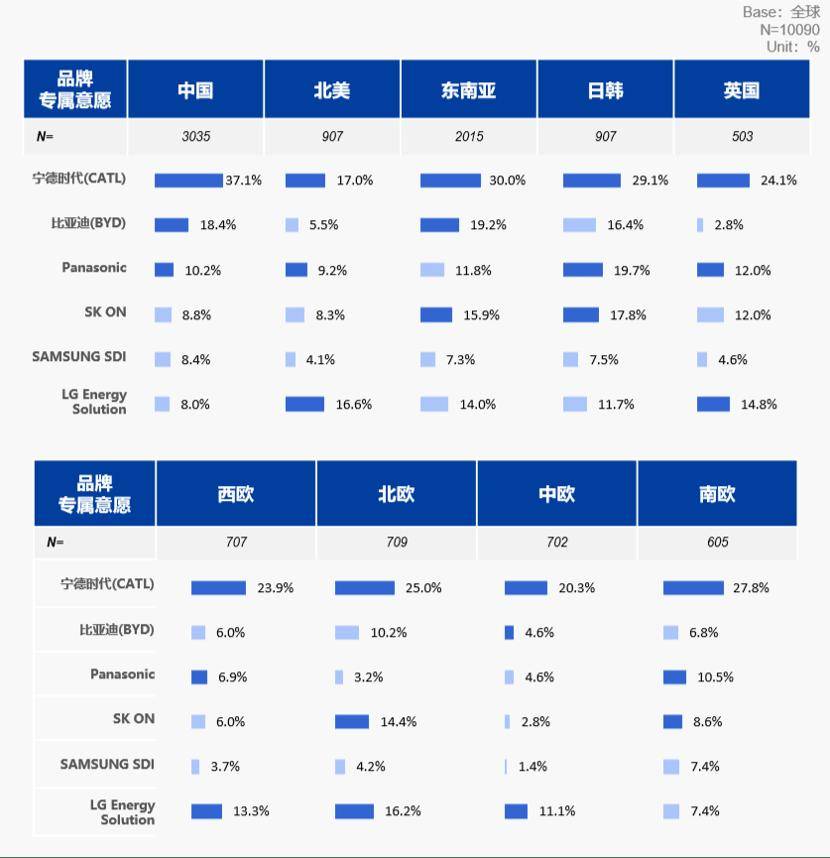
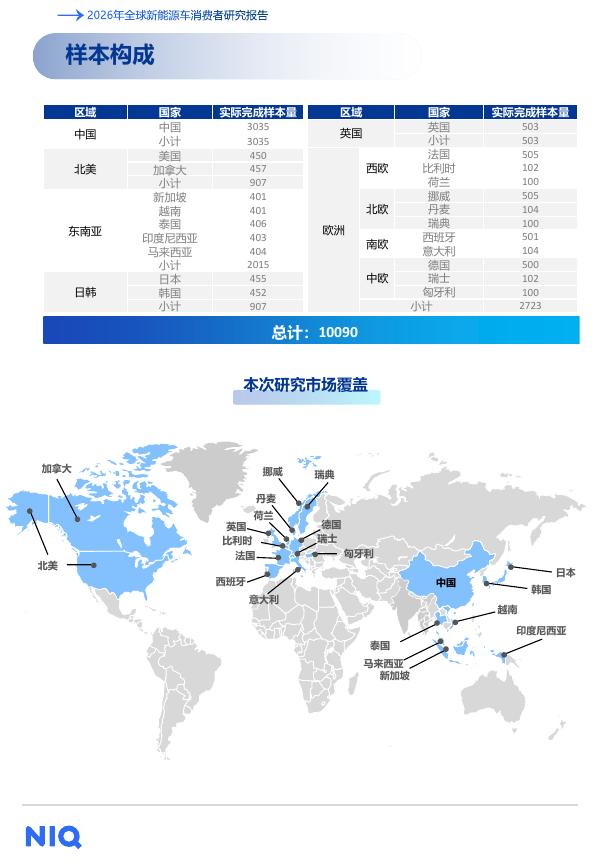
Original visualization of NIQ's complete table. These are reported intentions, not market shares or actual purchases. Regional groupings follow the report. North America combines 450 US and 457 Canadian respondents; Japan and South Korea are also combined. Sample composition.

NIQ reports 37.1% for CATL in China, compared with 18.4% for BYD and 8.0% for LG Energy Solution. In its North American results, CATL and LG Energy Solution recorded 17.0% and 16.6%, respectively.

The commercial value of the comparison is the question it raises for local sales and marketing: which supplier names help a vehicle gain consideration in the market where it will be sold? An automaker can use these findings to choose what to investigate with its own prospective customers.

McKinsey and NIQ examine related parts of this question. The former measures battery-brand trust among buying factors; the latter reports stated intentions associated with named suppliers. Their results can inform the same strategy.

European research asks what buyers want to know

A peer-reviewed study by Popowicz and colleagues examined battery-passport information using 211 valid responses, predominantly from Germany and Austria. Of those participants, 196 owned EVs. Published in 2025, the study used a survey launched in December 2022 and recruited through EV forums. Original study.

Expected lifetime and warranty received higher overall median scores than manufacturer and supplier information. Each respondent's score multiplied interest by importance, both rated from one to six. The resulting scores describe information priorities, not purchase probabilities.

Original visualization of three selected attributes from the study's 22; values come from Popowicz et al., Figure 4. This purposive sample is not representative of European buyers. The manufacturer/supplier attribute also includes production location and date. Scores cannot be compared numerically with the percentages in the China chart.

The finding offers a useful question for sales teams: what is the buyer trying to establish by asking about the battery?

A supplier's name may be part of the answer. The customer may also want to understand expected life, warranty coverage, or what happens if a problem develops. Research should distinguish these needs before a company decides that putting a larger supplier logo in its advertising will help.

For automakers, this raises a practical question: alongside identifying the supplier, how clearly do sales materials explain expected lifetime and warranty coverage? A vehicle-choice study could examine how these details work together when a buyer compares offers.

Measure the decision a brand is supposed to change

The next useful research step is a choice experiment: vary the disclosed supplier while holding the vehicle's other attributes constant, then separately introduce changes in price, warranty, or delivery time. That would test whether the name itself affects stated choice and what trade-offs buyers are willing to make.

Observed behavior would strengthen the evidence further. Shortlist selection, test-drive requests, deposits, and completed purchases should be measured separately.

For now, an automaker can make battery information easier to use: identify the supplier accurately, explain the relevant warranty, and make clear which configuration the information describes. A battery company can investigate which associations customers attach to its name and whether those associations survive a realistic vehicle comparison.

That is the commercial question worth pursuing: when the buyer reaches the order page, what does the battery brand actually change?


r/DrEVdev • • Sep 17 '26

Battery Tips Why Does Your Tesla Warm Its Battery Before Fast Charging?

3 Upvotes

r/DrEVdev • • Sep 17 '26

Battery Tips Your Tesla Shows Fewer Miles — Is the Battery Degrading?

1 Upvotes

r/DrEVdev • • Sep 15 '26

One reason legacy automakers may have a much harder time catching Tesla than people think

19 Upvotes

There’s a lot of discussion these days comparing Tesla with legacy automakers, especially because of autonomous driving.
Personally, I think it’s much harder for legacy automakers than people think. There are many reasons, but I want to talk about just one: internal politics.
This is something I’ve seen in different countries, so I don’t think it’s specific to Korean, American, European, or Chinese companies.
Traditionally, the engine and powertrain organizations were at the center of automakers. People who spent their careers there naturally ended up in many of the important technical and management positions.
But suddenly the engine is no longer the most important technology. Now it’s batteries, motors, electronics, software, computing, etc.
Technically, you can just change the organization and move people and resources to these new areas.
In reality, it’s not that simple.
If the engine organization becomes less important, some of the people who were previously at the center of the company have to lose authority, budget, headcount, or even their positions.
But how many people are going to say, “My area is not important anymore, so for the good of the company I’ll give up my position”?
Not many.
So you get friction between the old core organizations and the new ones. And this isn’t just people arguing in meetings. It affects roadmaps, technical decisions, development processes, budgets, hiring, headcount and who owns what.
Most of the time, the existing powerful organization wins.
One solution is to create a completely new organization. Volkswagen tried something like this with CARIAD.
But that doesn’t automatically solve the problem either. The new organization still has to work with the existing organizations, and the old power structure is still there.
You could say, “Then just change the CEO.”
That can help, but even if you bring in a CEO from outside, or someone from a previously less powerful organization, the existing organization doesn’t suddenly disappear. If the people below don’t cooperate, changing the company is still very difficult.
Of course, this isn’t unique to the auto industry. You can see the same thing in other industries, large organizations, and even governments.
But I think this gives Tesla a pretty big advantage.
Tesla never had a powerful engine organization that had to give up its position to software, batteries or electronics. It started without that legacy.
And with a CEO as dominant as Elon Musk, I also imagine it’s pretty difficult to play this kind of internal politics against a major technology direction decided from the top.
I’m not saying this is the only reason Tesla has an advantage, or that legacy automakers can’t catch up.
Just one reason why I think changing a legacy automaker may be much harder than it looks from the outside.


r/DrEVdev • • Sep 12 '26

Battery Research Why Tesla Warms the Battery Before Fast Charging

8 Upvotes
Figure 1. Thermal preparation and the initial charging response in selected LFP and NCM/NCA charging sessions. Time zero marks the start of DC charging.

In BMS engineering, we usually try to keep the battery at a moderate temperature, often around 25°C, to limit aging. Fast charging changes that trade-off. At high charging rates, raising the temperature can reduce lithium plating and help mitigate degradation.

The figure below shows how battery temperature and current change before and during six Tesla fast-charging sessions.

What the charging sessions show

Figure 1. Thermal preparation and the initial charging response in selected LFP and NCM/NCA charging sessions. Time zero marks the start of DC charging.

The red curve is the highest module temperature, the orange curve is signed C-rate, and the gray dashed curve is outdoor temperature. Positive C-rate means current entering the battery. Yellow shading marks the reported heating state, purple the reported preparation state, and blue the DC-charging phase. The red dotted line marks 2C on the right-hand axis; it is not a temperature target.

In L4, the highest module temperature rises from about 31.5°C to 41.5°C before charging begins. In N2, it rises from about 27°C to 35.5°C. The temperature increases overlap with reported heating periods. Because they occur before DC charging starts, they cannot be explained by losses from DC charging.

Once charging begins, current increases sharply. In several sessions, particularly N2 and N3, current then decreases while battery temperature continues to rise. Peak current and peak temperature occur at different times. The temperature reached later in a session should therefore not be treated as the temperature required before charging can start.

Why heating can mitigate degradation

At high charging rates, lithium transport and the reaction that inserts lithium into graphite can become limiting. Lithium can then deposit as metal on the anode instead of being stored in the graphite. This lithium plating can cause irreversible capacity loss.

Raising temperature improves transport and reaction rates, which can reduce plating risk. However, higher temperature also accelerates side reactions. The benefit depends on controlling both the temperature and the time spent at that temperature.

Yang et al. demonstrated this balance by combining elevated-temperature fast charging with a short period of thermal exposure. Their experiments showed that this approach could improve fast-charge cycle life while limiting degradation from prolonged heating [1]. The research explains the physical benefit; the six sessions here illustrate charging behavior rather than directly measuring lifetime degradation.

From cell science to vehicle control

Putting this into a production vehicle is not easy. The cell supplier and OEM need to agree on temperature limits and lifetime requirements, and the vehicle needs to coordinate heating, charging current, and cooling.

In a patent filed in 2012, Tesla described raising battery temperature before fast charging to mitigate degradation [2]. Tesla later announced navigation-triggered battery warming for Supercharging in March 2019 [3].

These charging sessions show why the period before plugging in matters. Battery temperature is already changing before the charger supplies current, and it continues to evolve as current rises and tapers. Understanding fast charging means looking at that whole sequence.

For the complete analysis, access the full technical report on Batter Machine. Brief registration is required.

References

[1] X.-G. Yang et al., “Asymmetric temperature modulation for extreme fast charging of lithium-ion batteries,” Joule, vol. 3, no. 12, pp. 3002–3019, 2019. doi:10.1016/j.joule.2019.09.021.

[2] C. Dangler, S. G. Stewart, and C. H. Kishiyama, “Fast charge mode for extended trip,” U.S. Patent 9,728,990 B2, filed Oct. 31, 2012; granted Aug. 8, 2017. Patent text.

[3] Tesla, “Introducing V3 Supercharging,” Mar. 6, 2019. Tesla announcement.


r/DrEVdev • • Sep 07 '26

Battery issues A Tesla Battery Pack Failure During a Drive: What Dr.EV Recorded

6 Upvotes

This case are published with the user’s authorization. Personal identifying information has been excluded.

A Dr.EV user in China experienced a high-voltage battery fault during a drive on September 1, 2026. The vehicle still displayed 32 km of remaining range, but the center screen warned the driver to pull over safely because the vehicle was shutting down.

The Dr.EV driving chart recorded a sudden change in cell-group voltage difference. Later inspection photos also showed substantial dents in the high-voltage battery enclosure at the rear lifting points.

These records show what happened before and after the warning. They do not prove which component inside the pack caused the electrical abnormality.

The warning seen by the driver

The recorded trip ran from 20:36 to 21:40. Near the end of the drive, the vehicle showed 32 km of range together with the shutdown warning.

The vehicle still displayed 32 km of range while warning the driver to pull over safely because it was shutting down.

Figure 1. The driver-facing warning. The complete alert code is not visible in the photograph.

Remaining range is a vehicle-level estimate. Battery protection also depends on the voltage reported by every series-connected cell group. A vehicle can therefore display remaining range while stopping operation because one reported group has reached a limiting condition.

The sudden change in the Dr.EV chart

The upper Dr.EV chart shows cell voltage in orange and C-rate in blue. The lower chart shows maximum cell-group voltage difference in orange and battery level in blue.

Dr.EV trip overview showing C-rate, cell voltage, battery level, and maximum cell-group voltage difference.

Figure 2. Dr.EV record from 20:36 to 21:40.

The important observation comes from comparing C-rate with voltage difference.

Part of the driveC-rate shown in the upper chartMaximum voltage difference
Above approximately 40% batteryMany strong negative C-rate events, some approaching the lower end of the chart near −7CMostly below approximately 0.1 V
Below approximately 40% batteryThe load is not consistently greater than it was earlierThe difference suddenly becomes large and unstable, with transient peaks approaching 1.0 V
Near 7.3% batteryNegative C-rate is still presentApproximately 0.548–0.568 V

This means high C-rate alone does not explain the large voltage difference. Earlier in the drive, the chart shows equal or stronger negative C-rate events without a large separation among the reported cell-group voltages.

At around 40% displayed battery level, the behavior changes. After that point, driving load appears to expose or amplify an abnormal condition. The maximum difference later approaches 1.0 V. The 0.548–0.568 V values shown below are the readings near the end of the trip, not the maximum value reached during the complete drive.

Near 21:39, Dr.EV displayed cell-group voltages of approximately 2.502–3.068 V and a voltage difference of approximately 0.568 V.

Figure 3. Near 21:39, the displayed battery level was approximately 7.6%–7.7%. Near 21:40, it was approximately 7.3%, with a reported cell-group range of 2.526–3.074 V and a difference of 0.548 V.

Physical deformation of the battery pack

Photos taken after removal of the high-voltage battery show large inward dents in the pack enclosure. The service record identifies the locations as both rear support or lifting points and lists the damage type as denting.

Two inward dents visible along the battery-pack enclosure near a rear lifting area.

Figure 4. Two visibly deformed areas on the pack enclosure.

A substantial inward dent visible at the other rear lifting or support area of the battery pack.

Figure 5. Deformation at another rear support area.

These are physical deformations, not only surface scratches. The photographs do not show how the dents occurred, so they should not be presented as proof of improper lifting or a particular accident.

The deformation could possibly have affected a component near the damaged area, including:

  • A voltage-sensing wire or connector
  • A busbar, weld, fuse, or other electrical connection
  • A cell group or module
  • A cooling component or module support structure

The photographs do not show the inside of the affected locations. They therefore cannot establish whether any of these components was actually damaged.

What the service record says

The service record describes the customer’s complaint as a high-voltage battery fault. It also records dents at both rear lifting points.

Cropped Tesla service record showing the high-voltage battery inspection and replacement options.

Figure 6. Publication crop of the service record. The service-order number and unrelated billing information are excluded.

The visible inspection results include:

  • High-voltage battery exterior: recorded as normal
  • Recorded damage location: both rear support or lifting points
  • Recorded damage type: dents
  • High-voltage battery airtightness test: passed
  • One-minute pressure difference: 0.002 PSI
  • Battery SOC during service: 19%
  • Insulation resistance: 10,072 kΩ
  • Signs of water exposure on the battery surface: marked “No,” although the following description appears to mention water staining in the center area
  • Liquid inside the high-voltage battery: no, approximately 0 litres
  • Selected service option: D

Option D calls for replacement with a factory-repaired or refurbished high-voltage battery, with the old battery recovered by Tesla.

Passing the airtightness test and finding no internal liquid indicate that the enclosure was not obviously punctured or leaking. The high insulation-resistance value also does not show a major electrical leak from the high-voltage system to the enclosure.

Those checks do not establish that everything inside the pack was mechanically or electrically undamaged. An enclosure can remain sealed while a sensing connection, internal conductor, module mounting point, or cell group has been affected.

The form also appears to classify the battery exterior as normal while separately recording dents at both rear lifting points. The photographs provide direct evidence of deformation, but the reason for this wording in the form is not available.

Possible explanations

The combined records allow several possibilities to be discussed without selecting one as the cause.

Physical deformation may have placed pressure on an internal connection, sensing circuit, module, or cell group. This could possibly create an abnormal voltage reading or a real voltage drop under load.

A voltage-sensing connection could also have become unstable independently of the dents. A loose sensing wire, connector, or shared voltage tap can produce a sudden change in the reported voltage difference and cause the BMS to respond protectively.

An internal current-carrying connection could have developed high resistance. In that situation, the reported voltage difference would grow when current increased and might recover when the load was removed.

A weak cell group remains another possibility. A group with reduced capacity or increased resistance may remain close to the others at higher battery levels and separate rapidly when it reaches its lower-voltage region.

What Dr.EV adds to this case

Without the driving chart, the available evidence would show physical pack damage, a vehicle warning, and a replacement decision. Dr.EV adds the behavior leading up to the warning:

  • Strong C-rate events occurred earlier without a large voltage difference.
  • The voltage-difference behavior changed suddenly near 40% battery level.
  • After that point, the difference became sensitive to driving load.
  • Transient maximum difference approached 1.0 V.
  • The difference was still approximately 0.55–0.57 V near the shutdown event.
  • The vehicle still displayed non-zero battery level and 32 km of remaining range.

r/DrEVdev • • Aug 30 '26

Battery Tips How to Know If Your Tesla Is Balancing Its Battery

Post image
12 Upvotes

The sawtooth is cell balancing. The car has found some cells holding more charge than the rest and is bringing them back in line with the others. It is not damage, and it is not a fault in the charger.

Many drivers believe the Supercharger balances the cells, since it is the most powerful charger the car ever sees. The truth is the opposite. Balancing is very slow and needs many hours to finish, and a Supercharger session ends after about half an hour, long before the work is done. A car that only ever fast charges starts balancing at the end of every session and never gets to finish, so the sawtooth comes back larger in every charging graph. Slow charging at home is what gives the car the hours it needs.

So if your charging graph shows the sawtooth, charge at home or on any slow AC charger, let the charge run all the way to your set limit, and then leave the car plugged in for several hours more. Overnight is the easiest way to do all three at once. Do this regularly, not once: a single slow charge removes only part of a large imbalance, and it is the habit that keeps the cells together. Fast charging on the road stops mattering once the pack gets its slow hours at home.


r/DrEVdev • • Aug 25 '26

Battery Research A Case of Tesla Battery Failure During Parking

6 Upvotes

Battery faults usually appear while the battery is working hard: during fast charging, hard acceleration, or hard braking. This one appeared while the car was parked. Among the recent failure cases we have analyzed, it is the first that started this way.

To be clear from the start: battery failures that begin while a car is parked are very rare, and nothing in this case overheated. The pack stayed at 30.5 °C before, during, and after the event. On the evidence below, the cells themselves look healthy. The problem appears to be in a connection or sensing path inside the pack, not in the cells.

What happened

The vehicle is a 2020 Model 3 Long Range with about 125,000 km and roughly 400 full charge cycles. It had been parked for almost seven hours, unplugged, with a discharge current of about 0.5 A, as the figure below shows. Then the two cell group voltages that the car reports, the highest group and the lowest group, suddenly separated. The lowest reading dropped by 216 mV and the highest reading rose by 120 mV at the same time. The difference between the two readings jumped from 4 mV, where it had stayed for the previous ten months, to 340 mV, and it has remained that wide ever since.

Throughout this period the car was in Park, the speed was zero, the odometer did not move, the charge port was disconnected, and the temperature was constant.

Why this does not look like a cell problem

When a cell group loses charge, its voltage falls. No other group's voltage rises in response. Here, one reading rose at the same moment the other fell. Charge also cannot move from one group to another: the groups are connected in series, so the same current flows through all of them.

The size of the drop does not fit a real discharge either. A 216 mV drop corresponds to losing about 20% of the group's charge. To lose that much charge in under twenty minutes, a current of about 110 A would have to flow. The figure above shows the actual current: about 0.5 A. And if that charge had instead been consumed inside the pack through an internal short, its energy would have been released as heat, roughly 400 W concentrated in one spot for eighteen minutes. The module temperature never moved from 30.5 °C.

There was also no warning. A cell group with a real internal problem degrades over weeks or months, so the voltage difference would have widened gradually before the failure. It did not. The difference stayed flat for ten months and then jumped in a single sample.

What it looks like instead

Each cell group's voltage is measured between two sensing points, and two neighbouring groups share the point between them. That shared point is added to one group's measurement and subtracted from its neighbour's. So if the voltage at that one point is wrong, one group reads too high and its neighbour reads too low, which is exactly the pattern seen here, from a single cause.

For this reason, the most likely explanation is that a connection or sensing path between two adjacent groups has partially broken, rather than that a cell has failed. One caveat: in a pack where single cells are connected in series, instead of parallel groups, a genuine cell failure can produce a similar pattern.

After this event, the owner reported a BMS_a079 alert during charging. The exact cause can only be confirmed by opening the pack, but the data points away from the cells and toward the connections around them.


r/DrEVdev • • Aug 25 '26

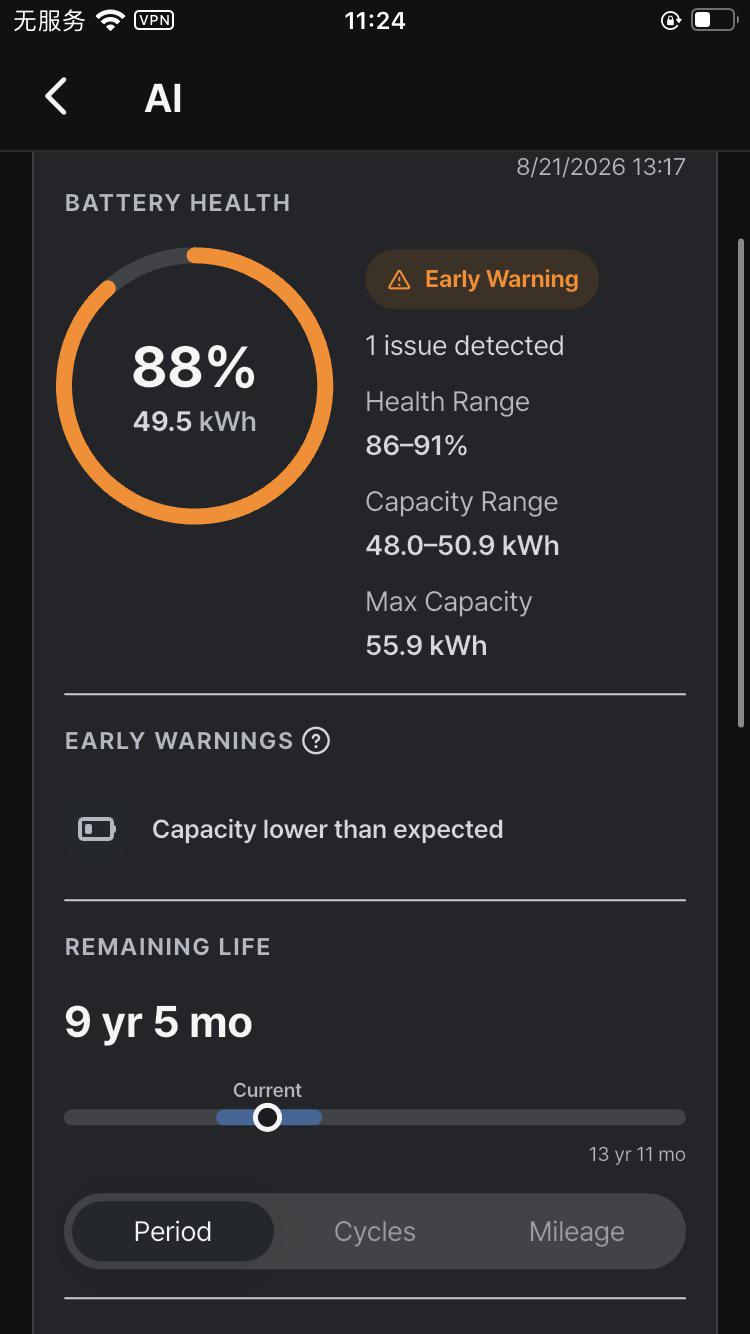
Battery Health Test Model 3 Standard max capacity drops from 55.9 to 49.5 in six years

Post image
7 Upvotes

2020 Model3, the max capacity drops from 55.9 kWh to 49.5kwh