r/DrugCounselors • • Sep 10 '26

Mod Re-Welcome and Re-Ground-Rules

9 Upvotes

Welcome to r/DrugCounselors ! If you are not a drug counselor or equivalent, see r/AskADrugCounselor . This is a place for anyone who fits the broad category of a counselor (state licensed or not) and who works with clients or patients who have substance use disorders. (We consider alcohol a "drug," and recovery coaches, sponsors, and peer support specialists as counselors.)

This sticky post has been updated today. Here are some of our rules:

  • This is for substance use counselors ("Drug Counselors"), all those licensed to help those with substance use disorders (SUDs) and for those considering the career field, etc. This is for mutual support for professionals.
  • Protect HIPAA and Anonymity.
  • Be civil and constructive.
  • No drug sales or illicit sourcing.
  • No soapboxing / ax grinding on legalization.
  • Stay on topic.
  • No AI Content.
  • Support the Community.

r/DrugCounselors • • 2h ago

Work Are most sessions going to repetitive to clients? Plus how do you find good content for groups?

1 Upvotes

I'm having an issue where some topics my clients have already seen or talked about for group sessions.

It seems like a lot of what I can go over is a little repetitive. Like we can discuss coping skills, how to process emotions, thinking patterns, what gives their life purpose, etc etc.

For example I brought up thinking distortions and a client said they already knew those. Felt in part a little wasted.

Plus how do you find good content for groups? I've got 9 hours of group per week. I'm having difficulty finding stuff to the point that I am looking while outside of work because I don't want to show up empty handed.


r/DrugCounselors • • 20h ago

Resources Grief, trauma, and SUD CEU's

Thumbnail
reddit.com
2 Upvotes

r/DrugCounselors • • 2d ago

Work Thoughts on praising clients

6 Upvotes

Okay, I’ve been thinking about this a bit, and I was reminded of it when I saw a post about praising clients in the r/therapists community. I’m a newer therapist, and I feel like, with this population, it’s extremely beneficial to praise clients for the small steps they take in their recovery journey. I’m curious whether others feel this is an acceptable approach. I also co-facilitate IOP/GOP groups, and every time clients move down or graduate, I let them know how proud I am. I’m open to any thoughts or feedback on this topic.


r/DrugCounselors • • 3d ago

LCDC-I I have been doing this job for 4 months and 90 percent of it is convincing/harassing clients to do counseling, is this just what it is?

11 Upvotes

Title pretty much describes it. Since i am so new to this field, I have no idea if this is the norm or if its just the company I work for. I truly appreciate my clients that show up to session, talk with him, seem engaged, and all of that. But like I said, 90 percent of my job is cold calling / calling clients multiple times to get them to complete their sessions. And they don't care, they don't want counseling. They want to not experience withdrawals, they aren't ready to do counseling/therapy yet so they use the clinic to dose and go, which is fine. They are in whatever stage of change they are in. But my hands are tied. Our care plans say "prescribed minutes" but our Dr's and us as counselors arent actually prescribing minutes, we assign amounts based on insurance and theres no room for adjustment. Even if my clients get left behind by their rides home (which is a 2 hour drive sometimes), is homeless and has no way to charge their phone, is in their 70s and isn't interested in counseling, hasn't used for 10 years...nothing matters. All that matters is I call and call and call. Its so frustrating and I am so curious if this is what it likes for all programs/clinics? Because I don't feel like my job is to be a nuisance. Its to be a supporter. But all this job is letting me do is feel lile burden.


r/DrugCounselors • • 3d ago

Resources IC&RC exam in 5 days

4 Upvotes

Hey guys I'm 5 days out from testing for the IC&RC AADC exam. I looked at a post here from 8 months ago, but there were changes to the exam since then. AI is saying that the core functions aren't specifically relevant anymore and rather the sub-domain/blueprints are tested on the exam.

What I've done so far: Made a quizlet referencing Trivium's Addiction Counselor study guide and did both tests from the book and scored an 86% on the last one on Monday, did all of open-exam-prep's questions and missed around 5 +/- 5 out of 130, and made flashcards out of all of the one's missed. Watched Lebelle counseling videos and all of his core functions (uncertain about relevance) and open-exam-prep's youtube test and I was hung up on maybe 2 or 3 acronyms. I looked at the blueprints and had AI make 2 questions out of each sub-domain. These questions were not specific in nature, but seemed helpful for potential scenarios.

I also took the NCE recently and passed, and am using flashcards I made from the counselor purple book. So 6 stacks of flashcards total.

I am just reaching out and asking for any and all advice on what I should focus on what more I should do. Idk if I can know every substance abuse assessment available and if I should know every type of opiate, etc. Any and all help would be appreciated. Thank you!


r/DrugCounselors • • 4d ago

Resources 2027 HIPAA Privacy Rule Final Rule: What SUD and Mental Health Facilities Need to Do, and When

Post image
1 Upvotes

2027 HIPAA Privacy Rule Final Rule: What Mental Health and SUD Facilities Need to Do, and When

By A Ant, CADC-II, Licensing & Accreditation Expert

Does your mental health or substance use disorder program have to change anything because of the new HIPAA Privacy Rule? Yes, a few things. The first change is the new 15-day deadline to answer records requests, and it applies from July 19, 2027. Below is what each type of operator needs and when.

HHS announced the final rule on November 16, 2026, and the Federal Register published it on November 19, 2026 (91 FR 74848). The rule says it takes effect January 19, 2027, and that covered programs must comply by July 19, 2027. The rule is “HIPAA Privacy Rule: Changes to Support Coordinated Care and Individual Engagement and Reduce Regulatory Burdens,” 45 CFR Parts 160 and 164, document 2026-23429, and you can read the full text here: official Federal Register page. HHS also posted a plain summary: HHS fact sheet on the final rule.

Does This Rule Apply to You?

Only if you are a HIPAA covered entity or a business associate. HHS says a provider is covered when it sends information electronically for a transaction HHS has adopted a standard for, such as electronic claims. A program that never does that is not covered by this rule. Most programs that bill insurance electronically are. If you are not sure which side you are on, settle that first, because everything else depends on it.

The Timeline for Both Types of Operator

DateWhat happensStatus
Feb 16, 2026Part 2 compliance date under the 2024 Part 2 final ruleAlready passed
Nov 19, 2026Rule published in the Federal Register (91 FR 74848)Published
Jan 19, 2027Rule takes effectConfirmed in the published rule
Jul 19, 2027Compliance date (180 days after the effective date)Confirmed in the published rule
Jan 19, 2028Outer limit for older business associate agreements that were never renewed (1 year after the effective date)Scheduled

What Every Covered Program Needs by July 19, 2027

A 15-day records clock. You must act on a patient’s request for their records as soon as practicable and no later than 15 calendar days after you receive it. That is down from 30. You get one extension of up to 30 days, and inside the first 15 days you must tell the patient in writing why you need it and the date by which you will provide access. Time spent confirming who the requester is counts against the clock. HHS says in the rule that the smallest entities will feel the shorter deadline most directly, and we found no separate deadline for them, so plan on a one-person records office having the same 15 days as a hospital. Where a state law sets a shorter deadline, HHS’s right of access guidance says the shorter one controls.

Fees. You may charge only for labor to copy, supplies for paper or media copies, postage, and a summary the patient agreed to. In-person inspection is free. So is access through a patient portal or an app. If you charge for copies at all, you must post a fee schedule on your website if you have one, make it available where care is delivered, and give it on request.

Requests and identity checks. Under 45 CFR 164.524(b)(1), you can require written requests if you tell patients you do. The rule treats measures that make access harder when an easier one would work as unreasonable. HHS’s preamble gives notarization, a wet signature where an electronic one is valid, and demanding in-person ID when remote verification is practicable as examples.

Your Notice of Privacy Practices. The rule adds a right to discuss the notice with a designated person or office, and the notice has to give that contact’s email address. The signed acknowledgment of receipt is eliminated. HHS says it will update its model notices and the model Part 2 Patient Notice before the compliance date, so wait for those before you rewrite anything.

Vendor agreements. Under 45 CFR 164.532(e), a written business associate agreement that met the rules before publication, and is not renewed or changed between the effective date and the compliance date, is treated as compliant until the earlier of its first renewal or change after July 19, 2027 or January 19, 2028. Verbal arrangements do not qualify. An old agreement does not change your own 15 days, so ask your records vendor now how it will meet them.

SUD Treatment Facilities: What You Need and When

SUD programs carry two rule sets, HIPAA and 42 CFR Part 2, and this final rule changes only one of them.

CFR Part 2 is unchanged. A federally assisted program that provides SUD diagnosis, treatment or referral still needs patient consent for treatment, payment and health care operations, per HHS’s Part 2 page. One consent can cover all future uses for those purposes. Once a covered entity receives a record under that consent it can redisclose as HIPAA allows, except in legal proceedings against the patient. Compliance with the 2024 Part 2 rule was required on February 16, 2026, and anyone can file a Part 2 complaint with OCR since that date. If your consent form or notice is not updated, that is a current problem, not a 2027 one.

The new care coordination permission does not replace Part 2 consent. The rule text says it does not remove the obligation of Part 2 programs to get patient consent for treatment, payment and health care operations. A Part 2 program that sends a client’s information to a community organization because the HIPAA permission exists, without the Part 2 consent, is the mistake to avoid here. In the programs we work with, information goes to a hospital or another provider only after the client has signed a release of information. Staff check the signature on the release against the signatures on file in the client’s EMR. Part 2 consent is always respected. We have received ROIs where the signatures clearly didn’t match, and we reached out to the client and they denied ever asking for their records. We never sent the records and informed the requester that the request was denied, with no stated reason. HIPAA still applied to the client, and giving a reason would have violated their HIPAA rights by confirming they were a client. So great caution must be exercised here to ensure you are not inadvertently violating the HIPAA rights of your clients. Signature checks are what we do internally to verify identity. We also call the client and verify the request, and we can telehealth with the client as well to verify the request is coming from them. The new rule also bars checks that make access harder when an easier one would work. In our view, these are easier ones, because they put the onus on us and not the client.

Family and caregiver permissions do not override Part 2. The Privacy Rule’s family disclosure permissions do not negate Part 2’s consent requirement. The bona fide medical emergency exception still applies, with the disclosure documented in writing afterward under 42 CFR 2.51, and where both rule sets apply, the conditions of both have to be met.

Now through January 2027. Build the same single request log described above, and add a check for whether the record is a Part 2 record before anything goes out. Your intake staff should be able to say, for any chart, whether Part 2 applies.

By the compliance date. Your Notice of Privacy Practices already had to carry Part 2 information as of February 16, 2026. A Part 2 program that is also a covered entity may use a combined notice. Add the designated contact when HHS releases its updated model notices, not before. If your program is a Part 2 program and a covered entity, both clocks run: Part 2 consent rules and the 15-day access clock.

Mental Health Facilities: What You Need and When

Outpatient clinics, residential programs, psychiatric hospitals and group practices share the same dates. What changes for you is where behavioral health rules and the new rule meet.

Now through January 2027. Find out how a records request reaches your program today. In many clinics it lands in two places: the front desk and the clinician or counselor’s inbox. The request is reviewed and either approved or more information is requested. The 15 days start when the request is received, not when the reviewer gets to it. Pick one log. Decide who owns it and who covers when the reviewer is out, and write both names into your policies. What Policies Do Behavioral Health Clinics Need to Operate? shows where records and HIPAA procedures sit in a policy manual. Fifteen days sounds long until a request sits on a reviewer’s desk over a holiday.

By the compliance date. Know what you can withhold. Under 45 CFR 164.524, psychotherapy notes are excluded from the right of access. A denial based on harm has to rest on a licensed health care professional’s judgment that access is reasonably likely to endanger the life or physical safety of the patient or someone else. When a personal representative is the one asking, substantial harm to the patient or someone else is also a ground. Either way, a different licensed professional reviews the denial when the patient asks. A general worry that the chart will upset the patient is not enough. If your denial language is a standard sentence in the file, it needs work.

Family and caregiver disclosures do not change. HHS proposed replacing “professional judgment” with a “good faith” standard and replacing “serious and imminent” threat with “serious and reasonably foreseeable.” It did not finalize either. HHS says it will do outreach and technical assistance on the existing permissions to share with family, friends and caregivers, and it points to its mental health information sharing guidance. It also left the definition of incapacity alone, and stated that a diagnosis of serious mental illness, by itself, does not determine whether someone can make their own decisions. If your staff are waiting for permission to share more with families, this rule did not grant it.

The new care coordination permission. Under 45 CFR 164.506(c)(6), you may now disclose information without authorization to social service agencies, community-based organizations and home and community-based services providers for individual-level care coordination or case management that counts as treatment or health care operations. The minimum necessary standard still applies where it applies. HHS declined to require consent, authorization, an extra written agreement with the outside organization, or advance notice beyond what your privacy notice already requires, and it expects these disclosures to stay consistent with that notice. It also did not finalize an exception to minimum necessary. State laws that are more stringent than HIPAA still apply, and state mental health records laws are often where the stricter limits sit. Write down who gets what before the first request arrives.

Your state license sets its own records rules on top of this.

Mental Health and SUD Side by Side

QuestionMental health programSUD program (Part 2)
15-day records clockYes, from Jul 19, 2027Yes, if a covered entity, from Jul 19, 2027
Care coordination with community groupsPermitted without authorization, minimum necessary appliesHIPAA permission exists, but Part 2 consent is still required
Family and caregiver sharingProfessional judgment and serious and imminent threat stayPart 2 consent rules still control
Records denialLicensed professional determination, no psychotherapy notes accessSame HIPAA rule, plus Part 2 limits on use in legal proceedings
Privacy noticeNew contact, wait for HHS modelPart 2 content already due Feb 16, 2026, wait for HHS model

What We Would Start First

This part is our judgment, not the rule’s text. Start with the records request log and a named owner, because it is the one change that cannot be bought off the shelf. Then ask your records and EHR vendors in writing how they will meet 15 days. Then decide who in your program may use the new care coordination permission and for whom.

Frequently Asked Questions

When does the new HIPAA Privacy Rule take effect for mental health and SUD programs?

The rule was published in the Federal Register on November 19, 2026. It takes effect on January 19, 2027, and covered programs must comply by July 19, 2027.

How fast do we have to answer a patient records request?

As soon as practicable and no later than 15 calendar days after receipt, starting July 19, 2027. You may take one extension of up to 30 days if you tell the patient in writing, within the first 15 days, why you need it and the date by which you will provide access. A shorter state deadline controls.

Does the new care coordination permission let a SUD program skip Part 2 consent?

No. The rule states that the permission does not remove the obligation of Part 2 programs to obtain patient consent for treatment, payment and health care operations. Part 2 was not changed by this rule.

Can family members now get more information about a patient with a mental illness?

Not under this rule. HHS did not finalize the proposed good faith standard or the serious and reasonably foreseeable threat standard. Professional judgment and the serious and imminent threat standard remain, and more stringent state laws still apply.


r/DrugCounselors • • 5d ago

Work Any advice or general things to know for getting into recovery as a career??

Thumbnail reddit.com
1 Upvotes

r/DrugCounselors • • 8d ago

Community Professional addiction recovery grifters

Thumbnail reddit.com
7 Upvotes

r/DrugCounselors • • 11d ago

Resources ADC IC&RC study guide needed urgent

4 Upvotes

I purchased the main one off of counselor magazine but it is not working. I can’t play it. My test is in 4 days please help me. Not that it matters but I am in LA if anyone has physical study materials.


r/DrugCounselors • • 11d ago

Work CA AOD registration

3 Upvotes

I'm a new hire with Pinnacle Treatment Centers in Redding, CA, onboarding for a Drug Counselor position. One of the requirements is AOD registration, which comes with a separate $100 registration fee.

I was provided a discount code for the 10-hour Ethics course, but I'm wondering whether Pinnacle typically covers or reimburses the $100 registration fee, or if employees are expected to pay it out of pocket.

$100 is a significant expense for me, so I'd like to understand my options before paying.

Has anyone gone through this process with Pinnacle or obtained their AOD registration in California? I'd appreciate any insight, particularly from current or former employees.

Thanks!


r/DrugCounselors • • 11d ago

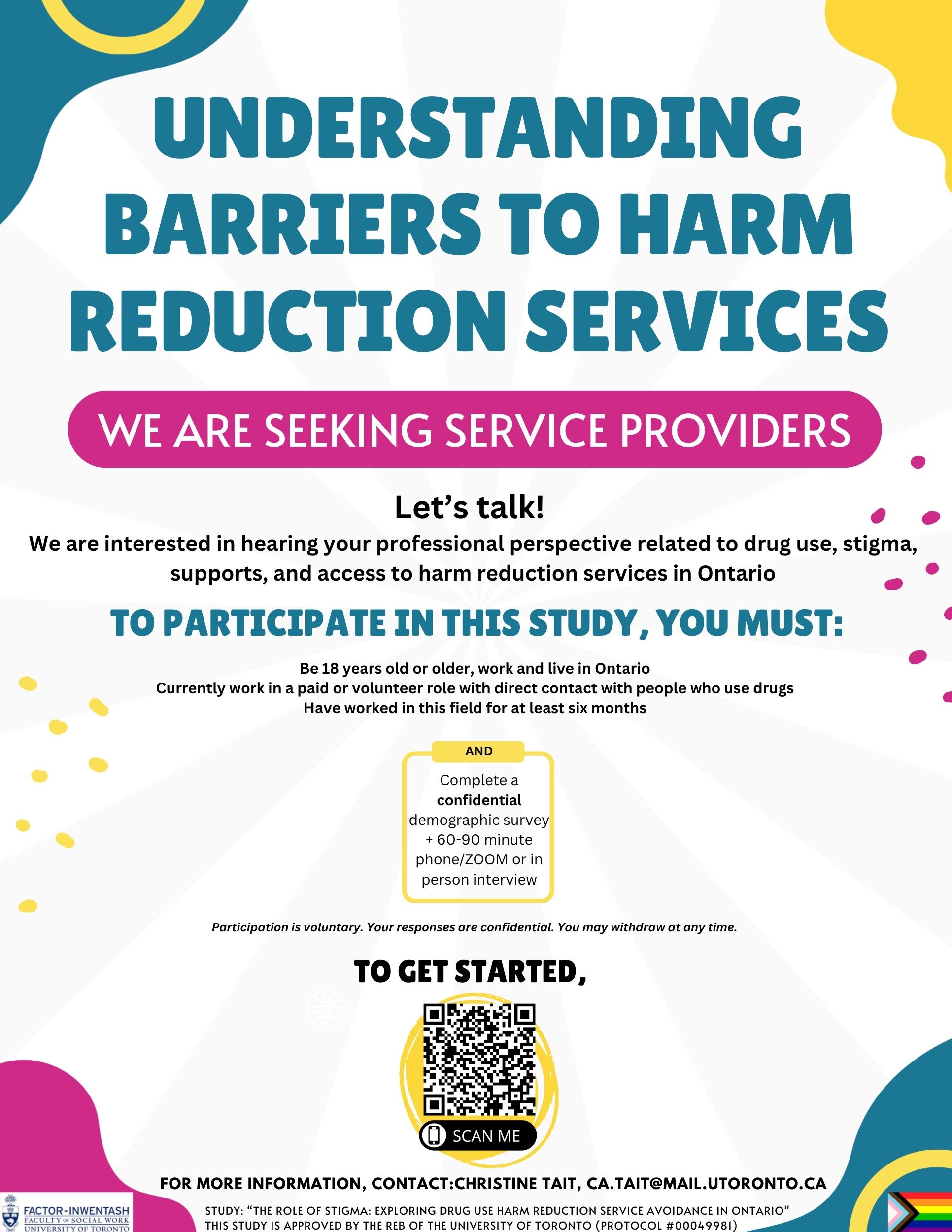
Work Research study seeking Ontario professionals who work directly with people who use drugs

Post image
1 Upvotes

Hi everyone, I am a PhD student at the University of Toronto conducting a research study to explore the barriers to harm reduction service use in Ontario.

I am seeking service providers: adults 18+ living in Ontario who currently work in a paid or volunteer role involving direct contact with people who use drugs, and who have worked in this field for at least six months. This includes anyone across health, social, and community services.

This study seeks to learn about your professional perspective on stigma, supports, and the barriers people face in accessing harm reduction services.

Participation in this study is voluntary. It will involve a demographic survey completion and a 60–90-minute confidential interview (Zoom, phone, or in person - your choice!). A $20 gift card will be provided for your time.

Your organization will not be identified in any part of this study, and your employer will not be informed of your participation.

If you or someone you know would be interested in participating, please share! Your observations and perspectives can work to improve harm reduction services in Ontario.

You can learn more about this study and check your eligibility at this link: Survey Link


r/DrugCounselors • • 12d ago

Work LCAS. My client passed while giving CPR.

8 Upvotes

My family owns the facility I work at, I was living across the street when this happened. A house manager sprinted to my house freakinggggg out, just told me to follow him. I get to the apartment and the client is unresponsive, he is on the couch and it honestly looked like he was really comfy, I couldn’t think of a better way honestly. Anyways, I roll him off the couch and start CPR, sternum rubs (I know contraversisl) and giving narcan. While giving CPR he aspirated.. that smell sticks with me, it goes where I go. They just turned the apartments into offices so we are closer to PHP & SACOT classes and the clients can come if they need help. They put me where he passed. Fun fact about me, I suffer from OCD and one of my main themes is death, how I can control it, ways to prevent it, ways to keep my daughter alive forever. I know its not rational and I have gotten very, very good at cognitively restructuring my thoughts, and not letting the thoughts consume me, even though sometimes the feelings feel real, but I know that it’s not. Anyways, I think this room is triggering my OCD, I also am in recovery from substance use disorder, I feel very strong in my recovery. Don’t get me wrong but I feel like just being in here poetic Jeopardy and I don’t like it and I said something but nothing‘s happened and it’s my own family that’s not listening. I just wanted to share.


r/DrugCounselors • • 12d ago

Work Should I tap out of the field altogether after what happened?

3 Upvotes

Years ago I experienced a really awful traumatic event and I tried to heal myself by becoming an addictions counselor and throwing myself into trying to help others overcome their trauma and underlying triggers.

The woo woo inpatient tx center where I worked was very new agey and definitely catered to high earning clients. I swallowed the mission of the program hook line and sinker even tho there were glaring red flags. Staff was on call 24 hrs a day, we were constantly having to be berated by spoiled entitled brat clients. Then they practically doubled my workload and I only got a one dollar an hr raise. I was gaslighted for bringing my concerns to management and the place had cult like quality to it. I worked in operations and the environment started to mess with my mental health.

I unraveled and I ended up having a panic attack in front of the clients and I had to leave them alone at the facility and I just left. I had to.

Well, this was years ago. I’m now working my own recovery program and I long for the hustle and bustle of working in residential substance abuse treatment. There was opportunity to be creative, reach out and touch lives and get to know some really amazing people. I feel like I’ve grown and have better boundaries and better judgement now.

Is having a freak out in front of clients a deal breaker for future employment in the field? I’m not perfect but I always do my best


r/DrugCounselors • • 13d ago

Community How do you all celebrate a recovery milestone, do you worry about it creating pressure on the person?

Thumbnail reddit.com
1 Upvotes

r/DrugCounselors • • 14d ago

Work From Addict to a 14 Year Sober Addiction Counsellor

Thumbnail
youtu.be
6 Upvotes

r/DrugCounselors • • 15d ago

Work How to start getting supervision hours?

3 Upvotes

I completed my courses and think I will be going for the CADC, how do I apply to a rehab without being certified, and to have my hours signed off so I can become certified?

I see a lot of positions open but they all require that the applicant already be certified. How do I even get started? Do I apply and explain my situation? Do I email instead asking if they can sign off on the hours?

Like I literally have no idea where to start and who to go to. Do I need to be an RADT first? What’s the process?

All of my work experience is behavioral health and several of the clients I worked with were dual diagnosis, and practically all of them had used at some point in their life. So I do have experience with people who struggled with addiction but the facilities I worked at were primarily behavioral health so it doesn’t count and I can’t get my hours through them.

I just feel like I have no guidance at all and would like to figure out what my next steps should be.

Edit: I am in California.


r/DrugCounselors • • 16d ago

Resources LCDC Practicum sites?

Thumbnail reddit.com
2 Upvotes

r/DrugCounselors • • 16d ago

Resources How the care of consumers with Alcohol and Other Drug issues is experienced by Nurses and how they make meaning of their experiences.

2 Upvotes

Peer-reviewed, published qualitative research.

Edited to add brief summary.

I’m an Australian RN, AOD and MH clinician with lived experience and emerging academic researcher. I’m passionate about reducing stigma and discrimination and improving services for those with AOD/MH issues / experiencing challenges.

I want to share with you some research that I conducted on an important area which is often overlooked - the experiences of Nurses’ providing care to consumers with alcohol and other drug (AOD) issues.

A quick summary - TL;DR:

I reviewed 24 qualitative studies from 12 countries exploring nurses’ experiences of providing care to consumers with alcohol and other drug (AOD) issues across a range of healthcare settings.

Seven interconnected themes emerged, highlighting the emotional, ethical, relational and organisational complexities of providing this care, including stigma, challenges with pain management, limited support, education and training needs, and how nurses interpret and make meaning of their experiences.

An important finding was how stigma, language, attitudes and previous experiences can influence nurses’ perceptions, interpretations, interactions and clinical decision-making.

The research also highlights how workplace cultures, organisational structures, systems and processes can influence nurses’ experiences and the care they provide.

A snippet from the paper demonstrating unacceptable practice:
“These safety concerns extended beyond exposure to aggression and unpredictability to fears relating to clinical risk. Nurses even reported administering injections of distilled water rather than prescribed medications to calm consumers, due to fears about potential drug interactions and overdoses.”

It’s clear to see how important it is to understand nurses’ experiences, including the factors influencing their attitudes and behaviours, if we want to address issues such as this and improve care for consumers.

The cumulative and influencing factors are evident in how the themes interconnected - for example, of the 22 studies with the theme ‘The Spectrum of Stigma’, it co-occurred with ‘Ethical Issues in Professional Practice’ in 20 studies.

Links to open access of the published research:

Link to online pre-print:
https://doi.org/10.1111/jocn.70527

Link to online PDF:
https://onlinelibrary.wiley.com/doi/epdf/10.1111/jocn.70527

**

Full Summary:

As you all know, consumers with AOD issues have complex needs. They often have intersecting physical and mental health conditions, history of trauma, and multiple health and social needs. They interact with healthcare services in many different ways and require diverse treatment and support across multiple areas. Among all of these areas are nurses, who play a critical role in healthcare.

Previously, research has largely focused on nurses providing care to consumers with AOD issues within specific services and settings (such as emergency departments and dedicated drug and alcohol services), or explored particular aspects of care (such as nurses’ experiences of managing alcohol withdrawal).

However, consumers with AOD issues require care across all areas and what has been missing is a broader understanding of nurses’ experiences across the diverse services, settings and contexts where they provide this care.

I conducted a qualitative scoping review to explore: What are nurses' experiences of providing care to consumers with alcohol and other drug issues, and how do they construct meaning from these experiences?

Across 12 countries, 24 studies explored nurses’ experiences in a diversity of settings, including EDs, ICUs, inpatient, outpatient and community services, medical, surgical, maternity, specialised and dedicated units.

7 themes were identified including - Emotional Aspects of Care; Ethical Issues in Professional Practice; Navigating Pain Management; Limited Support; Education, Training and Skills in Practice; The Spectrum of Stigma; and How Meaning is Constructed in Practice.

This paper brings into view the emotional, ethical, relational and organisational complexities of this care, the challenges surrounding stigma, language, pain management, education, skills and support and importantly, how nurses construct meaning from their experiences. Nurses interpreted and made meaning of their experiences through their interactions with consumers, their own responses, previous experiences, professional responsibilities, reflection and the broader contexts in which care occurred.

In addition to uncovering the experiences of nurses across diverse services, settings and contexts, this research provides insight into how complex health systems, processes and workplace cultures can contribute to the way things unfold in practice. It’s an important step towards understanding what nurses experience when providing care to a population that continues to experience marginalisation and stigma, what those experiences may mean for both nurses and consumers and the influence and impact on the provision of care.

I look forward to hearing your thoughts and discussing this research with you all. I’m thinking it’s not surprising for you all and that clients/consumers have reported to you the findings in the paper.

Link to the published research:
https://doi.org/10.1111/jocn.70527

Reference:
Kearns, K., Galeano, R. and Alexander, L. (2026). Behind the Curtain of Care. Nurses’ Experiences Providing Care to Consumers with Alcohol and Other Drug Issues: A Qualitative Scoping Review. Journal of Clinical Nursing [Preprint] 1 - 29.


r/DrugCounselors • • 18d ago

Work Is it best to major in social work or psych for yr bachelor's to work in this field

4 Upvotes

Hey all I work as a tech at a rehab, I left school over a decade ago but I am 3/4 of the way through a bachelor's degree. I ultimately want to work as a therapist in an inpatient substance abuse treatment setting. Is it best to major in social work or psychology?


r/DrugCounselors • • 20d ago

Resources Considering going back to school for social work or have questions about therapy? AMA this Wednesday!

4 Upvotes

Hi!

If you are a social work student, practicing clinician, or interested in therapy, Dr. KaRon Spriggs-Bethea, DSW, LCSW, a Professor of Social Work at Herzing University, is hosting an AMA in r/IAmA this Wednesday, Nov. 4, from 1–2 p.m. CT.

He will be answering questions about working in substance use and addiction treatment, how to approach relapse and recovery without judgment, using modalities like CBT and DBT, launching a private practice, and avoiding burnout in the field.

Drop into the live session in r/IAmA to ask him anything about therapy, education, and clinical practice!