r/econometrics • • 21h ago

Econometrics project that would look good on my résumé

16 Upvotes

I’m about to graduate in December and I took econometrics; are there econometrics projects that I could work on that would look good for back office, finance roles, or reconciliation, sort of roles? My top choice is to be an analyst in infrastructure finance or any government or quasi government role at the state level.


r/econometrics • • 1d ago

Machine Learning for economists

35 Upvotes

Hello, I would like to know the materials and pathways as economists you used to get acquainted with ML methods that economists usually use..

I'm from a developing nation where most economists haven't acquinnted themselves with how ML can be used in economics.


r/econometrics • • 1d ago

Would you trust an econometric model built by AI agents?

0 Upvotes

Hi everyone! I noticed the recent thread on how economists get started with ML and AI methods, and it made me want to share a project I've been working on and learn from this community.

It's called Economic Modeling Studio. It's free and open source (MIT), and it runs inside AI coding assistants such as Claude Code, Codex, Cursor and Gemini CLI. The idea is to give economists something like a small modeling team: specialist agents for different areas, and step-by-step workflows that go from a research question to a documented, independently validated model.

What it can help with:

  • Scoping: turning a question into a model choice, comparing model classes and recording the decision before any code is written.
  • Building: semi-structural and gap models, DSGE and HANK, VAR/BVAR, local projections, DFM and nowcasting, panel and causal methods, IO and CGE, trade, climate-macro, fiscal and debt sustainability, and ML methods, which are always compared with a simple benchmark.
  • Estimating: calibration and estimation, with ranges rather than single points.
  • Validating: a separate validator agent, with no access to the build conversation, checks conceptual soundness, re-implements core outputs and runs benchmarks, sensitivity and stress cases.
  • Modular models: components such as a fiscal rule, a trade block or a financial accelerator can be added or swapped. The studio first shows how each change affects the rest of the model.
  • Code translation: between Stata, R, Python, EViews, MATLAB/Dynare, GAMS and others, tested against the original output.

A few principles I built it around: you approve every step; the agent that builds a model never validates it; if data is missing, the result says "not assessed" rather than filling the gap; and every result can be reproduced with one command.

An example run: I recorded one session, unedited, starting from the question "What happens to Norway's budget, inflation and krone if oil prices fall 30%?" In about 73 minutes it produced a draft gap model from public data, checked it against the 2014–16 oil price fall, and sent it to the validator. The validator rated it pass with conditions and left one finding open for review, which is exactly what I'd want from a first draft. Here's the video if you're curious.

I'd really value your thoughts on:

  1. What checks would you expect a careful referee to run that a tool like this should always include?
  2. What would make you comfortable using a model built this way, and what would make you hesitant?
  3. If you give it a try on a question you know well, I'd love to hear what works and what doesn't.

r/econometrics • • 1d ago

Is Computational Economics a good journal for an undergrad's first publication?

7 Upvotes

It's only Q1 by citescore, Q2 in every other metric and B in ABDC


r/econometrics • • 1d ago

From an Economics graduate to a professional graduate: what’s the roadmap?

2 Upvotes

Hello everyone!
I’m currently pursuing a BA in Economics, Nepal and I’m in my third semester.
I’m making this post because I’d genuinely like to hear from seniors, economics graduates, researchers, and people currently working in the field. I want to make the most of my undergraduate years, but sometimes I feel unsure about whether I’m preparing in the right direction.
I’m genuinely interested in building a career in Economics, particularly in monetary economics, economic research and policy analysis. My long term goal is to work at Central bank, preferably in its research department. I’m also considering pursuing a fully funded master’s degree abroad and possibly a PhD later.

What should I focus on during my bachelor’s to become a good economist?? Which skills, subjects, software, research experience or opportunities should I prioritize?

Also, for those who’ve pursued higher studies or built careers in Economics, what do you wish you had done differently during your undergrad years?

I’d appreciate honest advice, practical suggestions and resources. Thanks!


r/econometrics • • 1d ago

What bachelor’s degrees would you recommend for Econometrics master’s?

0 Upvotes

Hello everyone, I’m trying to find a good bachelor’s programme in EU which is suitable for Econometrics master’s uni in Norway/Denmark. What would you recommend? Applied Economics, Applied Mathematics/Mathematics..? I know that there are great BSc Econometrics programmes in the Netherlands, but I am not from the EU, so that would cost a lot. I’m ready to spend more money on Master’s, but I see no point in doing so for BSc. Would be really thankful for answers.


r/econometrics • • 4d ago

Book /Videos suggestion - Causality in Macro / VAR

5 Upvotes

Hello everyone, hope you are having a great day.

I would like for some recommendation on books that treat causality in a macro setting as The effect or Causal Inference: The Mixtape. I have some background in econometrics, but mostly old school, where all we cared was having the perfect regression, and each coefficient was treated as causal.

I've updated myself with the previous books in micro settings, and I've read about the difficulties in macro, that are kind of addressed with VARs. I am currently reading Structural Vector Autoregressive Analysis by Kilian and Lutkepohl (2016) and while I do understand some of the explanations, the order and how is presented are a bit confusing/hard for me. As an example, I (think I) understand that the Wold theorem is important, because its how Impulse Responses are created, but it is not that clear what is the use of the theorem when they are presenting that for the first time.

Anyway, is there any book or video or lecture that could help me with filling that gap in knowledge in VARs?


r/econometrics • • 5d ago

Walk-forward vs k-fold for a price-cycle forecast: is this setup sound?

7 Upvotes

I built a forecast for Sydney petrol prices and ran into something I'd like opinions on.

The model says "fill now" or "wait" each day. Over the last 12 months of walk-forward testing it was right 72% of the time. That sounds good until you notice that prices fall slowly most of the time and jump suddenly, so just saying "wait" every day is right 48% of the time. Over the full 2021–2026 backtest, it's 83% against 63% for always-wait.

So I report it against the best constant call, not a coin flip. For the price itself I compare MAE against a no-change forecast (4.9c vs 11.3c at 7 days for unleaded).

Is the best-constant-call baseline the right one here, or is there something better for a three-way call (up, flat, down)? I've thought about a skill score against climatology, but I'm not sure how that works with three classes.

(Project's at checkbowser.app if you want to see how it's presented.)


r/econometrics • • 5d ago

How would you test whether a crowd forecast adds anything beyond past prices?

5 Upvotes

working on a small project. i have about 4 months of daily 24h forecasts for btc from a crowd/market source (a probability for each price range) and the actual closes. i also have my own AR-GARCH forecast for the same days.

the question is simple: does the crowd forecast hold information my model doesnt?

ideas so far:

- forecast encompassing test, regress the actual on both forecasts and see if the crowd one gets a weight
- compare log scores of the full distributions, then a diebold mariano test on the difference
- just add the crowd mean as regressor and see if its significant

not sure which is right for distributions instead of point forecasts, or if i'm missing something obvious. any pointers appreciated


r/econometrics • • 6d ago

How can I start being proficient with econometrics ?

22 Upvotes

Hello, I’m planning to get ready for the economic consultancy interview? And I need to know some econometrics ? can someone recommend me good courses or materials that I can use to start getting proficient ? Thank you in advance !


r/econometrics • • 5d ago

looking Advanced Causal Inference project work ideas

0 Upvotes

Hello there!
I'm attending an advanced causal inference course and I have to do a project work on Stata. As of now I have 0 ideas on the topic. The professor suggested to find a policy and start from there, but I'm having issues with finding a decent dataset.
If it was environment or climate related somehow it would be awesome since I'm enrolled in environmental economics (it's not mandatory though since the advanced course is elective). Any idea? thanks in advance 😄


r/econometrics • • 7d ago

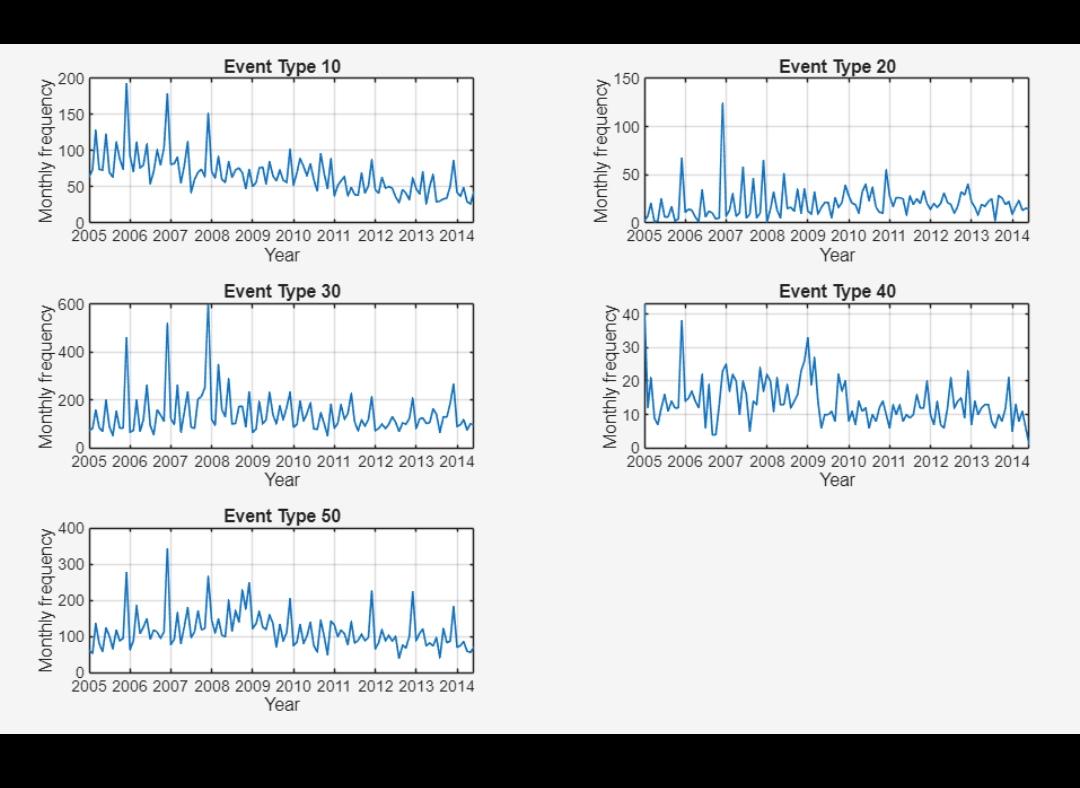
Seeking advice on treating seasonality

Post image
24 Upvotes

r/econometrics • • 8d ago

[Discussion] What classes should I take for the upcoming school year?

Thumbnail reddit.com
4 Upvotes

r/econometrics • • 8d ago

Uji F adalah bukan uji simultan uji f adalah pengujian secara bersama-sama/overall test apakah terdapat koefesien regresi yang tidak bernilai nol atau apakah terdapat variabel bebas yang berpengaruh dalam model, lht Garsperz, 1991. => banyak penulis Indonesia memaknai hasil uji F relatif salah.

0 Upvotes

r/econometrics • • 9d ago

Econometrics and machine learning.

Thumbnail reddit.com
2 Upvotes

r/econometrics • • 10d ago

BTC 24h range forecasts mostly miss on volatility jumps. Is GARCH still the right tool here?

8 Upvotes

doing a small project on 24h interval forecasts for btc. what i keep seeing, with my own GARCH(1,1) and with the other forecasts i compare against: most days the 80% interval is fine, probably because btc moves sideways most days and vol clusters. almost all the misses come from a handful of big jump days.

so coverage over the whole sample looks ok, like 78-82%, but on the top 10% vol days its closer to 40%.

questions:

- is GARCH with t errors still the standard answer, or do people use jump models or realized vol (HAR) for this now?

- is it even fair to judge a 24h interval on jump days, or should those be scored separately?

- has anyone tried mixing a GARCH band with a market implied one?


r/econometrics • • 11d ago

Should I do a economics/econometrics masters?

12 Upvotes

Hi all, this post is quite long, just a heads up!

I am thinking of applying for a phd in economics or econometrics 2028 in germany. The applications start next year.

My background is not in econ I did a bachelors in commerce with accounts and finance specialization and am currently in the last yr of my masters in commerce.

I decided to do a phd when starting masters but I didn't know much about how the phd works. When I was looking into topics that interests me I thought why not test economic theories with statistics (our program covered basics of both). Then i stumbled upon econometrics and I really loved it.

I realised I need to have a masters in economics and because of personal reasons I cannot do another degree after completing my m.com as I would not have any income to support it. I applied for a MA economics degree in ignou. For those of you outside India its a government institution which is recognised and a distance learning college. I got accepted into ignou but while reading through the material I realised its mostly on par with a bachelor level economics and is not rigourous enough for a phd. The ma is recognised in anabin database even in odl mode, the college too although Idk how the admission commitee will view it. The degree will still help with the credit deficiency side.

So now I can either apply for a masters in economics or even a research masters, but the only con is that i wont have enough money to cover the living expenses for two years in germany, the only way is to get a loan.

Another thing is that I was thinking of studying the syllabus of lse's msc econometrics syllabus on my own through mit ocw or online courses as lse's syllabus is preparing the candidates well for a phd, and do research on the topics i learnt to show that I do know the stuffs.

So is doing the self studying worth it or is the masters route worth it for the long run?

I know the post was long and thank you for reading if you reached here! My long term goal is to become a policy analyst, work with macroeconomic data.

r/econometrics • • 11d ago

Panel Regression: How to handle missing values & choose the best model?

8 Upvotes

Hello, my knowledge in this topic is very limited so I have several things I'm not clear with. My dataset consists of State and Year with one dependent variable and a few independent variables. Let's say I have obtained the values for all variables, except for State X where the GDP (independent variable) figures are not available. Is there any way to handle this or do I need to remove entirely State X in my analysis? The GDP of that state is available very recently, starting from year 2024 (which isn't included in my analysis).

I also tried running panel regression analysis using R with missing values on State X and the software automatically removed the observations. I got significant p-values for pooled OLS and FE model, but using Hausman test, RE is preferred. Would RE be a valid model? In previous studies, FE is always a favourable model. How do I choose the best model?


r/econometrics • • 13d ago

Some of time series and electricity

3 Upvotes

Hi guys, I work in energy sector and i have some data about generaton from some plants. Some of the plants are mixed (solar, diesel) or just one kind of energy (hidroelectric, solar), so my question, how would you make a kind of monitoring system? Would you use a kind of overfitted model with confidence intervals, or would you look for the best forecast model?


r/econometrics • • 14d ago

hands on workshop: compare statistical forecasting with ML and foundation models

2 Upvotes

hey everyone, sharing this because it covers a question that comes up quite often in time series modeling: when do more complex models actually perform better?

packt publishing is running a hands on workshop comparing traditional forecasting methods with newer machine learning approaches. what gets covered:

  • build statistical forecasting baselines with StatsForecast
  • compare statistical models against MLForecast and neural forecasting approaches
  • use time-aware backtesting to evaluate forecasting performance without data leakage
  • explore conformal prediction, forecast uncertainty, and hierarchical reconciliation

it is led by Graeme Davidson, Lei Ma, and Jeffrey Tackes, over 2 days online, November 28–29, starting at 10:30 AM ET. the models are evaluated using the same retail dataset.

Full details and the agenda are here

happy to answer any questions about what gets covered.


r/econometrics • • 15d ago

Econometric critiques from the 70s and 80s

Thumbnail backtothepriors.substack.com
21 Upvotes

Currently working through the history of economic thought and started out with philosophy of science and some basic epistemological ideas which naturally had to include econometrics at some point. This is the first article that really covers econometrics (1b did cover Meehl, but thats more psychometrics). Next time I will go through the 2010 retrospective on Leamer and I am really looking forward to it.

Looking forward to hear what you think, while I did my focus on data science in my Bachelor's and feel pretty confident during my master's modules, I am only starting to read into the theory behind it.


r/econometrics • • 14d ago

Predoc Interview With DIL

4 Upvotes

I have a final round predoc interview with DIL. They asked me to bring a pen and paper, a calculator only to the interview. What sort of questions should I practice? Any suggestions will be helpful. Thank you.


r/econometrics • • 16d ago

Question about Synthetic Control Method (pre-treatment variables)

12 Upvotes

Hi everyone!

I'm new to econometrics (my background is in public policy and political science) and have a question about the use of pre-treatment variables in the SCM, specifically variables used as predictors/covariates rather than as outcomes.

Suppose my pre-treatment period runs from 2000 to 2011 (the treatment year is 2012). Is it acceptable to use census data from just one year (e.g., 2001 or 2011) for these pre-treatment covariates? Or should I ideally aim to have a complete panel covering the entire pre-treatment period?

I'd also really appreciate any recommendations for literature on SCM. I already know about the Mixtape, so I'm looking for other references, ideally with accessible explanations and practical guidance.

Thanks!