r/ExperiencedFounders • • 14d ago

AMA I'm Gal Zahavi, founding engineer at Wajo AI. We're building AI agents that make phone calls, book appointments, coordinate with businesses, and handle everyday tasks for you. I previously worked on Gemini CLI at Google. AMA!

13 Upvotes

Hey everyone!

I'm Gal. I've spent a good chunk of my career building AI developer tools, but these days I'm working on something a little different, getting AI to actually do things outside of a chat window.

I'm currently a founding engineer at Wajo AI, where we're building Fo, a personal AI assistant that handles real-world tasks for you. Things like calling businesses, booking appointments, coordinating with vendors, following up on orders, and all those annoying little tasks that somehow end up eating your entire afternoon.

The idea is pretty simple, instead of AI telling you how to get something done, why not have it actually do it for you? Turns out making that work is a lot harder than it sounds.

Before Wajo, I spent about five years at Google working on Cloud AI SDKs, Gemini Code Assist, and most recently Gemini CLI, where I led the security work. I also like building open-source stuff in my spare time, including IDX0 and Pickle Rick, a Gemini CLI extension I built for running continuous agent loops.

One of the bigger challenges we're dealing with at Wajo is getting agents to work reliably when things don't go as planned. For example, what happens when a business doesn't pick up the phone? Or the appointment you wanted isn't available? Or something that should be simple ends up needing three phone calls and a couple of days of back and forth?

These are the kinds of problems I've been spending a lot of time thinking about. It's not enough for an agent to understand what you want, it needs to figure out what to do next, follow through, and sometimes realize that getting a human involved is actually the better option.

We're also figuring out how these agents should work with actual people and businesses, because I don't think the answer is necessarily to automate absolutely everything.

Anyway, figured I'd introduce myself and share a bit about what we're building at Wajo. I'm really curious what other founders think about where AI agents are headed and what problems people are running into.

Happy to talk about Fo, the technical challenges behind it, my time working on Gemini at Google, going from a big company to an early-stage startup, or really anything else.

Hit me with any questions you wanna ask!


r/ExperiencedFounders • • 20d ago

AMA I’m JJ Tang, co-founder and CEO of Rootly. We raised a $15M Series A and built incident response software used by NVIDIA, Figma, and LinkedIn. Now we’re building AI agents for SRE. AMA!

20 Upvotes

Hey r/ExperiencedFounders!

I’m JJ Tang, co-founder and CEO of Rootly. Before starting Rootly, I worked in product at Instacart and spent a few years at IBM across Cloud and Watson Health. I was also the first employee at Ada earlier in my career.

The idea for Rootly came out of my time at Instacart. I saw firsthand how messy incident response becomes as engineering teams and systems scale. An outage isn’t just about finding what broke. Someone needs to coordinate the response, page the right people, keep everyone updated, document what happened, and make sure the same problem doesn’t keep coming back. So, we built custom incident tooling to help us at Instacart.

That eventually became Rootly. We started by building incident management and on-call infrastructure, and today teams use Rootly for incident response, on-call, communications, retrospectives, status pages, and the broader incident lifecycle.

More recently, a huge part of our focus has shifted toward AI SRE. Instead of AI just summarizing an incident after the fact, we’re building agents that can actually participate in the investigation: looking at telemetry and code changes, pulling together context, forming hypotheses, and helping engineers figure out what's broken and how to stop it faster.

We went through Y Combinator S21, raised a $15M Series A, and Rootly is now used by engineering teams at companies including NVIDIA, Figma, DoorDash, Replit, Canva, Superhuman, Brex, and others.

There are a lot of interesting questions we’re dealing with as AI gets more involved in production systems. How much autonomy should an agent actually have during an incident? Where should humans stay in the loop? How do you earn enough trust for an engineering team to rely on an agent when production is actively on fire? And what happens to on-call as these systems get better?

Happy to talk about any of that, as well as going from product at Instacart to founder, YC, fundraising, enterprise sales, building for SRE teams, or growing Rootly over the last five years.

I’ll be answering questions on November 5 @ 10:00 am EST. Thanks for the opportunity; ask me anything!


r/ExperiencedFounders • • 5h ago

Where are all the curious people in India☕??

1 Upvotes

I'm a Startup founder , currently spending most of my time building a startup.

One thing I've realized is that building gets a lot more interesting when you're surrounded by people who are equally curious—whether you're working on a startup, learning AI, designing products, coding, marketing, or just constantly thinking, "What can we build next?"

I'm not trying to pitch anything or sell anything. I'd just love to connect with people nearby who enjoy creating, learning, and sharing ideas.

If you're from Chembur (or nearby) and this sounds like you, drop a comment or send me a DM.

Maybe we can grab a coffee, exchange ideas, and build a small community of people who enjoy making things. 🚀


r/ExperiencedFounders • • 5d ago

I'm Forrest Smith, co-founder and CEO of Kineon. I moved to China at 19 to build things. A torn MCL got me building a wearable laser device.

11 Upvotes

Hey Reddit, I’m Forrest. I moved to China at 19, started my first business at 20, and spent the better part of two decades building things there. I went from sourcing fabric to making LED lighting. All that time I kept playing rugby, which is how my knee got a vote in what I’d build next.

After I tore my MCL, I went looking for ways to keep doing the things I loved. I had plenty of experience building lights, but building one for use on the body raised a whole different set of questions. What wavelength are we using? How much light reaches the tissue we’re targeting? How do you check that a device delivers a consistent dose when people put it on at home? My co-founder Tom and I got hooked on those questions, and that’s how Kineon started.

*More life in the life you lead.* For me, that’s a personal goal: more years training CrossFit and Hyrox, more chances to compete with my kids, and more healthy time with my family. For someone else, it might be getting back on a favorite trail or keeping up with their kids without having to sit out. Those are the changes worth building for, and the ones I want us to get better at measuring. That’s why we work with clinicians and bring research into the engineering, from how we deliver light to how we measure what happens when people use it.

AMA

Ask me what we know about red and near-infrared light, how a panel differs from a wearable laser, or where the research still leaves me with questions. I’m equally happy to talk about manufacturing in China, crowdfunding, or what it takes to get a prototype into someone’s hands.

Drop your questions below. I’ll be here *Tuesday, Nov 24, noon to 2 p.m. ET*. Bring the skeptical questions. I’m a hardware founder, not a doctor, so I can talk research and engineering, but I can’t give personal medical advice.


r/ExperiencedFounders • • 11h ago

Startup founders: Are you happy with what your tech team is delivering?

Thumbnail reddit.com
2 Upvotes

r/ExperiencedFounders • • 13h ago

Founder-led sales has become the bottleneck in my deeptech B2B/B2G startup. How did you get out of it?

Thumbnail reddit.com
1 Upvotes

r/ExperiencedFounders • • 21h ago

Founders: Are you getting the right outcomes from your tech initiatives

Thumbnail reddit.com
1 Upvotes

As companies grow, I’ve noticed a pattern that can become quite expensive: The engineering team is constantly busy, but it’s difficult to connect the work to business outcomes. The requirement/product roadmap keeps changing based on the latest customer request or leadership priority. Features get shipped, but adoption doesn’t necessarily follow. Product, sales and engineering teams have different interpretations of what needs to be built. The founder is still the person making most of the important product decisions.

Everyone wants to explore AI, but it’s unclear which use cases are actually worth investing in.
Often, the problem isn’t a lack of developers or effort. It’s a lack of product clarity, prioritisation, ownership and execution discipline.

A little about me: I’ve spent many years in technology and product roles, including product leadership at a largest CRM MNC, and currently lead technology for a growing business. I’ve worked across product strategy, large-scale platforms, engineering teams and technology transformation.

I’m now building an independent Product & Technology Advisory practice, focused on helping startups and growing businesses get more value from their technology investments.

The idea is fairly simple: help founders identify what’s slowing their product down, where engineering effort is getting wasted, what needs fixing first, and how to build better product practices without necessarily hiring a full-time senior product leader.

I’d love to hear from founders/cofounders here:

  • Which of these problems resonates most with your current experience?
  • Do you have a dedicated product leader, or does product management still sit with the founder/CTO?
  • Would an independent, time-bound assessment of your product and execution challenges be useful?

If you’re dealing with some of these challenges and would like to explore whether I can help, feel free to DM me. Happy to share how I approach the work and discuss whether there’s a fit.

PS: Not pitching a large consulting engagement. The intention is to solve specific problems, pragmatically.


r/ExperiencedFounders • • 1d ago

Bootstrapped marketplace founder watching a funded competitor accelerate. When is it time to raise? (i will not promote)

Thumbnail reddit.com
1 Upvotes

r/ExperiencedFounders • • 1d ago

0 to 187k Google search impressions in 3 months (TL;DR it's all bots)

Thumbnail
gallery
3 Upvotes

TL;DR: 86% of the impressions were bot scrapers on Google. Unclear if bot traffic affects AEO at all, not even sure how we can measure it.


We launched a new website late August with zero search presence, it's a small B2B services site built with Next.js on Cloudflare Workers via OpenNext, with Payload as the CMS and D1/R2 behind it.

So far, we've measured

1.7K clicks, 187K impressions, average position 5.1. Most of that isn't what it looks like. This post covers the technical work and then what the numbers really mean. I've kept our niche and keywords out of it on purpose.

1. Crawl and index hygiene

  • Canonicals. Set metadataBase and a self-referencing canonical on all 13 route types. Paginated blog and author listings all canonicalised to page 1, which folded the deeper pages, and the older posts only they linked to, into page 1. Now ?page=2 and beyond canonicalise to themselves and get their own title. ?page=1 301s to the bare URL.
  • Real 404s. /blog?page=99 returned a 200 with an empty grid that Google could index. Past the last page it's a 404 now, and so is a junk page parameter.
  • Lowercase slugs enforced in the CMS.
  • Sitemaps split by type: the main one, the programmatic pages and the tools each get their own. That way GSC shows indexing per type. lastmod is a real content date (see section 3), never the CMS save time.
  • Domain consolidation. We had 20 posts on an older domain. We moved them and 301'd every slug one to one rather than pointing everything at the homepage.

2. Structured data

JSON-LD per page type: Organization and WebSite site-wide, then BlogPosting, BreadcrumbList, FAQPage where there's a real FAQ, and ItemList on ranked list posts. BlogPosting carries an author entity with its own author page.

3. Honest freshness dates

The CMS's updatedAt is not a modified date. It moves on every save. One bulk edit with no prose changes gave sixteen posts the same modified time. Publish that as dateModified or sitemap lastmod and you're claiming freshness the content doesn't have.

  • Posts have a lastSubstantiveUpdate field that an editor sets only when the content really changed. dateModified, article:modified_time and lastmod use it, fall back to the publish date, and ignore it if it lands on publish day.
  • Landing pages get their dates from git. A prebuild script runs git log over each page's own directory and its copy entry, and writes a generated file that gets committed. A tweak to a shared component doesn't bump anything. A copy change to that page does, and the visible "Updated <Month Year>" line follows. Nothing auto-rolls the month.

4. Meta and share cards

  • Titles held to about 60 characters and descriptions to what the SERP preview actually shows. We checked every page against an OG inspector rather than guessing.
  • Per-post Open Graph images generated with next/og. It does run on Workers.
  • CMS fields for an SEO title, an SEO description and a short "quick answer" paragraph that sits high in the post.

5. Internal linking

Across the whole blog there was 1 link from one post to another. We took it to 69 and left no orphans. That was manual work: for each post, find the 3 to 5 others it genuinely relates to and link from body text.

6. Programmatic pages

We built 120 directory-style reference pages from a dataset we maintain, each with its own data rather than a template with a swapped noun. They're read at build time only and kept out of the Worker bundle. Shipping them inside it added real weight to cold starts (more on that below). They got their own sitemap. These pages ended up taking a big share of the impressions, mostly the machine kind described in the next section.

7. Speed on Workers

This took the most effort and moved rankings the least. It still mattered for us. Cold starts. The Worker script was about 28MB raw, 6.66MB gzipped, and Payload alone was 9MB+ of that. After the site sat idle, the first request took 1.3 to 2.45 seconds to first byte. Around 0.75 to 1s of that passed before our code even ran, which is the isolate loading the script.

What we tried, in order:

  1. Cached CMS reads with tags, invalidated from Payload's afterChange hooks. That helped warm requests and did nothing for cold ones.
  2. A patched OpenNext cache. Pages rendered at runtime were coming back STALE on fresh isolates because Next assumed a 1s revalidate window. We patched @opennextjs/aws so they serve as cache hits. That got rid of the 200 to 800ms re-renders.
  3. Moved the programmatic data out of the bundle: 6.66MB down to 6.18MB gzipped. Better, but a cold isolate still had to load the whole Next app.
  4. Put a 4KB Worker in front. This was the fix. It serves GET HTML from the Cache API, keyed on hostname and build id, and only calls the Next Worker through a service binding on a miss. It bypasses /admin, /api, /_next, RSC requests and preview cookies. Pages older than 5 minutes refresh in the background. Behind that sits an R2 "shelf" shared across colos, so a miss in one location reads from R2 instead of waking Next.
  5. Purge by page. OpenNext doesn't emit x-next-cache-tags outside minimal mode, so we patched it to record tags and add the header. The front Worker stores copies tagged with hashed versions of those tags. A CMS publish purges only the matching pages, re-renders the edited page first and marks the rest stale. Same idle test after the front Worker went live: 57 to 155ms TTFB. Cached pages answered in 53 to 101ms when I checked today.
  6. Other speed work:
  • Images resized through Cloudflare and served from a separate R2 media subdomain. Cold image variants went from 1-4s to 0.5-1.1s.
  • The LCP image gets priority. First-viewport layout is settled in CSS so LCP doesn't wait for hydration.
  • A hero video went from 18.7MB (1080p) to 3.7MB (720p) and is deferred.
  • Third-party tags were the biggest TBT cost. Mobile TBT was 425 to 712ms, with GTM and GA taking 250 to 420ms of it. Tag Manager now loads on first interaction or 5s after load, and the session recorder at 10s. The trade-off is that a bounce without any touch inside 5s goes uncounted. We accepted that.
  • Mobile TBT is measured in GitHub Actions as the median of 5 Lighthouse runs against prod after every deploy. A busy laptop gave us 345ms and 1,720ms for the same page on the same afternoon, so we stopped trusting local runs. Lighthouse on the homepage (Nov 14): 90 performance and 100 SEO on mobile. Desktop scored 100 on both. Did any of this move rankings? I can't show that it did. Position changes line up with content and indexing dates, not with the speed deploys.

What the numbers actually say

Last 28 days vs the 28 before: | | Sep 26 to Oct 23 | Oct 24 to Nov 20 | |---|---|---| | Clicks | 269 | 1,365 | | Impressions | 9,261 | 179,167 | | Pages getting impressions | 117 | 234 | Weekly clicks went from 3 (week of Aug 24) to 650 (week of Nov 9). 90% of those clicks went to one post. It's a consumer how-to that has nothing to do with what we sell, ranking around position 4 to 6. Our commercial pages are still on pages 4 to 8 for their main terms.

86% of impressions are machines

The query report is full of this pattern (keywords swapped out):

Query shapeImpressionsClicks
<platform> · <community A> alternatives28,8950
<platform> · <community B> alternatives19,8230
<platform> · <community C> alternatives13,8910
<platform> · <community D>13,7860
<platform> · <community E> alternatives13,7470

No person types a middle dot into Google. Of 150,932 impressions on queries GSC names, 129,484 (86%) have this shape, and together they got 0 clicks. GSC now has a separate report for Google's generative AI features. It shows 49.3K impressions for us, nearly all arriving after Oct 28.

My read is that these are the background searches an AI answer runs before it writes a reply. One comparison post picked up about 30K of those AI impressions and 0 clicks. There's a second tell. Long, chatty question-style queries show up in our GSC word for word, and they match prompts we track in an AI visibility tool. Some of our impressions are our own monitoring. If your impressions jumped this autumn and your clicks didn't, filter the query report for non-human shapes before you report the number to anyone.

Then it dropped

The last week of the chart falls hard. Comparing Nov 11-15 with Nov 16-20, the top post went from 474 clicks to 157. Its average position barely moved (6.2 to 6.5) while impressions halved, so it looks like a demand drop, not a lost ranking. GSC's most recent days are always incomplete as well. I don't have a confident explanation yet. We're going to keep measuring top of the funnel broad search impressions and monitor bottom of the funnel high intent searches.

What I'd tell someone starting from zero

  • Do the hygiene in a weekend: canonicals, real 404s, split sitemaps, JSON-LD. It's table stakes.
  • Don't fake freshness. Tie dates to real changes.
  • If you're on serverless, measure cold TTFB after 15 to 45 minutes of idle, not right after a deploy. A warm test hides the whole problem.
  • Measure TBT in CI, not on your laptop. Defer third-party tags and accept the data loss.
  • Split impressions into human and machine query shapes. The total means very little now. Ultimately, good content wins SEO. I'm hoping the bump in bot scraping Google means it equals som kind of AEO indexing ,but there's zero way to tell. Happy to go deeper on the front Worker or the OpenNext patches in the comments.

r/ExperiencedFounders • • 1d ago

Startup founders: Are you happy with what your tech team is delivering?

Thumbnail reddit.com
0 Upvotes

r/ExperiencedFounders • • 2d ago

Founders: How do you evaluate your first Head of Marketing/CMO after 10 months when revenue is still founder-led?

Thumbnail reddit.com
1 Upvotes

r/ExperiencedFounders • • 3d ago

Is there a group for actual founders?

3 Upvotes

Asking for a friend…

DM me


r/ExperiencedFounders • • 4d ago

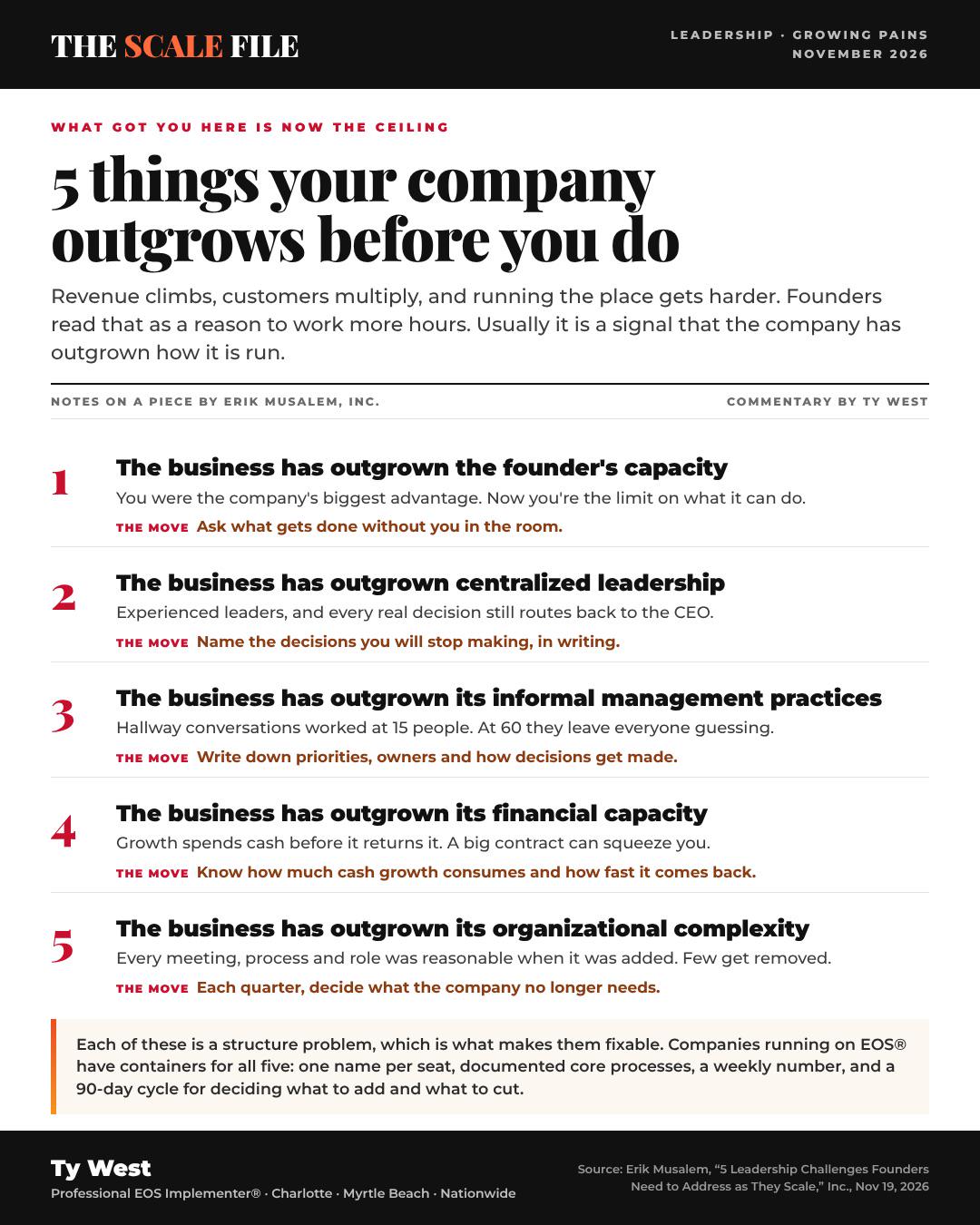
5 things your company outgrows before you do

Post image
7 Upvotes

r/ExperiencedFounders • • 4d ago

Sound Ventures (VC cofounded by Ashton Kutcher) is up $7B from ANT IPO

Thumbnail
gallery
6 Upvotes

r/ExperiencedFounders • • 4d ago

Startup registration in UK

Thumbnail reddit.com
3 Upvotes

r/ExperiencedFounders • • 4d ago

At 45 contractors across 12 countries, when do you finally standardize how everyone gets paid?

1 Upvotes

about 45 contractors in 12 or so countries, and i've paid all of them myself for four years. the ops person i hired last month has spent her first weeks drawing our setup on the whiteboard and this week asked me for a date when it becomes one thing. the honest list is a wise account for most of them, a usdt wallet for the ones who asked for that, a bank login for a couple who can't take either, and a spreadsheet where i note who got what and when, which i update on the train. the 12 we've added since the summer are on kleos, new people go there now, so that part is one list and she had it in an afternoon. then she asked who approves that list and that's also me, so for those 12 the handover so far is a login. the older people i'm not keen to move. three of the senior devs have been paid the same way since the first year, and one of them told me flat out he's not changing how he gets paid for an ops hire he hasn't met. i get that. i also get that the spreadsheet is on my laptop and nowhere else. she's put the end of the year on the whiteboard and i've been finding reasons it can wait, and she's been writing those on the whiteboard too. at 45 people in a dozen countries, has anyone moved the people who liked the old way of being paid, and what did it take?


r/ExperiencedFounders • • 5d ago

A look at our early days and are you using MCP as a go-to-market channel?

Thumbnail
moneymagician.eu
1 Upvotes

r/ExperiencedFounders • • 5d ago

Building 16VC has been a difficult journey. Here's what I've learned.

Thumbnail reddit.com
1 Upvotes

r/ExperiencedFounders • • 5d ago

I run one portfolio site covering CPO, CMO, AI lead, and PMO work. 4,523 visits last month, 3 active clients, zero outbound.

1 Upvotes

Six months ago I stopped pitching myself role by role. Instead of "hire me as a fractional CPO" or "I also do marketing," I built one site that shows the actual work across product, marketing, AI, and project leadership. 9 pages, 28 data models behind it, real case studies, a running lexicon of AI/strategy terms I update weekly, trend breakdowns pulled from LinkedIn, X, and YouTube.

Last 30 days: 4,523 visits, 3 clients signed, and most conversations start with someone referencing a specific page, not a cold pitch from me. Scaleups don't want to explain their context five times to five different fractional hires. They want one person who already gets product, growth, and AI strategy, and can prove it with depth, not a resume PDF.

Still figuring out how much "show the work" content converts versus just looking busy. Anyone else running a multi-discipline fractional practice? What actually gets a scaleup CEO to book the first call?


r/ExperiencedFounders • • 5d ago

Scaleups hire a fractional CPO, a fractional CMO, and an AI consultant separately, then spend 3 months just getting them to agree on strategy

2 Upvotes

Watched this happen at two companies I've consulted for. Leadership brings in a product lead for the roadmap, a marketing lead for growth, and an AI consultant for the "we need an AI strategy" box. Three different people, three different mental models, three sets of slides that contradict each other by week six.

The real cost isn't the extra invoices. It's the founder playing translator between three fractional execs who've never worked together, while the actual decisions sit stuck in Slack threads.

I started positioning differently after seeing this twice. One person owns product, marketing, AI, and project leadership as one connected view, not three disconnected hires. Same strategic thread runs through the roadmap, the GTM, and the AI rollout, because it's coming from one brain that's accountable for all of it.

Curious if this is a universal problem or just something I've seen in two messy scaleups. Anyone had better luck keeping multiple fractional hires aligned?

Pratap Potakamuri
https://invinci.ca
https://chowdary.me


r/ExperiencedFounders • • 7d ago

Founder to a Founder

Thumbnail reddit.com
1 Upvotes

r/ExperiencedFounders • • 7d ago

Looking to collaborate with builders and founders.

1 Upvotes

Hello, builders and founders!

Hope you're having a great day.

I'm looking for contract opportunities in Data Analytics or Data Engineering.

I hold a Master's degree from the US and have 4 years of professional experience. I'm eager to collaborate on projects and contribute to growing businesses.

I'm flexible with compensation, with a target budget of around $3,000/month.

If you have any opportunities or know someone looking for data talent, I'd love to connect!

Looking forward to hearing from you.

Thanks!


r/ExperiencedFounders • • 8d ago

I’m a Startup Transaction Lawyer & Company Secretary. Ask me about fundraising, compliance, ESOPs, investor agreements, and startup legal issues. “I will not promote”

3 Upvotes

Hi founders,
I work with startups and investors on fundraising transactions and corporate compliance.
In simple language, I help companies with things like:
• Raising money from angel investors, VCs, and funds
• Converting term sheets into legal documentation
• ESOP implementation for employees and founders
• Share allotments and cap table issues
• Board and shareholder approvals
• FEMA compliance for foreign investments
• Legal and secretarial due diligence before funding rounds
• Fixing compliance issues that investors discover during due diligence

A lot of founders focus on building the product and growing revenue, which is exactly what they should be doing. But many fundraising delays happen because of avoidable legal and compliance mistakes.
Some common questions I get:
• “Can I issue shares after receiving the money?”
• “Do I really need a shareholders’ agreement?”
• “What happens if we forgot ROC filings?”
• “How do ESOPs actually work?”
• “An investor wants CCPS. What does that mean?”
• “Will due diligence kill my funding round?”

If you’re a founder, startup operator, or someone planning to raise funds, ask me anything.
I’ll do my best to explain things in plain English without legal jargon.

Disclaimer: General information only. Not legal advice.


r/ExperiencedFounders • • 9d ago

Hi, founder I have questions regarding the business I want to start, i would appreciate if you can give me some insight.

Thumbnail
gallery
1 Upvotes

I'm 19f, I have a limited budget. I want to bring in weird and whimsy energy stuff which we can't really find locally. Which would include decore I'm thinking of ceramics, some jewellery and clothes in future. I know that clothes market is hard to get in.

I'm attaching some screenshots of ceramics I want to start with, I have yet to connect with factories I have collected few contacts with the help of Google.

Realistically speaking,what are the things i should be prepared for. How much it may cost if i order minimum quantities. How much does running ads cost? About opening a website I'll get someone to make in my budget.

Do you see potential in this or I'm taking big risks?