r/FragileXReseach • • 4d ago

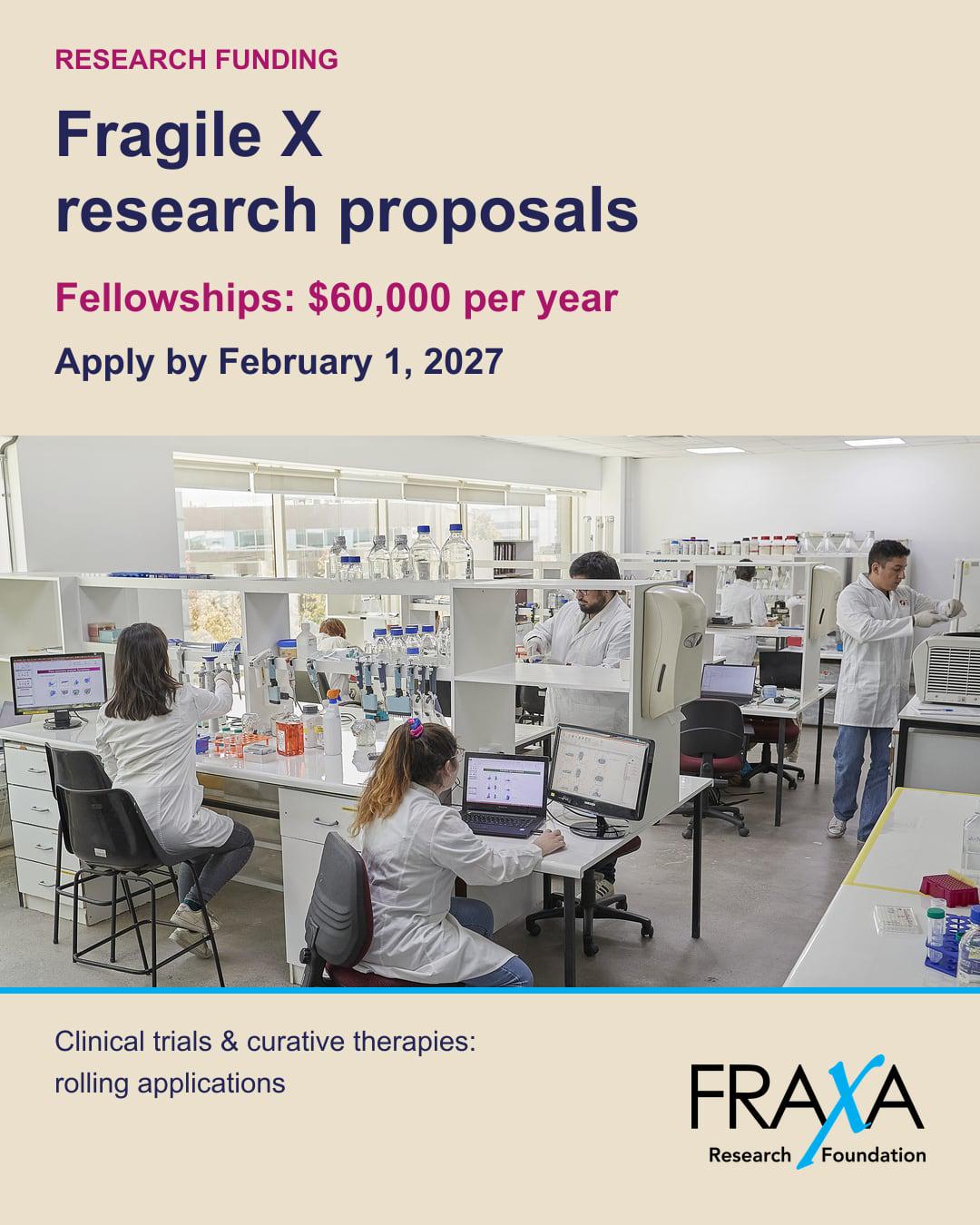
FRAXA 2027 Fragile X research fellowships: $60,000/year, apply by February 1
Post image
2 Upvotes

Know a researcher with an idea that could help move Fragile X treatments forward?

FRAXA is inviting applications for 2027 research fellowships. The deadline is February 1, 2027, and fellowship funding is increasing from $50,000 to $60,000 per year.

FRAXA seeks projects with a translational, preclinical, or clinical focus and the potential to advance treatments for Fragile X syndrome. Fellowships are initially funded for one year and may be renewed for a second year based on progress.

Prospective applicants should send a letter of intent to Dr. Michael Tranfaglia at mtranfaglia@fraxa.org before submitting a full application. Clinical trial and curative therapies proposals are accepted year-round.

Please share this opportunity with scientists, clinicians, university colleagues, or others connected to research teams.

https://www.fraxa.org/fragile-x-research/grant-application/


r/FragileXReseach • • 9d ago

PLEASE, help me understand the risks of intermediate Fragile X

3 Upvotes

My wife is at 10 weeks with our baby. We have had some minor issues (hypothyroidism discovered at 4 weeks, now medicated), but our NIPT came back all negative. We thought we were in the clear, and discovered we are having a baby boy. However, we just got the results of her carrier tests and it noted that she is an intermediate carrier for Fragile X. One chromosome is healthy (33 repeats) the other is just under the threshold for premutation (53 repeats).

This came out of left field and we’ve been scrambling to understand what this means. From what I’ve gathered:

1.) Our son has a 50% chance of inheriting the “bad” X.

2.) If he inherits this, the odds are low (but not nonexistent) that it increases to intermediate. This could be an issue for when he has children of his own. There is also a non-zero chance it increases to a full mutation or high enough premutation to cause cognitive issues in him.

3.) The odds of this showing negative symptoms is drastically increased in boys since they only have the one X chromosome.

\*\*My questions:\*\*

Given that she is only an intermediate carrier, could our son have symptoms?

Should my wife do AGG interruption testing (I know insurance won’t pay because she is intermediate)?

Is it worth getting an amniocentesis or CVS to check his repeats?

Should we do IVF for our other children?

Please help two scared soon to be first time parents understand what all of this means.


r/FragileXReseach • • 18d ago

Peptide-Functionalized Lipid Nanoparticles for mRNA Delivery to Restore FMRP in Fragile X Syndrome

Thumbnail
fraxa.org
4 Upvotes

Getting FMRP into brain cells is a challenge a FRAXA-funded team is working to solve. FMRP is the protein missing or reduced in Fragile X syndrome.

FRAXA has awarded a two-year, $200,000 grant to researchers at the New Jersey Institute of Technology and Stanford University. Maryam Hajfathalian, PhD, and Michelle James, PhD, are leading the project with FRAXA postdoctoral fellow Md Emranul Karim, PhD.

The team will test whether tiny particles called lipid nanoparticles can carry FMR1 messenger RNA (mRNA), the instructions for making FMRP, into lab-grown nerve cells and enable those cells to produce the protein. This early-stage work could help establish a foundation for a potential treatment that addresses the underlying cause of Fragile X.

Donor support makes FRAXA research grants like this possible. As you consider your year-end giving, a gift to FRAXA helps researchers test new ideas and build the evidence needed to pursue potential treatments.


r/FragileXReseach • • Oct 28 '26

PDE2 Drug Program Builds on FRAXA-Funded Research

Thumbnail
fraxa.org
5 Upvotes

Rumi Therapeutics will advance RTX-7340, a potential treatment for Fragile X syndrome, under an agreement with Enthorin Therapeutics. The approach builds on research supported by FRAXA.

RTX-7340 targets PDE2A, an enzyme that breaks down chemical messengers important for learning and memory. PDE2 is a different target from PDE4D, the enzyme targeted by Shionogi’s zatolmilast.

FRAXA helped lay the groundwork by funding Dr. Thomas Maurin’s fellowship with Dr. Barbara Bardoni at INSERM in France. Their studies showed that inhibiting PDE2A improved brain-cell function and social interactions in Fragile X animal models. Enthorin also credits FRAXA’s support for helping translate these discoveries into drug development. FRAXA supporters helped make that early research possible.

RTX-7340 is moving toward clinical development. Studies in people will be needed to establish its safety and determine whether it benefits individuals with Fragile X.

Read more about the program and FRAXA’s role in the research behind it.


r/FragileXReseach • • Oct 21 '26

[Translational Science Grand Rounds presentation] Nonsense-mediated mRNA decay in human health and disease: Reframing the role of FMRP in Fragile X Syndrome

Thumbnail urmc.rochester.edu
2 Upvotes

Longtime FRAXA-funded researcher Dr. Lynne Maquat will share how her studies of RNA biology led to discoveries about Fragile X syndrome in a free virtual presentation hosted by the University of Rochester.

Her talk will explore nonsense-mediated mRNA decay (NMD), a process that helps cells manage the quality of their genetic messages, and how it becomes disrupted in Fragile X. FRAXA has supported her team through multiple research grants investigating this pathway and its potential as a treatment target.

The presentation is part of Rochester’s Translational Science Grand Rounds series and is geared toward researchers and health care professionals interested in a deeper look at the science.

Thursday, November 12, 2026
12:00-1:00 p.m. ET | Online | Free


r/FragileXReseach • • Oct 07 '26

11 month old son was just diagnosed with FXS.

9 Upvotes

Hi! My youngest son is 11 months old and was recently diagnosed with Fragile X Syndrome. He was diagnosed with Ventrigulomegaly at around 20 weeks gestation and later diagnosed with Agenesis of the Corpus Callosum. It was kind of a domino effect. The FXS caused the ventrigulomegaly, which caused the ACC. FXS and ACC symptoms are almost identical and the majority of which my son has experienced. He was “floppy” with hypotonia, had to be put on prescription formula for GI problems, had significant milestone delays, so on and so forth. Although he’s had some pretty big set backs he has remained in good health with no major issues so far. he’s very happy, he recently started sitting up unassisted and crawling, even said his first two words! I know this condition, along with ACC, are highly symptom based, but I was wondering if anyone who has it or has a child with the mutation could give me insight as to what your day to day is like or how it effects you? The geneticist gave us statistics and an outline of symptoms and things like that, but I’d like to hear from a real person that’s affected by it. Thank you for chiming in!


r/FragileXReseach • • Oct 01 '26

Shionogi to End Zatolmilast Open-Label Extension for Adolescents

Thumbnail
fraxa.org
5 Upvotes

Shionogi has shared an important update on the zatolmilast open-label extension study for Fragile X syndrome.

Following further review and analysis, Shionogi concluded that efficacy measures did not detect a positive treatment signal in adolescents. The company is discontinuing participation for those ages 17 and under. No new safety findings have been reported.

The open-label study remains open for adults. Currently enrolled participants from the adolescent study who are 18 or older by October 31, 2026, may continue without changes or interruptions.

This is a painful setback for affected families and for everyone working toward effective treatments for Fragile X syndrome. We are deeply grateful to the families and participants who have contributed to this research.

At FRAXA we will learn from this experience and use these lessons to advance treatment development and, ultimately, a cure.


r/FragileXReseach • • Sep 17 '26

Circular RNA Delivery of FMRP in a Human Neurodevelopmental Model of Fragile X Syndrome

Thumbnail
fraxa.org
10 Upvotes

Restoring FMRP, the protein missing in Fragile X syndrome, is a central goal of a University of Rochester research project supported by a $200,000 FRAXA Research Foundation grant.

Led by Drs. Lynne Maquat and Christoph Pröschel, the team is exploring circular RNA as a way to help cells produce FMRP. Unlike most viral gene therapy approaches, this approach could potentially allow repeated treatments.

Using lab-grown models of brain tissue made from patient cells, researchers will study differences in FMRP across brain cell types. Their findings could help guide treatments that address the underlying cause of Fragile X syndrome.

This grant is one of many made possible by donors in the Fragile X community. Thank you for supporting research that moves this work forward.


r/FragileXReseach • • Sep 02 '26

Education

5 Upvotes

Hello,

Update: I've mistakenly posted that the child has Fragile X, but he actually has X Chromosome Deletion. Apologies for the mix up. I'm new to this diagnoses.

I'm an Orton-Gillingham specialist and I'll soon be working with someone who has Fragile X. I want to make sure I am doing everything possible to help. Can anyone tell me if they or a relative with x chromosome deletion has learned to read? If so, did they use a whole language program that relies on memorization, such as Edmark? Or did they learn using a phonics approach. Any help anyone can provide will be useful. It is very important to me that I help this child so I'm trying to learn everything I can about Fragile X.


r/FragileXReseach • • Aug 18 '26

Just discovered my toddler (2F) has Fragile X. Any advice?

7 Upvotes

We found out I was a carrier following my son’s diagnosis of a totally different condition so we did a full genetic carrier screen and got my older daughter tested. She’d already been in physical therapy and speech therapy with us not knowing any underlying reason for the delays.

Does anyone have advice for what I can do to best help my little girl now that we have a diagnosis?


r/FragileXReseach • • Aug 13 '26

Development of Non-Hallucinogenic Substituted Tryptamines (SubTryps) for Fragile X Syndrome

Thumbnail
fraxa.org
6 Upvotes

Can scientists keep the therapeutic benefits and lose the hallucinogenic effects?

FRAXA has awarded a $100,000 research grant to Clinton E. Canal, PhD, India R. Breuer, and Jason V. Wallach, PhD, to investigate DPT-derived compounds as a potential treatment approach for Fragile X syndrome.

Their previous work found that DPT (a tryptamine-based molecule) can suppress seizures in a Fragile X mouse model through mechanisms separate from those responsible for hallucinations. Now, the team is designing and testing new non-hallucinogenic compounds to identify candidates that may reduce seizures and improve learning and memory.

The research will also help determine which brain receptors are most important to these effects, providing direction for future drug development in Fragile X syndrome.

This grant is one of many made possible by the families, donors, and supporters who continue to invest in Fragile X research.


r/FragileXReseach • • Aug 07 '26

Fragile X Family Conversations: Sharing, Learning, Supporting

Thumbnail
fraxa.org
5 Upvotes

Calling all families navigating the Fragile X journey! Join us on Wednesday, August 19 at 12:00 pm ET for Fragile X Family Conversations: Sharing, Learning, Supporting. This exclusive event is a space just for families and caregivers to connect, share experiences, and offer each other support.

These sessions provide unique opportunities to brainstorm with others who truly understand the daily challenges of Fragile X. With every member of the FRAXA team personally connected to Fragile X we’re here to offer a welcoming community where families can feel seen, heard, and hopeful.

Space is limited – register now to reserve your spot!


r/FragileXReseach • • Aug 06 '26

FRAXA-DVI Study Finds Promising Results for Marvel Biosciences' A2A Receptor Drug in Fragile X Model

Thumbnail
fraxa.org
5 Upvotes

Encouraging news from FRAXA-DVI: Marvel Biosciences reports that its A2A receptor blocker, MB-204, improved behavioral and cognitive measures in a mouse model of Fragile X syndrome.

This study brings FRAXA’s research strategy full circle. FRAXA first funded academic research showing that A2A receptors could be a promising Fragile X treatment target. We then worked with Marvel Biosciences to evaluate MB-204 through the FRAXA Drug Validation Initiative, our streamlined preclinical testing program.

These findings are promising. MB-204 is a preclinical drug and will need to be studied in people.

MB-204 is on its way through the drug development pipeline and a step closer to clinical trials.


r/FragileXReseach • • Jul 23 '26

The FRAXA Story: 30+ Years Advancing Fragile X Syndrome Research

Thumbnail
youtu.be
7 Upvotes

FRAXA began with a simple question: now that the cause of Fragile X syndrome was known, could research lead to effective treatments and ultimately a cure?

More than 30 years later, that question continues to guide our work.

Our new origin-story video traces the advances that helped shape Fragile X syndrome research, from early gene therapy studies and clinical research to pharmaceutical partnerships, drug validation platforms, RNA-based approaches, and today’s curative therapy programs.

But this story is about more than scientific milestones.

It is about the families, researchers, clinicians, donors, and industry partners who kept identifying the next barrier to progress and working together to remove it.

Their persistence helped transform Fragile X syndrome from a poorly understood condition into a serious field of therapeutic research, with multiple paths toward better treatments and a cure.


r/FragileXReseach • • Jul 09 '26

Research Grant: Neurodevelopmental Splicing Defects in Fragile X Syndrome Brain Models

Thumbnail
fraxa.org
6 Upvotes

As we move through July toward World Fragile X Day on July 22, FRAXA continues to support Fragile X syndrome research across borders.

FRAXA recently awarded a $100,000 grant to Rachid Mazroui, PhD; Emeline Lelong, PhD; Samer Mohamed Hussein, PhD; and Karun Singh, PhD, at Laval University in Quebec, Canada.

Their project focuses on RNA splicing, a process that helps determine how genes produce different RNA and protein forms during brain development. Using human brain organoid models and single-cell long-read RNA sequencing, the team will study how loss of FMRP may alter RNA isoforms in Fragile X syndrome.

The researchers will also explore whether some altered RNA isoforms can be corrected using antisense oligonucleotides, or ASOs, a therapeutic approach designed to adjust RNA processing directly.

This grant reflects the international reach of Fragile X syndrome research and the role of donor support in making research advances possible.


r/FragileXReseach • • Jun 30 '26

FRAXA Funds First Research Grant in the Middle East

Thumbnail
fraxa.org
4 Upvotes

As we head into July and toward World Fragile X Day on July 22, FRAXA is proud to support Fragile X syndrome research across borders.

We recently awarded a $100,000 grant to Leena Ibrahim, PhD, and Deyl S. Djama, PhD, at King Abdullah University of Science and Technology in Saudi Arabia — marking the first time FRAXA has funded research in the Middle East.

Their project examines how disrupted communication between the thalamus and sensory cortex may contribute to sensory processing difficulties in Fragile X syndrome. This is a distinctive approach: while much Fragile X research has focused on individual neurons or the cortex, this team is studying the brain circuits that connect key sensory relay systems. By exploring thalamus-to-cortex signaling and testing whether correcting these circuit changes can improve behavior in animal models, the researchers aim to identify new therapeutic targets for sensory symptoms.

This grant reflects the global reach of the Fragile X community and the importance of donor support in making new international research collaborations and advances possible.


r/FragileXReseach • • Jun 26 '26

New Fragile X Clinical Trial: Mirum Study

Post image
3 Upvotes

I thought this would be a good place to post this, as this study has recently opened recruitment at new sites and hasn't been talked about in this subreddit for a while.

This is a randomized, double-blind, placebo-controlled, phase 2 study evaluating the safety and tolerability of the medication in male participants with Fragile X Syndrome.

If you would like more information about participation, feel free to visit this site's website (below) or consult the study materials.

https://autismcenter.org/research/


r/FragileXReseach • • Jun 16 '26

Fragile X Treatment Pipeline: Current and Emerging Clinical Trials (2026 Webinar)

Thumbnail
fraxa.org
3 Upvotes

Several Fragile X clinical trial programs are recruiting participants now or expected to begin in the coming months.

In a recent FRAXA webinar, clinicians Elizabeth M. Berry-Kravis, MD, PhD, Craig Erickson, MD, and Mike Tranfaglia, MD, discussed current and emerging trials, including programs focused on PDE4D inhibition, BK channel modulation, behavior-focused treatments, repurposed medications, and early genetic strategies.

One theme came through clearly: developing new therapies is only part of the challenge. Researchers are also working to improve clinical trial design, outcome measures, and biomarkers so studies can better capture meaningful change in Fragile X syndrome.


r/FragileXReseach • • May 27 '26

TFEB-Mediated Activation of the Autophagy-Lysosome Pathway in Dopaminergic Neurons

Thumbnail
fraxa.org
4 Upvotes

FRAXA's first Scandinavian research grant has been awarded to Francesco Longo, PhD, and Charlène Perian, PhD, at University of Gothenburg in Sweden. This $100,000 award will fund studies on how defects in the autophagy-lysosome pathway may contribute to altered dopamine signaling and behavioral inflexibility in Fragile X syndrome.

Using mouse models, the team will test whether activating the master protein regulator TFEB can restore dopamine function and improve behavioral flexibility. This work could help validate a new therapeutic approach for Fragile X syndrome.


r/FragileXReseach • • May 21 '26

What’s Next in Fragile X Clinical Trials?

Thumbnail
fraxa.org
7 Upvotes

Join FRAXA Research Foundation on Tuesday, June 10 at 5:00 PM Eastern for a practical, forward-looking webinar on the Fragile X treatment pipeline.

Featuring Elizabeth M. Berry-Kravis, MD, PhD, and Craig Erickson, MD, this session will explain current and emerging clinical trials for Fragile X syndrome, including programs from Spinogenix, Mirum, Servier, and others. The discussion will cover the science behind these approaches, where each program stands today, and what families may want to know about eligibility and participation.

A live Q&A will follow the presentations.


r/FragileXReseach • • May 13 '26

Shionogi Update on Zatolmilast Fragile X Clinical Trial Findings

Thumbnail
fraxa.org
6 Upvotes

Shionogi has shared an important update on its Phase 3 clinical trials of zatolmilast in Fragile X syndrome.

Neither trial met its original endpoint. In the adult study, there was a statistically significant signal on the Numeric Rating Scale, a caregiver assessment that includes language use, but because it was a secondary measure, that finding alone is not typically enough to support FDA approval.

This is a painful setback for families and for everyone working toward effective treatments for Fragile X syndrome. It is also a reminder of how urgently the field needs better clinical trial methods, stronger outcome measures, and continued investment in Fragile X research.

At FRAXA, we are committed to learning everything we can from this experience and using those lessons to help drive the next advances in treatment development and ultimately a cure.


r/FragileXReseach • • May 07 '26

Researchers at the University of Wisconsin-Madison are studying how loss of FMRP affects brain cell development in Fragile X syndrome

Thumbnail
fraxa.org
5 Upvotes

Led by Xinyu Zhao, PhD, with FRAXA Fellow Jiyoun Lee, MS, the project uses human neurons and brain organoids to examine molecular changes linked to mitochondrial function, abnormal cell development, and delayed neuronal maturation.

The goal is to identify proteins that contribute to these cellular changes and evaluate whether adjusting those proteins may help restore cellular function. This work could help point toward treatment targets for future Fragile X syndrome research.

This $100,000 grant is one of many made possible through donor support from the Fragile X community. Each contribution helps FRAXA fund research that advances understanding of Fragile X syndrome and supports the search for better treatments.


r/FragileXReseach • • Apr 09 '26

How do sex and gene dosage shape behavior in Fragile X?

Thumbnail
fraxa.org
5 Upvotes

FRAXA Research Foundation has awarded a grant to support research on how sex and gene dosage affect brain function and behavior in Fragile X syndrome. The $100,000 grant goes to Olivier Manzoni, PhD, at INSERM and Aix-Marseille University in Marseille, France.

The project focuses on the nucleus accumbens, a brain region involved in motivation, reward, social behavior, and decision-making. By combining deep-learning-based behavioral analysis with studies of neuronal structure and electrical activity, the team aims to better understand why Fragile X syndrome can present differently in males and females.

This project is part of FRAXA’s broader research portfolio, made possible through community support.


r/FragileXReseach • • Apr 07 '26

Opening the Gate: BK Channel Modulation as a Promising Treatment Strategy for Fragile X Syndrome

Thumbnail
fraxa.org
4 Upvotes

BK channel modulation is gaining attention as a targeted treatment strategy for Fragile X syndrome.

Dr. Michael Tranfaglia traces how years of FRAXA-supported research helped build the case for BK channels as an important treatment target, from early ion channel biology and proteomic findings to patient genetics, preclinical studies, and drugs now moving through clinical development.

For families affected by Fragile X syndrome, the need is clear: therapies that address the biology driving hyperexcitability in the brain. This is where FRAXA continues to focus, supporting research that connects mechanism, biomarkers, and treatment development in ways that can lead to real clinical advances.

It also reflects something important about FRAXA’s model: sustained investment in high-potential ideas can help move a concept from basic discovery toward translation. In the case of BK channels, that long arc of research is becoming easier to see.


r/FragileXReseach • • Mar 30 '26

New Fragile X paper: NLX-101 corrected multiple behavioral deficits in FMR1 KO2 mice

Thumbnail sciencedirect.com
4 Upvotes

A newly published paper adds an important datapoint supporting another potential treatment strategy for Fragile X syndrome.

In this preclinical study, Neurolixis' NLX-101 corrected a broad range of behavioral phenotypes in FMR1 KO2 mice, including hyperactivity, stereotypy, anxiety-like behavior, and memory deficits. For Fragile X syndrome, this strengthens the case that postsynaptic 5-HT1A signaling is a viable therapeutic strategy.

This work builds on earlier FRAXA-supported research showing effects on audiogenic seizures, auditory processing, and EEG measures. Together, these findings suggest selective 5-HT1A targeting may have potential across multiple Fragile X symptom domains.

Another reason this pathway stands out: the 5-HT1A receptor is already a clinically validated drug target in humans, which may lower biological risk compared with many other Fragile X targets.

We are especially pleased to see Dr. Michael Tranfaglia, FRAXA’s Medical Director, as a co-author on this paper alongside collaborators at Neurolixis. FRAXA has supported this line of research because we believe the strongest advances come from programs that build consistent evidence across studies, models, and outcome measures.

This is exactly the kind of research progress FRAXA exists to drive: focused, translational, and grounded in a clear path toward treatments for people living with Fragile X syndrome.