r/GarysEconomics • u/xena_lawless • 4h ago
Hungary Adopts Wealth Tax as Europe Targets Growing Inequality

34
Upvotes
r/GarysEconomics • u/xena_lawless • 4h ago
r/GarysEconomics • u/ConcernedCollin • 23h ago
We hear much of rate raises, NI rises and minimum wage increases and their negative impact on youth employment. What we hear less of is the damaging effect of rent increases on the retail and hospitality sector.
Between 2021 and 2026 cumulative retail rent increases are estimated to have risen between 10-20%. In 2026 alone, prime high-street rents were 4.5% higher than the previous year, while retail park rents soared to an annual growth rate of 5.15%. (CBRE:UK Retail at a Glance Q3 2026; 04/11/26)
My simple question is: “ Why do the political and economic right rarely comment on this factor and its affects on youth unemployment within retail and hospitality?
Whereas it is true that wages have grown faster than retail rents, the latter increases are not insignificant, yet we hardly ever hear those on the right complaining about the negative effect commercial company rent rises have on youth unemployment.
Maybe its because these increases in costs flow manly from financial institutions and property investors rather than from government policies. It would seem that ensuring employers pay a decent wage and provide decent working conditions is not valued as much as investors increasing their unearned income.
Maybe it is time we took heed of Adam Smith who said, landlords “love to reap where they never sowed”. In other words, landlords contribute nothing towards production yet extract a cost in the form of rents.
I am not saying renters should not make a return on their investment, only that when they raise rents it increases retail and hospitality costs and therefore has a negative effect on youth unemployment.
It would be refreshing if the right acknowledged this alongside their constant criticism of minimum wage increases, NI rises and worker protections.
r/GarysEconomics • u/neutralnot • 4d ago

r/GarysEconomics • u/whatevervibestoday • 3d ago
r/GarysEconomics • u/ConcernedCollin • 5d ago
Numbers are often boring and misleading, but I make no apology for using them, like everyone else, to make a political and economic point.
Day in and day out we are told that Rachel Reeves increase in employer’s National Insurance (NI) contributions are making it too expensive to hire workers, especially the young, thereby contributing to a sluggish economy and a growing proportion of 16-24 year olds not in employment.
Being of a left-wing persuasion I took this with a pinch of salt but when I investigated the figures Reeves policies do seem to put a large additional cost on employers. Reeves increased NI contributions from 13.8% to 15 percent of earnings. Not a particularly large increase. However, she simultaneously reduced the threshold at which employer’s start paying NI from £9100 a year to £5000 a year.
Under the new system an employer will be paying an additional £790 per year for someone on minimum wage. If you are a company employing 100 minimum wage workers that is an extra cost of £79.000 per year.
This is a lot of money by anyone’s standards but is it the full picture?
In a logical world extra costs must be compared against profits. Using Office for National Statistics ONS) figures for the 2025/2026 financial year, corporate gross operating surplus (profit) was £656.4bm - a comfortable profit margin.
The point I am making is that, as a whole, UK industry is alive, kicking and making money. Good, that’s how it should be.
The question then arises as to how much Rachel Reeves NI increases for employers affected corporate profit margins?
The employers NI changes from April 2025 were estimated to raise £25 billion from employers. This works out as an additional cost of 3.8% of overall profits.
This is hardly the disincentive to hiring new workers that it is made out to be. The increase in NI costs may not be spread evenly, but overall, they are a tiny fraction of business profits as a whole. Isn't it time were were told the whole truth when it comes to taxes and not just the ideologically driven misrepresentation of the right or the greed driven behaviour of corporates.
r/GarysEconomics • u/brianwhelanhack • 6d ago

r/GarysEconomics • u/CynonValley_Commando • 6d ago

r/GarysEconomics • u/Icy_Yam_9951 • 6d ago
r/GarysEconomics • u/ConcernedCollin • 7d ago
Long live Kemi Badenoch! May your bones never crumble, your heart never tire, or you mind play tricks on you.
Kemi has promised to cut £36 billion from the “over-blown” welfare bill. Adult disability and sickness benefit cuts will save £13.7 billion. Child disability benefits will be slashed, saving £2.8 billion. Access to benefits for foreign nationals will be reduced by £9.5 billion. The two-child benefit cap will be reintroduced, saving £3,1 billion, and welfare fraud crackdowns will bring additional savings.
According to the Office for Budget Responsibility (OBR) welfare spending in 2025/26 was roughly £333.8 billion. Nearly half of this was for State Pensions. Without doubt this is a lot of money, but is it a historically high figure?
The 2000’s saw welfare spending, as a percentage of GDP between 9-11%. Following the post-financial crisis (caused by greedy bankers) it rose to 12.3%, but had dropped back down to around 10% just before Covid. The 2026/27 estimated figure is 11.1 of GDP.
In short, although a very large amount of money is spent on welfare, as a percentage of GDP welfare payments have been held at 10-11% for the past 25 years. Why, then, is Kemi so keen to cut welfare? Why does she make statements like this?
“The weight of the welfare burden is crushing our economy.” (Independent: 09/10/26)
The answer is simple – she is ideologically driven. Like Thatcher before her, Badenoch is a free-market conservative. Like Liz Truss, Badenoch believes as a matter of faith that the welfare state should be shrunk, shrunk regardless of social and individual cost.
If she was really interested in reducing the welfare bill she would be championing higher wages and pensions, not calling for welfare cuts. “What!” I hear you cry. “Are you mad?"
Here is a figure you wont here Badenoch shouting about. If you count all Universal Credit plus Pension credit as support for low wages and low pensions, the figure is roughly 30% of welfare spending.
Nearly £93 billion of welfare spending goes to topping up low wages. In short, the taxpayer is subsidising industry and business for not paying its workers a living wage. Badenoch, could if she wished, insist workers were paid a living wage and make three times the saving in welfare payments she plans to make by cutting support for the sick and disabled. But that is not the modern Tory way. They are happy to top up low wages to save employers money, but they are unprepared to help those who are sick or disabled.
Rather than asserting welfare payments keep people in poverty and out of work, maybe Badenoch would do well to heed a different philosophical perspective.
"A job should lift workers out of poverty, not keep them in it” (Bernie Sanders)
r/GarysEconomics • u/SpiritofLiberty78 • 8d ago
r/GarysEconomics • u/PottedNick • 8d ago
r/GarysEconomics • u/FlyWayOrDaHighway • 10d ago
r/GarysEconomics
•
u/an1uk
•
11d ago
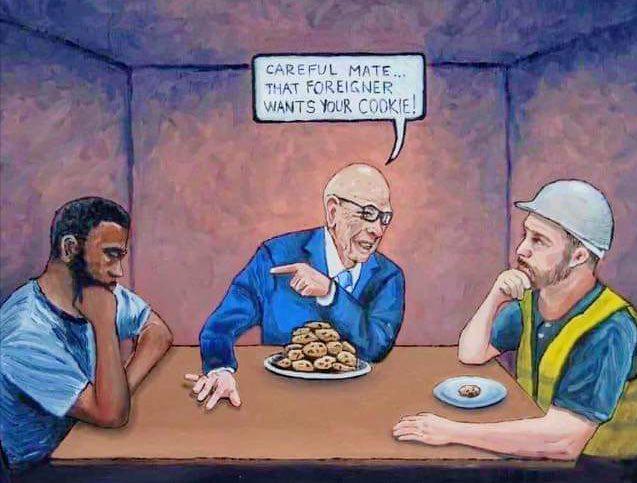
If you want to see where your money is going, look who has it all.
r/GarysEconomics • u/ProgressiveLeftFeony • 9d ago
Gary assumes Wealth is fixed, yet the budget constraint lets it grow.
He uses a budget constraint of roughly Wₛᵣ= (1+r/p)Wᵢ+(w/p)L - Cᵣ/p. That lets the rich turn consumption income into extra wealth. The problem here is Gary specified that total wealth is fixed so he uses the budget constraint (in bad faith) that only works when wealth is not fixed together with the market clearing for wealth condition, which only works when wealth is fixed.
The result is: Nonsense
So the rich have no real decision to make. With fixed wealth, the correct constraint is Cᵣ/p= (r/p)Wᵢ + (w/p)L. The rich simply consume their income and p (the asset price) cancels out. The asset price result he wanted to prove in his paper has nothing to come from.
r/GarysEconomics • u/CynonValley_Commando • 11d ago

r/GarysEconomics • u/brismelkikai • 10d ago
Idk why people on this sub are demonizing billionaires like you do realize billionaires can only be billionaires if they provide billions in value right?
BUT BUT "monopolies and govt grants" let's actually keep it a buck vast majority of billionaires don't take government grants or bailouts and aren't monopolies
And those who do is because not to save the billionaire but because the economy relies on their service, if Amazon failed tens of thousands of people would be out of jobs and billions of investment would disappear and the economy would be wrecked
Lastly how are people here ok with "exit tax" which will stop billionaires from taking a lot of wealth but after that the billionaires future wealth creation disappears meaning the country loses on future wealth
Let's says Mercedes leaves Germany and Germany taxes them 50% of all of their wealth, cool now they start building factories in America and in long term America gains more in future tax revenue than Germany did
Lastly people here believe in "fixed pie fallacy" they think billionaires are hoarding wealth not creating it, like be honest could Apple exist without its founder? No could space x exist without its founder no? You need expertise in wealth creation and management which what billionaires are
r/GarysEconomics • u/Late_Comb_3078 • 11d ago
r/GarysEconomics • u/absolve_it • 12d ago
r/GarysEconomics • u/RAbabbler • 14d ago

