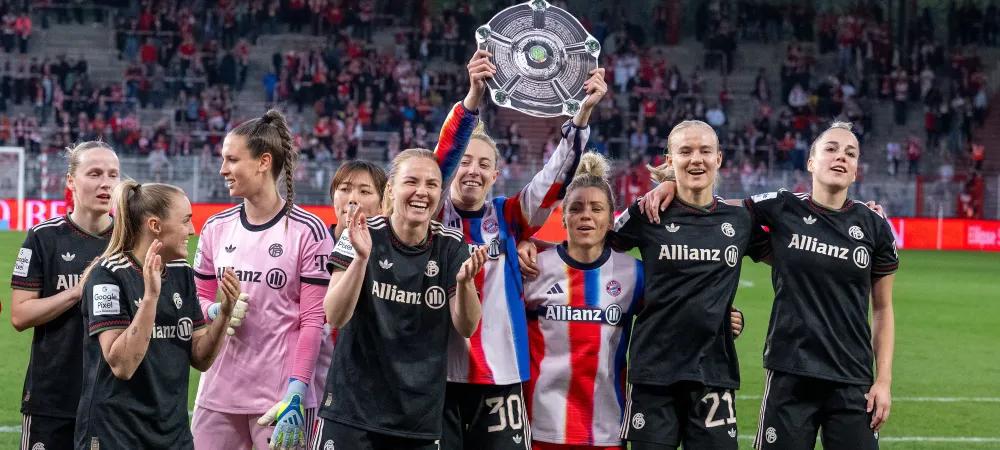
Zu unserem Heimspiel der FC-Frauen gegen Werder Bremen kam eine DFB-Delegation bestehend aus Andreas Rettig, Per Mertesacker, Nia Künzer, Christian Wück, Maren Meinert, Saskia Bartusiak und Michael Fuchs, die von Vize-Präsident Ulf Sobek und Nicole Bender-Rummler, Direktorin der #effzeh-Frauen, herzlich begrüßt wurde. Auch Geschäftsführer Thomas Kessler kam nach seiner Rückkehr aus München zum Austausch dazu.
Danke für Euern wertschätzenden Besuch."
———
"Great visit to the Geißbockheim 🤩
A DFB delegation consisting of Andreas Rettig, Per Mertesacker, Nia Künzer, Christian Wück, Maren Meinert, Saskia Bartusiak and Michael Fuchs came to our FC women's home game against Werder Bremen, which was warmly welcomed by Vice President Ulf Sobek and Nicole Bender-Rummler, director of the #effzeh women. Managing director Thomas Kessler also came to the exchange after his return from Munich.
Play-offs, investors, and greater television presence:Klaus Mühlbäckencourages German women’s football to be bold and take risks. In doing so, the sports consultant explicitly calls on public broadcasters ARD and ZDF to step up to their responsibilities.
Klaus Mühlbäck works for the auditing and consulting firm BDO, advising sports organizations on business models, sports branding, and strategic development. Previously, from 2011 to 2025, he was a professor at the International School of Management (ISM), where he headed the “International Sports Management” degree program.
For an analysis conducted in collaboration with the Bundesliga, Mühlbäck surveyed the 36 clubs in the first and second divisions regarding strategic, financial, and organizational issues. A significant portion of this work was dedicated to women’s football.
Mr. Mühlbäck, through your work at BDO, you advise sports clubs and organizations that face future challenges similar to those of the Women’s Bundesliga. How does German women’s football compare internationally?
The Women’s Bundesliga remains one of the top leagues in the world. There is really only one league that has pulled somewhat ahead of Germany—much like the situation in the men’s game—and that is the English league, the Women’s Super League (WSL). The Spanish league is also noteworthy, and perhaps even superior, thanks to FC Barcelona. However, in terms of revenue, it trails Germany: in the 2024/25 season, Liga F generated approximately 25 million euros, compared to around 43 million euros for the Women’s Bundesliga. Nevertheless, there is still significant potential for growth. Commercialization is the key to everything. In this respect, I would describe the awarding of media rights as a historic opportunity.
This Monday, the league association will decide who will hold the broadcasting rights for the 2027/28 and 2028/29 seasons. Looking ahead, there will be new kick-off times, a Sunday "simulcast" (multiple matches covered in a single broadcast), and additional "showcase" matchdays.
The simulcast format has been well-established in men’s football for over 20 years, and I am convinced it will also benefit women’s football. The primary goal in awarding these media rights is to find a partner willing to invest in the future of women’s football and to further develop the Bundesliga’s public profile.
In your view, what is the fundamental problem?
The Women’s Bundesliga struggles to generate reach. Last year, a match between Cologne and Munich at the Müngersdorfer Stadion drew around 35,000 spectators; however, the average attendance is typically closer to 2,500 to 3,000. There is a heavy focus on just a few clubs—namely FC Bayern, VfL Wolfsburg, and Eintracht Frankfurt, and perhaps also Union Berlin, Hamburger SV, and Werder Bremen. Separating from the DFB (German Football Association) was the right move for the Women’s Bundesliga. It is essential to establish an independent structure to reach both the media and the audience, as well as to boost (sponsorship) revenue. Once more funds are available, the next step will be to further enhance competitiveness on an international level. That is the task for the coming years.
Klaus Mühlbäck
As part of the media rights process, a new league format is also being considered. The season could be expanded to include seven decisive matches: four to determine the championship and three to decide an additional promotion or relegation spot. Do you believe such play-offs are an effective way to make the league more competitive?
I am a proponent of play-offs. While there are some counterarguments—raised primarily by FC Bayern and VfL Wolfsburg—I believe that, all things considered, they are a useful tool for generating increased attention over a limited period. However, this requires the matches to be staged effectively. Furthermore, play-offs do not solve the fundamental problems facing the Women’s Bundesliga; they can merely serve as one component in the development of an appropriate marketing and growth strategy.
Do you consider a title won after just two play-off matches to be equivalent to a championship title earned over the course of 26 matchdays?
In ice hockey, the champion is the team that wins the play-offs. This is also a cultural matter, as fans have been accustomed to this for decades. In football—both men’s and women’s—we are essentially only familiar with a league-based format. In that sense, what is being pursued in the Women’s Bundesliga represents a paradigm shift. However, I believe it is worth it. Sometimes, you have to do things very differently. The fans will get used to it.
But surely it cannot be in the league’s best interest to have clubs competing in the Champions League that would not have qualified during the regular season?
That is a certain risk. In the Men’s Bundesliga, I would likely decide differently. But in the women’s game, we do not yet have a comparable level of attention or public profile. For that reason, I would argue in favor of sacrificing some degree of sporting fairness—and the significance of the regular season—to achieve this. There is also another aspect where the same logic applies: the distribution of additional revenue.
Up until now, TV rights revenue has been distributed equally among the clubs.
That is a sacrifice that must be made for the sake of the league association as a whole. Ultimately, we are talking about "coopetition"—a combination of cooperation and competition. While the equal distribution of media revenue might be frustrating for the larger clubs, the league as a whole benefits when TV funds are allocated in a more balanced way; this allows weaker teams to develop further and, in the medium term, secure a stronger position. This makes the league more attractive—not just to fans, but to players as well.
During the negotiations, the media companies were able to indicate which format they would prefer. Based on this, the clubs will decide whether or not to implement play-offs. What do you expect will happen?
My guess is that media companies favor play-offs for the reasons already mentioned. Ultimately, it comes down to viewership ratings and the ability for TV channels and streaming services to generate advertising revenue. For that, they might even be willing to pay more than the current five million euros per season. However, there are also other factors that could help boost reach.
Supposed the clubs in the Women’s Bundesliga decide to introduce play-offs: they would then end up competing with the cup final and the Champions League final in May. How can they ensure they don’t get lost amidst all these other decisive matches?
One approach could be to differentiate the timing—for instance, by scheduling the play-offs for late April to secure a unique window. However, I wouldn’t necessarily recommend that. Instead, the idea needs to take root that the Women’s Bundesliga play-offs are, in their own right, a major highlight. Take the Conference League in men’s football as an example: five years ago, no one knew what it was, but now it’s firmly established in the calendar. A compelling narrative needs to be built toward the end of the regular season: "Who will make it into the play-offs? FC Bayern and VfL Wolfsburg have already qualified, but any team up to seventh place still has a chance." If that’s achieved, the Women’s Bundesliga can carve out its own space.
In your view, what would a good TV deal look like?
It’s not just about who pays the most. It might be worth choosing a smaller media partner, provided they commit to investing in women’s football. This includes ensuring a professional-grade broadcast: the women’s game should receive the same standard as the men’s—incorporating six to eight additional camera angles, live interviews, and a "match of the day" feature with commentators, presenters, and experts on-site at the stadium. That costs money, certainly, and I’m not even sure it would be profitable in the first two or three years. It’s an investment, and the media partner has to be willing to make that commitment. If they are, then it’s a good deal.
Full stands, like those seen at Union Berlin, remain a rarity in the Women’s Bundesliga. Reuters
According to media reports, MagentaSport is reportedly unwilling to increase its payments, and DAZN might potentially withdraw entirely after the upcoming season. How realistic is it that TV revenues can be increased?
If they aren’t prepared to take this path with the Women’s Bundesliga, that would be a shame. In that case, the clubs should give another media partner a chance. I can see several TV channels and streaming services that might be willing to seize this opportunity. In my view, the figure should be at least ten million euros per season. When I compare that to what is paid in other sports—or in the men’s game—it’s a laughable sum anyway. Given the projections for how women’s football could develop over the coming years, this would be an absolute bargain of an investment.
Does women’s football need more investors to create a more balanced competitive landscape in the Bundesliga?
There is no regulation in the statutes for women’s football comparable to the "50+1" rule. However, the DFB (German Football Association) congress recently amended its statutes; following this change, Section 16c of the DFB statutes now also applies to the *FBL e.V.* (the association governing the Women’s Bundesliga). Consequently, the Women’s Bundesliga is tied to the DFB’s structural framework, meaning that any club in the Women’s Bundesliga must remain under the majority control of its parent association.
In the second division, the current league leader is Viktoria Berlin—a club in which the US-based fund Monarch Collective holds a stake of up to 38 percent, alongside approximately 240 other investors.
If we want German football to remain competitive, the only path forward is through investment. For instance, Mercury 13 invests exclusively in women’s football. They currently have three European teams in their portfolio (FC Como, Bristol City, and FC Badalona), and these clubs are set to make significant strides within their respective leagues. I would welcome it if Mercury 13 were to acquire a club in the Women’s Bundesliga and drive its professional development. Now is the right moment to devise a model that achieves both: opening the door to investors while ensuring transparency, financial stability, and the preservation of each club’s identity.
These are two aspects that would differ fundamentally from the men’s Bundesliga.
I view women’s football as an independent entity. It should not present itself as a mere appendage to the men’s Bundesliga; rather, it must cultivate its own distinct profile. For this reason, it might also be worth exploring a unique championship format. In the European context, play-offs could serve as a "unique selling point" (USP). So, would it be helpful to explore new paths—approaches that perhaps haven’t even been considered in men’s football yet?
The women’s Bundesliga needs to distinguish itself from the men’s league. That is the recipe for success, and it is the direction in which development should head: not only by appealing to a different audience, but also by establishing unique features—such as a "conference" broadcast (showing multiple matches simultaneously), which would be a Sunday women’s version rather than the Saturday men’s equivalent.
Is there a particular country or association whose model you see as a blueprint for German women’s football?
Not in the sense that the women’s Bundesliga should replicate another model exactly. Of course, one can adopt elements from other countries—such as the independent league management seen in England or the franchise system used in the United States. At the same time, one must not overlook the inherent strengths of German football: its traditions, club structures, deep roots within society, and, certainly, its robust youth development system. A combination of all these aspects could be the solution for the future. The women’s Bundesliga should not attempt to become a scaled-down version of the men’s league. What is needed is a professional infrastructure that extends down to the second division, centralized commercial rights management, and an attractive model for investors. This autonomy of the women’s Bundesliga is essential."