r/GustavosAltUniverses • • 1h ago

20th Century AH (1901–2000) Gustavoism Rises Classic | Liberated Zone (1964–1968)

Post image
2 Upvotes

On 1 April 1964, Leonel Brizola and Gustavo Henrique formed the Frente Única Brasileira (FUB) and launched a joint armed uprising against the Brazilian military dictatorship that assumed power that same day. Brizola's Grupos dos Onze and Gustavo's Partido Popular Nacional attempted to take over the riograndense cities of Uruguaiana and Pelotas, two left-wing strongholds.

Thousands of left-wing nationalists, the highest-ranking of whom was Jefferson Cardim Osório, in the Brazilian military defected to the rebels, allowing them to capture both Uruguaiana and Pelotas by 8 April and establish a "liberated zone" symbolized by a black-white-red flag and a heraldic coffee branch, two Brazilian labourite symbols.

Cardim Osório's troops began advancing throughout southern Rio Grande do Sul, and, by the end of the month, they controlled one-third of the state. Brazilian President Humberto de Alencar Castelo Branco ordered an offensive in order to nip this left-wing revolution in the bud, scoring several victories but being defeated by labourist guerrillas in the Battle of São Lourenço do Sul (3–6 May 1964).

Brazil's defeat in this battle prompted the hardline faction of the Brazilian military, led by Arthur da Costa e Silva, to overthrow the moderate Castelo Branco on 25 May 1964. A week before, the United States, Paraguay, Argentina and Nicaragua launched a military intervention on the side of the military dictatorship. Argentine troops captured Uruguaiana almost immediately, and the liberated zone was soon reduced to the southern third of Rio Grande do Sul.

But, again, the FUB was not fully defeated, because Uruguay remained neutral and refused to allow OAS troops to traverse its territory. If it did, the Brazilian military would easily win the civil war, and Brazil would remain a capitalist nation to this day.

Throughout 1964 and 1965, the FUB and the Brazilian government fought a guerrilla war in Rio Grande do Sul, but, in January 1966, the Maoist PCdoB launched a guerilla movement in the Amazon rainforest, distracting the federal government's attention and allowing the FUB to capture two-thirds of Rio Grande do Sul by mid-1966.

Porto Alegre remained out of reach, however, until January 1967, when the CGT union launched a general strike in the city. This strike allowed the FUB to capture the city on 26 March, beginning the liberated zone's transformation from a rebel territory into a proper government with its own institutions.

Upon capturing Porto Alegre, Cardim Osório launched a fullscale offensive towards Santa Catarina, most of whom (other than Florianópolis and the border with Argentina) fell by August 1967. The next state to be invaded was Paraná, which, apart from the strategic Foz do Iguaçu and Paranaguá, was fully under FUB control by January 1968.

A month after capturing Curitiba, the FUB launched the Operação Guararapes, whose goal was to capture the Rio-São Paulo megalopolis. The OAS successfully foiled this goal, but the operation prompted the entire Soviet bloc to begin supporting the FUB (Cuba was already doing so) and was a major blow to the military dictatorship as the city of Florianópolis was captured.

Consequently, on 15 April 1968, Gustavo and Brizola proclaimed the Governo Revolucionário Provisório, which retained Brizola as vice president but was dominated by the radical socialist PPN rather than the social democratic PTB. Almost five years later, the GRP gave way to the República Democrática do Brasil.


r/GustavosAltUniverses • • 2h ago

Revolutionary Era AH (1789–1900) The 1828 United States presidential election, but Adams wins

Thumbnail gallery
1 Upvotes

r/GustavosAltUniverses • • 4h ago

Contemporary AH (2000–2026) Gustavoism Rises Classic | United Arab Republic (1984–present)

Post image
2 Upvotes

Since the Iranian Revolution did not happen in this timeline, Iraq invaded Syria instead of Iran in September 1980, because Saddam Hussein hated Hafez al-Assad and wanted to eliminate his rival for the leadership of the Ba'athist movement. The Soviet Union, Libya and North Korea supported Syria, but the United States, France and Brazil backed Iraq.

On 13 April 1984, the Iraqi Army captured Damascus and executed Hafez al-Assad. Saddam installed an Iraqi-aligned Ba'athist puppet government before annexing Syria 15 days later on his 47th birthday. He then proclaimed the United Arab Republic (not to be confused with the 1958–1961 union between Egypt and Syria).

Alawites led by Rifaat al-Assad launched an insurgency, with Soviet support, in the coast of Syria, but Saddam and the Muslim Brotherhood crushed them by late 1986, perpetrating a genocide of Alawites that greatly reduced Alawite influence in what used to be Syria. Also by that point, Saddam's ally Michel Aoun was firmly in power in Lebanon.

With opposition to his annexation of Syria fully quelled, Saddam continued the economic development schemes he began in Iraq in the early 1970s. The UAR's vast oil reserves allowed the country to become one of the fastest-growing economies in the world and ensure a high standard of living for its population.

Saddam eventually turned on the Muslim Brotherhood – which opposed Ba'athism – and began developing nuclear weapons. Despite Israeli shenanigans, the UAR eventually tested its first nuclear warhead in 1998, turning Iraq/Israel into another India/Palestine or Brazil/Argentina.

Since its refounding, the UAR provided billions in funding to Yasser Arafat's PLO in order to defeat the "Zionist entity", but the two intifadas were still unsuccessful and Israel was not destroyed thanks to the support it received from the United States, United Kingdom and Iran. UAR-Iran relations remained tense due to the Khuzestan dispute.

By 2010, the UAR had become the prominent Arab power, being arguably stronger than Saudi Arabia due to its larger population and more diverse economy (not relying just on oil). A year later, protests against Saddam broke out as a part of the Arab Spring, but he brutally slaughtered the protestors.

Arabia's response to COVID-19 was heavy handed but effective. Saddam eventually died of natural causes in 2023 and was succeeded by his 57 year old son Qusay, who began diversifying the economy of the UAR away from oil and strengthening the country's soft power worldwide.

Currently, the UAR is a totalitarian one-party state led by the Arab Socialist Ba'ath Party. Arabia has one of the worst human rights records in the world and commits human rights abuses against its citizens every day, but membership in the Ba'ath Party is open to Arabians of all backgrounds, and there is no religious discrimination (except against Alawites).

As far as international relations go, the UAR has good relations with Brazil, the Soviet Union, Turkey, the Gulf states, North Yemen, Sudan, Mauritania, India and China, but poor relations with the United States, Israel and Iran. Soap operas and other cultural products made in the UAR have become increasingly popular worldwide.

Like India, China, Iran and Brazil, the UAR is considered one of the world's rising powers not just culturally but also politically and economically. Arabia is ranked as the 41st most populous country in the world and the 22nd largest by popular GDP, and it is the only Arab country and one of two Muslim ones (the other being Pakistan) to possess nukes.

Arabia qualified for the 2026 FIFA World Cup, but was eliminated at the round of 32 by Haaland's Norway, which defeated the UAR by 1–0. Qusay Hussein said he was satisfied with the UAR's result and that the UAR would continue to work to strengthen its national football and Olympic teams.


r/GustavosAltUniverses • • 6h ago

Contemporary AH (2000–2026) Gustavoism Rises Classic | 2024 East German presidential election

Post image
8 Upvotes

President Reiner Haseloff was constitutionally ineligible to run for a third term. His centre-right to right-wing DSU held a presidential primary on 26 January 2024 to decide the party's nominee; Minister of Interior Steffen Große won the primary with 65.7% of the vote, defeating MP for Saxony-Anhalt Ulrich Siegmund and MP for Bradenburg Jan Redmann.

Große said he would, among other things, support a social market economy, lower taxes and levies, and secure and affordable energy. He also called for an energy mix that includes modern, safe nuclear energy as well as renewable energies and future technologies. On social issues, the DSU platform strongly backed freedom of speech and direct democracy, called for stricter controls on immigration, and opposed cancel culture.

Since the PDS was firmly controlled by Sahra Wagenknecht – who was the party's unsuccessful nominee in 2019 – by that point, the party chose to nominate her at its biennial congress instead of holding a presidential primary. Wagenknecht promised everything from more generous pensions and an increase in the minimum wage to constraining climate protection measures and toughening asylum regulations.

The PL, a PDS splinter party opposed to Wagenknecht's social conservatism and cultural nationalism, nominated Eva von Angern in the presidential election. Angern was economically to the left of Wagenknecht and supported net zero and open borders, positions that appealed mostly to East Berlin but not to the rest of East Germany given how right-wing it is.

Neo-nazi Peter Schreiber of the DNP gained a surprising amount of traction for the same reason. His far-right platform called for remigration, social security for East Germans and control against plutocracy, and natalist measures to increase birth rates, appealing to many voters who were either dissatisfied with the system or bigoted.

BFD nominee René Domke was both economically and socially liberal, supporting open borders, free trade, lower taxes, and joining the EU and NATO. And unlike the other candidates, he did not rule out German reunification, which still had some degree of support given how similar the two Germanies were.

Like always, the polls were tight when the election started, but, as the campaign progressed, Große won over the majority of swing voters, with only pensioners and the poor continuing to support Wagenknecht. On 17 July 2024, Große won the first round by a double-digit margin, winning all states other than Bradenburg and even carrying East Berlin because the left-wing vote was split.

After the first round, Angern and Communist candidate Torsten Schöwitz endorsed Wagenknecht while the other candidates either endorsed Große remained neutral. In the end, Große was able to rally right-wing and centrist votes behind him, allowing him to win the second round by an even larger margin than the first.

Große and his cabinet were inaugurated on 1 September 2024. He kept his campaign promises to lower taxes and levies and adopt stricter laws against immigration, but his other promises remained unfulfilled, and many Germans saw him as an out of touch elitist, which he denies being.


r/GustavosAltUniverses • • 21h ago

20th Century AH (1901–2000) Murder of Frank William Abagnale Junior (Sic Semper Tyrannis Universe)

Post image
3 Upvotes

Frank William Abagnale Junior, an American con artist notable for his scams in the United States, was found murdered on July 10, 1970, in Paris, France. His body was found riddled with bullet holes. Ballistics tests revealed that the murder weapon was a 9mm handgun, but the weapon itself was never found. Abagnale's killer would also never be identified.


r/GustavosAltUniverses • • 1d ago

Contemporary AH (2000–2026) Gustavoism Rises Classic | German Republic (1994–present)

Post image
6 Upvotes

On 3 June 1994, the Berlin Wall fell and the East German communist regime began to collapse. Three months later, East Germany held its first ever free and fair elections; they ended in a victory for Hans-Wilhelm Ebeling's German Social Union (DSU), which heavily played on the Prussian identity East Germany was already exploring.

Ebeling supported German reunification, but the more hardline Soviet leader Nikolai Ryzkhov blocked it in order to maintain the Soviet sphere of influence in Eastern Europe. Therefore, Germany, including Berlin, remained permanently divided, albeit with open borders and no wall.

In December 1994, East Germany adopted a new constitution. It turned the country into a semi-presidential republic; replaced the GDR's symbols with the Imperial flag/anthem and the Prussian coat of arms; and removed the "Democratic" from East Germany's official name, finishing the transformation of Germany from a socialist state to a conservative one.

Ebeling's administration adopted "shock therapy", privatizing East German industries and adopting the framework of a market economy. This reversed the economic stagnation of the GDR and led to consistent economic growth (like in neighbouring Poland), but many East Germans were negatively affected by the reforms and felt nostalgic for the GDR.

Unlike its neighbours, East Germany never joined NATO or the EU, although it did distance itself from the Soviet Union in favour of close relations with the United States and Western Europe. Western corporations began investing in East Germany, improving the country's economy even further.

In 2004, Ebeling retired and was succeeded as the president of East Germany by Eckhardt Rehberg, who lost reelection to Angelika Gramkow in 2009. Gramkow attempted to restore the positive aspects of the GDR and improve relations with the USSR, but this program faced strong opposition and the DSU returned to power in the 2014 elections, with Reiner Haseloff.

During Haseloff's presidency, the economy of East Germany continued to grow and integrate itself with the rest of Europe, allowing him to defeat Sahra Wagenknecht for reelection in 2019. Haseloff responded fairly effectively to COVID-19 and remained popular throughout his second term, allowing the more right-wing Steffen Große to be elected President in 2024.

Currently, East Germany is a developed country with good relations with its neighbours West Germany, Poland and Czechoslovakia. Remaining independent allowed Eastern Germany to be a significantly better place than in real life, but neo-Nazism, corruption, and poverty are still big problems.

Given the legacy of communism, most East Germans are atheists. While religiosity briefly increased somewhat after the fall of communism, it later declined again, and the vast majority of East Germans born after 1994 do not believe in God or religion. Protestant culture remains influential though.

With no threat of war against anybody, the East German military has gone from one of the strongest in the Eastern Bloc to a pretty weak force mostly armed with late 1980s and early 1990s weaponry. A West German invasion to forcefully reunify Germany is unlikely to happen, but it would certainly be successful given the military disparity between the two Germanies.

The East German national football team has qualified for the 1974, 2018 and 2026 FIFA World Cups. Currently, it is considered one of the rising stars of international football, despite remaining significantly behind West Germany. East Germany does somewhat well in the summer and winter Olympics as well.


r/GustavosAltUniverses • • 1d ago

Contemporary AH (2000–2026) Not Flash, Just Gordon: Gordon Brown calls a snap election in 2007

Thumbnail gallery
3 Upvotes

r/GustavosAltUniverses • • 1d ago

Contemporary AH (2000–2026) Frank Underwood's War (Sic Semper Tyrannis Universe)

Post image
4 Upvotes

Context: 

  1. The events of Better Call Saul and House of Cards happen in the same continuity, but key lore events of both shows are altered to accommodate SSTU events. For example, Walter White is murdered before the events of Breaking Bad even happen in the first place (This is the first point of divergence) and various canon House of Cards characters either don’t exist at all or survive past the point in which they canonically died (Ex: Zoe Barnes survives past her canonical death scene and Rachel Posner is never born at all).
  2. The events of Reboot Modern Warfare (2019) happen, but Reboot Modern Warfare games II (2022) and III (2023) do not.
  3. 2000 US Presidential election
  4. 2016 US Presidential election 

From 2013 to 2016, former Democratic Majority Whip Frank Underwood and corrupt lawyer Saul Goodman embarked on a campaign of political retribution against the Republican Party, owing to the belief that Lionel Winchester, the winner of the 2012 US Presidential Election, rigged things in his favor. The campaign went by the operational codename Operation D-Day, though some commentators also referred to it as the Dark Winter Attacks, the Black Winter Attacks, or simply Underwood's War.

The first phase of the operation involved Underwood and his recently appointed right-hand man Saul Goodman bribing Washington police chief Barney Hull to release Peter Russo from custody, and agreed to cover up his arrest in exchange for campaign contributions. Underwood and Goodman used Russo, and Washington Herald reporter Zoe Barnes who engaged in an extramarital affair with him, as the mouthpieces of his conspiracy. Russo and Barnes were the catalyst for the education reform which politically undermined the Winchester Presidency. 

Phase two of the operation saw the murders of at least fifteen people, most of whom were part of Winchester’s campaign team. 

The campaign culminated in Frank announcing his bid to run for the U.S. presidency in 2016, and picking Saul Goodman as his running mate. Underwood's ultimate plan would come to a screeching halt when he was assassinated on January 25, 2017.

Author's note: This is the first time I used Wikipedia's sandbox. Apologies if it looks terrible.


r/GustavosAltUniverses • • 1d ago

Contemporary AH (2000–2026) Gustavoism Rises Classic | Soviet Union (1922–present)

Post image
7 Upvotes

Since the independence of the Baltics and Georgia in 1995, the Soviet Union has been made up of the Soviet Socialist Republics of Armenia, Azerbaijan, Belarus, Kazakhstan, Kyrgyzstan, Russia, Tajikistan, Turkmenistan and Uzbekistan. In addition, Abkhazia and South Ossetia are associated states of the USSR like Niue is an associated state of New Zealand.

In addition to the Soviet-Afghan War not happening, another reason the USSR survived was that Nikolai Ryzhkov, who led the Soviet Union from 1985 until his death in 2024, implemented economic reforms transitioning the USSR from a command economy to a market socialist economy combining planning and markets. Consequently, Russia remained mostly economically and demographically intact during the 1990s.

While the USSR is no longer a superpower, it is still the strongest – at least on paper – military power in the world, and the fourth-largest economy by nominal and PPP GDP, behind the United States, China and Japan. Not to mention that Vietnam, Laos, rump Yugoslavia, and Mongolia are Soviet satellite states.

Currently, Ivan Melnikov leads the Soviet Union as its General Secretary, while Yury Afonin is Premier and Vladimir Kashin is its ceremonial president. Putin wields considerable authority as the chairman of the KGB, and General Secretaries Sergei Syrankov of Belarus and Petro Symonenko of Ukraine are fairly powerful as well.

Despite making it past the 1990s, the USSR still has major societal problems, such as corruption, alcoholism, and a work-shy workforce. And Putin's KGB is responsible for widespread human rights abuses against Soviet dissidents and LGBT people, who are denied many rights (for instance, gay marriage is illegal across the entire Union).

Under Ryzhkov and Melnikov's leaderships, the russification of Ukraine, Belarus and Central Asia continued and many Russian settlers still moved to these regions. Separatist movements are active throughout the USSR, but they face energic repression from the KGB and have no chance of actually seceding parts of the union.

Relations between the Soviet Union and the Brazilian-led socialist bloc in Latin America and Africa are friendly, but the Brasília Pact is fully independent and separate from the USSR and the remnants of the Soviet bloc. Plus, there's ideological competition between Gustavoism and communism, especially in Africa where these two left-wing ideologies are often rivals.

Since the Cold War never ended, relations between the US and the USSR remain hostile to this day, despite occasional periods of détente. The entire world – not just South America and the Indian subcontinent – lives in fear of a nuclear war, which is a common theme in pop culture (i.e. Fallout).

The USSR remained good at sports, qualifying for every World Cup (except for 2010) after 1994 and finishing at least third on the medal table of every Summer Olympics held after 1996. Doping is still a major controversy though, leading to tensions between the Soviet Olympic committee and the IOC.

According to experts, the USSR is on a long-term trend of decline, especially when compared to China/India/Brazil. But a full collapse of the union is unlikely, unless a leader attempts to turn the country into a democracy and a hardline coup attempt fails – which is a unlikely sequence of events.


r/GustavosAltUniverses • • 1d ago

Contemporary AH (2000–2026) Gustavoism Rises Classic | National People's Party (1948–present)

Post image
4 Upvotes

On 10 February 1948, Gustavo Ferreira Henrique left the social democratic PTB because of its support for the centrist, conservative-leaning government of Eurico Gaspar Dutra. He immediately began preparing to launch a new party that was basically the PTB, but advocating for socialism rather than corporatism.

He was soon joined by Caio Prado Júnior and Nelson Werneck Sodré, two dissidents from the PCB, which had been outlawed by the Dutra administration the previous year. On 12 March 1948, Henrique, Prado Júnior, and Werneck Sodré headed a Congress with 250 delegates that formally established the PPN.

Brazilian authorities were suspicious of the party, and it was only registered on 12 January 1950, after proving to the Supreme Electoral Court it was not a communist or subversive organisation. Rather than working with the clandestine PCB, the PPN preferred to cooperate with the PSB – which advocated for democratic socialism – instead.

But this cooperation had its limits, because the PPN supported Getúlio Vargas instead of PSB nominee João Mangabeira in the 1950 presidential election. Gustavo's non-Marxist socialism, based on communal traditions and the thoughts of historical Brazilian reformers, was at odds with the PSB's intellectual and Marxist origins, making relations between the two parties difficult.

The PPN continued to support Vargas throughout his presidency, and later endorsed Juscelino Kubitschek in the 1955 presidential election. During its early years, the PPN did very poorly in elections, with its candidates, including Henrique, usually winning just a few hundred votes; consequently, the party preferred to form coalitions with the PTB and PSB.

Leftist dissatisfaction with JK eventually boosted the PPN's fortunes, allowing Henrique to be elected to the Chamber of Deputies for Rio Grande do Sul in 1958. During the last two years of JK's presidency, the PPN opposed his administration, and went on to similarly oppose the right-wing populist Jânio Quadros.

By contrast, the PPN was fully supportive of João Goulart and his proposed reforms, describing them as the best way to modernize Brazil and prevent a communist revolution. Leftist intellectuals flocked to the PPN, allowing it to elect a further three federal deputies – Prado Júnior, Werneck Sodré, and Celso Brant – in the 1962 elections.

In early 1964, Gustavo prepared to run for President in 1964. Polls held in Brazil's major cities showed that 4% of the urban population supported the PPN, and that Gustavo would win 2% of the vote in a presidential election against JK, conservative Carlos Lacerda, and leftist Miguel Arraes, meaning that Gustavoism would be a historical footnote without the 1964 coup.

Henrique responded to the coup by launching a nationwide uprising against the military dictatorship, triggering the Brazilian Civil War, which also involved a OAS military intervention on the side of the Brazilian military dictatorship, and guerrilla warfare from far-left and far-right militant groups. The PPN eventually won the war on 30 March 1973, and proclaimed the Democratic Republic of Brazil.

After coming to power, the PPN suppressed centrist, right-wing and communist political parties, and forced the PTB and PSB to become puppet parties like the ones in China and East Germany. The party established the MSE as a nationwide secret police and the Voluntários da Pátria as a paramilitary force to purge Brazil's traditional elite, which was almost completely eliminated by 1976.

Henrique eventually died in 2002 and was followed as Brazilian president and PPN chairman by Roberto Requião (2002–2007), Ciro Gomes (2007–2011), Vinícius Caldeira Brant (2011–2015), and incumbent Aldo Rebelo, who turned himself into the party's most important figurehead other than Henrique, and reaffirmed the PPN's commitment to Brazilian nationalism.

Internationally, the PPN is the leader of the Front for the Liberation of Latin America (FLAL/FLLA), an alliance of Latin American left-wing parties under Brazilian leadership. It has good relations with the League of Communits of Yugoslavia and the United Arab Republic's ruling Arab Socialist Ba'ath Party.

Diário Nacional is the PPN's official newspaper, and the paper with the highest circulation in Brazil. Like most political parties, the PPN has a women's wing, the Liga das Mulheres Brasileiras; a youth wing, the Juventude Brasileira; and a student wing, the União Nacional dos Estudantes (UNE), which was originally unrelated to the PPN but was coopted during the Brazilian civil war.

In December 2025 the PPN had 20,500,000 members out of a population of 200 million. Like in other socialist countries, the party's members have privileges the rest of the population doesn't, and a higher standard of living than the average Brazilian (although Brazil has a higher quality of life than in the real world).


r/GustavosAltUniverses • • 2d ago

Revolutionary Era AH (1789–1900) The 1824 United States presidential election, but Jackson wins

Thumbnail gallery
2 Upvotes

r/GustavosAltUniverses • • 2d ago

Contemporary AH (2000–2026) Gustavoism Rises Classic | Democratic Republic of Brazil (1973–present)

Post image
12 Upvotes

Since the Brazilian Revolution of 1973 – when Gustavo Ferreira Henrique's Partido Popular Nacional (PPN) overthrew the Brazilian military dictatorship after a decade-long civil war – Brazil has been a socialist state ruled by the PPN, which rejects both capitalism and communism in favour of a synthesis of Brazilian labourism and Titoism.

Brazil's constitution defines the PPN as the country's paramount, vanguard party. Despite being labeled a "one-party state", Brazil allows three other legal parties: the PTB, the PSB, and the PV; they're just subordinated to the PPB and exist solely to provide a veneer of democracy, controlling just a few seats in the unicemeral National Congress.

In reality, Brazil is an oppressive dictatorship responsible for many human rights abuses, such as torture, arbitrary arrests, and extrajudicial executions. The Ministério da Segurança do Estado (MSE) and the Voluntários da Pátria (VP), both of whom are currently led by Rafael Lusvarghi, are in charge of suppressing dissent, censoring the media, and promoting a favorable image of the government at home and abroad.

The revolution also turned Brazil into a unitary state, stripping state and municipal governments of any autonomy and turning them into mere mechanisms of federal control over lower level divisions. States and municipalities are banned from having their own anthems and flags, and they cannot make languages other than Portuguese official either.

Corruption is also a significant issue, and is even worse than in real life because the government is not accountable to the populace. While President Aldo Rebelo – who has led the country since 2015 – himself is not corrupt, many lower level officials are; the MSE covers up corruption cases, giving Brazilians the impression their government is clean.

Despite all these problems, Brazil is the fifth largest economy in the world by both nominal and PPP GDP, thanks to Brazil's control over a sphere of influence encompassing all independent South American countries other than Argentina, in addition to Cuba, Nicaragua, Angola, Mozambique, Guinea-Bissau, Cape Verde and São Tomé e Príncipe.

The economy of Brazil is a market socialist economy like these of Yugoslavia and Janos Kadar's Hungary. Brazil's government has a monopoly over oil, mining and heavy industry, but consumer goods industries are democratically managed by the workers, agriculture is dominated by family farming and agricultural coops, and there is a semblance of workers' democracy at the council/local level.

Brazil tested its first nuclear warhead in 1990, and currently has 60 to 85 nukes. Since Argentina, Brazil's greatest enemy and an anti-communist military dictatorship led by Aldo Rico, also has nukes, South America lives under constant fear of a nuclear war between the two dictatorships.

In spite of being stronger than in real life, Brazil does not control all of its pre-1973 territory, because the United States has occupied the island of Fernando de Noronha ever since. America uses the island as a base from which to undermine the Brazilian regime by spreading propaganda and supporting dissidents, resulting in high tensions between Brasília and Washington.

As a non-Marxist socialist state, Brazil rejects state atheism and has almost complete religious freedom, except for neopentecostal churches, which are seen as a US psyop and banned. 20% of Brazil's population is irreligious, and atheists, deists and agnostics are a majority of the population in the wealthier southern region. Liberation theology is the country's dominant religious philosophy, and the PPN has mostly positive relations with the Catholic Church.


r/GustavosAltUniverses • • 2d ago

Contemporary AH (2000–2026) Doğu the Red Sultan | 2026 bombing of Turkey

Post image
6 Upvotes

Trump was infuriated by the Turkish-Iranian arms deal and decided to retaliate by bombing Turkey, as did Israel, which resented Perinçek's support for Hezbollah and Hamas. America and Israel asked Greece to join the operation, but Greek prime minister Panos Kammenos refused to avoid triggering a full-scale war with Turkey (although he did allow the United States to use its military base in Crete), drawing criticism from pro-Trump Minister of Sports Afroditi Latinopoulou.

On 16 March 2026, the United States launched simultaneous bomber, drone and cruise missile airstrikes against Ankara, Istanbul and North Cyprus in order to assassinate Doğu Perinçek, ensure he was replaced with a pro-western leader, and weaken the Turkish military enough to ensure a popular revolt broke out if he survived. Israel soon joined the bombing, sending 64 fighter jets and 32 UAVs to attack these three locations; the long distance from Ankara and Istanbul meant that aerial refueling was needed in these cases.

Turkish Su-35 and F-16 fighter jets scrambled to defend the country, but the Turkish Air Force was both numerically and technologically (Turkey had no stealth fighters in active service) to the US and Israeli ones. Thus, 16 aircraft and 11 S-400 launchers were destroyed on the ground by cruise missile strikes, and 21 other aircraft were shot down during aerial combat.

Turkey did manage to shoot down 2 American B-1 Lancer bombers, 42 American F-16, F-15 and F/A-18 fighter planes, 6 Israeli F-16I and F-35 fighter planes, 7 American UAVs, and 3 Israeli UAVs, and one Burke destroyer was damaged by a Turkish anti-ship missile. Furthermore, Perinçek – who hid in an underground bunker in Ankara – his son Mehmet, and his right-hand man Gökçe Fırat Çulhaoğlu remained unharmed, and the Turks retaliated by launching drone strikes against Israel.

By 23 March, it was clear the US and Israel had failed to achieve their strategic goals, causing them to halt the bombing. In fact, the bombing of Turkey had the opposite effect of rallying the Turkish population behind the Ulusalist government, whose popularity had already been increasing for years.

After the end of the bombings, Perinçek claimed he had won a "specular victory" over the United States, and made 23 March a holiday named the "Day of Victory over US imperialism". 17 Turkish and North Cypriot civilians were killed and 55 were wounded by the operation; they were posthumously declared "martyrs of Kemalism" by the Great National Assembly.

While Perinçek remained in power and Turkish support for Iran continued, the Turkish military was significantly weakened by the bombings, and was now less of a threat to Western interests in MENA. Over a year later, the Turkish Air Force has yet to be rebuilt.


r/GustavosAltUniverses • • 2d ago

20th Century AH (1901–2000) The Czechoslovakian-Slovak Referendum

2 Upvotes

Earlier this morning, Czechslovokian president, President Josef Otto Czechoslovakia of Czechslovokia held a national referendum to grant or not to grant the Slavaks autonomy in Slovakia.

Though filled with speculation it is theorize that the president made this decision for the sole reason of rising instability and already existing questions of autonomy. But surprisingly to both Hungarians and Czechs, the Slovaks did NOT vote for autonomy instead the consensus of the regular Slovak was that after seeing what Czechoslovakia could be and other powers. So the Slovaks decided to remain united under the strong Czechoslovak rule, as Czechs and Slovaks both hate the Hungarians. But reports indicate that the hungarians are just kind of bummed out and that they don't really care and they will just continue with what they're doing.

Does anybody know what chick Slovakia will do next absolutely not nobody knows not even the council only the president who will debate with the council and then do whatever the president wills as long as it follows the rules that I won't specify.

[End of News Segment, Broadcast, Thing? Idk]


r/GustavosAltUniverses • • 2d ago

Contemporary AH (2000–2026) Doğu the Red Sultan | 2025 Syrian coup d'état

Post image
7 Upvotes

Despite winning the Syrian civil war, Assad's rule remained weak throughout the 2020s because of how incompetent and corrupt he was. Vladimir Putin and Doğu Perinçek eventually grew concerned by this situation and feared the entire Ba'athist regime would be overthrown if Assad didn't go.

In mid-2025, tensions grew between Assad and his army chief of staff Abdul Karim Mahmoud Ibrahim, who began to publicly criticize the Alawite sectarianism and lack of economic and military reforms of the Assad regime. Mahmoud Ibrahim and fellow Syrian general Suhayl al-Hasan eventually began planning a coup against Assad.

By the time Assad's security services learned about the coup plot, it was too late. On 17 June, Hasan and Mahmoud Ibrahim launched military uprisings in Damascus and Aleppo, capturing both cities by the end of the day and putting Assad under house arrest; this ended almost half a century of rule by the Assad family.

After the success of a coup, Mahmoud Ibrahim appeared in state television to announce the coup and the formation of a military junta. Cheering crowds formed in the streets of Damascus after Assad's overthrow, and the majority of Syrians, except for Alawites, were pleased.

Mahmoud Ibrahim's junta ended the Alawite dominance of the Syrian government and gave other religious groups a larger stake in the Ba'athist regime. He also launched stricter rules and a purge against corruption; put Assad and other members of his inner circle on trial; and reformed the economy of Syria to be less cronyist and more efficient.

Iran condemned the coup due to its obsession with the "Axis or resistance", but Russia and Turkey immediately recognized the new government and continued their military cooperation with Syria. Despite the reforms, Syria remained a totalitarian state responsible for widespread human rights violations, and there was no democratisation.

For instance, Syria retained its chemical weapons, ignoring OPCW requests for their destruction, and the Mukhabarat continued to repress democratic movements. As of the time of writing (July 2027), Mahmoud Ibrahim is firmly in power in Damascus, and has repressed opposition from both Assad loyalists backed by Iran and liberals/Kurds/Islamists supported by Qatar and the United States.


r/GustavosAltUniverses • • 2d ago

Contemporary AH (2000–2026) What would American history look like if the events of the first 4 seasons of the Netflix series House of Cards happened in real life?

Thumbnail
gallery
2 Upvotes

r/GustavosAltUniverses • • 2d ago

Contemporary AH (2000–2026) Doğu the Red Sultan | 2024 Moldovan presidential election

Post image
5 Upvotes

In the absence of a war in Ukraine, pro-Western sentiment was weaker in Moldova, making Maia Sandu's chances of winning reelection in 2024 doubtful. But she still had a chance and stood for reelection, highlighting the achievements of her administration and the benefits that would come from European integration.

Former President Igor Dodon – who lost reelection to Sandy in 2020 – took advantage of this to mount a comeback. Dodon criticized Sandu's liberal, pro-European policies and promised to put the interests of Moldova above those of Brussels, like he had allegedly done during his presidency.

Renato Usatii, the leader of Our Party (PN), gained a lot of momentum, especially in his native region. Usatii campaigned as a left-wing populist; he promised to turn Moldova into a "normal state" where state institutions would work for the people, and fully opposed European integration.

Former Gagauzia governor Irina Vlah was a dark horse candidate. A left-wing conservative, she promised to end the demographic crisis, return from dictatorship to democracy, pursue a balanced foreign policy based on the interests of the state, ensure an independent and professional justice system, and so on.

The campaign started with Dodon as the frontrunner, but he ran an awful campaign and squandered an easily winnable race, making him lose many voters to Vlah and Usatii. The abundance of pro-Russian candidates allowed Sandu to win the first round – albeit narrowly – thanks to support from diaspora voters.

But the other pro-Russian candidates endorsed Vlah, allowing her to win the second round by a landslide margin of 43% of the vote. According to the official returns, Vlah won 79% of the vote in Moldova itself, while Sandu won 58% of the diaspora vote. Vlah – who established the Fair Moldova party shortly after being elected – and her cabinet were inaugurated on 24 December 2024.

As a Gagauz, Vlah massively expanded relations between Moldova and Doğu Perinçek's Ulusalist Turkey, which increasingly traded and culturally exchanged with Moldova. She was also on good terms with Russia, Ukraine, Belarus, and Hungary, but relations with the EU deteriorated because Brussels accused her of democratic backsliding.


r/GustavosAltUniverses • • 2d ago

Contemporary AH (2000–2026) Doğu the Red Sultan | 2024 Ukrainian presidential election

Post image
4 Upvotes

Since Russia did not invade Georgia in 2008, it did not invade Ukraine in either 2014 or 2022, because the supine western response to the invasion of Georgia emboldened Russia. Since there was no active conflict with Russia, Petro Poroshenko was narrowly reelected in 2019, defeating Zelensky with 51% of the vote versus 48% for him.

Five years later, Poroshenko was term limited, prompting his European Solidarity party to nominate Kyiv Mayor Vitali Klitschko. Klitschko promised to continue Poroshenko's policy of European integration and, if possible, bring Ukraine into the EU, which it was a candidate member of but hadn't fully joined.

The pro-Russian Opposition Platform – For Life nominated Yuriy Boyko for a second time (he first ran in the 2019 presidential election, finishing third in the first round with 15% of the vote). Boyko criticized the economically liberal and pro-European policies of the Poroshenko administration, calling instead for increased state intervention and welfare and an improvement in relations with Russia, which were tense despite the war not happening.

With a neoliberal oligarch in office for 8 years, the agrarian, nationalist and populist Oleh Liashko gained more traction than in previous elections. Liashko promised wealth redistribution, cheap credit for farmers, and a move away from European integration, which he described as unsuccessful.

The failure of Zelensky's 2019 presidential bid caused him not to run for President again. Rather, his Servant of the People party nominated Oleksandr Korniyenko, who lacked Zelensky's charisma and name recognition and therefore did even worse, never polling above 17%.

Yulia Timoshenko, another major Ukrainian politician, did not run in 2024 either, and was replaced by Olena Kondratiuk, who ran on a populist platform similar to Liashko's but pro-European and less left-wing. Kondratiuk was similarly less charismatic and well-known than Timoshenko though.

Polls showed a close race, and by the end of the first round campaign, Boyko had a slight lead. He eventually won the first round before being endorsed by fellow pro-Russians Yevhen Murayev of the Opposition Bloc and Viktor Bondar of Change Ukraine.

Putin planned to launch a full-scale invasion of Ukraine if Klitschko was elected, but this proved not to be needed because Boyko won the second round with 52% of the vote. A day after the election, Klitschko gave a concession speech where he wished Boyko a successful presidency.

Boyko and his cabinet took office on 20 May 2024, and immediately realigned Ukraine with Russia, although the country's EU candidacy wasn't withdrawn to prevent another Euromaidan. The latest poll gave Boyko a 48% approval rating inside Ukraine.


r/GustavosAltUniverses • • 2d ago

Contemporary AH (2000–2026) Doğu the Red Sultan | Premiership of Doğu Perinçek (2022–2027)

Post image
2 Upvotes

From 2022 onwards, Turkey experienced a modest economic recovery, because Perinçek's expansion of trade with the Global South had a positive effect on the economy of Turkey, and Turkey remained a large enough consumer market for many EU countries – but not the USA – to ignore the sanctions. In FY2024, the economy of Turkey grew at a rate of 1.3%, making this the first time since 2013 when the country experienced positive GDP growth.

As the economic of Turkey recovered, Perinçek recovered some, but not all, of the popularity he had between 2007 and 2012, and some of the Turkish diaspora returned to Turkey. In August 2025, Oxfam Türkiye director Cengiz Boz said, "The situation in Turkey has improved considerably compared to a few years ago".

This improving economic situation caused Perinçek to be bolder in his foreign policy, supplying the pro-Russian juntas in Mali, Niger and Burkina Faso with large amounts of weapons and increasing military aid to the Houthis. Biden and especially Trump were alarmed at this Turkish expansionism.

But the Ulusalist damage was done, because a 2024 survey showed that 33% of Turks lived in poverty, 8% lived in extreme poverty, and 12% starved. Perinçek blamed the US/EU sanctions for this situation; it was actually caused by his adoption of socialism in a developed, industrialized country that did not need to abolish capitalism.

On 17 March 2025, the Great National Assembly passed a constitutional amendment banning same-sex marriage, and a law banning the use of public funds for trans people to transition. Two years later, Turkey remains one of the secular countries with the harshest discrimination against LGBT people, even though it does not reach the level of Iran.

When the United States and Israel launched airstrikes against Iran later in 2025, Turkey condemned the western moves and declared its support for Iran. When another war between these countries and Iran broke out the following year, the Ulusalist regime was more proactive and sold $3 billion in weapons to Tehran.

Trump retaliated by launching airstrikes and missile strikes against Turkey, causing significant damage to the Turkish Armed Forces but failing to overthrow Perinçek. In fact, the airstrikes, like the 2007 Turkish coup attempt, gave him a rally around the flag effect, increasing Perinçek's approval rating from 46% to 74%.

A year later, the 85 year old Perinçek retired after 25 years in power, because he felt his regime was entrenched enough for it to survive without him. In fact, Gökçe Fırat Çulhaoğlu led the Workers' Party to victory in the 2027 Turkish general election, thanks both to rigging and to genuine popularity, especially with upper middle class secular Turks.


r/GustavosAltUniverses • • 3d ago

20th Century AH (1901–2000) The 1999 Manitoba general election, but the PCs win

Thumbnail gallery
1 Upvotes

r/GustavosAltUniverses • • 3d ago

Contemporary AH (2000–2026) Doğu the Red Sultan | 2022 Turkish general election

Post image
1 Upvotes

During December 2021 and January 2022, there was speculation that Perinçek would retire and step down in favour of his son Mehmet, but Doğu Perinçek publicly denied these claims on 11 January, and announced he would remain the leader of the İP for the 2022 election.

Perinçek ran a Turkish nationalist campaign, emphasizing how he had massively expanded Turkey's geopolitical influence throughout the previous twenty years, and effectively defended Turkey from the massive conspiracy against the country Ulusalists believe exists. Supporters received his campaign positively, but other Turks were indifferent or hostile to his efforts.

The AKP was led by Abdullah Güler, who promised to lower taxes, privatize state-owned businesses, return to free trade, and rejoin NATO and its integrated command. Like in previous elections, the AKP faced widespread repression from Turkish courts, who prevented many candidates from running, and security forces, who arrested many opponents.

MHP leader Devlet Bahçeli took a tough stance on immigration, promising to deport thousands of illegal immigrants and build a wall on the Turkish-Syrian border to reduce immigration. Bahçeli also called for state capitalist economic policies and the improvement of relations with western powers.

Despite constant demonization by Turkish nationalists, the Turkish Federal Party remained popular with Kurdish voters, who were dissatisfied with the İP's economic mismanagement and fight against nonexistent "feudalism" in Turkish Kurdistan. Most polls showed the Federalists crossing the 10% threshold, which was certainly possible.

Independent observers thought the İP would certainly lose a free and fair election because of how awful the economy of Turkey was. The Ulusalists knew this and resorted to large-scale voter fraud in order to remain in power and prevent the "imperialist puppets" from winning.

On 22 July 2022, the İP won a landslide majority of seats and a plurality of 11.85% of the vote, improving on its 2017 performance significantly. The AKP also made minor gains, while the MHP suffered significant losses and the Federalists – painted purple on the map – lost all their seats due to winning just 9% of the vote.

Post-election protests against voter fraud were violently repressed just like in previous years. International organizations estimated that Turkish security forces killed 2,000 people and wounded 6,500, estimates the İP denied, claiming that the numbers were much lower and that the protestors attacked the police first.


r/GustavosAltUniverses • • 3d ago

Contemporary AH (2000–2026) Doğu the Red Sultan | COVID-19 pandemic in Turkey (2020)

Post image
5 Upvotes

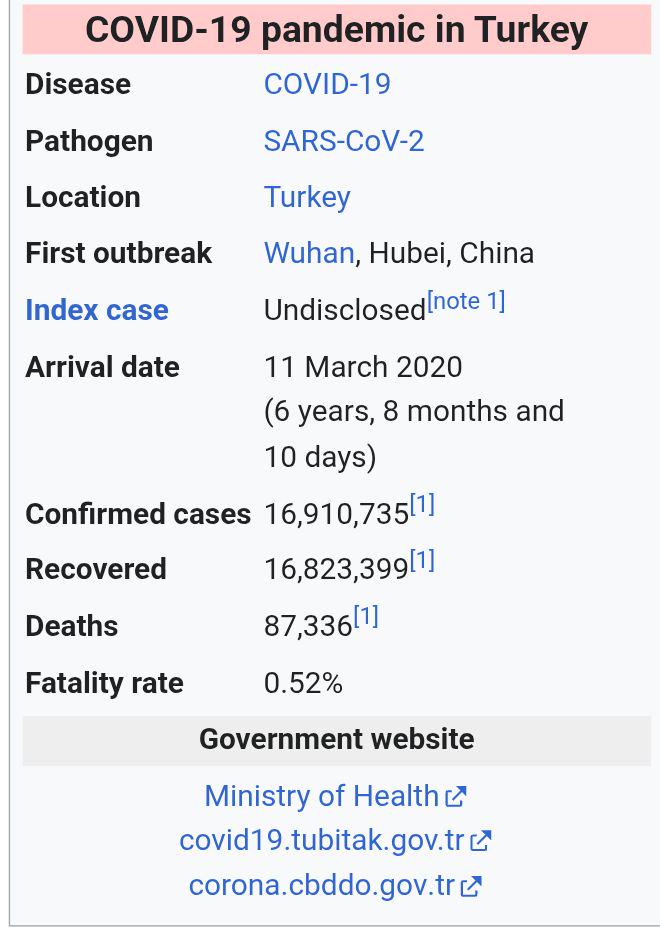
Given Turkey's relative lack of nursing homes, favourable demographics, long legacy of contact tracing, high number of ICUs, and universal healthcare, COVID-19 took a long time to arrive in Turkey, only doing so on 11 March 2020. By the end of the week, dozens of Turks had died, prompting Perinçek to impose lockdowns and mask mandates as strict as the ones in Russia.

The aforementioned factors made COVID have little impact in Turkey, killing just 87,336 people (0.5% of confirmed cases) and not overwhelming the public healthcare system like it did in other countries. But the international community accused the Ulusalist regime of underreporting COVID-19 statistics.

In October 2020, Perinçek began gradually lifting COVID restrictions, which were fully lifted by December. By that point, COVID-19 vaccines were already commercially available, and the government of Turkey made vaccination mandatory, resulting in the vaccination of most of the population by mid-2021.

As you can see, life returned to normal in Turkey earlier than in other countries. A major consequence of the pandemic was a boost in Perinçek's popularity, which had been very low because of the poor economy and his human rights abuses.


r/GustavosAltUniverses • • 3d ago

Contemporary AH (2000–2026) Doğu the Red Sultan | 2019 Greek general election

Post image
2 Upvotes

Greek Prime Minister Pamos Kamennos entered the 2019 general election in a strong position, because he had revoked the first and second memorandums and loan agreements between Greece, the EU and the IMF. He also repudiated part of Greece's debt, blaming it on a conspiracy to bankrupt Greece. These decisions had some negative consequences, but the majority of Greeks approved of them.

Furthermore, Kamennos' premiership saw democratic backsliding like these of Orbán in Hungary and Perinçek in Turkey. His People's Party (LK) increasingly controlled Greece's courts and media, in addition to adopting stricter controls on immigration and increasing religious influence in the education system.

Despite agreeing with Kamennos' end of austerity, Syriza opposed these policies, calling instead for the maintenance of secularism and open borders and the expansion of social programs and the public sector. Syriza leader Alexis Tsipras criticized Kamennos for his comments on the Greek junta, accusing him of whitewashing a brutal period in Greece's history.

Unlike Syriza and the LK, the formerly dominant KINAL (formerly PASOK) campaigned on a liberal, centre-left platform, criticizing the effects of the repeal of the two memorandums and the repudiation of part of Greece's debts. A non-negligible number of Greeks opposed these measures and supported the KINAL.

New Democracy had lost its position as one of Greece's dominant parties, because the majority of conservative Greeks now supported the LK. But Kyriakos Mitsotakis still campaigned on economic liberalism and pro-Europeanism, criticizing the Kamennos administration's populist and eurosceptic policies as harmful to Greece.

Dmitris Koutsoumpas's KKE strongly criticized the other parties, describing itself as the "only popular and democratic force in Greece", and called for the transformation of Greece into a socialist society. As a communist party, the KKE was friendlier to Ulusalist Turkey than the other parties, resulting in accusations of Turkish support for the party.

When the campaign started, both the LK and Syriza had a chance of winning, as did the KINAL to a lesser extent, but the LK ran a good campaign and voters did not feel the need for a leftward shift. Consequently, the LK won the election with 166 seats (thanks to a majority bonus) and 35.4% of the vote versus 50 seats and 30.4% of the vote for Syriza and 43 seats and 13.3% of the vote for the KINAL.

A day after the election, Kamennos thanked Greek voters for their support and vowed to continue defending the sovereignty of Greece during his second term.


r/GustavosAltUniverses • • 3d ago

Contemporary AH (2000–2026) Doğu the Red Sultan | Western Libya campaign (2017–2018)

Post image
4 Upvotes

On 17 March 2017, Khalifa Haftar's LNA launched a full-scale push towards Tripoli with Turkish and Russian support. Fearing the reunification of Libya under the hostile Haftar, Italy and Qatar provided military and financial aid to their ally the GNA, which managed to hold the LNA advance until December, when Haftar went on the offensive again.

By January 2018, the first phase of the campaign had been concluded, and the LNA was advancing upon Tripoli. Mercenaries from the Wagner Group and the Sudanese RSF, in addition to Turkish advisors, were present in Western Libya and played a key role in the LNA's successes.

Much of the GNA's military either surrendered or defected to the rebels, allowing the LNA and mercenaries to begin shelling Tripoli on 28 February 2018. A week later, they directly attacked the city, beginning the last major battle of the Second Libyan Civil War.

Wagner and the RSF committed horrific war crimes against civilians suspected of sympathizing with the GNA, leading to international condemnation. But the LNA and its allies far outnumbered and outgunned the GNA's forces, allowing Haftar to capture Tripoli on 25 March 2018 and proclaim himself the President of Libya.

Turkey, Syria and the United Arab Emirates immediately recognized Haftar's leadership; Doğu Perinçek called Haftar a "good friend of Turkey" and Bashar al-Assad became the first world leader to visit Libya after the fall of Tripoli. Despite controlling Libya's capital, resistance from Berber militias and GNA remnants would not be mopped up until July 2018, when the country was fully reunified under Haftar.

Haftar's victory meant that Libya now had a functioning government for the first time since early 2011. Haftar governed as a less schizo, more pragmatic version of Gaddafi, re-nationalizing Libyan oil and restoring many of the former Jamahiriya's welfare programs.

These moves earned him great popularity among Libyans, who were glad Haftar rescued Libya from chaos. But his regime was also responsible for human rights abuses, including the torture and sexual abuse of prisoners. He also aligned the country with Russia, Turkey and the UAE, three countries that also had a dubious human rights record.

Wagner PMCs remained present in Libya to train the LNA, now Libya's national military. Libya became strategically important to Putin because, like Turkey and Syria, it gave him military access to the warm water Mediterranean. It also allowed him to indirectly intervene in conflicts in the Sahel through Wagner.