r/HomeworkHelp • u/FerrousXI • May 23 '26
Answered [high school physics] how to do these DC circuit capacitor problems?
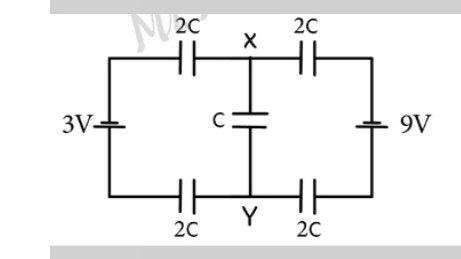
Calculate potential difference between x and y
6
Upvotes
1
u/devilkid15 Pre-University Student May 24 '26
You can use wheatstone bridge method as the ratio of adjacent capacitor is equal so, no charge will go to the middle capacitor , after that u can simplify the circuit to get equivalent capacitance and find charge for any given capacitance in this circuit.
1
u/HumbleHovercraft6090 👋 a fellow Redditor May 26 '26 edited May 26 '26
https://i.postimg.cc/rshCY8WL/Cap-Network.jpg
Eliminate Q1 and Q2 from the equations. And solve the resulting three equations for Vx, Vy from which you get potential difference. For reference, the negative terminal of 3V cell is grounded. Note that sum of charges at the plates seeing a common node like X or Y is 0 in steady state.
0
u/GammaRayBurst25 May 23 '26
Read rule 3.
Just use the superposition principle.
4
u/[deleted] May 23 '26
[removed] — view removed comment
1
u/[deleted] May 23 '26
[removed] — view removed comment