r/HomeworkHelp • u/16mirr0rss Secondary School Student • Aug 08 '26
:snoo_facepalm: High School Math—Pending OP Reply [Grade 10 Algebra 2 Honors: Trigonometric Functions) Would the equation for this graph be y=sin(2x-(3pi/4))-2
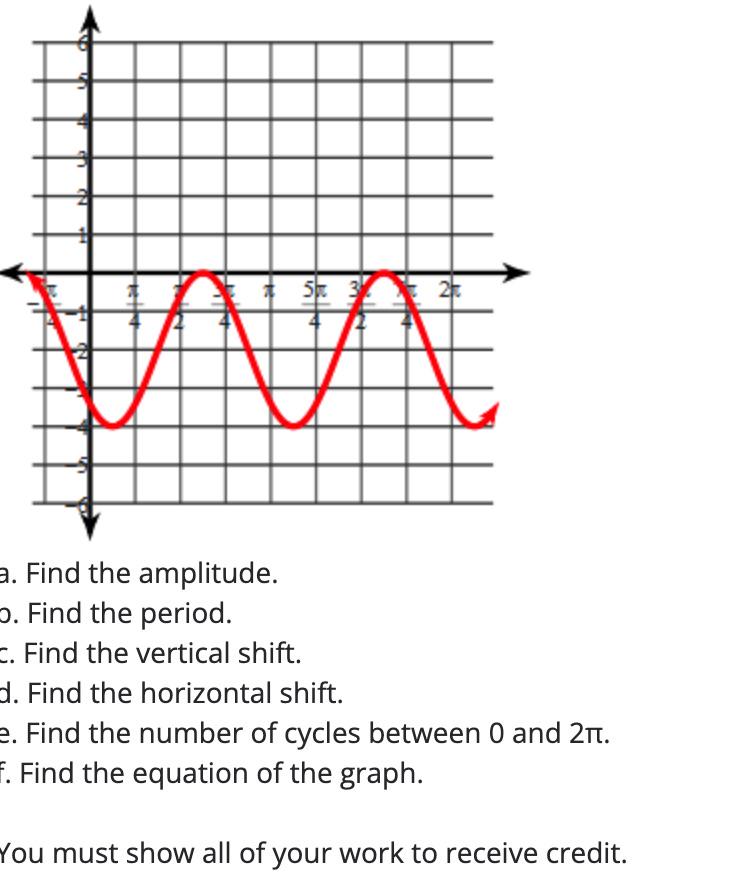
I’m not sure how I got the horizontal shift so explanation would be great🥹
1
Upvotes
1
u/Ghotipan Aug 08 '26
First, remember the formula y=asin(bx+c)+d, where a is the amplitude, b is the frequency, c is the phase shift, and d is the vertical shift.
We often introduce b as the period, where we say 2π/b is the period. In your written equation, you placed the amplitude inside the sin function. Start there, then try to work on the other mistakes.
1
u/cheesecakegood University/College Grad (Statistics) Aug 09 '26
First, when it comes to the shift (this relates to the period too), make very VERY sure that you do not mix up sin(bx + c) and sin(b(x + c)). They are different!!! Super common mistake. I wonder if this is causing a bit of confusion.
Sometimes your textbooks or teachers might give you one or the other. In a second I'll point out which is nicer to work with.
We potentially have four different transformations (vertical shifts and stretch/squeezes, and horizontal shifts and stretch/squeezes) and it's not always obvious to students how they combine, because it can get a bit tricky. So let's simplify.
Ideally you do them sequentially, and if you describe that order it's pretty easy to follow, but it's often easier to write (i.e. lazier, but mathematicians are lazy by nature) them combined all at once.
So let's give a general but useful example to make the danger real. What if I want to stretch out by 3 vertically, and then shift it up by 2 (making it taller, steeper, and elongated, but also slightly nudged up)? That's one thing. But maybe I shift up by 2 and THEN stretch by 3. This results in an OVERALL shift up of (0,0) by SIX, not 2! Note that "where the graph ends up" and "what I actually did" are NOT the same thing. I could still say "stretch vertically by 3 and then shift up by 2" and that's a valid thing to say, but that's not the same transformation, it's totally different.
That is to say: it's important to ask, are we talking about a recipe, or a result? The two are written differently!!
Also note that it's easiest to talk about things as they relate to zero (vertically, or (0,0) more generally) - if I take the point (5,5) and shift up by 2 and then stretch by 3 that's (5, (5+2) * 3) = (5, 30), which is a result of a shift up by 25. It's different obviously than stretch by 3 and then shift up 2, which is (5, (5 * 3) + 2) = (5, 17), a total resulting shift up by only 12! But if I do the same for (0, 0), I get (0, (0 + 2) * 3) = (0, 6) and (0, (0 * 3) + 2) = (0, 2). That might seem like me just repeating my point but in fact, something interesting happens there! Note that for the specific case of a "stretch then shift" the resulting y value IS the shift (2), we ignore any stretch effects (any stretch or squeeze times zero is zero). Same thing goes on with x.
Thus (0,0) transformations are very useful for finding any shifts when doing stretch-then-shift. This will be handy later.
One final important note before we get back to the practical upshot of all of this.
If you're moving from a graph to a formula, like you are here, it's obviously easier to describe the result, because that's what you're already looking at! You might "figure out" the recipe that was used to get it in the process. But in fact, the result is almost always more useful. For example, period represents the actual, final time between peaks (or one cycle anywhere for that matter), which is a result. We can also see that it's easy to observe the final resulting shift left/right with respect to the starting point x=0.
Also note that if you have a final result, generically there might have been several possible (different) recipes that give you the same result! It's worth mentioning that typical basic sine/cosine trig function are well-behaved vertically (-1 to 1 range transforms conveniently) but less so horizontally. Thus, mentally, for trig functions, it's best to imagine the recipe as always going in this order: Stretch/squish vertically, THEN shift vertically, THEN stretch/squish horizontally, THEN shift horizontally. If you combine this with the convenient fact I mentioned earlier about (0,0) telling you about shifts after stretches, we have a setup that can work very easily for us once you get the hang of things!
OK, so cheesecakegood, you yapper, get to the point. Do I use sin(B(x + C) or sin(Bx + C)? Use sin(B(x + C)) whenever you can. B(x+C) is a result but Bx + C is a recipe. And as I just explained, results are easier to use and reason about. Even more conveniently, B(x+C) is a shift happening after the stretch, which is also exactly what I just explained is easiest to work with. So you can just "look at the graph" and get something more directly. If you ever see BX + C, you should just convert it to B(X + C) every time. Not all textbooks teach this, but they should. Also, we can see that Asin(...) + D is also the same "stretch and then shift" again, so we are fine there too.
We can see that if we expand B(x + C) we get Bx + BC (in terms of the B and C as I defined them there) so we would need to do an extra step to transform [BC] into something that matches our graph. Not the end of the world, but annoying, and we are lazy so we don't want to.
In the form we like, B is the stretch factor (that directly converts to the period), full stop, and C is the horizontal shift, full stop. You measure with respect to some "landmark" that has a 0 in it, horizontally (all of them!). sin(x) already goes through (0,0), very nice, but cos(x) which has a nice x=0 point at (0,1) works just as well in practice. Heck, -sin or -cos are fine too.
If the period is normally 2pi, then if our result-period is just pi, it means every landmark comes twice as fast, which means although the period is smaller B is bigger than 1. This is the same kind of "opposite logic" behind why +C is a shift LEFT by C, not right. Opposite for stretches/shifts is reciprocal though, not opposite sign. Some students find that logic easier to memorize. Other students? Just memorize T (aka "period") = 2pi / B, or B = 2pi/T, it's the same equation. Up to you if you prefer memorization or intuition there (usually I say the intuition, but often here memorization wins since it's easy).
So yeah! Let's DO THE PROBLEM.
Let's follow their suggested order (although personally as I said above, it's better to do vertical stretch aka amplitude, then vertical shift, then horizontal stretch (period), then horizontal shift instead):
If they want you to show your work, it might be helpful to visually mark things on the graph: draw a line between peaks, or possibly draw vertical lines at each peak, measure its length, circle the landmark point you chose, draw in a dashed line as the midline, and write out your period (T) = pi and B=2pi/T equation explicitly, that's all.