r/HomeworkHelp • u/Electronic_Author366 'O' Level Candidate • Aug 27 '26
Middle School Math—Pending OP Reply [Middel School:Math]: Where did i go wrong with x?
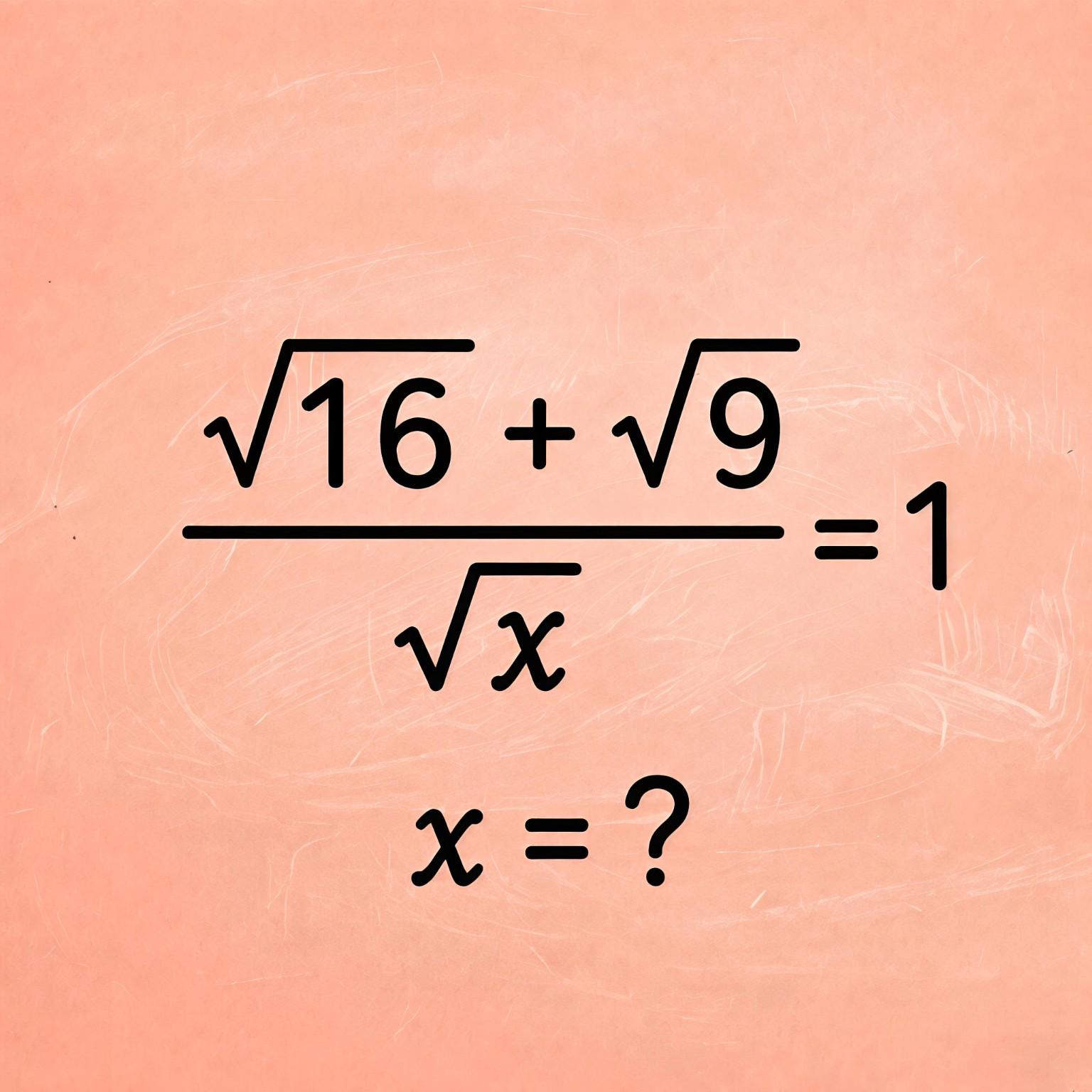
i got x=7 but I feel like I'm making a mistake somewhere, but I can't figure out where. Can someone explain what I'm doing wrong?
71
Upvotes
64
u/Ghotipan Aug 27 '26
The sqrt of x = 7. To solve for x, you need to get rid of that radical sign. Do you know what operation cancels out a square root?
83
u/LucaThatLuca 🤑 Tutor Aug 27 '26
4 + 3 is 7, so this says the ratio 7/√x is 1, i.e. 7 = √x.
This is not satisfied by x = 7 since 7 ≠ √7.
28
u/Junior_Character5301 👋 a fellow Redditor Aug 27 '26
can you show your work?
11
u/HyperbolicMathChambr Math Tutor Aug 28 '26
The goal when you solve for a variable, say x, is to isolate the variable on one side of the equation and everything else on the other side. So the solution would look like x = "something something".
Step 1: Simplify the numerator by finding the value of each square root and adding the results.
Step 2: Multiply both sides of the equation by square root of x. This will remove the square root from the left side's denominator and transfer it to the right side's numerator.
Step 3: square both sides to get rid of the square root symbol.
Step 4: No step 4, that's it! You have your answer.
11
u/Far-Fortune-8381 University/College Student Aug 28 '26
your mistake is that the square root of x equals 7. but x does not equal 7
23
u/spiritual_summer111 Aug 27 '26
I think x would be 49. The square root of 49 is 7. Once you do that, you have 7 divided by 7 which is 1.
6
u/Primary_Weather5726 Aug 28 '26
step 1: solve known square roots
√16 = 4
√9 = 3
(3+4) / √x = 1
7 / √x = 1
step 2: multiply both sides by √x (to move √x to the other side) ~ ignore this step if this is obvious
(7 * √x) / √x = 1 * √x
√x cancels out on the left (= 7) and 1 multiplied by √x on the right hand side = √x
7 = √x
Step 3: square both sides to remove square root
72 = (√x)2
√ 2 cancels out and just leaves x
49 = x
5
u/Mjhtmjht Aug 28 '26
I think you probably worked out the numerical value of the top line, but forgot that this number gave you 7 over the square root of x. Not simply x.
4
u/A_Squared93 👋 a fellow Redditor Aug 28 '26
You only assume positive and negative when square rooting a squared variable. Ex. If x2=9, then √ x=+/-√ 9. But √9 only equals positive 3
7
u/Wabbit65 👋 a fellow Redditor Aug 27 '26
The denominator needs to be 7, you got that far. So now, what is x such that the square root is 7?
2
u/ImSoSweepy Aug 28 '26 edited Aug 28 '26
It's been a minute, but:
The way I would do it is get the square roots for the numerator, which would be 4+3, and become (7/x2). Multiply by the inverse (x2/7) and you get (72=x) which is 49.
You can simplify the equation to (7/sqrt(x) = 1)
All you have to do is square 7.
It's been 20 years, so take that with a grain of salt.
2
u/SpecialTexas7 👋 a fellow Redditor Aug 28 '26
x=49
2
u/Fun-Moment1626 👋 a fellow Redditor Aug 28 '26
49 is the correct answer
2
u/Ketroc21 Aug 28 '26
You are right that you want to simply it to 7/7 = 1. But for the denominator to be 7, x must be 49, because it's root-x.
2
u/Icy-Speed6881 Aug 28 '26
Only the numerator of the left hand side is 7 ... multiply both sides by √x and you get √x=7 not x=7
2
u/ExtendedSpikeProtein 👋 a fellow Redditor Aug 28 '26
x=49 because 7/sqrt(7) does not equal 1, but 7/sqrt(49) does.
3
u/fermat9990 👋 a fellow Redditor Aug 28 '26
√x=7, x=49
2
u/CaptainMatticus 👋 a fellow Redditor Aug 27 '26
sqrt(x) is 7. x is 7^2
2
u/lexiconoflife 👋 a fellow Redditor Aug 27 '26
Sqr of 16 is 4
Sqr of 9 is 3
Left side 3+4=7
Right side sqr of x
Then square both sides, you will get 49 = x
2
u/Dapper-Hour-8645 👋 a fellow Redditor Aug 28 '26
7²
2
u/Teacher67 👋 a fellow Redditor Aug 28 '26
49
1
u/Tim_Xtreme_46 👋 a fellow Redditor Aug 28 '26
Check your work. If x=7, and you substitute it back in, does the whole expression still equal 1?
1
u/Ratchad5 👋 a fellow Redditor Aug 28 '26
The sum of Root of 16 plus root of 9 taken to the 2nd power equals X you skipped a step in squaring both sides to get rid of the square root of X
1
u/Swapdoodleboi 👋 a fellow Redditor Aug 28 '26
i'm assuming you got up to some things
the square root of 16 is 4, and the square root of 9 is 3. 3+4 equals 7.
remember, you're finding a number that FIRST has to be square rooted and THEN divides seven to equal one. what number can be square rooted, and after being square rooted can divide 7 to equal 1?
1
u/Severe-Possible- Educator Aug 28 '26
the denominator needs to be 7, so c has to equal 49.
1
u/modus_erudio 👋 a fellow Redditor Aug 28 '26
There is a seven in the problem, but it’s only an intermediate step. I imagine you got the seven from the square root of 16 plus square root of 9 being the same as 4+3. That yields the equation 7/√ x = 1.
You cannot solve √ x as a denominator, so you must shift it to the other side of the equation by multiplication of the entire denominator. This will cancel the √ x on the left side as it will appear in the numerator and in the denominator. Meanwhile, multiplying the right side of 1 by √ x yields √ x, due to the identative property of multiplication (i.e. anything time one is unchanged).
Now you have the equation 7=√ x. To cancel the root you need to square it, which means both sides must be squared. Thus you get the equation 7^2 = x. So seven squared is 49. This 49 = x, which means x = 49.
I hope that helps you understand the total process.
1
u/yosark University/College Student Aug 28 '26
16 and 9 are perfect square roots which in total equals 7.
Now for the square root of x, you have to find what equals 7 after square root which is 49. (7x7 = 49) X is equal to square root 49
7/7 =1
1
u/Onawani Aug 28 '26
Lol, this is hilarious. Amazes me how many people are contributing confusion to such a simple problem. Cinema 🍿
1
u/KookyPermit4405 👋 a fellow Redditor Aug 28 '26
Here’s a method you might understand better:
CROSS MULTIPLY
√x = √16 + √9
Now simplify:
√x = 4 + 3
√x =7 therefor the answer cannot be 7
The inverse of a √ is ^2 so do it to both sides
( √x)^2 =(7)^2
x=49
I think the mistake you made was not remembering that x is being square rooted, this can be eliminated by using the cross multiplication rule.
1
u/Feeling-Working-2820 Aug 29 '26
You are almost there.
You are right that the denominator should be 7.
But the denominator is square root of x....not x!
So, if the square root of x is 7, what is x ?
1
u/reasonedliberal Aug 29 '26
7/√x = 1
Multiply both sides by √x
7 = √x
Square both sides
x = 49
1
u/Ok-Chemical-7635 👋 a fellow Redditor Aug 29 '26
X is 49
1
u/matmit21 👋 a fellow Redditor Aug 31 '26
x=49
1
u/Ohz85 👋 a fellow Redditor Sep 03 '26
(7)2 = (√x)2
1
u/Silver-Ant-6588 👋 a fellow Redditor Aug 28 '26
49
1
u/AlienDragonWizard 👋 a fellow Redditor Aug 28 '26
√16+√9 = √x
4+3 = √x
7 = √x
(7)2 = (√x)2
49 = x
1
u/FQVBSina Aug 28 '26 edited Aug 28 '26
First, we need to see your solution process to tell you what you did wrong.
Second, we can see:
+/- 4 +/- 3 = sqrt(x)
Plus or minus because there are two solutions to squareroot since both positive and negative 4 squared give 16.
Then sqrt(x) has 4 solutions:
Sqrt(x) = 4 + 3 = 7
Sqrt(x) = -4 - 3 = -7
Sqrt(x) = 4 - 3 = 1
Sqrt(x) = -4 + 3 = -1
Which means there are two answers to sqrt(x): 7 and 1, because resolving squareroot you take the square and it ignores the sign. And that gives x = 1 or 49. When you learn quadratic equations in the future, this will become second nature to you.
0
u/Ericskey 👋 a fellow Redditor Aug 28 '26
You need the root of x to be 6
0
u/Bojack-jones-223 👋 a fellow Redditor Aug 28 '26
Since (4N)^(1/2) = ±2*N^(1/2), it really depends on your choice of sign during the simplification process. You'd need to work out each case. The easy case is if everything is positive then X=49. If, for example, in the numerator, the second square route you decide to use = (-3) instead of +3 then X=1.
-1
u/hallescomet Aug 28 '26
I got x=25
If you square everything on both sides of the equal sign you get (16+9)/x = 1. 16+9 equals 25, so (25/x)=1. Multiply both sides by x gets you 25=1x which is just x=25
-3
u/maths_in_the_hat Aug 28 '26
Not sure if you have hit this point in your math's, but a square root has two answers.
16 = 4 * 4 = (-4) * (-4)
So sqrt(16) can be both 4 and -4.
If you were to evaluate this at higher levels,
You could rearrange the equation to be
Sqrt(x) = sqrt(16) + sqrt(9) = (+4 or -4) + (+3 or -3)
Which has 4 solutions
Sqrt(x) = 4 + 3 = 7 Sqrt(x) = 4 - 3 = 1 Sqrt(x) = -4 + 3 = -1 Sqrt(x) = -4 - 3 = -7
When we square to get x we have 2 unique solutions
x = 49 or 1
116
u/[deleted] Aug 27 '26
[removed] — view removed comment