r/HomeworkHelp • u/i-stubbed-my-toe- • Sep 11 '26
Answered [middle school math] shouldn't the answer be 33?!
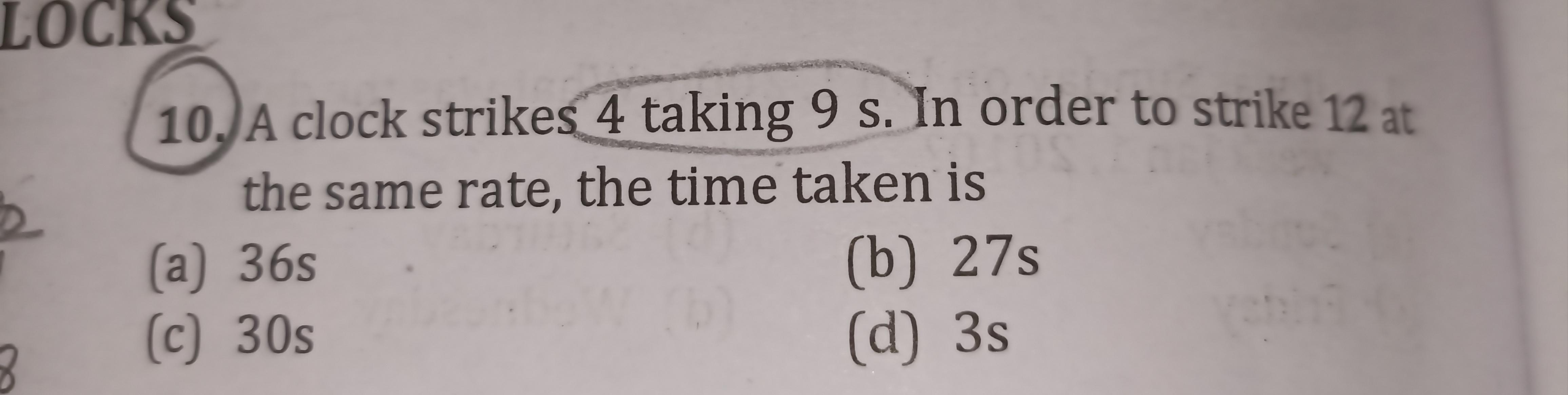
(i got it guys 😭🥹 there's too many answers I'm not able to keep up so thank u already but i got it 😭) Since there's an interval of 3 seconds between each bong shouldn't 33 seconds be taken for it to strike 12 times? There will be 11 intervals and each interval is 3 seconds so 11*3=33, right?!
Edit: thank you so much gng, I kinda understand why the answer would be 27s, and i thank everyone for explaining both how my logic was sound as well as the other ways one could approach this problem.
So 9 seconds for 4 bongs would not strictly only include the time immediately after that last bong bongs (😭), but also include the resonance of that bong. As in, we must assume in this scenario that the bongs are not short/immediate, but carry on for a short amt of time.
In this scenario, the amount of time 1 bong takes (assuming that the next one starts immediately as it's resonance fades out) would be 9/4 seconds.
This multiplied by 12 gives is 27 which is the answer ✨
•
u/AutoModerator Sep 11 '26
Off-topic Comments Section
All top-level comments have to be an answer or follow-up question to the post. All sidetracks should be directed to this comment thread as per Rule 9.
OP and Valued/Notable Contributors can close this post by using
/lockcommandI am a bot, and this action was performed automatically. Please contact the moderators of this subreddit if you have any questions or concerns.
201
u/VirusAlternative132 Sep 11 '26
I think it's easier to calculate this using the entire segment of time it takes the hand to strike 4. So in 9s the hand goes to 4, in another 9s, the hand would strike 8, and in yet another 9s, the hand would strike 12. So 9s+9s+9s=27s
32
u/unidentified2202 A Level Candidate Sep 11 '26
Use unitary method
Like time taken to strike 4=9 seconds
Time taken to strike 1=4/9 seconds
Time taken to strike 12= (4/9)×12
The answer is 27 seconds for the clock to strike 12
15
u/ChipChippersonFan Sep 11 '26
So you were expecting a "gotcha". When you realize that 33 is not an option, you should assume that this is just a straightforward math problem. -- 4:9 as 12:?
If this were a manual entry question, I would accept both 33 and 27, but it's not. So there's only one answer that makes sense.
13
u/LopsidedEdge9345 Sep 11 '26
This is a unit rate question. You’re looking for number of seconds to complete each strike. 9secs/4bongs=2.25 seconds/bong. Multiply that by twelve (or any number of strikes) to find the total time to bong (tttb)
26
u/calkthewalk Sep 11 '26 edited Sep 11 '26
Technically the answer is in determinable from 1 data point.
For 4 strikes you have 4 x Bong length + 3 X dwell length.
For 12 strikes 12 X Bong length + 11 X dwell length.
If the dwell length is 0, bong is 9/4 (as in the next bong begins immediately as the last fades out) then 12 takes 27 is a valid answer.
If the Bong length is 0 (each bong is a point in time) then dwell is 3 seconds and 33 would be the correct answer, but any value between these could be valid.
So I would say the correct answer is 27, but you could add a note "assuming no dwell time between bongs" which is also a funny thing to write on a test
6
u/Ditlev1323 Sep 11 '26
4=9
4*3=12
9*3=27
Honestly took me a bit to understand the question, it’s weirdly worded imo.
9
u/maelstrom197 👋 a fellow Redditor Sep 11 '26
I think the assumption is that the time for four bongs to sound is 9s, not that the first bong and the fourth bong are 9s apart. My guess would be that a "bong" isn't an instantaneous event, and you are also counting the sound that resonates afterwards. You're counting from the start of the first to the end of the fourth, not the start of the first to the start of the fourth.
Your logic is sound, but I don't think that's what the specific question is asking.
3
u/hjalbertiii Educator Sep 11 '26
If it takes 9 seconds to strike 4, (4 tolls of the bell) and 12 has 12 tolls, 12=3x4, 12 strikes takes 27 seconds.
3
u/Pretend-Conflict4461 Sep 11 '26
I would not have understood this question without looking at the answer choices. I thought that if a clock strikes 4, it's 4 o'clock and they wanted to know how long it would take to get to 12 o'clock...
3
u/Stenn-ish Sep 11 '26
You are starting from 0 not from 1.
0>1>2>3>4 - that is 4 ticks totalling 9 seconds. 4>5>6>7>8>9>10>11>12 - that is 8 more ticks, so 18 seconds + the 9 from before = 27
3
u/thirdeyefish Sep 11 '26
What is being asked here is for you to extract the factor and apply it to another number. It took n seconds for the clock to strike 4. How long will it take to strike 12?
12/4 = 3 3 x 9 = 27
But the important part here is being able to interpret what tools you need and what information you need. You aren't liable to have someone walk up to you and ask 'what's 3 times 9' and have that be important.
What is important is when you are driving somewhere and you're going 70 on the highway. You just passed a sign that says you are 350 miles away. How long is it going to take you to get there?
Or you're on a budget and you're buying cereal. The regular size is 4.39 and the bigger size is 5.49. Which cereal is actually cheaper? Because usually the bigger box is cheaper per ounce of cereal. But not always.
This is part of what you need to learn now and sometimes knowing that helps you to learn it. You should be good enough with the tools by this point. You know how to multiply and divide. Now you're learning how to use them.
2
u/Single-Astronomer-32 👋 a fellow Redditor Sep 11 '26 edited Sep 11 '26
Calculate it the way you want it but the answer is 27.
2
u/dawlben 👋 a fellow Redditor Sep 11 '26
4 strike per 9s = 4st/9s
you need to know 12 strikes
12st ÷ (4st/9s) =
2
u/mageskillmetooften 👋 a fellow Redditor Sep 11 '26
The bell goes 4 times in 9 Sec,
It's not an instant thing, it needs to move first to make the 1st noise. So wait-bong, wait-bong etc..
Also this is middle school, stop thinking about it and just do a simple:
4 strikes is 9 sec, 12 strikes is X sec
(12/4) x 9 = X sec
X = 3x9 sec
X = 27 sec
If you start assuming things that are not given, you can assume whatever you please and it will all be wrong.
You say it takes 3 seconds in between, I counter with that it takes 6 seconds to start up for the first bong, and after that it can do one bong per second so the answer should be 17 sec.
2
u/FQVBSina Sep 11 '26
You are overthinking the question. Which is a good thing, to have critical thinking abilities. But questions like these, especially math, is much simpler once you get past what the texts are describing. It is simply saying if the ratio is 4/9, what is 12/x? Which you simply multiply 3 on top and bottom.
2
u/BaccaBeats Sep 11 '26
Y’all are really over complicating this lol takes 9s to strike 4, 12/4=3 so 9x3=27
1
u/xnick_uy 👋 a fellow Redditor Sep 11 '26
This clock is kind of broken... shouldn't it take 20 s to strike 4 when starting from 12?!
If this is a regular clock, 9 s before reaching 4 requires the second hand to start at the "11 s" mark, which is near the number 2 (at the "2.2" mark). Then, to get from 11 s to the numer 12 (=60 s) it takes 49 s...
1
u/WoolyboolyWoolybooly 👋 a fellow Redditor Sep 11 '26
At a glance, it looks like an lcm problem. It is not.
1
u/ThisPassenger Sep 11 '26
You can set this up as a proportion problem because the prompt says the rate remains constant.
4/9=12/x. Solve for x.
1
u/trutheality Sep 11 '26
You are correct. The writer of the problem made a fencepost error. They were thinking "12 is 3 times 4, so the time taken should be 3 times 9," Rather than considering that 4 strikes mark 3 intervals and 12 strikes mark 11 intervals.
1
u/ValeWho Sep 11 '26
But the bong itself also takes time and since the exact time is not mentioned you can assume they just want you to multiply by 3
1
u/ApprehensiveHippo164 Sep 11 '26
A dictionary meaning for the English word strike: to make known the time by sounding. Safe to assume this is the meaning in context.
You need to hear full bong gap durations so you know there wont be another one. In that moment you know it didn't strike more than 4 and the clock has made the time known.
If we knew the clock maxes at 12 strikes, we could answer 24s, but 24-bongers also exists and 27s is an option we can pick.
1
u/Dear-Astronomer-7422 Sep 11 '26
The 4 is 20 seconds, which is 1/3 of 60 seconds, which is marked by 12 on a clock. If it takes 9 seconds to move a 3rd of the way to 12 you just need to add the other two 9 seconds. 9+9+9=27 Or yeah, just multiply 9 by 3
1
u/Legitimate-Ranger567 Sep 11 '26
You're overcomplicating the question. 12 is 3x bigger than 4. If 4 takes 9s, then 9x3=27.
1
u/vaelux Sep 11 '26 edited Sep 11 '26
This is not a trick question. The numbers in the word problem are the numbers they expect you to use.
But to make it physical for you:
You have to include the wind up ( attack in sound engineering terms) before the first bong (sustain in sound engineering) and the die down after the last bong (fade). The entire attack-sustain-gain cycle should be included. By only counting the intervals, you are doing
S-F-A-S-F-A-S-F-A-S
when the actual sound should be
A-S-F-A-S-F-A-S-F-A-S-F
Notice how each interval between S is equal to A+F? And that the second version has one extra A at the beginning and F at the end? That is the missing interval in your approach.
But you don't need to know sound engineering to solve this. 99% of the time the test is not trying to trick you. This item is testing the formula work = rate x time. They want you to be able to extract work, rate and time from the problem and put it in a formula. That 33 is not an option, further adds to the fact that they don't want to penalize you for thinking the way you do about it and push you to use the numbers in the problem. A test that was trying to trick you would include 33 as a trap answer.
1
u/burrdedurr 👋 a fellow Redditor Sep 11 '26
33 is the correct answer. 1st strike is at t=0. However, since 33 isn't an option then 27 is all that's left.
1
u/YellowGetRekt Sep 11 '26
I dont understand this comment section, why are we assuming that the timer starts at the first bong? It would take time for the first bong to happen aswell it's not instantaneous
1
u/Jkjunk 👋 a fellow Redditor Sep 11 '26
I believe you are overhanging this. If 4 bongs take 9 seconds then 43 bongs should take 93 seconds. In real life the actual intervals between bongs depends on how your clock works, but i don't think they are asking you to think about it in that level of detail.
1
u/Superb_Ask_759 Sep 11 '26
I would say you are technically correct. The question should be worded more precisely to capture the author's intention.
It's a question about rates, so first you find the rate, then use the rate to find the time.
In your framing, you correctly started your stopwatch at the first bong, and stopped it at the last bong. So your rate would be 1 bong / 3s. You're (correctly) not including the hammer windup time of the first bong in your rate calculation.
x---x---x---x
In the author's intended framing, the stopwatch starts when the hammer starts to windup before the first strike:
--x--x--x--x
So their rate would be calculated as 1 bong / 2.25s.
But because the pattern for this type of problem is to just find the rate using the numbers in the problem: 4 bong / 9 seconds, the pattern assumes all 'n' event takes the same amount of time, therefore it bakes into the answer that you'd be starting your stopwatch at the beginning of the hammer windup.
But this is a good example of why you shouldn't just apply a pattern blindly to a situation, without considering what might be different about it first.
1
u/cwolf-softball Sep 11 '26
This is not well phrased at all, but the answer would be 27s if it's to be interpreted the way I think it is.
1
u/Wooden-Hornet2115 👋 a fellow Redditor Sep 11 '26
Where are y'all getting two digit answers from? I'm getting 28809s. We know t0 is 3:59:51, and the end time is 12:00:00. We know the clock speed doesn't randomly change, as is constant. So it would take 8×3600+9 seconds, which is 28809. Am I stupid?
1
u/Head_Midnight666 Sep 11 '26
I don't even understand the question. I just guessed and made a ratio, which got 27, but the question makes no sense to me. strikes 4? What?
1
u/Confusedlemure Sep 11 '26
Assuming an instantaneous strike duration and assuming you do not know the time until a lack of additional strike, a strike interval is 2.5 seconds (9/4). 12 o’clock is a special case however since you know the time instantaneously with the last strike. The correct answer is 27.5 seconds ((12-1)*2.5).
1
u/Flat_Cow_1384 Sep 11 '26
Clearly this is going to be dependent on your mental model of how the "strikes" happen. Assuming strikes mean physical then its:
start-> windup and strike->bong->windup and strike->bong-> windup and strike->bong->windup and strike->bong->end ... so 4 gaps, 4 bongs -> 27 s for 12
If its more "electronic" and for clarity lets call them "beeps":
start-> beep -> delay-> beep->delay->beep->delay->beep-> end 3 gaps and 4 beeps -> 33s for 12
1
u/BConscience Sep 11 '26
It shouldn’t matter how long the sustains are. The question is asking about the strikes. You start the stopwatch at 1st impact, press the button again at the last (4th or 12th impact). So the last sustain isn’t counted in either case.
But seeing this is a multiple choice, you have no other option but to select the wrong but intended answer
1
u/Hello_Gorgeous1985 👋 a fellow Redditor Sep 11 '26
9/ 4 = 2.25. It takes 2.25 seconds for each strike. 12* 2.25 is 27.
Or, 9* 3 is 27 because 12/ 4 is 3.
1
u/oneStoneKiller Sep 11 '26
9 seconds divide by 4 strikes gives an approximate time per strike of 2.25 seconds. For the bell to strike 12 it would be 12x2.25 or 27 seconds.
1
u/Foxk 👋 a fellow Redditor Sep 11 '26
4 / 12 = 3 3 * 9 = 27
1
u/texas1982 👋 a fellow Redditor Sep 11 '26
It's a bad question because of depends where you start the stopwatch. L
1
u/F1-Dank-Fang Secondary School Student Sep 11 '26
How are yall so confident that the time starts at 0 and not at 3? Can someone explain that to me?
1
u/CyanDragon Sep 11 '26
4 strikes in 9 seconds.
8 (4+4, or 4x2) strikes in 18 (9+9, or 9x2) seconds.
12 (4+4+4, or 4x3) strikes in 27 (9+9+9, or 9x3) seconds.
1
u/YirgacheffeFiend Sep 11 '26
bong time = b (assume each bong is the same length)
wait time = w (assume each wait is the same length)
b1 + w1 + b2 + w2 +b3 + w3 +b4 + w4
when do you consider the clock to have struck 4?
if you imagine yourself physically timing the 9s, i think you would consider it to have started striking when the first scintilla of sound was emitted from the first strike (b1) and to have struck 4 when you hear the first scintilla of sound from the fourth strike which implies (b4=0, w4=0), which means you have 3b+3w=9, regardless of what b and w are. factor out a 3 and you get b+w = 3
in the case of striking 12 you also have (12 - 1)*b+(12 -1)*w, which is 11*(b+w) or 33
now someone may say, in order to know the clock has struck 4 you have to wait w after the fourth strike to ensure there is not a fifth strike
in that case you get bwbwbwbw 4b+4w = 9, so b+w = 9/4 and 12*(b+w) or 27 seconds
but this seems less physically accurate with how the timing would actually happen
1
u/Reasonable_Drink_789 👋 a fellow Redditor Sep 11 '26
4 is 1/3 of 12. So three times longer to chime. So 9x3=27
1
u/No_Needleworker_1105 👋 a fellow Redditor Sep 11 '26
27
1
u/TheLoneKid Sep 11 '26
This question sucks. Why doesnt it tell you where the clock started? How can we assume 1 to 4 took 9 seconds?
1
u/cthulhu944 Sep 11 '26
You need to compute seconds per dong or seconds/dongs. You can use that to compute however many dongs you want, 12 in this case.
1
u/Mr_Woodchuck314159 Sep 11 '26
I read the question and was like “it’s b!” I read your question and was like “it’s 33, why isn’t that an answer?”
And then I remembered my grandmothers grandfather clock. You could hear it wind the hammer back before the bong. If you start the timer at that point, the 27 makes more sense.
I would expect the wording to be “it takes 9 seconds for a bell to ring 4 times, at what second is the 12th ring occur” for the answer to be 33. I think this wording emphasizes ring so I would assume the timer starts on the first ring. The current wording could be either. Also, more of a riddle instead of straight math, granted I have seen riddles in math, and many riddles do use math. And I have also seen many math questions saying “oh, the answer is easy, it’s X/Y*Z. Not taking into account other variables that mean it doesn’t take x/y amount of time to do one thing.
1
u/gely50 Sep 11 '26
27 is just wrong. The 1st 9 seconds starts with a bong and ends with a bonge. 4 bongs. The 2nd nine seconds does not start with a bong, it start with a wait. 3 bongs.
1
u/Beau_Peeps 👋 a fellow Redditor Sep 11 '26
I get B. 27 sec.
1
u/Beau_Peeps 👋 a fellow Redditor Sep 11 '26
9÷4=2.25s x 12=27s.
1
u/Striking-Remote5920 👋 a fellow Redditor Sep 11 '26
The only correct answer is "I don't know."
1
u/No_Employment_8438 Sep 12 '26
There is often a set eight tones that happen before the bongs, so 12 (11 pauses) @ 4 o’clock, giving 20 (19 pauses) at 12 o’clock… I would say 16 seconds for a real clock.
But since the eight tones are generally faster and there is a longer pause before the bongs, it is a terrible question. It should specify some things.
1
u/HilariouslyPissed 👋 a fellow Redditor Sep 12 '26
It’s a ratio
1
u/wuzeq123 Sep 12 '26
For the people that dont get 33s logic
Imagine different situation:
-you have to take pills in equal intervals
-3 pills took you 1 hour
- how much time will pass to take 4 pills ?
So would the answer be
- straight forward ratio 1h/3 ->20 minut per pill -> so 4 pills 1h20m ?
- Or rather 1 pill every half hour so 1,5h total (of course this one)
So therefore all this discussion about waiting time, what is bong what is fade
1
u/Dear_End5797 Sep 12 '26
Easiest way to solve, find out how many seconds per strike. Apply seconds / strikes to the original statement to find. 9/4=2.25 seconds per strike. Then 12 strikes must be 12*2.25=27.
1
u/Commercial_Rate_3262 👋 a fellow Redditor Sep 12 '26
9x3
1
u/Nvenom8 👋 a fellow Redditor Sep 12 '26
If 4 is 9, 12 is 27.
1
u/mmbeliever 👋 a fellow Redditor Sep 12 '26 edited Sep 12 '26
It’s 27.
9 seconds times 3. It’s 3x amount, at the same rate.
Your explanation is overthinking the question, because the question already provides enough information. So you don’t have to calculate the rate for each clock bong.
1
u/UntrimmedBagel 👋 a fellow Redditor Sep 13 '26
Tbh I have no idea what this question is even asking
1
u/No-Emu-7319 Sep 14 '26
when i was learning word problems as a kid i was taught to pick out the important numbers that you will need to do the actual problem. to me this problem says that something happens 4 times in 9 seconds. how many seconds will it take to happen 12 times? 4 goes into 12 3 times so that would make it 3*9 to get the answer.
there is no need to break the original problem down to just going off 1 times. the fact that it's a clock making noises doesn't matter in this math problem. it might if someone was working on a clock and trying to get it to go off properly but we aren't going that deep. we are only interested in the numbers, not the real life aspect of it.
1
u/Content-Sherbet-4700 👋 a fellow Redditor Oct 01 '26
The question is terribly worded
1
u/Competitive_Bar2106 👋 a fellow Redditor Oct 02 '26
9 seconds/4 bongs = 2.25(seconds per bong)
2.25 seconds per bong * 12 bongs = 27 seconds
1
u/Adventurous_Sound390 👋 a fellow Redditor Oct 02 '26
For me answer 33 would make the problem more interesting. But if you do not see it in list of possible answers select not so interesting 27, supposing corresponding way of author`s thinking.
1
u/RunningAtTheMouth 👋 a fellow Redditor Sep 11 '26
27 Seconds.
Use ratios
So 27 seconds.
Now the truly analytic part of my mind wants to follow your logic, but we're talking middle school. They're not going to distinguish between the points & the gaps. It's just strikes.
0
u/Ghotipan Sep 11 '26
Sometimes we can't over think these problems. You're right in that the timer should begin at the first strike, but given the range of answers, it's pretty clear they didn't do that.
So there are two ways to chunk this problem up. You can say, "If 4 strikes takes 9 seconds, and 12 is 4 x 3, then it'll take 9 x 3 seconds" and arrive at 27.
Or you can say, "If 4 strikes take 9 seconds, then each strike takes 9/4 seconds, or 2.25 seconds. Then I'll multiply that by the total number of strikes" and also arrive at 27.
Since 27 is an option, it's clear they didn't start the timer at the first strike.
0
u/fletchro 👋 a fellow Redditor Sep 11 '26
I'm with you, OP. The answers are wrong based on the question. Or, the question is badly written. If they wanted you to solve a unit rate question, they should have said that Anna folds 4 envelopes, taking 9 seconds. Because for that kind of task you have to start, and the task takes some time!
When a clock strikes one, it "strikes". It doesn't take any time to strike, it's an instantaneous event. And if you were timing the event of a clock striking two, you'd hit the stop watch button as soon as you hear the first gong, and hit the button again as soon as you hear the second gong. So you'd really be measuring the time between gongs.
Everyone saying you "fell for fence post illusion" is silly. That's as nice as I can be.
0
u/Ok-Lavishness-349 Sep 11 '26
Yes it should be 33 seconds, if we ignore the duration of the bong itself (or count only to the beginning of the final bong) which we have to since the bong length isn't specified. I assume the answer they are looking for is 27 and that whoever wrote the test question is not particularly intelligent.
-1
u/Accomplished_Area_88 Sep 11 '26
On an analog clock to strike ___ means the hand on the clock reached that position. So it took 9 seconds for the (hour, minute, second, just pick one and be consistent) hand to go from 12 / 0 to 4
how long then does it take to make the full lap around the clock (since 12 would be both the starting and ending position)
-1
u/Orgy_nizer Sep 11 '26 edited Sep 11 '26
Your logic isn't wrong, but you're thinking about it a little harder than I think the teacher was. Focus more on the math than on the narrative of it being a clock sounding out it's bell. Just look at the numbers.
It takes 9 seconds to strike 4 times, that means 2.25 seconds per strike.
12 strikes at the same rate of 2.25 strikes per second, is 27 seconds.