r/HomeworkHelp • • Sep 11 '26

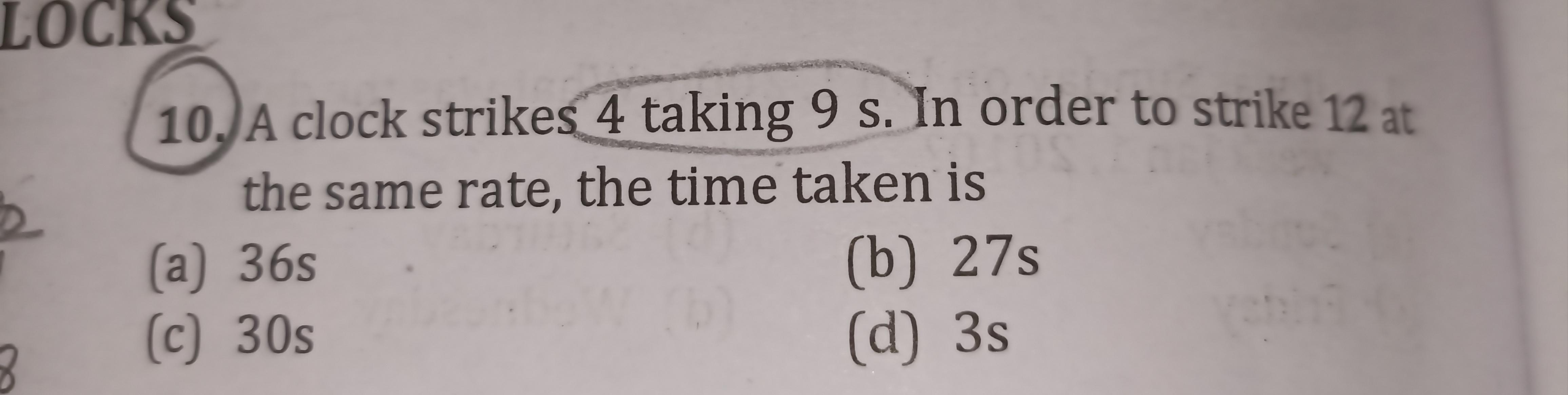
Answered [middle school math] shouldn't the answer be 33?!
Post image

(i got it guys 😭🥹 there's too many answers I'm not able to keep up so thank u already but i got it 😭) Since there's an interval of 3 seconds between each bong shouldn't 33 seconds be taken for it to strike 12 times? There will be 11 intervals and each interval is 3 seconds so 11*3=33, right?!

Edit: thank you so much gng, I kinda understand why the answer would be 27s, and i thank everyone for explaining both how my logic was sound as well as the other ways one could approach this problem.

So 9 seconds for 4 bongs would not strictly only include the time immediately after that last bong bongs (😭), but also include the resonance of that bong. As in, we must assume in this scenario that the bongs are not short/immediate, but carry on for a short amt of time.

In this scenario, the amount of time 1 bong takes (assuming that the next one starts immediately as it's resonance fades out) would be 9/4 seconds.

This multiplied by 12 gives is 27 which is the answer ✨

165 Upvotes

190 comments sorted by

View all comments

Show parent comment

14

u/ThunkAsDrinklePeep Sep 11 '26 edited Sep 11 '26

You guys would say the clock hasn't struck 4 until the fourth bong has faded?

OP isn't falling for the fencepost * "illusion"; they're correct. Unfortunately, this is just a poorly written ratios question. As others said, the "at the same rate" and lack of 33 as an answer are good clues to the authors intent.

To clarify: it doesn't matter how long the clock bongs ring or the length of silence between them. They are all intervals after the strike of the clocks hammer on the bell, which for our purposes is an instantaneous moment, like a clap. Clapping and clock striking are both fencepost problems.

Related viewing: the famous clock race scene in Chariots Of Fire.

12

u/[deleted] Sep 11 '26 edited Sep 11 '26

[removed] — view removed comment

4

u/Confusedlemure Sep 11 '26

Really like your interpretation here. I’m old enough to remember counting the strikes from another room. You really don’t know the time until the “lack” of another strike. But what about at 12? In that special case you know the time instantly after the last strike. I suppose you can argue that for all other cases you must wait for the fade so that sets the “standard”.

2

u/Beefington Sep 11 '26

You’re talking about how long it takes to interpret the information. u/Kite42 is right that 12 is a special case where you know it won’t continue, but also the interpretation time is irrelevant to the original question, which asks how long the striking takes. If it’s 5 o’clock, the clock is done as soon as the clapper hits the bell for the 5th time.

(Kite is also right about hating these ambiguous questions 😣)

3

u/ThunkAsDrinklePeep Sep 11 '26

I see what you're saying, but I dusagree. That's just not what the phrase "the clock strikes x" means. If you were timing the clock, you would stop not on the fourth strike, but the moment you should have heard a fifth?

1

u/amerovingian Sep 11 '26

I was leaning the other way, but I think you may be right here. You don't know the clock has struck 4 on the 4th bong. It could be striking 4 or 5 or any number up to 12. When the 5th bong does not arrive, that's when you know the clock has struck 4. So that's how long "striking 4" takes.

1

u/-Majgif- Sep 12 '26

No, the striking ends on the 4th. You needing to wait for the abscence of a 5th to know it doesn't change that.

If a book ends on page 300, you don't say it's 301 pages because you had to turn the page to make sure there wasn't more.

1

u/amerovingian Sep 12 '26

I agree with you--if what we mean by "the striking" is a sequence of strikes. But if we are thinking of "the striking" as a message encoding information about the current time, that message ends on the absent 5th strike. In the same way, the book's message ends with a final period and nothing coming after.

If someone were telling a story orally, we might not know when they reached the end of the story just from sound. They could be pausing for dramatic effect. "The hero laid down his head to die.... But then he rose again!" We don't really know if the story is over until the storyteller says "The End" or "Happily Ever After" or "So anyway, who wants a s'more?" or gives some other cue to tell us it's really over. The clock's way of encoding that is to space the strikes evenly in time and not make another strike.

3

u/Kite42 👋 a fellow Redditor Sep 11 '26

Ah, but at the moment of hearing the twelfth bong you would already know the time, would you not, Mr Bond?...No need to wait for the fading out when it is 12 o'clock. 33 seconds will suffice.

I hate these ambiguous questions.

2

u/Responsible-Kale2352 Sep 11 '26

What’s the ambiguous part? It takes 9 seconds for 4 bongs to happen. How long for 12 bongs? You have three sets of bongs, each of which takes 9 seconds. 3x9=27. It seems really straightforward.

I’m not clear on what the length of fading out has to do with anything.

4

u/wildgurularry Sep 11 '26

Picture a timeline of the clock striking (|) and fading (-) four times:

|-----|-----|-----|-----

Now, is the 9 seconds from the start of that timeline to the end? Or is it from the start of the 1st bong to the start of the 4th bong?

|-----|-----|-----|

Depending on how you interpret the 9s, it makes a huge difference on the answer. The teacher/question is assuming it is the first situation, where the 9 seconds includes the fade time at the end. This gives the answer 27 as you have noticed.

OP is assuming it is the second situation, where the 9s is measured between the moment the first chime is struck, and the moment the fourth chime is struck. This gives the answer 33 for 12 strikes, as OP noticed.

The question is somewhat ambiguous. One could argue that the first situation is "obvious", and since it is multiple choice, you can quickly check to see which case they are looking for. I have to admit that when I tried the question in my head, I got the answer 33, so I argue that the first interpretation is not 100% obvious.

1

u/GJT0530 Sep 12 '26

The ambiguity is on what's actually being measured that takes 9 seconds. If it's the time from striking the first Bell to striking the fourth Bell then it's 33 seconds. If it's the time from striking the first Bell until the fourth Bell fades out and the fifth Bell would be struck if there was a fifth Bell, it's 27 seconds.

1

u/Responsible-Kale2352 Sep 12 '26

But whatever you, or I, or OP’s Aunt Edna consider to be the one and only true way to measure a strike doesn’t matter, does it? For the sake of the problem, four strikes is nine seconds, regardless of what you consider “four strikes” to be.

1

u/GJT0530 Sep 12 '26

Yeah four strikes is 9 seconds but if you don't define what you're actually measuring, extrapolating that into a longer period is ambiguous that's the point.

1

u/Responsible-Kale2352 Sep 13 '26

What if I said flabbity-floop takes nine seconds. How long does three flabbity-floops take? Wouldn’t we see that it takes 27 seconds, even though we have no idea what we’re measuring or how it is defined?

1

u/WillowsEnd Sep 11 '26 edited Sep 11 '26

I was thinking the same thing and you put it very well.  Clock chimes aren’t instantaneous unless you only are counting the start of the chime as the moment of interest but that isn’t realistic for a clock. Like, yeah, when you are telling time from a clock chime you aren’t done til it fades away to determine there isn’t another after 

1

u/-Majgif- Sep 12 '26

I think you are working under a false premise. It has struck 4 as soon as it hits the gong the 4th time. Whether you know it or not until you wait for the absence of the 5th is irrelevant.

Regardless, they're asking about the time to strike 12. As there's no 13, there's no need to wait.