r/HomeworkHelp • • Sep 11 '26

Answered [middle school math] shouldn't the answer be 33?!
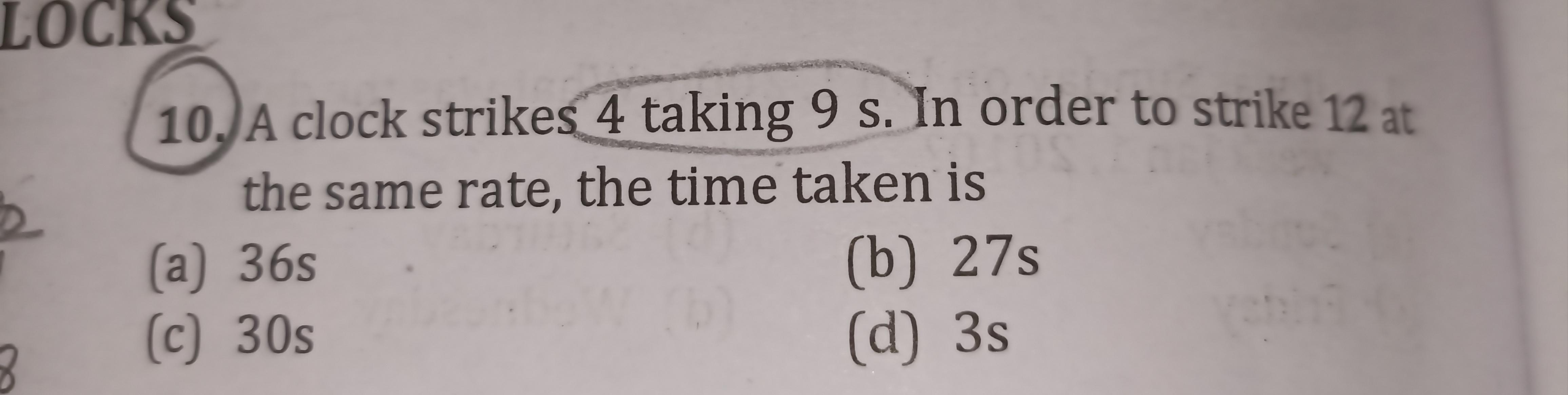
Post image

(i got it guys 😭🥹 there's too many answers I'm not able to keep up so thank u already but i got it 😭) Since there's an interval of 3 seconds between each bong shouldn't 33 seconds be taken for it to strike 12 times? There will be 11 intervals and each interval is 3 seconds so 11*3=33, right?!

Edit: thank you so much gng, I kinda understand why the answer would be 27s, and i thank everyone for explaining both how my logic was sound as well as the other ways one could approach this problem.

So 9 seconds for 4 bongs would not strictly only include the time immediately after that last bong bongs (😭), but also include the resonance of that bong. As in, we must assume in this scenario that the bongs are not short/immediate, but carry on for a short amt of time.

In this scenario, the amount of time 1 bong takes (assuming that the next one starts immediately as it's resonance fades out) would be 9/4 seconds.

This multiplied by 12 gives is 27 which is the answer ✨

165 Upvotes

190 comments sorted by

View all comments

Show parent comment

2

u/Responsible-Kale2352 Sep 11 '26

What’s the ambiguous part? It takes 9 seconds for 4 bongs to happen. How long for 12 bongs? You have three sets of bongs, each of which takes 9 seconds. 3x9=27. It seems really straightforward.

I’m not clear on what the length of fading out has to do with anything.

4

u/wildgurularry Sep 11 '26

Picture a timeline of the clock striking (|) and fading (-) four times:

|-----|-----|-----|-----

Now, is the 9 seconds from the start of that timeline to the end? Or is it from the start of the 1st bong to the start of the 4th bong?

|-----|-----|-----|

Depending on how you interpret the 9s, it makes a huge difference on the answer. The teacher/question is assuming it is the first situation, where the 9 seconds includes the fade time at the end. This gives the answer 27 as you have noticed.

OP is assuming it is the second situation, where the 9s is measured between the moment the first chime is struck, and the moment the fourth chime is struck. This gives the answer 33 for 12 strikes, as OP noticed.

The question is somewhat ambiguous. One could argue that the first situation is "obvious", and since it is multiple choice, you can quickly check to see which case they are looking for. I have to admit that when I tried the question in my head, I got the answer 33, so I argue that the first interpretation is not 100% obvious.

1

u/GJT0530 Sep 12 '26

The ambiguity is on what's actually being measured that takes 9 seconds. If it's the time from striking the first Bell to striking the fourth Bell then it's 33 seconds. If it's the time from striking the first Bell until the fourth Bell fades out and the fifth Bell would be struck if there was a fifth Bell, it's 27 seconds.

1

u/Responsible-Kale2352 Sep 12 '26

But whatever you, or I, or OP’s Aunt Edna consider to be the one and only true way to measure a strike doesn’t matter, does it? For the sake of the problem, four strikes is nine seconds, regardless of what you consider “four strikes” to be.

1

u/GJT0530 Sep 12 '26

Yeah four strikes is 9 seconds but if you don't define what you're actually measuring, extrapolating that into a longer period is ambiguous that's the point.

1

u/Responsible-Kale2352 Sep 13 '26

What if I said flabbity-floop takes nine seconds. How long does three flabbity-floops take? Wouldn’t we see that it takes 27 seconds, even though we have no idea what we’re measuring or how it is defined?