r/HomeworkHelp • u/Leafofplastic Pre-University Student • Sep 16 '26
Answered [5th grade math] Im having trouble understanding exactly what they mean. On Both the top and the next question under)
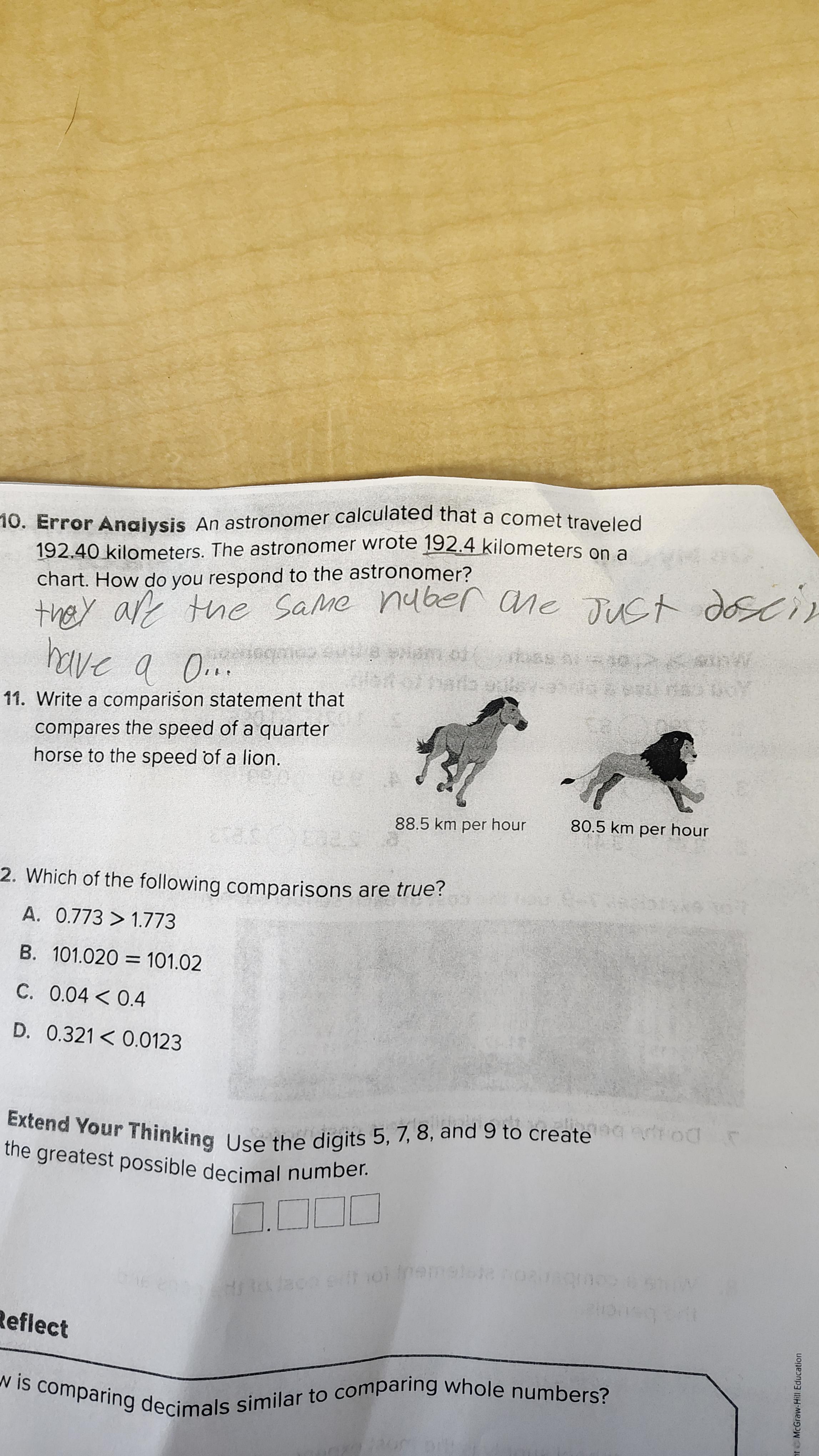
I was helping my little sister with her work and these parts we can't really get through. The first one because 192.40 kilometers is equal to 192.4 kilometers so we don't understand how that is wrong. And the 2nd one because what does it mean by a quarter horse? Is that like a quarter of the horses speed?
20
Upvotes
•
u/AutoModerator Sep 16 '26
Off-topic Comments Section
All top-level comments have to be an answer or follow-up question to the post. All sidetracks should be directed to this comment thread as per Rule 9.
OP and Valued/Notable Contributors can close this post by using
/lockcommandI am a bot, and this action was performed automatically. Please contact the moderators of this subreddit if you have any questions or concerns.
19
u/FormalTall1800 AP Student Sep 16 '26
I think you're right for the first one. A quarter horse is just a breed of horse. Pretend like "quarter" isn't even there.
56
u/Possible-Zone3087 Sep 16 '26
So the question for the first one is that 12.4 has only 3 significant figures. If someone read that number, they can only assume accuracy up to 12.4. The actual value could've been 12.41, 12.42, 12.48,.... Where as in the 2nd number 12.40, the number has 4 significant figures. Since the astronaut measured 12.40, he should write 12.40 to communicate that the measurement is accurate up to the 2nd decimal place.
18
u/QuietCapybara77 Sep 17 '26 edited Sep 17 '26
I tutor elementary students. People are way overcomplicating this.
At this age, they are learning to compare decimals. They are learning that a zero at the end of a decimal is the same as without the zero at the end. 10 and 12 just want them to recognize that the numbers are equal.
On 10, she was probably expected to at some point write 192.40 = 192.4
9
u/M_Mustaan_Rafique Sep 16 '26
Your sister's answer is correct, and the thread is overcomplicating question 10.
192.40 and 192.4 are the same number. A zero on the end of a decimal doesn't change its value, and that's the whole point the chapter is making. Look at the bottom of her page: question 12 has 101.020 = 101.02 in it, and the Reflect question is about comparing decimals. Same idea three times on one worksheet.
"Error Analysis" is just what this textbook calls that question type. It doesn't always mean somebody got something wrong. What's being tested here is whether you'll wrongly assume 192.40 and 192.4 are different. She didn't, so she's got it right. Her wording is already fine.
The significant figures answer you're being given is real maths, but it's high school chemistry and physics, three or four years past this book. Nobody asks a 5th grader about measurement precision on a page about comparing decimals. Don't let her write that one, she'll get marked down for it.
On question 11, a quarter horse is a breed of horse. It's called that because it's the fastest breed over a quarter of a mile. Nothing to do with fractions or with a quarter of anything's speed. Ignore the word "quarter" completely.
So it's just comparing 88.5 and 80.5:
88.5 > 80.5
Or as a sentence, "the quarter horse is faster than the lion." Either should be fine depending on what her teacher is after.
5
u/Simpicity Sep 16 '26
A "quarter horse" is a type of horse known for good sprinting speed.
While it is true that they are the same number... The heading is Error Analysis (surprising for 5th grade).
The difference between 192.40 and 192.4 is in precision. The real speed of the asteroid is going to actually be some number like 192.40023239482362034728492873428736874... and so on. It's unlikely to be a whole number or even some limited number of decimal places. So the astronomer ROUNDS the actual speed to get a result. Here, he rounded to 192.40 because the next digit was also 0. 192.40 narrows down what the actual speed of the asteroid could be more than 192.4 does. 192.40 means the asteroid speed is anywhere between 192.396 and 192.404.
192.4 means it is anywhere from 192.39 and 192.44. Since those are the numbers that round that way.
So what do you SAY to the astronomer? That they are losing precision by dropping the zero.
3
u/Alkalannar Sep 16 '26 edited Sep 17 '26
2
u/Gryphontech University/College Student Sep 16 '26 edited Sep 16 '26
192.4 and 192.40 is the same value. Later on in life you will learn that 192.40 is just a more exact value then 192.4 but that is way too advanced.
For the second one just compare the speed and see which one is faster. You could also say that a quarter horse (1/4 horse has a speed of 0 as it can walk) so it's much slower but this is not what are looking for.
1
u/atarivcs 👋 a fellow Redditor Sep 16 '26 edited Sep 16 '26
192.4 is less accurate than 192.40 because of possible rounding.
i.e. 192.4 could actually be 192.35 or 192.44 (or any distance in between) due to rounding.
But 192.40 is more precise, so the actual measured value can be only 192.395 to 192.404.
In other words:
192.4 is precise to the tenths digit, so the rounding error can be up to five of the next smaller digit (hundredths).
But 1942.40 is precise to the hundredths digit, so the next smaller digit is thousandths.
1
u/swbarnes2 Sep 16 '26
192.4 and 192.40 are slightly different things, because real world measurements have inherent uncertainty and if you don't specify what that inherant uncertainty is, people work it out from the sig figs. If you report 192.4, you are really saying that the value might be as high as 192.44 or as low as 192.35. When you report 192.40, you are saying that the real value should be between 192.395 and 192.404.
The other real world consequence is that if you are doing calculations with multiple measurements, you need to give a final answer with the same number of sig figs as your worst measurement. It doesn't matter much if you managed to figure out the mass of the thing to 6 sig figs if you only know its speed up to 4 figs. You wouldn't be able to pretend you knew its momentum to 6 digits, because you are way too uncertain about its speed.
1
u/MachoPikachu1 👋 a fellow Redditor Sep 16 '26
That's a very slow comet.
1
u/twizzjewink 👋 a fellow Redditor Sep 16 '26
As others have mentioned it boils down to how we view numbers.
192.40 != 192.4 because 192.4 may be 192.35 to 192.44 .. and because of that those numbers are not equal.
Technically he's right - but for the wrong reason. One doesn't have a 0 but I believe that the Teacher wants to know WHY.
1
u/daredeviloper Sep 16 '26
My interpretation:
When I write 1.2 what do I mean?
I mean 1 of something + 0.2 of something
But what is 0.2 of something?
It means 2/10, what does 2/10 mean?
It means you take something and you chop it up into 10 equal pieces and keep 2 of them
So 1.2 is : 1 and 2/10
So 1.2 of an orange is 1 orange + 2 pieces of an orange cut up into 10 equal pieces
What does 0.20 mean? 20/100
You instead cut up into 100 pieces ! And keep 20
1.20 of an orange is 1 orange + 20 pieces of an orange cut up into 100 equal pieces
It’s still the same “amount” overall but it’s more precise.
The smaller the pieces the more precise it is.
1
u/DCAmalG 👋 a fellow Redditor Sep 17 '26
Lord have mercy on the question writers.amen.
1
u/InterestedParty5280 Sep 17 '26 edited Sep 17 '26
For 10, I say: That's not very far for a comet. Maybe, he was calculating speed but that is not the right unit.
For 11: That's easier. The horse is faster than the lion.
1
u/Sure-Recognition-262 Sep 17 '26
For Q10, my response would be to ask the astronomer "is there a reason you're not recording the distance with the same precision as the measurement you have?"
Q11 I wouldn't been stumped by, but I see that the word "quarter" is a red herring, it doesn't mean one-fourth in this context, rather a "quarter horse" is a breed of horse. It feels unnecessary to pick a breed of horse which many people won't have heard of and which sounds like it has mathematical meaning. That aside, has your sister been taught what the expectation is regarding a "comparison statement" - all of the following are accurate:
But which they're expecting will depend what she's been taught they mean by a "comparison statement"
1
u/Lots-o-bots Sep 17 '26
They are the same number but ommitting the last 0 makes the error bar 10x bigger. A reading of 192.40 has a margin of error from 192.395 to 192.404. A reading of 192.4 has a margin of error from 192.35 to 192.44.
1
u/eileyle Sep 17 '26
Question 10 is about precision and significant digits.
If you are measuring yourself with a typical ruler or measuring tape, and you get a measurement of 165 centimetres, but you check out the measuring tape and it looks like the measurement is somewhere between 165 and 166 centimetres, but probably closer to 165, would you say that you are 165.45219 centimetres tall? No, you wouldn't, because your measurement device is not that precise. You would say 165 centimetres, maybe 165.5 centimetres if your measurement device has millimetres on it, and you wouldn't give any additional digits because your measurement device does not have the capacity to measure them.
In this question, the astronomer calculated 192.40 kilometres. This suggests that whatever device the astronomer was using to measure the comet had a precision up to every ten metres, or the second decimal place of kilometres. When the astronomer rounded it down to 192.4 kilometres, they were giving a less precise answer, implying that the device they used to measure the comet's distance traveled was not as precise as it actually was.
Regarding a quarter horse, that is simply a breed of horse. For more information, check out Wikipedia.
1
u/idont_readresponses Sep 18 '26
I’ve taught 5th grade math. The first question is about equivalent decimals. So the answer is correct. 192.40 is equivalent to 192.4.
People here are WAY overestimating about what 5th graders are doing. Guys.. this kid is 10. Talking about Sigfigs. It’s 5th grade math, not high school chemistry and physics, FFS.
0
u/Deep-Hovercraft6716 👋 a fellow Redditor Sep 16 '26
The first question is about the concept of precision. My response would be to question the astronomer whether or not he was recording the correct level of precision in his documentation.
The second question is just 88.5 is greater than 80.5.
You could simply say a quarter horse is faster than a lion. And as far as I understand that would satisfy the question.
The first question seems like something which is significantly more advanced than a question for a 5th grader. I don't think we got to that concept until well into high school and more practical classes like physics and chemistry.
0
u/Potential-Nebula-210 Sep 17 '26
The first question is about significant figures. 192.40 km, when written as the result of measurement, implies the true value is between 192.395 km and 192.404 km. When written as 192.4 km the implied range of uncertainty is larger 192.35 to 192.44 km).
The second question is how to verbally compare two numbers, probably expecting the comparison to be quantitative. You might say the horse is about 10% faster than the lion. (Or maybe 9.9% if you think this may be sig figs question too.)
0
u/OldGeekWeirdo Sep 17 '26
Question #10. I agree with the others that this is an issue of significant digits. While I don't remember encountering that subject before intermediate/middle school they might be introducing it at a younger age. It's not that hard a concept and will prove useful if they do any labs where they take measurements and do calculations based on that measurement.
One would have to go look over the child's math book before declaring this child hasn't been taught that subject.