r/HomeworkHelp • u/Timely_Arachnid_5598 AP Student • Oct 07 '26
Further Mathematics—Pending OP Reply (AP Precalculus) Not sure how to continue this
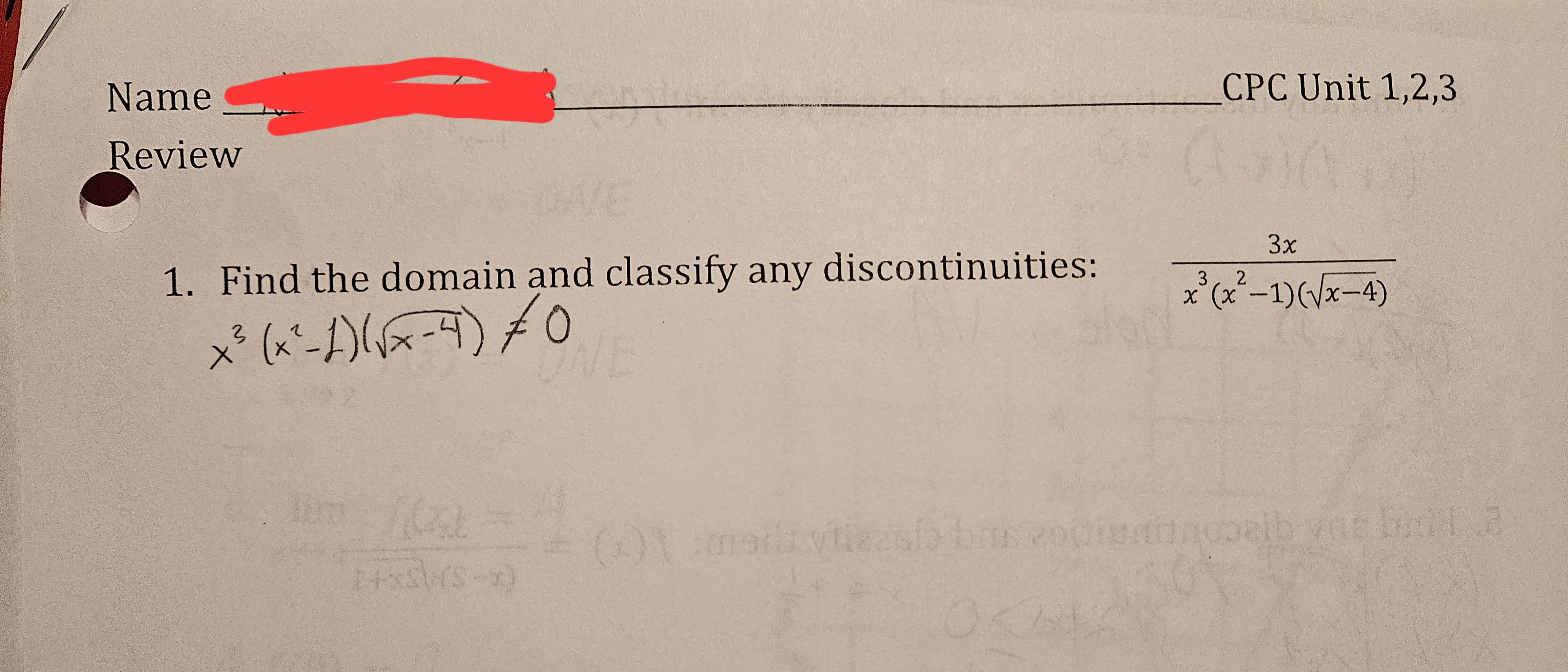
I know how to find discontinuities and domain, it is the exponents that are tripping me up
4
Upvotes
9
u/Kblitz88 🤑 Tutor Oct 07 '26
Okay! So this is a rational function f(x)/g(x) where the total domain is the domain of f(x) restricted by values that make g(x) 0 or undefined.
The domain of 3x is all real numbers so we can skip that.
Downstairs we have x³, x²-1, and √(x-4). Since we have the square root expression in the denominator, that's the one that matters, and thus x>4. x can NOT equal 4 since it's in the denominator. Therefore D: (4,∞) and VA at x = 4.
Note: Even though we have denominator zeroes at x = -1, 0 and 1, all of them are less than 4 so they don't count.
4
u/tserofehtfonam 👋 a fellow Redditor Oct 07 '26
If you're unsure how to continue, I'd call that a discontinuity.
1
u/JanetInSC1234 🤑 Tutor Oct 07 '26 edited Oct 07 '26
Set each term in the denominator equal to zero:
x^3 = 0 so x = 0
-----------------------
(x^2 - 1) = 0
(x + 1)(x- 1) = 0
x+ 1 = 0 OR x - 1 = 0
x = -1 OR x = 1
-------------------
sqrt (x - 4) > 0
x - 4 > 0
x > 4
------------------------
Domain: x cannot equal 0, -1, 1, and must be greater than 4.
So, since 0, -1, and 1 are all less than 4, you only need to write x > 4.
(4, ∞)
2
u/Jkjunk 👋 a fellow Redditor Oct 07 '26
Factor the terms in the denominator.
For what values of x is x^3 =0?
What about (x-4)?
What about x^2-1? You'll need to factor this term.
1
u/Jkjunk 👋 a fellow Redditor Oct 07 '26
Factor the terms in the denominator.
1
u/Anonimithree 👋 a fellow Redditor Oct 07 '26
Zero-product property for the ≠0, and the property of square roots for the sqrt(x-4)
1
u/Tyreathian 👋 a fellow Redditor Oct 07 '26
Find each case for which the denominator is 0.
By inspection, x = 0 will make x^3 = 0 so that’s one.
set x^2 - 1 = 0. -1,1
Set Sqrt(x-4) = 0
Now you’ve found the discontinuities
1
u/selene_666 👋 a fellow Redditor Oct 07 '26
So you would know what to do if the denominator were (x-1)(x-2)(x-3) ?
You're still looking for where the product of three terms is zero. That will happen when any one of the terms is zero. So what values of x can make x^3 = 0 ? And likewise for the other factors.
But division by zero isn't the only limitation. You also cannot take the squareroot of a negative number.
1
u/Techno_Eggnog 👋 a fellow Redditor Oct 07 '26
Start with the zero product property. You already set it up, so set each of the terms equal to zero and solve for x in each. That will be how you find some of the discontinuies since division by zero does not work.
For x^3, that’s a single term so you can just take the third root of zero (still zero). For (x^2 -1), that’s a difference of perfect squares. Break it down appropriately if you know the property already, if not go look it up in your textbook or on AP Classroom. For root(x-4), square both sides and solve for x. Note that this one will have further undefined values than just zero: you’ll only want real numbers in the domain!
1
u/AndersAnd92 👋 a fellow Redditor Oct 12 '26
Division by 0, square root of negative numbers; these are the relevant restrictions here - your task is to figure out when that occurs
Then you are tasked with figuring out if any of the discontinuities are removable
0
u/[deleted] Oct 07 '26
[deleted] — view deleted comment