r/HomeworkHelp • u/Subject-Repeat8061 • Oct 11 '26
Physics—Pending OP Reply [3rd grade, physics(forces), does this reasoning seem incorrect?]
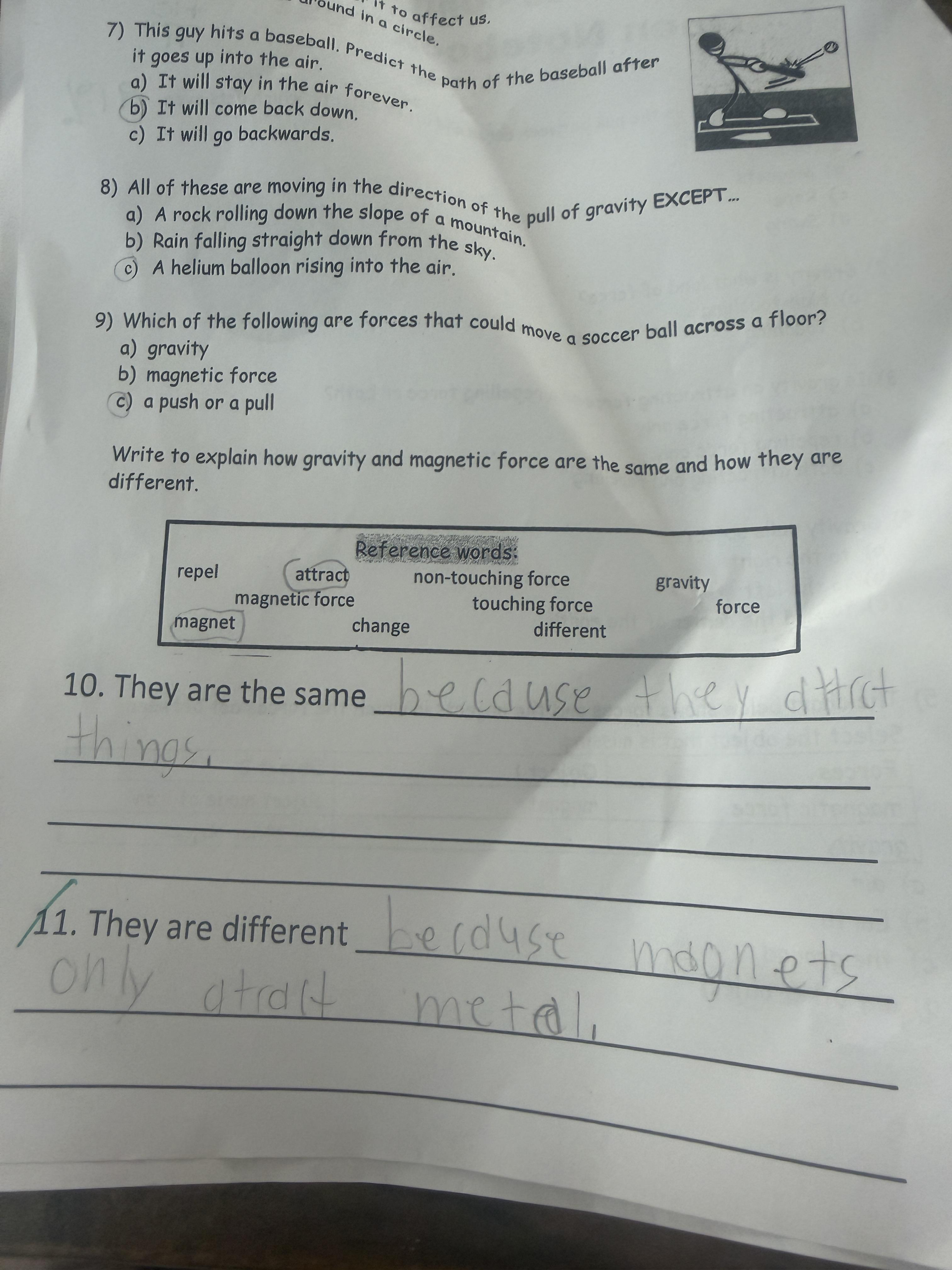
3rd grade.
Kiddo went to his teacher to see why his answer was incorrect.
He asked if he could have partial credit for the question, and said that his reasoning was that gravity attracts everything with mass while magnets only attract metal.
She said she wanted him to say “because magnets repel” for question 11. I’m not sure the question is worded specifically enough to warrant that exact answer.
Son is still wondering why his reasoning is wrong.
Thoughts?
23
Upvotes
•
u/AutoModerator Oct 11 '26
Off-topic Comments Section
All top-level comments have to be an answer or follow-up question to the post. All sidetracks should be directed to this comment thread as per Rule 9.
OP and Valued/Notable Contributors can close this post by using
/lockcommandI am a bot, and this action was performed automatically. Please contact the moderators of this subreddit if you have any questions or concerns.
34
u/FireCire7 Oct 11 '26
The teacher’s answer makes more sense given the reference words box has ‘attract’ and ‘repel’, but not metal.
Ignoring that, your son’s answer is reasonable.
I would’ve given partial credit.
11
u/Jwing01 👋 a fellow Redditor Oct 11 '26
His reasoning is not wrong. It is appropriate for 3rd grade.
His reasoning also does not (or minimally, given answer 10) use the reference words. It adds a distinction to "attract" but there are a lot of other things to explore here.
He needs to know that he is not wrong, strictly speaking, but much like losing points in writing for "add more detail", there are more concepts to explore here.
I will grant that the question should make a better standard as to how to use the reference words.
19
u/LetsGetStonks 👋 a fellow Redditor Oct 11 '26
It's an academic question, not a game show. His answer is not fully correct, AND a better answer is available using the reference words. Help your kid understand how he could've done better and move on. Not every kid can get perfect scores every time. In fact if he's (or she) getting perfects every time, they aren't actually learning anything from the assignment.
9
u/Apowwo Oct 11 '26
Sounds like the teacher wanted a specific answer to a question thats open ended and has multiple correct answers. For 3rd grade this is silly, he correctly stated a difference between them he should get the credit.
4
u/leeluhnichole Oct 12 '26
I taught 3rd grade science for 5 years with these standards before moving to middle school. The answer for number 11 would be incorrect because it’s not a true statement for the wording of the material. The key concepts that students are meant to be able to apply are that magnets can attract some metals and other magnets, and that magnets can only repel other magnets. These concepts are repeated constantly through every activity/lesson almost obnoxiously so students are able to recall them to apply it to multiple situations.
3
u/Appropriate_Steak486 Oct 12 '26
Incomplete, not incorrect.
The suggested keywords give clues as to what aspects are intended.
2
u/NoCarRes Oct 11 '26 edited Oct 11 '26
For a third grader, I think it is a great answer.
Admittedly, there are other reasons why gravity and magnets are different since they use different fundamental forces. The question did not indicate how many differences were required. The one distinction that the child listed is enough to indicate that they are different. The answer deserves full credit.
2
u/roboboom Oct 12 '26
For everyone being pedantic about this I will just add that 9 could also be A if the floor is not level.
3
u/Mirality Oct 12 '26
The kid's answer is incorrect. Magnets do not attract all metals, and there are things other than metals that they do attract. So right spirit but wrong answer.
2
u/ThomasTheDankPigeon Oct 12 '26 •
Wow, it’s kinda wild how many people are suggesting this is “correct for third grade.”
No. It is not the job of a teacher to give partial credit to a student for being able to produce vocabulary words that are adjacent to the answer. Sure, metal and magnets are very closely related concepts, but simply mentioning them together does not a correct answer make. In any case, magnets don’t exclusively attract metal either, so the answer itself is flatly incorrect in any case. Moreover, there is a word bank that is filled with terms that are certain to tie back to concepts already covered in class.
Based on the word bank, the acceptable answers to question 10 would be that both forces can attract, both are non-touching forces, both are not touching forces and possibly that they can both cause change (the teacher would likely be expecting an answer relating to change in location or speed).
As far as I can see, the only answer for 11 that doesn’t just repeat the usage of words like magnet, magnetic force, or gravity, is that gravity does not repel, while magnets can. I would not be surprised if this distinction was heavily emphasized in class, because even when you start getting into electromagnetism in college level physics 2 courses, it becomes clear that the two forces are astonishingly similar from a mathematical point of view with the exception of magnetic forces being able to repel. If a school is having a child compare and contrast the two at such a young age, the distinction of repulsive ability would really be the only thing I’d think is worth implanting in their mind.
1
u/goodskier1931 Oct 11 '26
I think they are both correct given his choice of words. Pretty confusing format for me, pretty good logic for a third grader.
1
u/marty-mcfryguy Oct 11 '26
Has he generally been instructed to use the reference words in the box? That would explain why the teacher is focused specifically on that point. The concept of "repel" was given to him, but he didn't use it.
And technically he's wrong about only attracting metal things but I think that understanding is close enough for third grade.
1
u/Deep-Hovercraft6716 👋 a fellow Redditor Oct 11 '26
They didn't finish the answer. They only gave half an answer. Because magnets attract metal and gravity attracts everything.
Or something like that. Also magnets repel other magnets when their polarity matches. But I don't know that polarity is 3rd grade level knowledge.
That's my guess.
1
u/Techno_Eggnog 👋 a fellow Redditor Oct 11 '26
By technicality… magnets don’t attract all metals. Also another technicality, some non-metals are slightly attracted to magnetic fields such as liquid oxygen.
…would a third grader know this? Probably the first one, but definitely not the second one. I’m still agreeing with the teacher, though, as the reference box is presumably to be used for any of the reasoning steps and “metal” is not in there. They previously used attract, so repel would be the best word to use.
1
u/Salindurthas 👋 a fellow Redditor Oct 12 '26
Gravity always attracts.
Magnets sometimes attract and sometimes repel.
There are some other differences, and more details to those differences, but this is one of the key differences, and I think it is reasonable to expect it to be mentioned as part of an answer that earns full marks.
Gravity is sort of special and unique in how it always attracts everything. There seems to be no 'opposite' to mass that can 'antigravitiate', but we can have positive&negative electrical charge, and north&south sides of a magnet.
1
u/Amazing-Shelter9284 Oct 12 '26
His answer is not strictly correct, but for 3rd grade, it's correct enough.
While the teacher's answer makes a better contrast, any difference should be fine when asking about differences like this.
The teacher just had a specific response in mind and won't take other answers. You could make a reasonable argument that when asking for a difference, any difference should work, but the teacher probably won't accept anything except the answer the teacher wanted. If we want to get really legalistic about it, nothing I can see states that you have to use the reference words, or even the purpose of the reference words.
All that said, unless you're aiming for a magnet school 😀 the grade here shouldn't be that important.
1
u/Tony_314 Oct 12 '26
Why are children penalized for thinking outside the box (in this case literally) but yet expect them to be creative?
1
u/OldGeekWeirdo Oct 12 '26
Both magnets and gravity attract metal. (The word "only" is ambiguous.) It would be clearer to say magnets don't attract non-metals.
1
u/BFly-85 Oct 12 '26
I don’t know why anyone isn’t bringing up the question of him answering he wrong question. Yes what he wrote is correct, but doesn’t answer the question asked.
The assignment is how gravity and magnetic force are the same and different and then use the reference words to help describe how those 2 concepts are the same and different.
1
u/Fancy_Sheepherder786 Oct 12 '26
The correct answer is "C". A "force" is a push or a pull on something. The 'something' must have mass in order to be affected. "Gravity" and "magnetism" are not the same in any way. Gravity is not a force, nor does it exert one (ask Dr. Einstein about curved space-time). Magnetism, as part of the electromagnetic spectrum, does exert force upon objects whether or not they are metallic.
1
u/LoudAd5187 Oct 13 '26 edited Oct 13 '26
I am reminded of the old story about the blind wise men and the elephant. One feels the tail, and says the elephant is like a rope. Another feels a leg, and says the elephant is like a tree trunk. Another feels an ear, and says the elephant is like a sail. Another feels the body, and says the elephant is like a solid wall. Another feels the trunk, and says the elephant is like a snake. Etc. The point is, gravity and magnetism are complex things. They are similar and different in more than just one way. As such, when asked for how they differ, if you provide a way (ANY WAY) they do differ, then the answer is correct. At the very least, that answer deserves some partial credit. I would say it is not completely correct, since a magnet does not attract all metals. And even those it does attract can feel different amounts of attraction. And some metals will actually feel a (weak) repulsive force. That brings about the answer the teacher wanted to see, that a magnet can both attract and repel. But like the elephant, magnetism is a complex thing. It has many aspects. I think your child's teacher was looking at only one of them. Other subtle ways (beyond a third grade discussion) the two are different might be based on how the two forces are generated, the effective relative strengths of the two forces, or in the distance the two fields operate over and how quickly they dissipate with distance. We could also point out that gravity attracts towards a center of mass, but that magnetism always involves a dipole field. (Of course, the concept of a dipole gets back to attraction vs repulsion.) Again, these latter are more subtle differences, but they are still important aspects.
1
u/Quint_Gen Oct 11 '26
The teacher is correct to mark the answer to Q11 as wrong because magnets do not attract all metals. They only attract* iron, cobalt and nickel. (Also Gadolinium and Dysprosium if the temperature is right but this is well beyond 3rd grade reasoning). The teacher is not correct in failing to explain this to the student.
Having said that, I imagine it is challenging to teach 3rd grade and need to be knowledgeable about a range of subjects instead of specialising as is evidenced by all the redditors responding who insist the student is right.
*This is ignoring paramagnetic effects which are very small and also beyond 3rd grade and even then some metals are diamagnetic.
0
u/mlh0508 👋 a fellow Redditor Oct 11 '26
Most teachers don’t like to be corrected by parents, but in this case I don’t understand her reasoning considering it’s open-ended. I would ask her to explain to him why his answer is incorrect, instead of just explaining the correct answer.
It’s just one question on a test, so it may be worth letting go. Sometimes more directions are given verbally that parents can’t see.
However, if he has missed something the only way to learn from the mistake is explaining to him why it’s wrong. Simply telling him the right answer did not really clarify anything for him.
0
u/CountCrapula88 👋 a fellow Redditor Oct 11 '26
Your kid is smart :)