r/HomeworkHelp • Pre-University Student • 26d ago

Physics—Pending OP Reply [Grade 11 physics]: Electricity
Post image

How to find the equivalence guys.

19 Upvotes

29 comments sorted by

8

u/Gryphontech University/College Student 26d ago

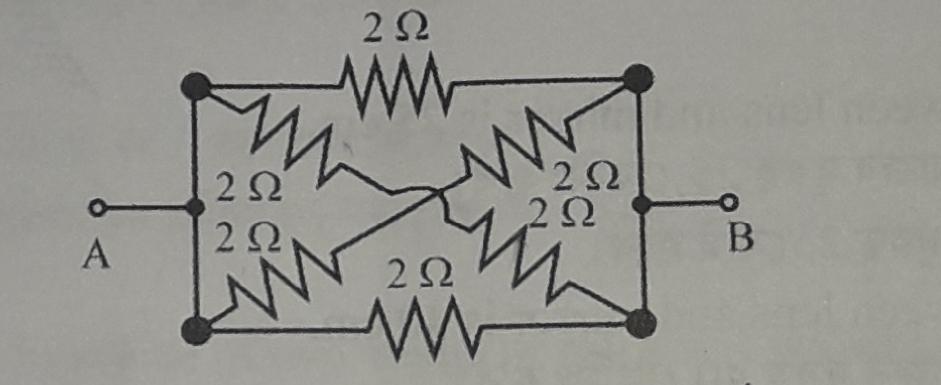
ALWAYS redraw the circuit in a simpler way, this is only confusing cuz it goes criss-cross apple sauce.

So you have 4 branches

  1. 2
  2. 2+2
  3. 2+2
  4. 2

Once you figure out the resistance of each parallel branches you can find the eq. Resistance using the formula.

You got it from here or do you still have questions?

4

u/Dangerous_Cat_4525 Pre-University Student 26d ago

Tried like this. Turns out to be 2/3. Ans is 2ohm according to book

19

u/TA1930 Pre-University Student 26d ago

The book is simply wrong by observation. Any parallel combination of resistors is going to be smaller than the smallest resistor, so it’s impossible for it to be 2 ohms. Source: am EE

2

u/Southlander24 👋 a fellow Redditor 26d ago

Yep, that's a beautiful observation to make.

5

u/fumblinthrulife77 👋 a fellow Redditor 26d ago

Bruh, let me know what your teacher says about this being wrong, I'm legit curious how the book ended up at 2 Ohms

3

u/Simbertold 👋 a fellow Redditor 26d ago

Probably simply a typo. Someone wanted to type 2/3, and the /3 somehow got lost.

2

u/Gryphontech University/College Student 26d ago

Your book is wrong, Req is 2/3. You understand how to solve these problems, you will do well on the exam :)

2

u/Southlander24 👋 a fellow Redditor 26d ago

The diagonal 4 ohms and 2 ohms are in parallel. That applies to both the top and the bottom horizontal lines.

Call that equivalent resistance X. Then you have X ohms and X ohms are in parallel.

0

u/Dangerous_Cat_4525 Pre-University Student 26d ago

Tried turns out to be 2/3ohm. Answer was supposed to be 2ohm

3

u/fumblinthrulife77 👋 a fellow Redditor 26d ago

2 ohms is wrong, the correct answer is 2/3 Ohms

Middle path is (2+2) parallel and then a series connection to another (2+2) parallel

So 1/(1/2+1/2) + 1/(1/2+1/2) = 2

Top middle and bottom are parallel, so 1/(1/2+1/2+1/2)

1

u/Southlander24 👋 a fellow Redditor 26d ago

Yep, there are 4 different paths to get from A to B, all parallel (2, 4, 4, and 2 ohms).

1

u/Southlander24 👋 a fellow Redditor 26d ago

2/3 ohms is correct. Your book's answer is wrong.

5

u/NoSituation2706 26d ago

Color code the nodes and remind yourself what parallel really means

5

u/HumbleHovercraft6090 👋 a fellow Redditor 26d ago

It is 2 || 4 || 4 || 2

i.e.

2 || 2 || 2

Text book has a typo.

1

u/ci139 👋 a fellow Redditor 26d ago

for that port assignment you get 2 pairs of 2Ω and 4Ω resistances in parallel that reduces to 1Ω and 2Ω in parallel so you apply R(A,B)=1/(1/1+1/2)=2/3Ω

otherwise if the outputs would be at the Fig.'s center it'd form a balanced bridge where (IF the resistors match exactly their name values) the middle two 2Ω resistors in parallel "cancel out" and you have 2 current nodes each through 4Ω resistance so ← such would result in 2Ω equivalent resistance

2

u/Dangerous_Cat_4525 Pre-University Student 25d ago

I guess, this is the way book did it. But the mcq on the book has both options 2/3 and 2

1

u/JonJackjon 21d ago

I would look it as:

  • 2 4Ω resistors in parallel = 2 Ω
  • that in parallel with two more 2Ω resistor = 2Ω / 3 = 0.66667

1

u/ci139 👋 a fellow Redditor 21d ago

i should have provided it with a Figure , yes thanks for pointing out Xb

1

u/KarifAval 26d ago

Should've noted every line of resistors to make it easier for us to help. the diagonal resistors arent connected to each other, dont mix it up.

series add each diagonal-2-resistors lines, getting 2+2=4 ohm each of the diagonal. then you parallel add the single resistor lines with one of the series-ed diagonal for each, getting (2x4)/(2+4)= 4/3 ohm for every line, finally, parallel add them so 3/4 x 2 = 3/2 ohm

im typing this with no checks beforehand please correct me if im wrong

1

u/KarifAval 26d ago

*sorry, 3/2 is 1/TotalOhm, the ohm would be 2/3 ohm

1

u/Dangerous_Cat_4525 Pre-University Student 26d ago

Exactly mine is 2/3 but the book answer sheet says 2ohm. That's why I posted to see what is my error

1

u/KarifAval 26d ago

The book is probably wrong. Try to ask your teacher I supposed.

1

u/Simbertold 👋 a fellow Redditor 26d ago

It is obviously not 2 ohm. At the very least, you have two parallel direct lines of 2 ohm (Top and bottom), which would have an equivalency resistance of 1 Ohm. Anything parallel you add to that can only lower the resistance, not increase it.

2/3 Ohm is correct.

2

u/HHQC3105 👋 a fellow Redditor 26d ago

All the big dark pins can be collapsed into A or B. Then re-draw each line, they all connect to the same A <-> B

1

u/SnooPets5564 👋 a fellow Redditor 26d ago

Are those resistors or does the wire just do that?

1

u/Ecstatic-Recipe5664 26d ago

I mean, in reality it does do that inside some resistor,s like resistors are just wire or layered matterial. Wire has resistance too its just usually too small to matter so why calculate it.

Also guess what, in eu standards that notation for resistors is closer to the coil's notation then to the resistor's.

1

u/CumFilledAntNest 26d ago

Points with no resistors between them have the same voltage, so you can collapse them into 1 point. That means that 2 right points are 1 and the 2 left points as well. Each diagonal line has an equivilent resistance of 4 (they are intersecting, the half circle means one goes over the other), so you have 4 parallel resistors starting and ending at the same point, which are 2Ω, 4Ω, 4Ω, 2Ω. Together they are 1/(½+¼+¼+½)=⅔Ω.

1

u/jfeijo2005 👋 a fellow Redditor 25d ago

2/3 Ohm